
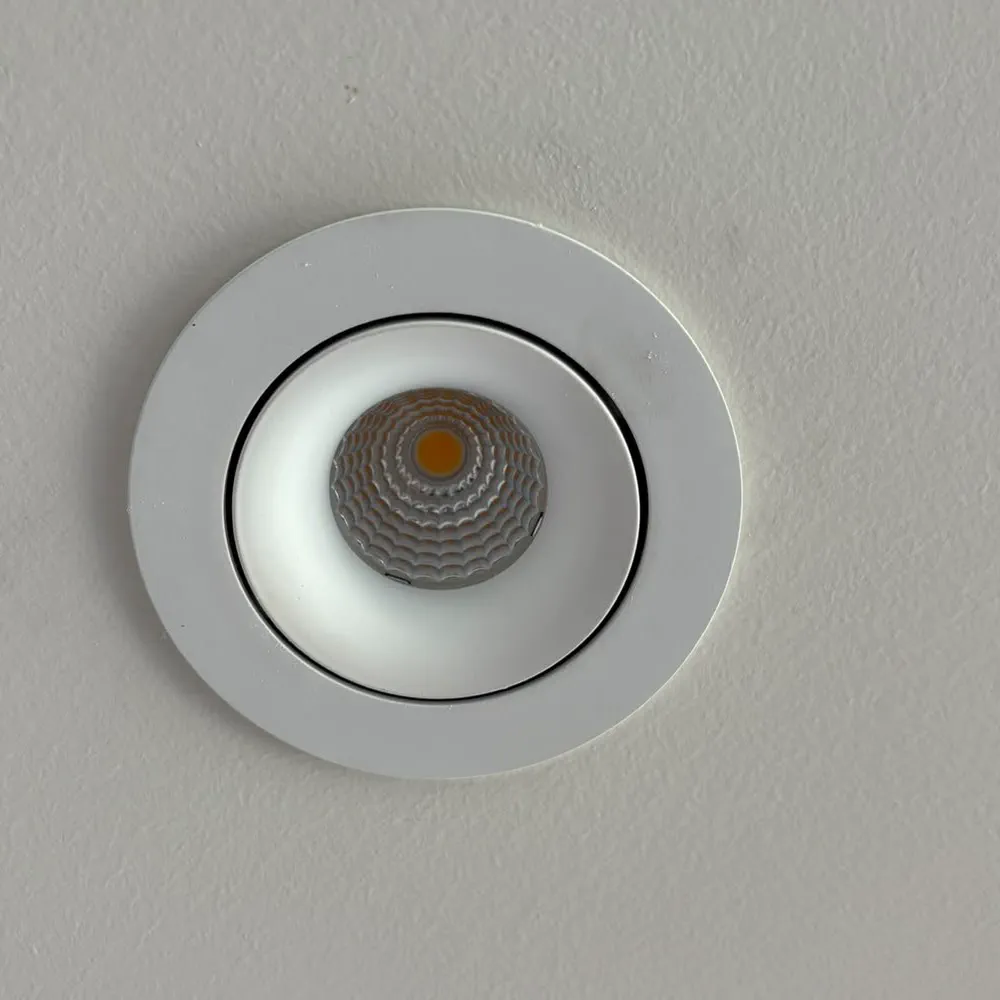
The key points
- Many older halogen downlights rely on a clear gap in the insulation to shed heat.
- The transformer beside each low-voltage halogen runs warm too, and it is easily buried when insulation is topped up.
- An LED globe doesn't make an old fitting safe to cover. A complete IC-rated LED unit does, and the transformer comes out.
- Get the lights checked before new insulation goes in, and before any rental insulation work under the coming standard.
- Scorching, a hot smell or a light that cuts out when warm means switch off and call an electrician. Smoke or flame means get everyone out.
Why an old downlight is a heat problem
A halogen globe makes light by heating a filament until it glows, and most of the power it draws comes out as heat. Above the plaster, that heat collects in a tight space beside timber joists and cable.
Fittings from that era were generally meant to shed heat into open air, so many were installed with a ring cut out of the insulation around them. That works while the gap stays open. It stops working when batts get pushed across during a top-up, loose-fill is blown over the top, or a stored box ends up resting on a fitting.
Energy Safe Victoria says fire brigades respond to more than 300 domestic electrical fires each year, many caused by old wiring that has degraded or can't cope with modern equipment. It doesn't say how many involve downlights, so we won't guess. But a hot fitting, tired cable and insulation packed around both is worth sorting out early.
The parts you can't see: transformers and old cable
Low-voltage halogens, the small two-pin globes common in kitchen and lounge renovations, run through a transformer lying in the roof beside the light. It runs warm, and as a loose box on top of the plaster it is easily forgotten and covered.
Then there's the cable. Wiring that has spent decades beside a hot fitting can go stiff and brittle, and the joint where the light was connected can work loose. The Hobsons Bay Planning Scheme credits post-war residential expansion with transforming Altona and Laverton. Houses from that period were generally built with pendant or batten lights, so downlights in them are usually a later addition.
Energy Safe Victoria lists flickering lights among the tell-tale signs of faulty wiring, and suggests getting the wiring checked by a licensed electrician if your house is over 30 years old. When buying a home built before the 1980s, it says a wiring check before moving in is imperative.
Signs you can spot from the room below
Most warning signs are visible without going near the roof. Look at the trim and plaster around each light for brown or yellow scorching, a brittle discoloured trim or a ring of stained paint.
Watch how the lights behave. One that goes off after running a while and comes back once it cools is often a thermal cut-out doing its job, or a transformer on the way out. A globe that fails far sooner than its neighbours, a flicker or buzz, or a hot plastic smell with the lights on all deserve a proper look.
Keep your hands off the fittings. A halogen globe can burn skin, and taking a fitting down is electrical work. Energy Safe Victoria says it is illegal and potentially fatal for unlicensed people to do any electrical work, and that it isn't a DIY job even for small tasks like changing a light switch.
If a light smells hot or looks scorched
Turn the light off at the wall. If the smell or marks are more than a one-off, switch off the lighting circuit at the switchboard if it is safe to do so, and leave it off until an electrician has looked. Don't climb into the roof to investigate; it is easy to disturb old cable or put a foot through the ceiling.
If you see smoke or flame, get everyone out. Never put water on an electrical fire, because of the risk of electrocution. For a small one, turn off the power to the source if it's safe and use a fire blanket or dry chemical extinguisher; for anything larger, leave the house.
It's also a good moment to check your smoke alarms. The Building and Plumbing Commission says they are compulsory on or near the ceiling of every storey, and Fire Rescue Victoria says to test the batteries every month by holding the test button until the alarm beeps three times.
What an IC-rated LED downlight changes
IC stands for insulation contact. An IC-rated fitting is built to sit against or under ceiling insulation, within the limits of its marking and the maker's instructions. LED fittings draw a small share of the power of the halogens they replace, so far less heat reaches the ceiling.
The rating belongs to the fitting, not the globe. An LED globe in an old halogen fitting leaves the housing, the transformer and the need for a gap exactly where they were, and it may flicker because many old transformers weren't designed for such a light load. Replacing the whole unit, with its own matched driver, takes the transformer out and lets the insulation close back over the light.
In Melbourne's west that is a comfort issue too. Bureau of Meteorology records for Laverton average 27 days a year at or above 30 °C, mostly December to February, and July's mean minimum there is 5.2 °C. Every open ring around an old downlight is a hole in the insulation, letting heat in on summer afternoons and warmth out on winter nights.
- LED globe in the old fitting: least disruption, but the gap and transformer stay.
- Complete IC-rated LED unit: the usual fix, with patching only if the old cut-out is too big.
- Fewer or moved lights: worth a look where a grid of halogens lit the room.
Adding or topping up insulation? Do the lights first
Insulation installers aren't there to assess your lighting. The cleanest order is electrician first, insulation second. With IC-rated fittings in and the transformers gone, batts can run straight across instead of being cut around every light.
If the insulation is already in, have the downlights checked anyway. An electrician can confirm which fittings may be covered, clear insulation from any that can't, and leave a record of what's up there so the next person isn't guessing.
Rental providers have a specific rule to plan for. Consumer Affairs Victoria's new minimum energy efficiency standards, phased in from 1 March 2027, include ceiling insulation. That standard requires a licensed electrician to complete an electrical safety checklist and fix any electrical issues within 30 days before insulation is installed.
What a downlight check and replacement involves
A useful visit starts in the rooms: how many fittings, what type, and whether any are scorched or misbehaving. Then the electrician goes up through the manhole to check each fitting, its transformer, the nearby cable and how the insulation sits.
Replacement goes fitting by fitting. The old unit and transformer come out, the cable and joint are checked, a complete IC-rated LED unit goes in, and insulation is laid back over it where the rating allows. Existing dimmers have to suit the new drivers.
Energy Safe Victoria says you must engage a registered electrical contractor for electrical installation work, and a licensed electrician must provide a Certificate of Electrical Safety when the work is done. Lights are among its examples of non-prescribed work, and you should get a copy within 30 days.
- Which rooms have downlights, and roughly how many.
- Photos of the fittings and any scorch marks.
- When insulation was last added, if you know.
- Clear access under the manhole.
When it makes sense to get Total Comfort in
Scorch marks, a hot smell or lights cutting out on their own aren't things to leave for a quieter month. Switch that circuit off if it is safe to, and get it looked at.
Less pressing reasons are just as common: you're topping up insulation, you've bought an older home, you're a rental provider preparing for the insulation standard, or you're tired of replacing halogen globes. Our electricians can check what you have, give honest advice on whether it needs changing, and give you a fixed price for the agreed scope before any work starts.
If the fittings are sound and properly clear of the insulation, we'll say so. A check that ends with nothing to replace is still a useful answer.
Common questions
Quick answers
- Why has the ceiling around my light gone brown?A brown ring hugging the edge of a light is usually heat or dust.
- One downlight has stopped working. Is it the globe or the fitting?Check whether it has a removable globe.
- Why do my LED lights buzz or hum?Most buzzing LEDs come from a mismatch rather than a fault: a dimmer built for old halogen globes, an LED driver that doesn't suit the dimmer, an old transformer left in…
- Why do my light globes keep blowing?Globes that fail early usually have help.
Sources for this guide
14 sources, with the date each was checked
- 1.Energy Safe Victoria: Fire brigades respond to more than 300 domestic electrical fires each year. Many of these fires are caused by old wiring that has degraded or is unable to cope with the demands of modern electrical equipment. Accessed 30 September 2026.
- 2.Victorian Government, Hobsons Bay Planning Scheme (PDF snapshot, last updated by VC292 on 11/09/2025): The heritage places of Hobsons Bay reflect the key themes that have shaped the development of the city since the establishment of Williamstown in the 1840s as the first port of Melbourne, through the development of… Accessed 30 September 2026.
- 3.Energy Safe Victoria: Old switchboards, particularly those without a safety switch Old power switches or power points, particularly broken ones Flickering lights Sparks from switchboards, switches or power points. If your house is over 30… Accessed 30 September 2026.
- 4.Energy Safe Victoria: Gas and electricity are inherently dangerous and it’s illegal and potentially fatal for unlicensed and unqualified people to undertake any electrical or gasfitting work. Homeowners and consumers must always use… Accessed 30 September 2026.
- 5.Energy Safe Victoria: Electrical work isn’t a DIY job, even for small jobs such as changing power points or light switches. Accessed 30 September 2026.
- 6.Building and Plumbing Commission (formerly Victorian Building Authority): Smoke alarms are compulsory and must be installed in every residential building, on or near the ceiling of every storey. Smoke alarms need to be positioned to wake sleeping occupants. They must be located between each… Accessed 30 September 2026.
- 7.Fire Rescue Victoria: TEST your smoke alarm batteries Every month Press and hold the test button until the smoke alarm beeps three times. Accessed 30 September 2026.
- 8.Bureau of Meteorology: Mean number of days ≥ 30 °C 6.9 6.0 4.5 0.7 0.0 0.0 0.0 0.0 0.1 0.9 2.8 5.1 27.0 82 1943 2026 Mean number of days ≥ 35 °C 3.6 2.4 0.9 0.0 0.0 0.0 0.0 0.0 0.0 0.1 0.5 1.9 9.4 Accessed 30 September 2026.
- 9.Consumer Affairs Victoria: New minimum energy efficiency standards for residential rental properties come into effect in phases from 1 March 2027. The new standards cover 6 areas: heating cooling hot water shower heads ceiling insulation… Accessed 30 September 2026.
- 10.Consumer Affairs Victoria: The standard also requires an electrical safety checklist to be completed and any electrical issues to be addressed by a licensed electrician within 30 days before the installation of insulation. If the insulation… Accessed 30 September 2026.
- 11.Energy Safe Victoria: If you are planning to have electrical installation work done, you must engage a registered electrical contractor (REC). They will send a licensed and qualified electrician to do the work to the required standards. Accessed 30 September 2026.
- 12.Energy Safe Victoria: For electrical installation work performed within your electrical installation including but not limited to lights, power points, air conditioning, hot water service etc. Accessed 30 September 2026.
- 13.Victorian Electoral Commission (2023 electoral structure review fact sheet): New housing developments are planned in residential growth areas including Truganina, Tarneit, Wyndham Vale and Manor Lakes, as well as near activity centres and public transport. Accessed 30 September 2026.
- 14.Consumer Affairs Victoria: Anything on this list is legally defined as an urgent repair: burst water service blocked or broken toilet system serious roof leak gas leak dangerous electrical fault flooding or serious flood damage serious… Accessed 30 September 2026.
Planning advice for homeowners. Installation requirements depend on the property and equipment. Where this guide refers to Victorian safety or rental rules, use the linked official guidance for the current requirements.