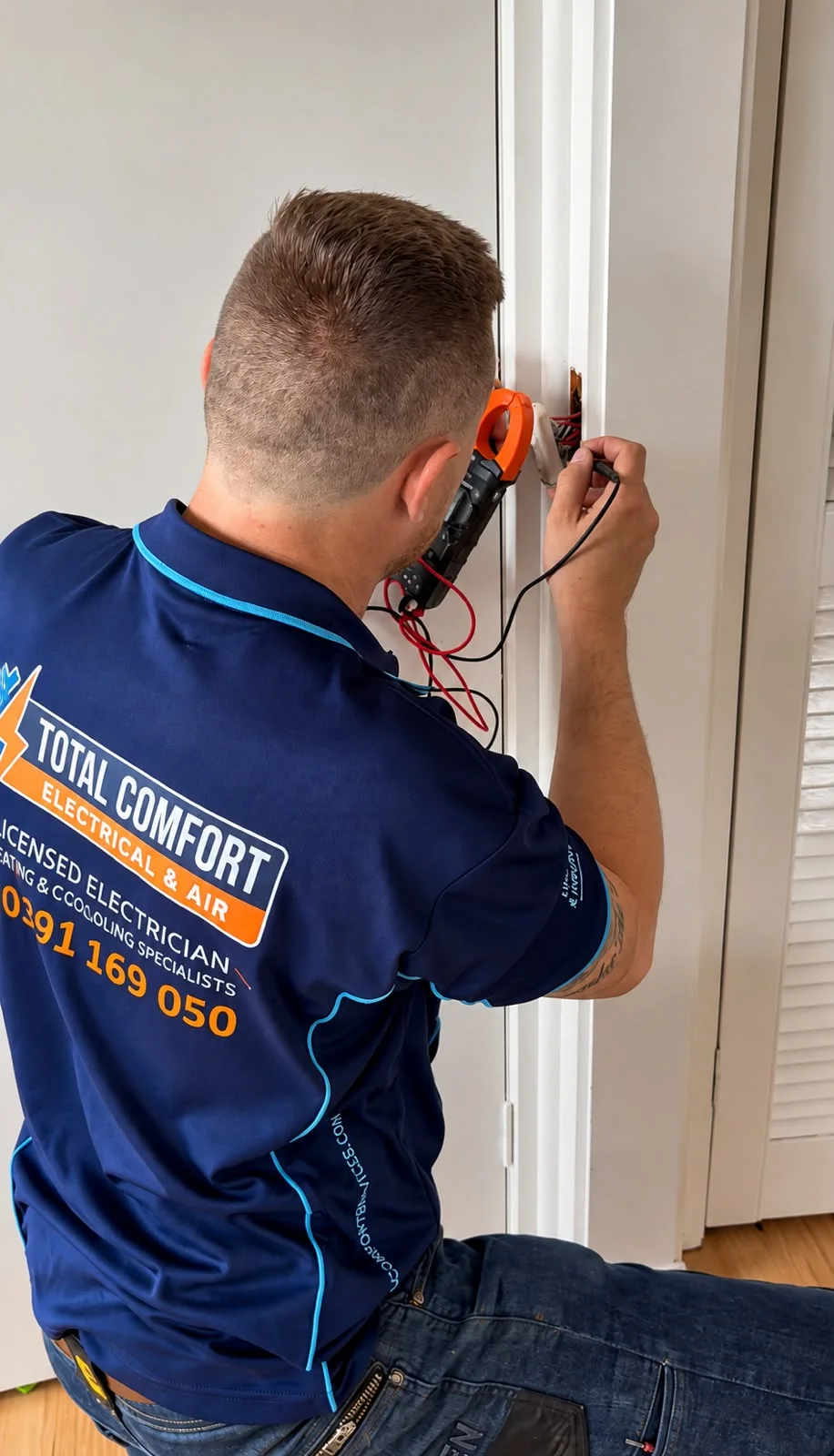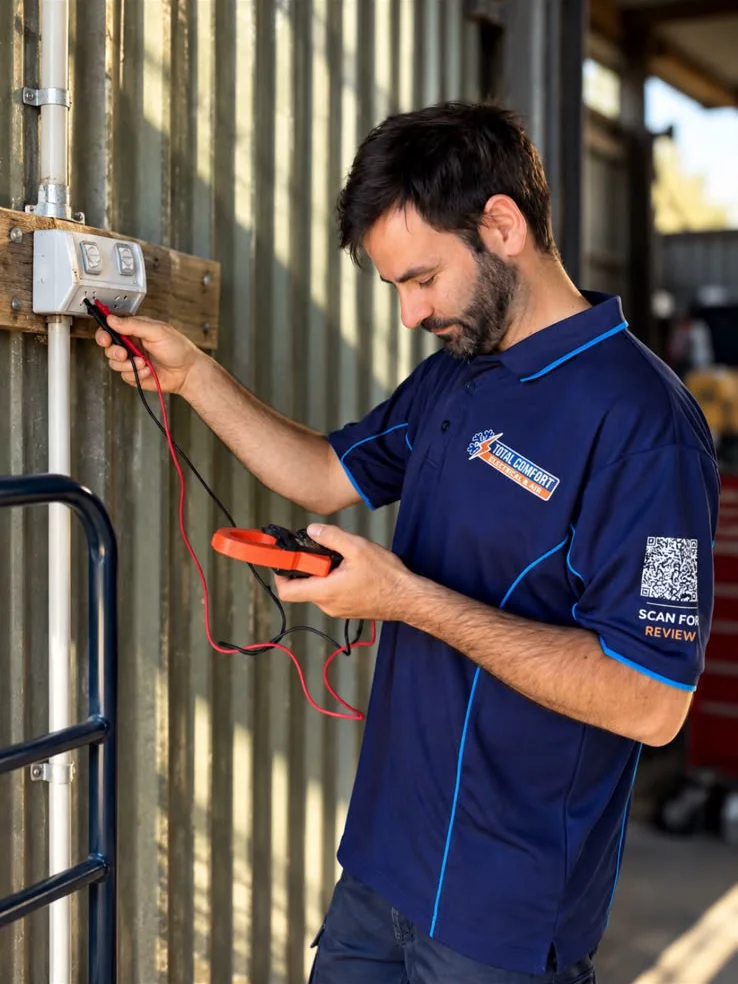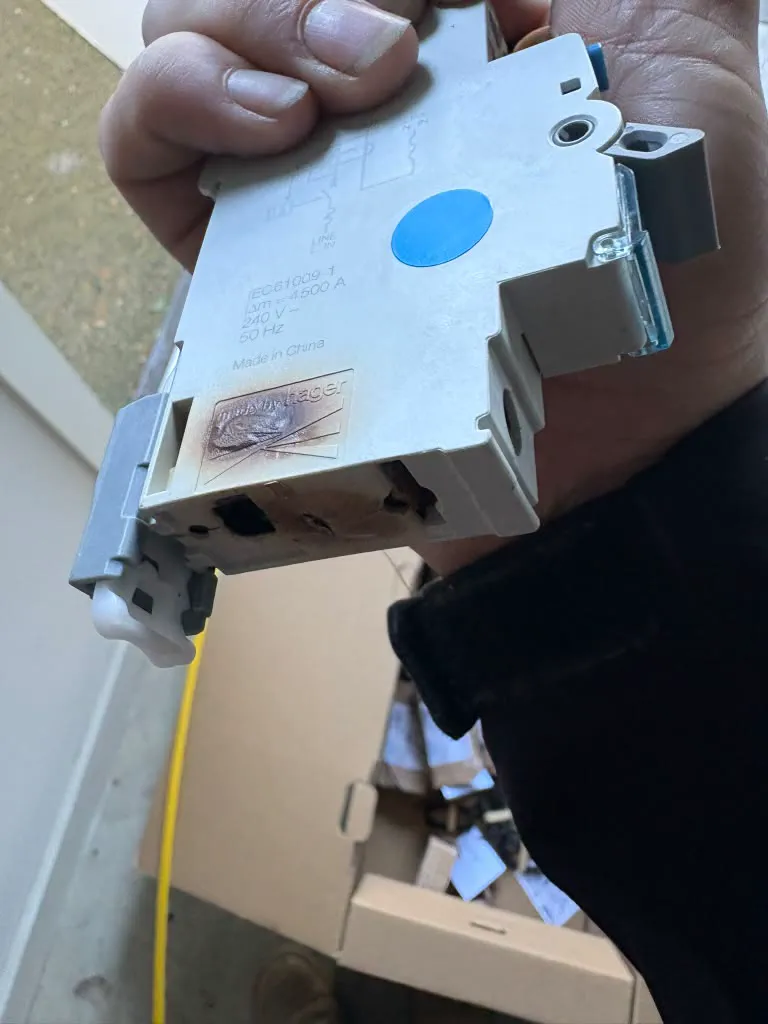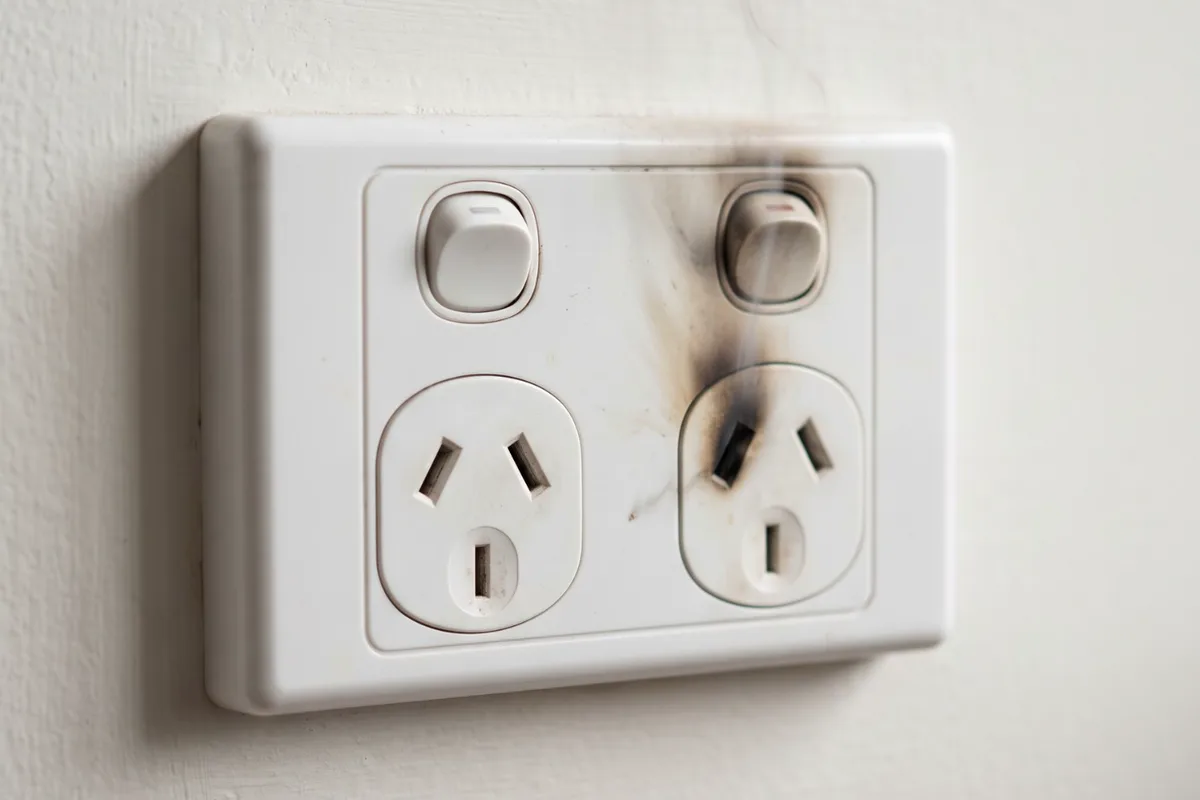
Sparks, crackling or brown marks at a power point or switch mean heat is building behind the plate, usually from a loose terminal, worn contacts or too much load. It gets worse with use.
When to get it checked
Sparks with the wall switch off
If a plug sparks going in or out while the switch on the point is off, the switch isn't cutting the power. It has failed or was wired wrongly.
Crackling, buzzing or a flash at the switch
Sound or light from a point or switch is current jumping a gap. Often it only shows with the heater or kettle running, or as the lights flicker when you touch the switch.
Brown marks or darkened pins
Browning around the pin holes or rocker, or discoloured plug pins, show heat building inside. It's usually worse behind the plate.
Plugs that droop or wobble
Worn socket contacts let a plug sag under the weight of its lead, and it arcs each time it shifts.
Why it happens
5 common causes
Loose terminals
Heavy loads warm and cool the copper, slowly loosening terminal screws. A loose cable arcs, runs hotter and loosens further.
Worn contacts
Years of plugs going in and out tire the socket springs, squeezing the current through a tiny, very hot spot.
Too much on one outlet
Heaters, kettles and dryers sharing one outlet through an adaptor push it past its rating.
Moisture
Steam and splashes at laundry, kitchen and bathroom points, and rain at outdoor ones, corrode terminals and let current track across them.
Old fittings and past alterations
Decades-old switches go brittle, and amateur joints show up as heat sooner or later.
What the job covers
What we usually do on this job. Your quote confirms it for your place.
- What to switch off while you wait
- Circuit isolated and proved dead before work starts
- Terminals, insulation and wall box checked for heat
- Burnt points and switches replaced
- Damaged cable cut back to clean copper
- Neighbouring outlets on the circuit checked
- Circuit tested before handover, plus your certificate
Your options, explained
Replace the fitting
Low disruption- Best for
- A worn or lightly scorched fitting with clean cable behind it
- How it works
- A new fitting goes in and the cable is re-terminated on clean copper.
- Worth knowing
- The usual outcome.
Repair the cable
Medium disruption- Best for
- Heat that has reached the cable or the next joint
- How it works
- The burnt end is cut back to sound copper, or a new length is run from the outlet before it.
- Worth knowing
- May need a small access hole, left ready for patching.
Take the load off
Medium disruption- Best for
- Points burnt by heaters or kitchen appliances on adaptors
- How it works
- Extra outlets nearby, or a dedicated circuit for the heavy appliance.
- Worth knowing
- Fixes why it overheated, not just what burnt.
The people behind the work
One local team for electrical, heating and cooling. Family-run, based in Altona Meadows, with 19 years in the industry.
Licensed electrical contractor (REC 38187)See more team photos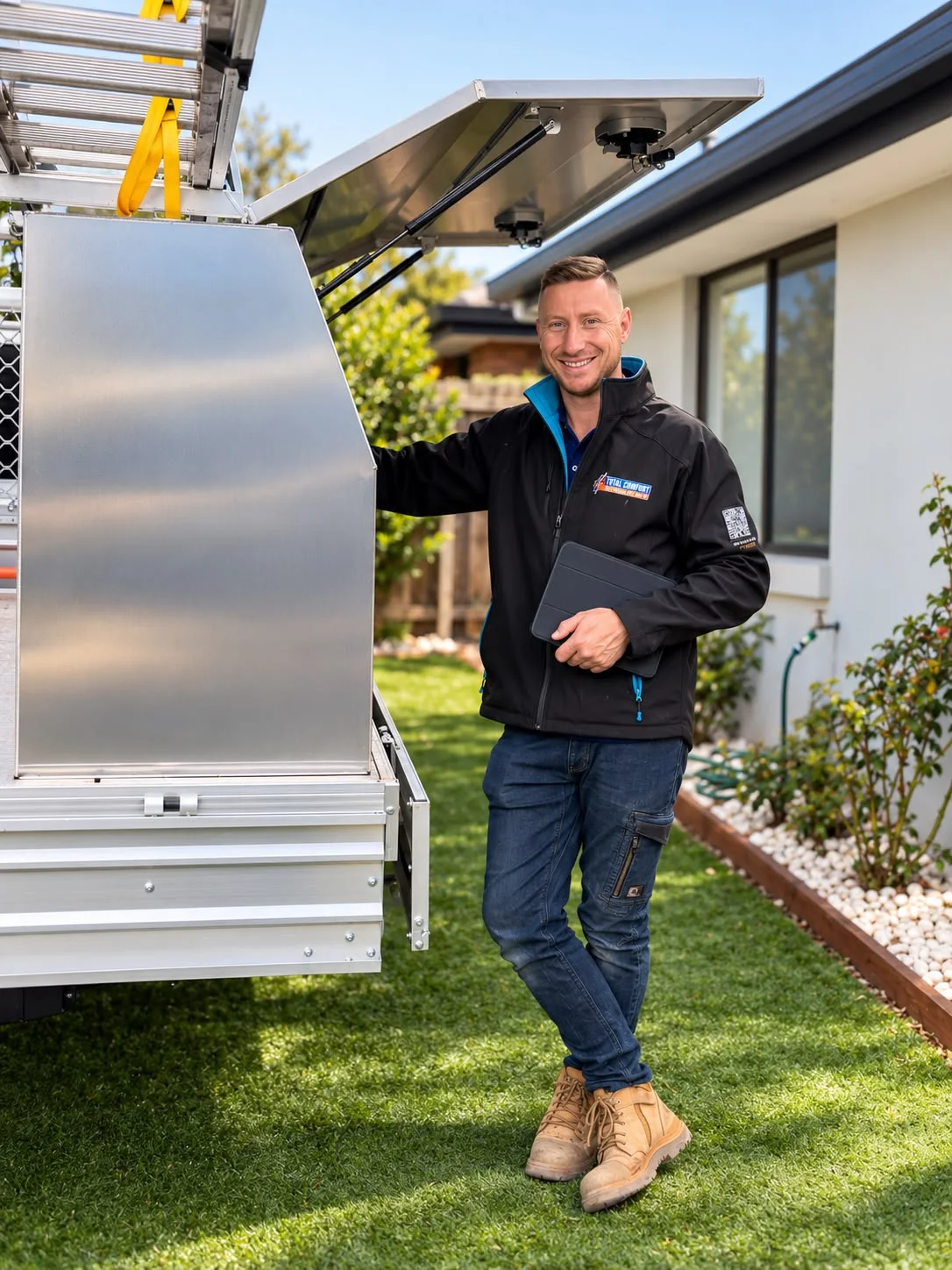
Worth knowing before you book
- Leave it off
- Each arc damages the contacts, so a point that sparked once is likely to spark again.
- Switchboard, not plate
- Turn the circuit off at the board if it's safe, not at the scorched plate.
- Note what was running
- What was plugged in and whether anything tripped helps us find the cause.
What affects the price?
The right scope depends on your installation. These are the details we check so your quote is useful, with any additional work explained before it proceeds.
How far the heat went
A scorched plate with clean cable behind it is quick. Damage into the cable or the next outlet takes longer.
The replacement fitting
Standard, USB, weatherproof and dimmer fittings differ in parts and fitting time.
Wall and access
Brick, tiled splashbacks and lath and plaster take more care than plasterboard.
What testing finds
More heat damage or a failed insulation test means extra work, priced before we do it.
How it runs
- 1
Tell us what happened
What sparked, what was plugged in and what tripped.
- 2
Make safe and trace
Circuit isolated, fitting opened, heat followed back to clean cable.
- 3
Repair and test
Burnt parts replaced, circuit tested, cause explained.
Step by step, in more detail
5 steps
Advice first
We ask what sparked and what was plugged in, and tell you what to leave off in the meantime.
Isolate and prove dead
The circuit is switched off at the board and tested dead at the fitting before anything is opened.
Trace the heat
We check the terminals, insulation and wall box, following any browning back to clean copper.
Check the run
Points are usually looped together, so we check the neighbours too, and the appliance's plug and lead.
Repair and test
Damaged parts are replaced. Insulation, earth continuity and polarity are tested before power goes back on, then the safety switch is trip-tested.
What is safe to do, and what to leave to us
Safe for you to do
- Turn the circuit off at the switchboard if it's safe to reach, not at the scorched plate.
- Keep children and pets away, and leave a note on the point so nobody uses it.
- For a small flare-up, cut the power if it's safe and use a fire blanket or dry chemical extinguisher. Otherwise get everyone out.
Leave these to us
- Putting water on a smoking or burning fitting.
- Pulling a plug from a hot or marked point while the power is on.
- Opening the plate or swapping the fitting yourself. It's licensed work in Victoria.
- Resetting a breaker or safety switch that tripped as it sparked.
- Moving the load to an adaptor in the next outlet.
When to get us in
- A spark with nothing being plugged in or switched
- Smoke, melting or a hot-plastic smell, even once
- Marks on a plate or plug
- A tingle from a switch plate or plug
- A breaker or safety switch that tripped as it sparked
More detail
Light switches and dimmers
Every switch arcs a little inside as it breaks the circuit, but you shouldn't see a flash or hear a crackle from the room. Older dimmers can also buzz and run hot with LED globes they weren't designed for, and a matched dimmer or a plain switch fixes it.
What we find behind the plate
The damage behind the plate tells us why it failed. One blackened terminal points to a connection that worked loose. Browning across the whole fitting and brittle insulation mean years of too much load, and green or white crust on the brass means moisture.
Habits that stop the next spark
Switch the point off before you plug in or unplug, and pull on the plug, not the lead. Give heaters, kettles and dryers an outlet each, and keep portable heaters off power boards. If you always need an adaptor in one room, it needs more outlets.
Local rules and conditions
Victorian requirements and local conditions that shape this job, with the sources listed at the foot of the page.
Weatherboards in Newport and Footscray
Energy Safe Victoria lists sparks from switches or power points as a sign your wiring may be faulty, and says a house built more than 30 years ago should have its wiring checked. The Newport Estate precinct is mostly Victorian, Federation and Interwar weatherboards, and Upper Footscray's mostly small Edwardian ones, well past that mark.
Cold nights and plug-in heaters
Laverton's July mean minimum is 5.2 °C, and that's when portable heaters run for hours from one outlet. A reverse cycle air conditioner can move three to five units of heat per unit of electricity, against about one for a standard electric heater.
Renting with a scorched point
Tell your agent or rental provider straight away. Consumer Affairs Victoria lists a dangerous electrical fault as an urgent repair, which rental providers must make immediately. They also pay for repairs that aren't the renter's fault.
Useful reading
Guides to read before you decide, with checklists and questions to bring to the quote.
- Power out? How to tell if it's the network or your houseDark street or just your place? A few checks from the front window to the meter box tell you who to contact first, without opening anything.
- What electrical work you can and can't do yourself in VictoriaWhere Victorian law draws the line on home electrical work, the short list of jobs that are yours, and what to do when a job goes past it.
- Certificates of Electrical Safety explainedWhat a Victorian COES records, how prescribed and non-prescribed work differ, when your copy should arrive and why it belongs in your house file.
- A safety switch keeps tripping: what to record and when to callUnderstand the difference between a protective device doing its job and a fault that needs investigation.
Common questions
Questions people ask about this
- My power point cover is cracked. Is it safe to use?No.
- Something seems unsafe while I wait for the visit. What should I do?Stop using whatever seems unsafe, switch it off at the switchboard if it's safe to reach, and keep people and pets away from it.
Sources for the rules and local facts on this page
12 sources, with the date each was checked
- 1.Energy Safe Victoria: Old switchboards, particularly those without a safety switch Old power switches or power points, particularly broken ones Flickering lights Sparks from switchboards, switches or power points. If your house is over 30… Accessed 30 September 2026.
- 2.Victorian Heritage Database (Heritage Council Victoria); entry maintained by Hobsons Bay City Council from the Hobsons Bay Heritage Study 2006: Aesthetically, it is significant for the groups of relatively intact examples of representative housing, from the Victorian, Federation and Interwar periods. They are notable for their consistent character, which is… Accessed 30 September 2026.
- 3.Victorian Heritage Database (Heritage Council Victoria); entry maintained by Maribyrnong City Council: The general character of the Precinct is one of small Edwardian single-storey detached housing with mainly weatherboard wall cladding, corrugated iron roofing, similar front and side setbacks and narrow block frontages… Accessed 30 September 2026.
- 4.Bureau of Meteorology: Mean minimum temperature (°C) 14.0 14.4 12.7 10.0 7.8 5.9 5.2 5.7 6.8 8.4 10.3 12.2 9.5 81 1943 2026 Accessed 30 September 2026.
- 5.Energy Rating (GEMS Regulator / DCCEEW): Reverse cycle air conditioners are much more efficient at heating than standard electric heaters (bar heaters, convection, or radiant heaters). ... During the normal operating range in Australia for every unit of… Accessed 30 September 2026.
- 6.Consumer Affairs Victoria: Anything on this list is legally defined as an urgent repair: burst water service blocked or broken toilet system serious roof leak gas leak dangerous electrical fault flooding or serious flood damage serious… Accessed 30 September 2026.
- 7.Energy Safe Victoria: Electrical work isn’t a DIY job, even for small jobs such as changing power points or light switches. Accessed 30 September 2026.
- 8.Energy Safe Victoria: Gas and electricity are inherently dangerous and it’s illegal and potentially fatal for unlicensed and unqualified people to undertake any electrical or gasfitting work. Homeowners and consumers must always use… Accessed 30 September 2026.
- 9.Energy Safe Victoria: Do not touch or attempt to repair a loose, cracked or broken power point switch – cover it immediately and arrange for a licensed electrician to replace it. Accessed 30 September 2026.
- 10.Victorian Legislation (legislation.vic.gov.au) - Electricity Safety Act 1998, authorised version 089 (effective 8 Sep 2026): electrical installation work means installation, alteration, repair or maintenance of an electrical installation; Accessed 30 September 2026.
- 11.Energy Safe Victoria: Whenever a licensed electrician completes any electrical installation work, they must provide a Certificate of Electrical Safety (COES). Accessed 30 September 2026.
- 12.Energy Safe Victoria: For electrical installation work performed within your electrical installation including but not limited to lights, power points, air conditioning, hot water service etc. Accessed 30 September 2026.