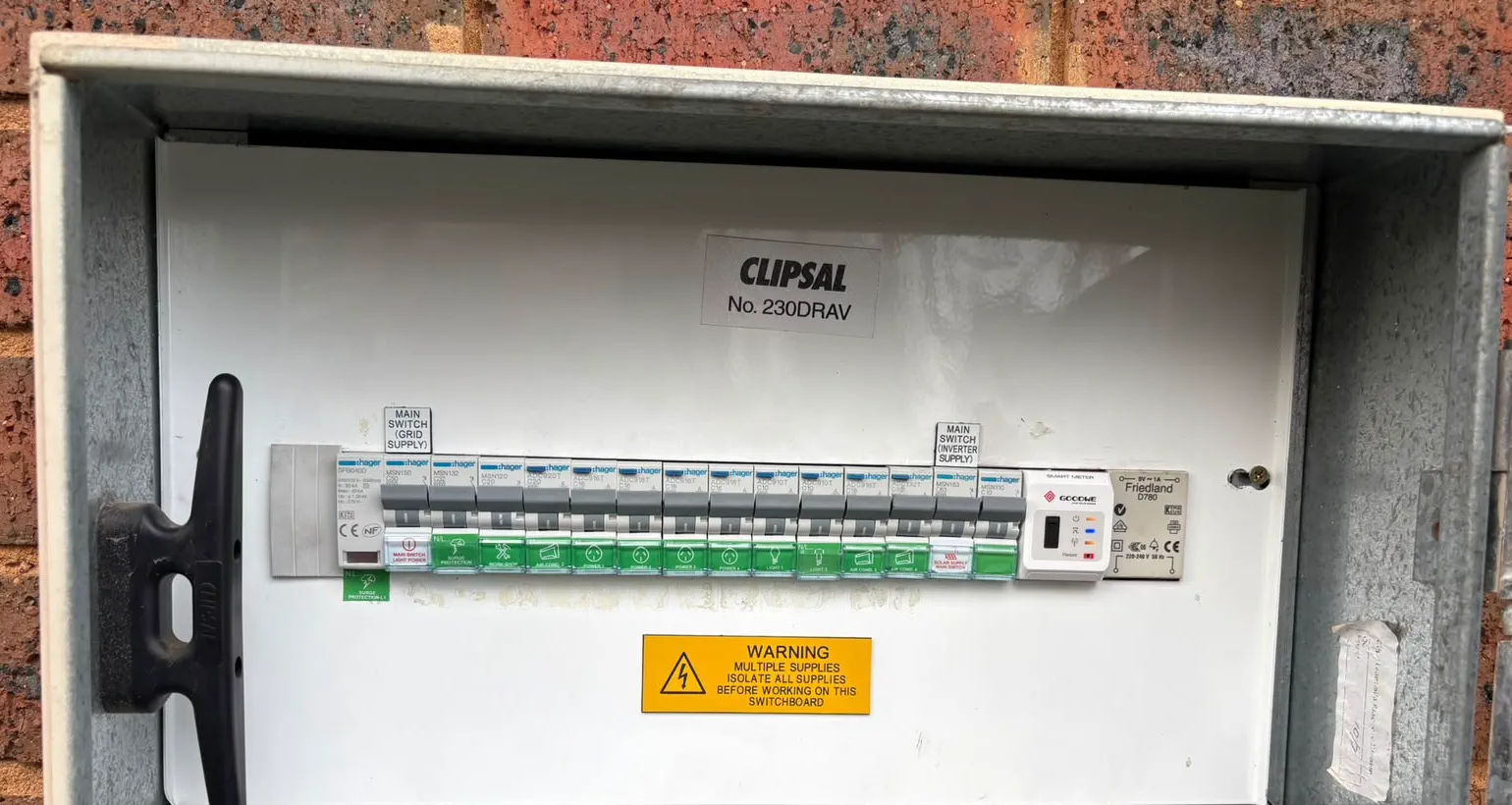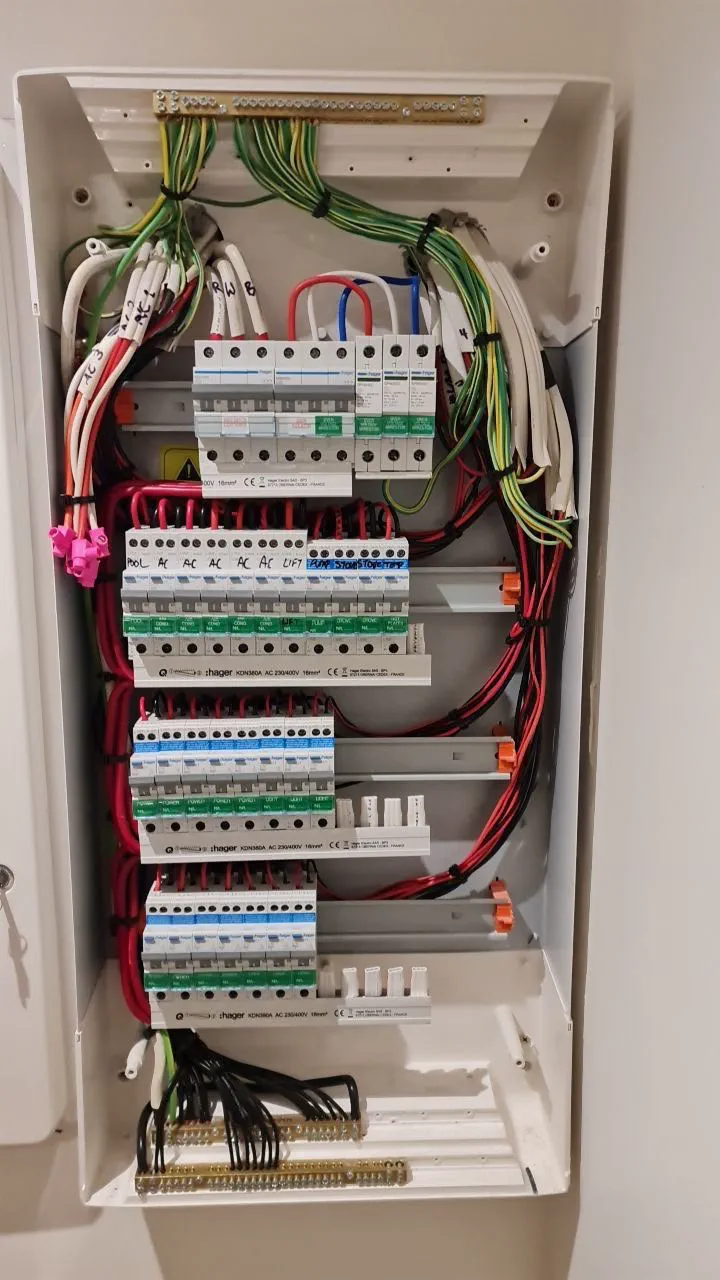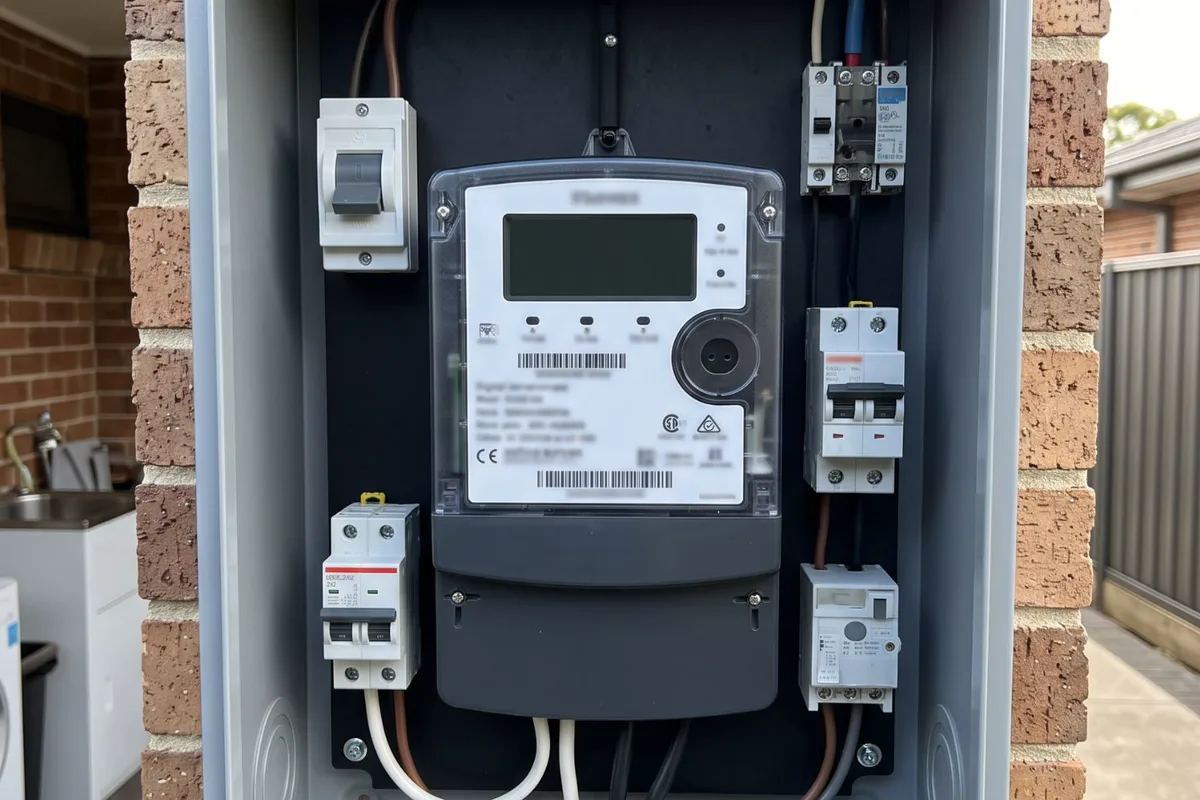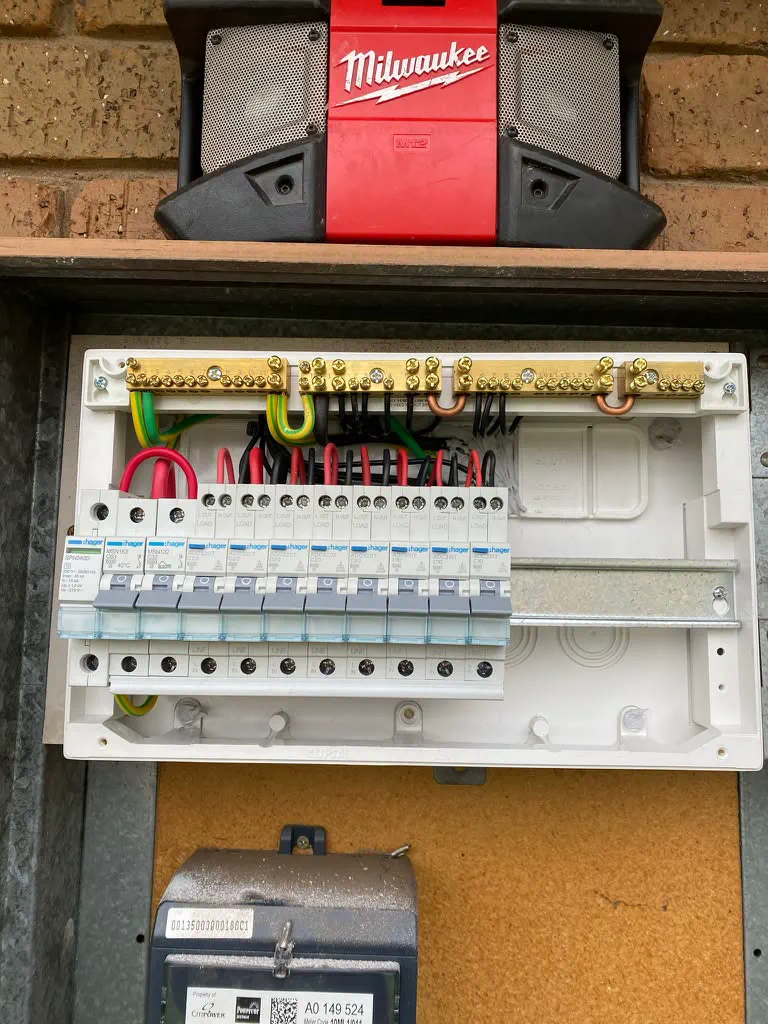
Plenty of switchboard problems come down to one failed breaker, a loose connection or a damaged cover. We test the circuit and the device separately, repair what's worth keeping, and tell you plainly when the board itself is the problem.
When to get it checked
A breaker that won't stay on
It trips straight back off, won't latch, or feels loose or gritty when you flip it. Sometimes the circuit is at fault, sometimes the device itself has failed. Testing tells which.
Warmth, buzzing or crackling
A cover that's warm to the touch, a hum you can hear from the hallway, or crackling when a big appliance starts. Loose connections heat up under load.
Scorch marks or a hot smell
Brown or black marks around a device, melted plastic or a smell like hot electrics. Switch off at the main switch if it's dry and safe to reach, and leave it off.
A broken cover, door or enclosure
A cracked cover, a door that won't close, missing blanks over empty slots or a meter box letting in rain. Gaps expose live parts and let in water, dust and insects.
Work someone else left unfinished
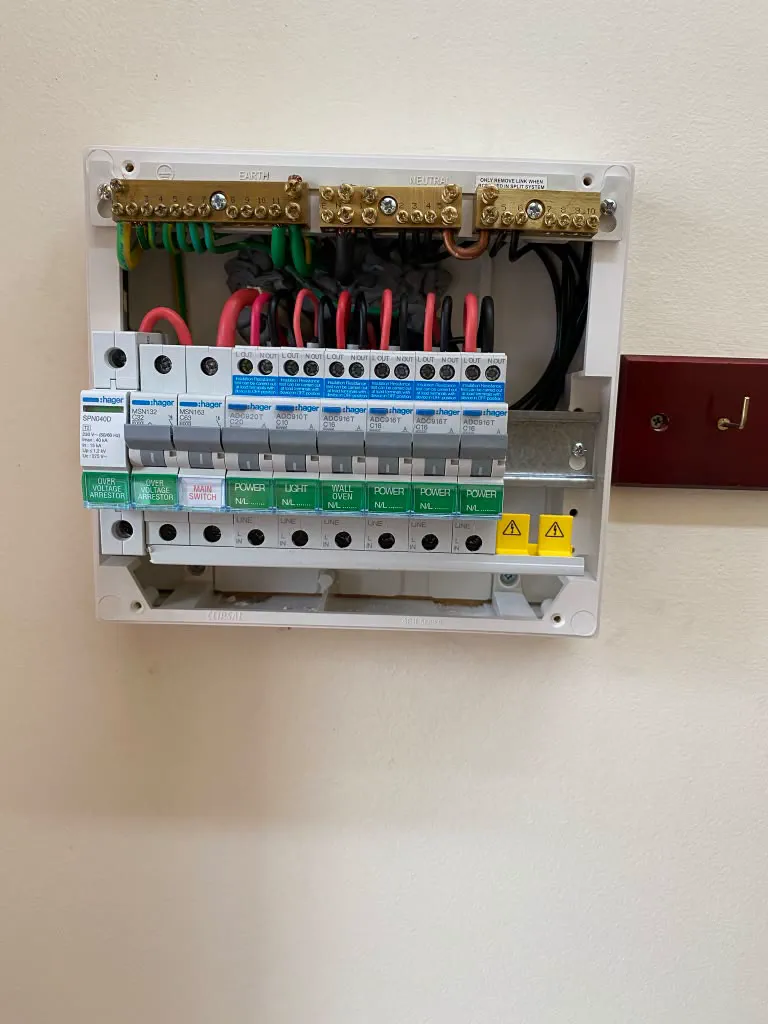
Loose cables after an air conditioning install, unlabelled circuits, or a breaker added without a proper cover. It may work, but it isn't right.
Why it happens
4 common causes
Connections loosen over time
Terminals warm up and cool down with every load, and screws gradually lose their grip. A loose terminal runs hotter, which loosens it further.
Devices wear out
Breakers and safety switches are mechanical. Springs and contacts wear, particularly on circuits that trip often or carry heavy loads like ovens and heaters.
Water, dust and pests
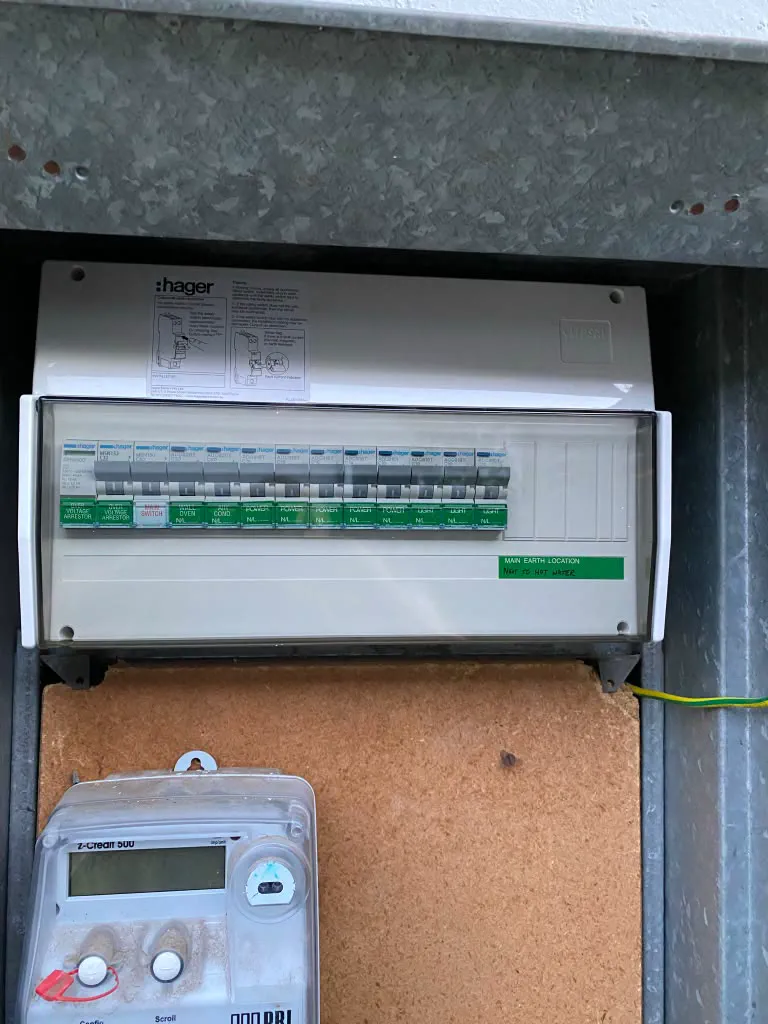
Outdoor meter boxes take the weather for decades. A failed seal or broken door lets in rain, dust, spiders and sometimes mice, which chew insulation and nest behind devices.
Earlier work done poorly
Undersized cable, a device forced into the wrong chassis, or a terminal holding two cables it wasn't made for. Problems like these often surface years later.
What the job covers
What we usually do on this job. Your quote confirms it for your place.
- Circuit tested separately from the device
- Board checked for heat damage and loose terminations
- Failed breakers or safety switches replaced
- Loose or damaged connections remade
- Missing blanks and damaged covers replaced
- Circuits we work on tested before switch-on
- Safety switches trip-tested
- Circuits relabelled where needed
- Certificate of Electrical Safety issued
Your options, explained
Repair the faulty part
Low disruption- Best for
- A sound breaker-type board with one failed device or loose connection
- How it works
- The failed breaker, safety switch or main switch is replaced and its connections remade, with testing before and after.
- Worth knowing
- The simplest fix. New devices must suit the board's chassis, which usually means the same maker.
Repair and add protection
Medium disruption- Best for
- Sound boards with circuits that have no safety switch
- How it works
- While the cover is off, RCBOs or safety switches go in for circuits that have none, if the board takes compatible devices.
- Worth knowing
- Only where the board has room. Our circuit breaker and RCBO page explains the options.
Replace the board
High disruption- Best for
- Fuse boards, scorched busbars, deteriorated panels or boards with no room left
- How it works
- A new switchboard goes in with safety switches on every final sub-circuit, inspected before it's switched on.
- Worth knowing
- More work, but some damage can't be repaired safely. See our switchboard upgrades page.
The people behind the work
Our own photos from jobs like this one. Based in Altona Meadows, with 19 years in the industry.
Licensed electrical contractor (REC 38187)See more team photos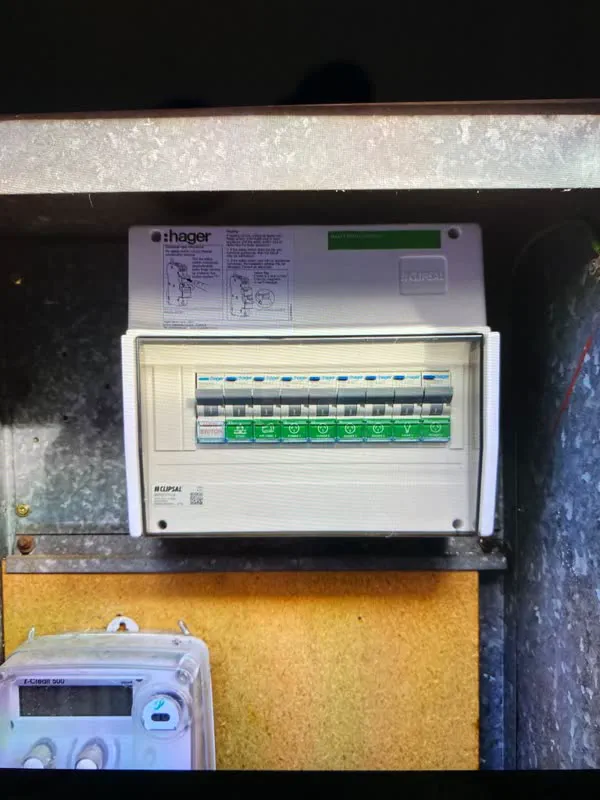
Worth knowing before you book
- Send a photo first
- Door open, covers on. It helps us bring the right parts.
- Parts must suit the board
- New devices need to match the chassis, usually from the same maker.
- Some boards aren't worth fixing
- If yours isn't, we'll explain why before you spend anything.
What affects the price?
The right scope depends on your installation. These are the details we check so your quote is useful, with any additional work explained before it proceeds.
What has actually failed
One breaker is a small job. Heat damage that has spread to the busbar, neutral link or neighbouring devices is not.
Parts that suit your board
Devices have to match the existing chassis. Older or discontinued ranges can be hard to source, and that can tip the decision towards a new board.
Faults on the circuit
If the trouble is out on the circuit rather than in the board, the cable or appliance at fault needs finding too. We agree that with you before it goes ahead.
The enclosure and panel
A cracked cover, a rusted meter box door or a backing panel that may contain asbestos changes what can be done, and how.
Access
A board behind joinery, in a cramped cupboard or high on an outside wall takes longer to work on safely.
How it runs
- 1
Describe the fault
What tripped, what was running, any smell or noise.
- 2
Test and explain
Circuit and device tested, options and price agreed.
- 3
Repair and retest
Parts replaced, connections remade, circuits tested.
- 4
Label and certify
Labels updated and a certificate issued.
Step by step, in more detail
5 steps
Tell us what's happening
Which breaker, what was running, any smell or noise, and a photo of the board with the door open and no covers removed. That helps us bring the right parts.
Test, don't guess
We isolate and test the circuit and the device separately, check connections for heat damage, and look over the rest of the board while the cover is off.
Repair or replace, explained
You get the options and the price for the agreed scope before any work starts. If the board isn't worth repairing, we say so and show you why.
Fix and retest
Failed devices are replaced with types allowed today, loose terminations are remade, damaged covers and blanks are replaced, and every circuit we touched is tested.
Label and hand over
Circuits are labelled, any safety switch is trip-tested with you watching, and you get a Certificate of Electrical Safety for the work.
What is safe to do, and what to leave to us
Safe for you to do
- If a breaker trips, unplug what was running on that circuit and reset it once. If it trips again, leave it off.
- If the board is hot, buzzing or smells of burning, switch off at the main switch only if it's dry and safe to reach, then keep everyone away from it.
- If there is smoke, fire or immediate danger, get everyone out of the house.
- Keep the area in front of the board clear so it can always be reached.
Leave these to us
- Taking the switchboard cover off, or tightening anything behind it.
- Taping a breaker on, or swapping in a bigger one so it stops tripping.
- Spraying insect spray, cleaner or water into a meter box or switchboard.
- Letting anyone unlicensed work on the board. Energy Safe Victoria says unlicensed electrical work is illegal and potentially fatal.
When to get us in
- A breaker or safety switch trips again after one reset
- Warmth, buzzing, crackling or a burning smell at the board (switch off at the main switch if it's safe to reach)
- Scorch marks, melted plastic or a cracked device
- A broken cover, missing blanks or a meter box that lets in water
- Before you add a circuit to a board that has already had problems
More detail
Repair or replace: how we decide
A repair makes sense when the board itself is sound: a breaker-type board in a good enclosure, with devices still available to suit it and no heat damage beyond the failed part. Replacing one breaker, remaking a loose termination or fitting a new cover can give that board years more service.
Replacement makes more sense when the problem is the board. Ceramic fuses, a scorched busbar or neutral link, a backing panel that's breaking down, or a range of devices nobody makes any more all point that way. So does a board with no room for what you plan to add next. We'll show you what we found and let you decide.
What a new device has to match
A replacement isn't always the same as the part that failed. Energy Safe Victoria says Type AC safety switches must not be installed in Australia, even like for like, so a failed Type AC device is replaced with a type that's allowed today. Existing Type AC devices installed, tested and certified before 1 May 2023 don't have to come out just because they're there.
The device also has to suit the board's chassis and busbar. Mixing makers on one busbar can leave a poor connection, which is exactly the kind of fault that causes heat. We prefer Hager and Clipsal, use other reputable brands where they suit, and match what's already in the board where we can.
Why a repaired board may still trip
Fixing a failed device sometimes reveals what it was hiding. A breaker that had stopped tripping reliably may now trip on an overloaded circuit, and a working safety switch will react to current leaking from a worn appliance or a damp outdoor fitting.
That isn't the repair failing. It's the protection doing its job. If it happens, note what was running, leave the switch off after one reset, and let us know so we can trace the circuit.
Local rules and conditions
Victorian requirements and local conditions that shape this job, with the sources listed at the foot of the page.
One part, or the whole board
Work on a main switchboard is prescribed work in Victoria, inspected by a Licensed Electrical Inspector. Energy Safe Victoria says the repair or replacement of a single component part can be excluded from that, so swapping one failed device usually needs no inspection. Replacing the board does, and its power stays off until it's inspected.
Older meter boxes in Altona and Laverton
Hobsons Bay's planning scheme says post-war growth transformed Altona and Laverton. Powercor lists a defective meter box or fused mains box as the customer's to fix, and WorkSafe Victoria lists switchboards and their backing boards as a typical asbestos location in buildings built or renovated before the late 1980s.
Hot afternoons find weak connections
The Laverton weather station averages 27.0 days a year at or above 30 °C and 9.4 days at or above 35 °C, mostly December to February. Air conditioners, fridges and pool pumps work hardest then, and a connection that coped all winter can start to overheat.
Useful reading
Guides to read before you decide, with checklists and questions to bring to the quote.
- Planning a switchboard upgrade without surprisesWhat the electrician needs to check, how to compare the scope and what to organise before the power goes off.
- A safety switch keeps tripping: what to record and when to callUnderstand the difference between a protective device doing its job and a fault that needs investigation.
- Ceramic fuses and old switchboards: what to look forA look-but-don't-touch guide to old switchboards: rewireable fuses, a missing safety switch, suspect backing panels, heat marks and what replacement involves.
- Certificates of Electrical Safety explainedWhat a Victorian COES records, how prescribed and non-prescribed work differ, when your copy should arrive and why it belongs in your house file.
Common questions
Questions people ask about this
- How do I tell which switch has tripped on my switchboard?Open the switchboard door and look along the rows of switches.
- What do the numbers and letters on my circuit breakers mean?The number is the breaker's rating in amps: the current it can carry continuously without tripping.
- Why does my main switch trip?Many main switches are only isolators and can't trip on their own.
- My meter box door is broken or won't close. Who fixes it?The property owner.
- What is a sub-board, and do I have one?A sub-board is a smaller switchboard fed by its own cable from a circuit breaker on your main switchboard.
From the blog
Sources for the rules and local facts on this page
12 sources, with the date each was checked
- 1.Energy Safe Victoria: 'Prescribed' certificates are for electrical installation work that requires inspection by a Licensed Electrical inspector. This includes (but is not limited to): Consumer mains cables, main switchboard, meter box and… Accessed 30 September 2026.
- 2.Energy Safe Victoria: In effect, Regulation 249(4) allows the repair or maintenance (including replacement) of a single component part of an electrical installation that is classified as prescribed electrical installation work to be excluded… Accessed 30 September 2026.
- 3.Energy Safe Victoria: The electrician has eight business days after the work is completed to have that work inspected by a licensed electrical inspector (LEI). If an electrician replaces a main switchboard at a property, power cannot go back… Accessed 30 September 2026.
- 4.Victorian Government, Hobsons Bay Planning Scheme (PDF snapshot, last updated by VC292 on 11/09/2025): The heritage places of Hobsons Bay reflect the key themes that have shaped the development of the city since the establishment of Williamstown in the 1840s as the first port of Melbourne, through the development of… Accessed 30 September 2026.
- 5.CitiPower & Powercor: Customer installation defects fall under customer responsibility and require prompt rectifications to ensure either the safety of the electrical installation, unhindered access to our assets by our employees or that our… Accessed 30 September 2026.
- 6.WorkSafe Victoria: A person who has management or control of a workplace, and employers or self-employed persons and employees should be aware of the typical uses and applications of ACMs, particularly in buildings constructed or… Accessed 30 September 2026.
- 7.Bureau of Meteorology: Mean number of days ≥ 30 °C 6.9 6.0 4.5 0.7 0.0 0.0 0.0 0.0 0.1 0.9 2.8 5.1 27.0 82 1943 2026 Mean number of days ≥ 35 °C 3.6 2.4 0.9 0.0 0.0 0.0 0.0 0.0 0.0 0.1 0.5 1.9 9.4 Accessed 30 September 2026.
- 8.Energy Safe Victoria: Type AC RCDs must not be installed in Australia. This includes like for like replacement. We recommend that electrical contractors advise customers of the new requirements. However, it is not mandatory to replace… Accessed 30 September 2026.
- 9.Energy Safe Victoria: Whenever a licensed electrician completes any electrical installation work, they must provide a Certificate of Electrical Safety (COES). Accessed 30 September 2026.
- 10.Victorian Legislation (legislation.vic.gov.au) - Electricity Safety Act 1998, authorised version 089 (effective 8 Sep 2026): electrical installation work means installation, alteration, repair or maintenance of an electrical installation; Accessed 30 September 2026.
- 11.Energy Safe Victoria: Electrical work isn’t a DIY job, even for small jobs such as changing power points or light switches. Accessed 30 September 2026.
- 12.Energy Safe Victoria: Gas and electricity are inherently dangerous and it’s illegal and potentially fatal for unlicensed and unqualified people to undertake any electrical or gasfitting work. Homeowners and consumers must always use… Accessed 30 September 2026.