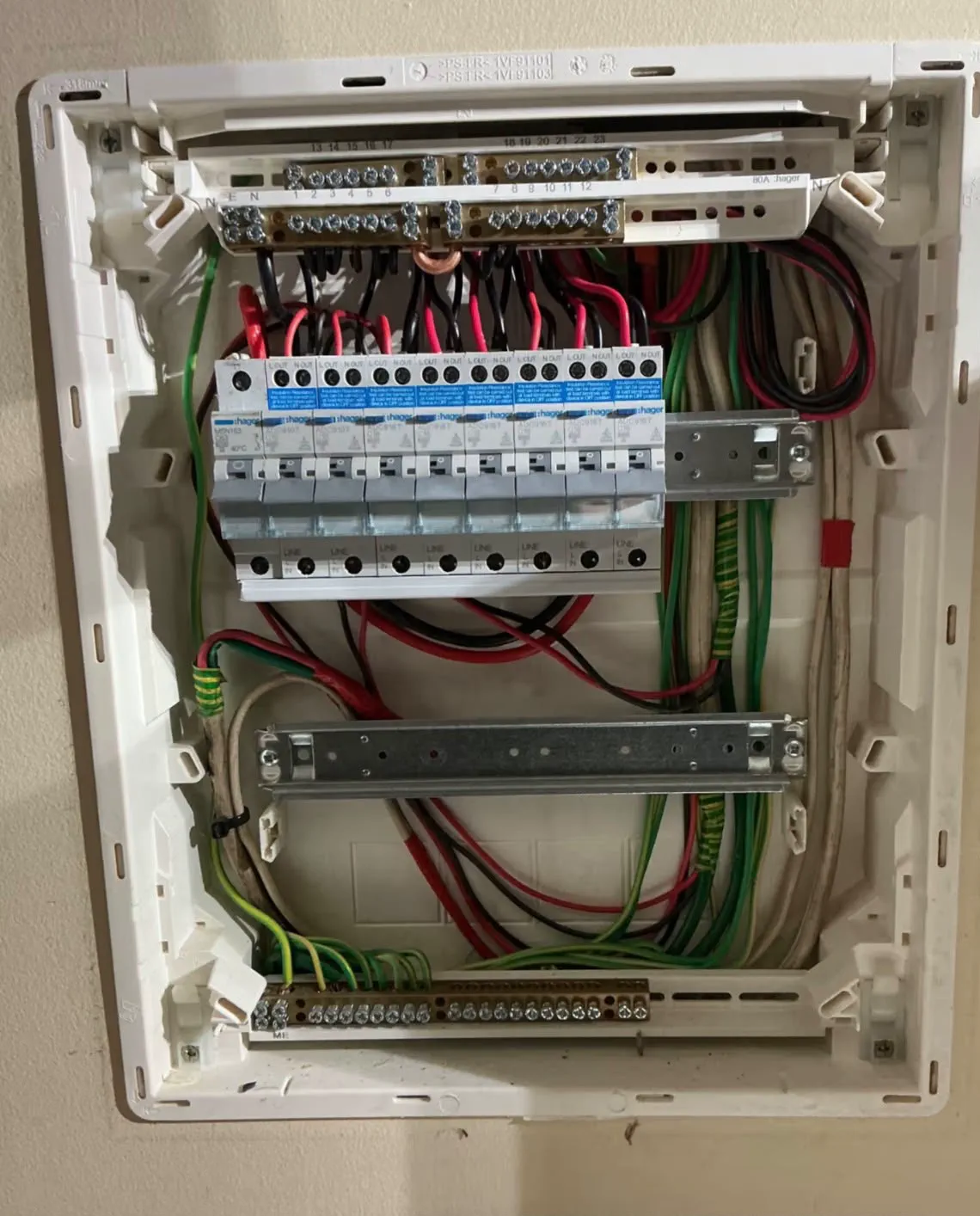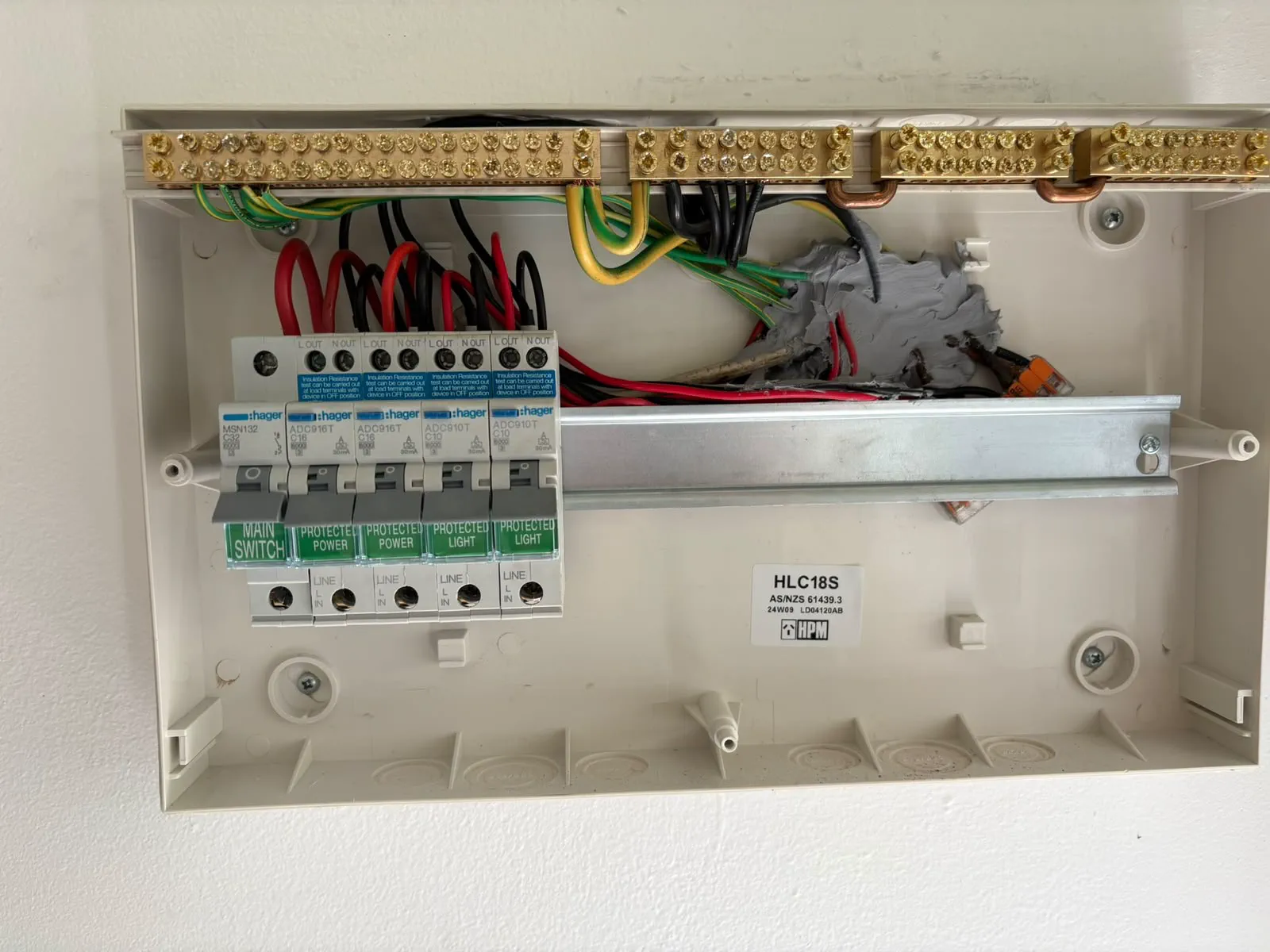
A dead section of the house means its circuit or group of circuits has been cut off: by a trip, a failed part, a loose connection or, less often, the supply. We find which, fix it and test every affected circuit.
When to get it checked
One end of the house is dark
The back bedrooms are dead and the front runs normally. Rooms are wired in groups, so the dead area traces back to one circuit or safety switch.
Lights work but power points don't
Or the reverse. Lighting and power run on separate circuits, so one circuit or its protection is the likely cause.
A switch at the board is down
A safety switch or breaker is off or stuck halfway. Safety switches always have a test button and '30mA' printed on them.
Nothing has tripped, yet rooms are dead
Every switch is up but part of the house is off. On an old fuse board, a blown fuse looks just the same from outside.
Why it happens
4 common causes
A tripped safety switch or breaker
A safety switch trips when current leaks to earth, often through a worn appliance or a wet outdoor light. A breaker trips on overload or a short, like a heater, kettle and dryer on one circuit on a cold night.
A failed breaker or safety switch
These devices wear out. One that won't latch, or sits on while its circuits stay dead, has usually failed inside.
A loose or burnt connection
Connections at the board or in a junction box loosen and overheat over the years until the rooms beyond them lose power, often after some flicker or a faint hot smell.
One phase of the supply lost
Some homes take supply on more than one phase, each feeding its own set of circuits. Lose one and every circuit on it dies with nothing tripped.
What the job covers
What we usually do on this job. Your quote confirms it for your place.
- Supply side or house side confirmed first
- Every safety switch and breaker checked
- Dead circuits traced to the fault
- Failed breakers or safety switches replaced
- Loose or heat-damaged connections remade
- Restored circuits tested and safety switches trip-tested
- Certificate of Electrical Safety for the repair
Your options, explained
Find and fix
Low disruption- Best for
- A leaking fitting, faulty appliance or loose connection
- How it works
- We trace the fault, deal with the cause and restore the circuit.
- Worth knowing
- The usual outcome.
Replace a failed device
Low disruption- Best for
- A breaker or safety switch that won't reset or hold
- How it works
- The device is swapped for a compatible one and its circuits are retested.
- Worth knowing
- Energy Safe Victoria says Type AC safety switches must not be installed, even like for like.
Switchboard upgrade
High disruption- Best for
- Old fuse boards, scorched boards or no compatible parts
- How it works
- A new board with safety switch protection on every final sub-circuit, which AS/NZS 3000 requires when a board is replaced.
- Worth knowing
- Power can't go back on to a new main switchboard until a licensed electrical inspector has inspected it.
The people behind the work
Our own photos from jobs like this one. Family-run, based in Altona Meadows, with 19 years in the industry.
Licensed electrical contractor (REC 38187)See more team photos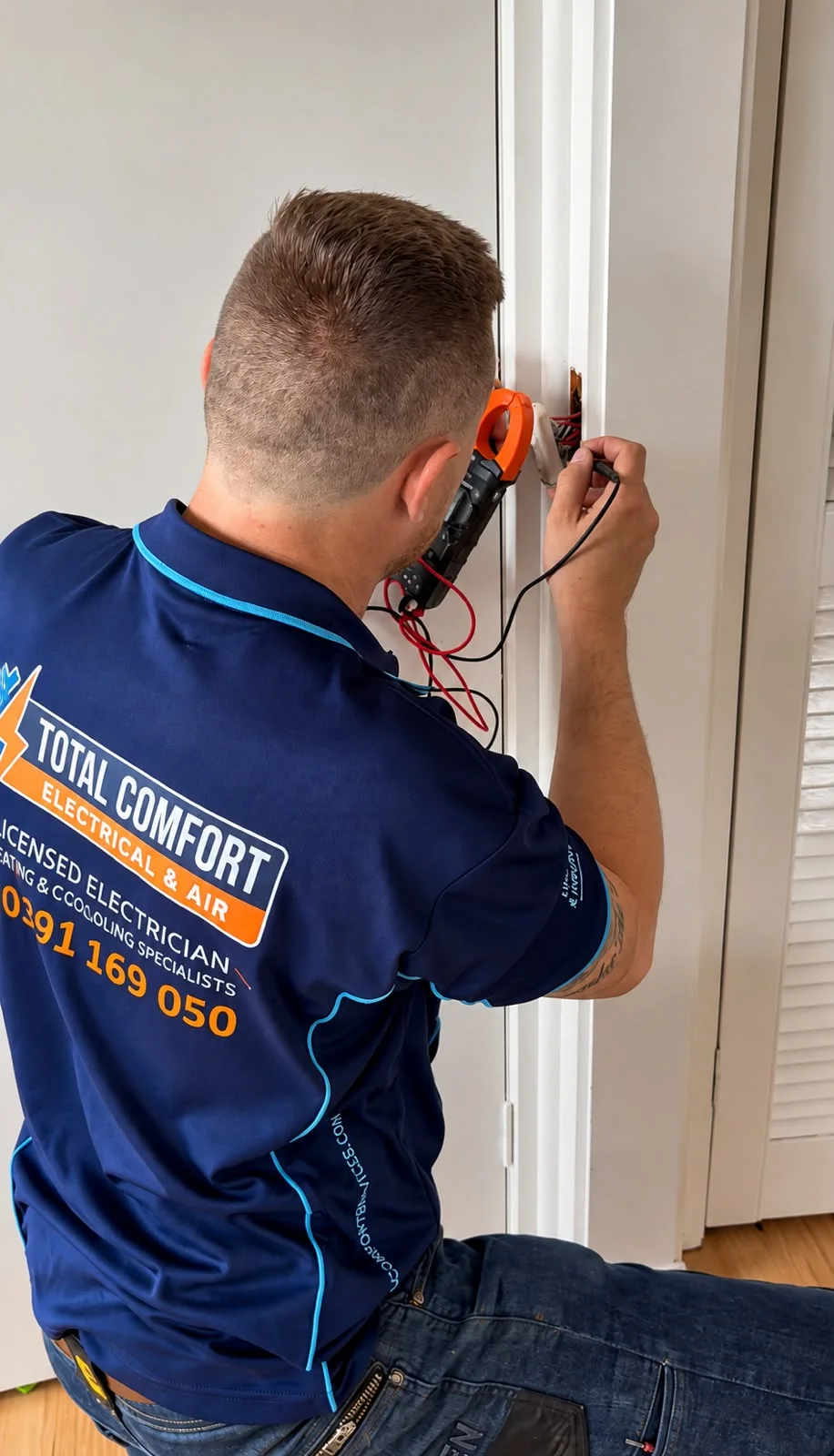
Worth knowing before you book
- Reset once, then leave it
- If it trips again or won't reset, leave it off, unplug things in the dead rooms and call a licensed electrician.
- Tell us what was running
- The appliance that was on, recent rain or recent work on the house are our best clues.
- Labels aren't always right
- Board labels are often missing or out of date after renovations, so tell us which rooms are dead, not just the label.
What affects the price?
The right scope depends on your installation. These are the details we check so your quote is useful, with any additional work explained before it proceeds.
Whether the fault is present
A fault that's there when we arrive is quicker to find than one that comes and goes.
Where it sits
Cable in a roof space, under a floor or out to a shed takes longer to reach.
Circuits behind one switch
Six circuits behind one safety switch means six circuits to split and test.
The board's age
An older board may have no compatible parts left, which turns a device swap into a bigger job.
How it runs
- 1
Tell us what went dark
Which rooms, what tripped and what was running.
- 2
Test and trace
We test at the board and along the circuit to find the cause.
- 3
Fix and restore
We repair it, test each circuit and trip-test the safety switches.
Step by step, in more detail
4 steps
Hear what went dark
We ask which rooms are out, what tripped and what was running. That tells us which circuits to start on.
Find the dead circuits
We check every device at the board, measure the supply at the main switch and pin down which circuits are off. A supply fault goes to your distributor.
Split, test and repair
Unplugging appliances and insulation testing each circuit separates a faulty kettle from a damaged cable in the wall. You get the price before we start.
Restore and certify
Each circuit is tested before it goes back on and the safety switches are trip-tested. Installation work comes with a Certificate of Electrical Safety.
What is safe to do, and what to leave to us
Safe for you to do
- If lights in the working rooms are dull or flickering, leave the board alone and call your distributor.
- Otherwise, check the switchboard without removing covers and reset a tripped switch once.
- Unplug appliances in the dead rooms. Energy Safe Victoria says this helps prevent surge damage.
- If there's smoke or fire, get everyone out and keep clear.
Leave these to us
- Resetting a switch again and again, or holding or taping it on.
- Removing covers, pulling fuses or changing fittings. Electrical work isn't a DIY job, even small ones.
- Running a lead from a working room. If an appliance caused the trip, it can trip that circuit too.
When to get us in
- A switch won't reset, or trips again straight away
- Rooms are dead but nothing at the board has tripped
- Heat, buzzing or a burning smell at the board or a fitting
- Tingles or shocks from taps or appliances
More detail
Why one fault takes out a group
Your board splits the house into circuits for lights, power points and appliances like the oven. Many boards put several circuits behind one safety switch, so a single trip darkens every room on them. Newer boards often give each circuit its own combined device, keeping a fault to one circuit.
Tracing a missing phase
We measure every phase at the main switch. If all are healthy, the fault is in the board or on the circuits. If one is missing, we trace it back towards the point of supply, where the network meets your installation and the owner's responsibility for repairs begins.
Map your circuits before the next outage
Energy Safe Victoria tells householders to press the test button on each safety switch every three months, which should trip it and cut the power. Note which rooms go dark and you'll know what each switch covers. If nothing loses power, the switch may have failed; call a licensed electrician straight away.
Local rules and conditions
Victorian requirements and local conditions that shape this job, with the sources listed at the foot of the page.
When it's the supply, not the board
Dull or flickering lights alongside the dead circuits can point to a supply fault, which is your distributor's to fix. Powercor's Altona Terminal Station (West) supplies areas including Altona Meadows, Laverton, Point Cook, Werribee and Tarneit. Jemena's supply area reaches Williamstown and Footscray.
Ceramic fuses in older boards
Post-war residential expansion transformed Altona and Laverton, says the Hobsons Bay Planning Scheme. If your board still has ceramic fuses, leave a blown one to us: WorkSafe Victoria lists ceramic fuses in switchboards among its examples of asbestos-containing materials.
Useful reading
Guides to read before you decide, with checklists and questions to bring to the quote.
- Power out? How to tell if it's the network or your houseDark street or just your place? A few checks from the front window to the meter box tell you who to contact first, without opening anything.
- A safety switch keeps tripping: what to record and when to callUnderstand the difference between a protective device doing its job and a fault that needs investigation.
- How and when to test your safety switchesHow to run the push-button test at home, what an electrician’s trip-time test measures that the button can’t, and what to do when a switch fails.
- Renting and the power or heating has failed: what to doNo power or a dead heater in a Victorian rental? What to check safely, what counts as urgent, how to report it, and what to do if nobody responds.
Common questions
From the blog
Sources for the rules and local facts on this page
14 sources, with the date each was checked
- 1.Powercor Australia, Project Assessment Draft Report: Altona Terminal Station (West) (June 2025): It supplies part of Melbourne’s western growth corridor. This includes the areas of Laverton, Laverton North, Altona Meadows, Werribee, Wyndham Vale, Mount Cottrell, Eynesbury, Tarneit, Hoppers Crossing and Point Cook… Accessed 30 September 2026.
- 2.Jemena Electricity Networks (Vic) Ltd, 2025 Distribution Annual Planning Report (2 December 2025): Figure 1-1 shows the JEN supply area, which ranges from Gisborne South, Clarkefield and Mickleham in the north to Williamstown and Footscray in the south, and from Hillside, Sydenham and Brooklyn in the west to… Accessed 30 September 2026.
- 3.Victorian Government, Hobsons Bay Planning Scheme (PDF snapshot, last updated by VC292 on 11/09/2025): The heritage places of Hobsons Bay reflect the key themes that have shaped the development of the city since the establishment of Williamstown in the 1840s as the first port of Melbourne, through the development of… Accessed 30 September 2026.
- 4.WorkSafe Victoria: Fuse blankets and ceramic fuses in switchboards Pitch-based (eg Zelemite, Ausbestos, Lebah) electrical switchboards Accessed 30 September 2026.
- 5.Energy Safe Victoria: monitors the flow of electricity through a circuit detects a problem that may pose a risk to personal safety turns the power off within 0.03 of a second always has a test button and '30ma' printed on them. Accessed 30 September 2026.
- 6.Energy Safe Victoria: Locate your electricity box outside your home and check whether the safety switch has tripped. If it has tripped, reset the switch. If the switch won’t reset, call a licensed electrician. Accessed 30 September 2026.
- 7.Energy Safe Victoria: The point of supply is the changeover point from the electricity distribution network to the electrical installation, where the property owner becomes responsible for the maintenance and repair of the electrical… Accessed 30 September 2026.
- 8.Energy Safe Victoria: Whenever a licensed electrician completes any electrical installation work, they must provide a Certificate of Electrical Safety (COES). Accessed 30 September 2026.
- 9.Energy Safe Victoria: Type AC RCDs must not be installed in Australia. This includes like for like replacement. We recommend that electrical contractors advise customers of the new requirements. However, it is not mandatory to replace… Accessed 30 September 2026.
- 10.Energy Safe Victoria: If a switchboard is required to be replaced then as per clause 2.6.3.2.5 (Alterations to installations and replacement of switchboards) of AS/NZS 3000: RCD’s are required on all final sub-circuits. Accessed 30 September 2026.
- 11.Energy Safe Victoria: The electrician has eight business days after the work is completed to have that work inspected by a licensed electrical inspector (LEI). If an electrician replaces a main switchboard at a property, power cannot go back… Accessed 30 September 2026.
- 12.Energy Safe Victoria: In the event of a power failure turn off and unplug all electrical appliances at the powerpoint. This will help to prevent equipment damage in the event of a power surge. Accessed 30 September 2026.
- 13.Energy Safe Victoria: Electrical work isn’t a DIY job, even for small jobs such as changing power points or light switches. Accessed 30 September 2026.
- 14.Energy Safe Victoria: Follow these steps to check your safety switch every three months: Press in the test buttons on each safety switch which will cut the power and trip the switch into the off position. You may hear a clunking sound. If… Accessed 30 September 2026.