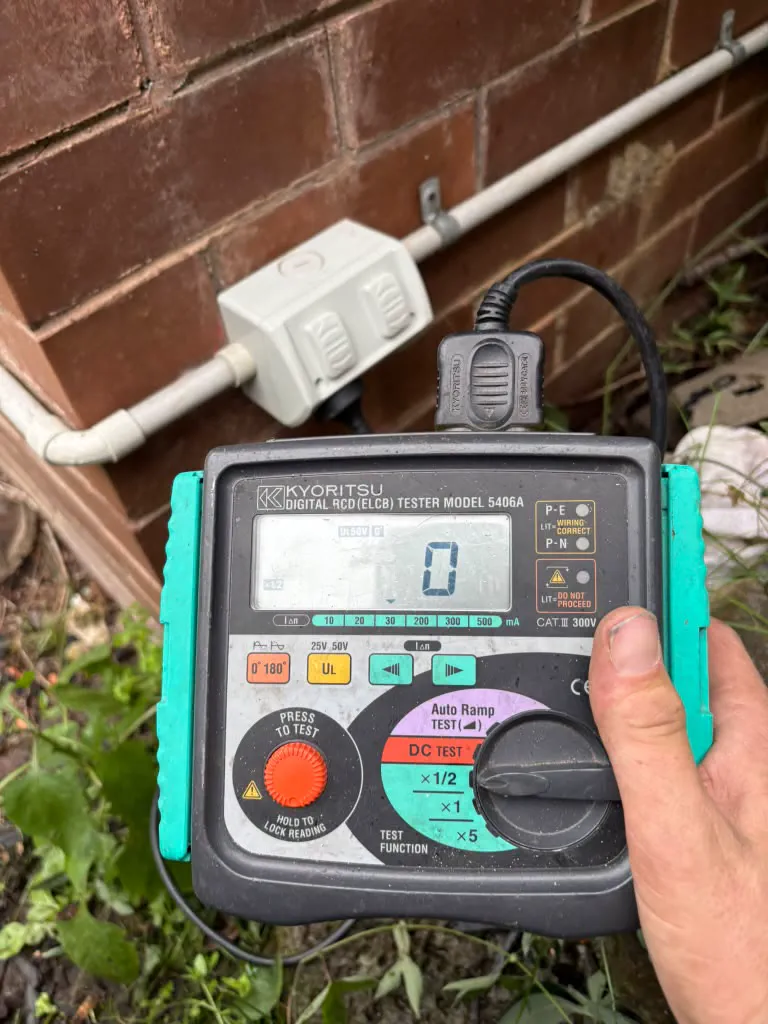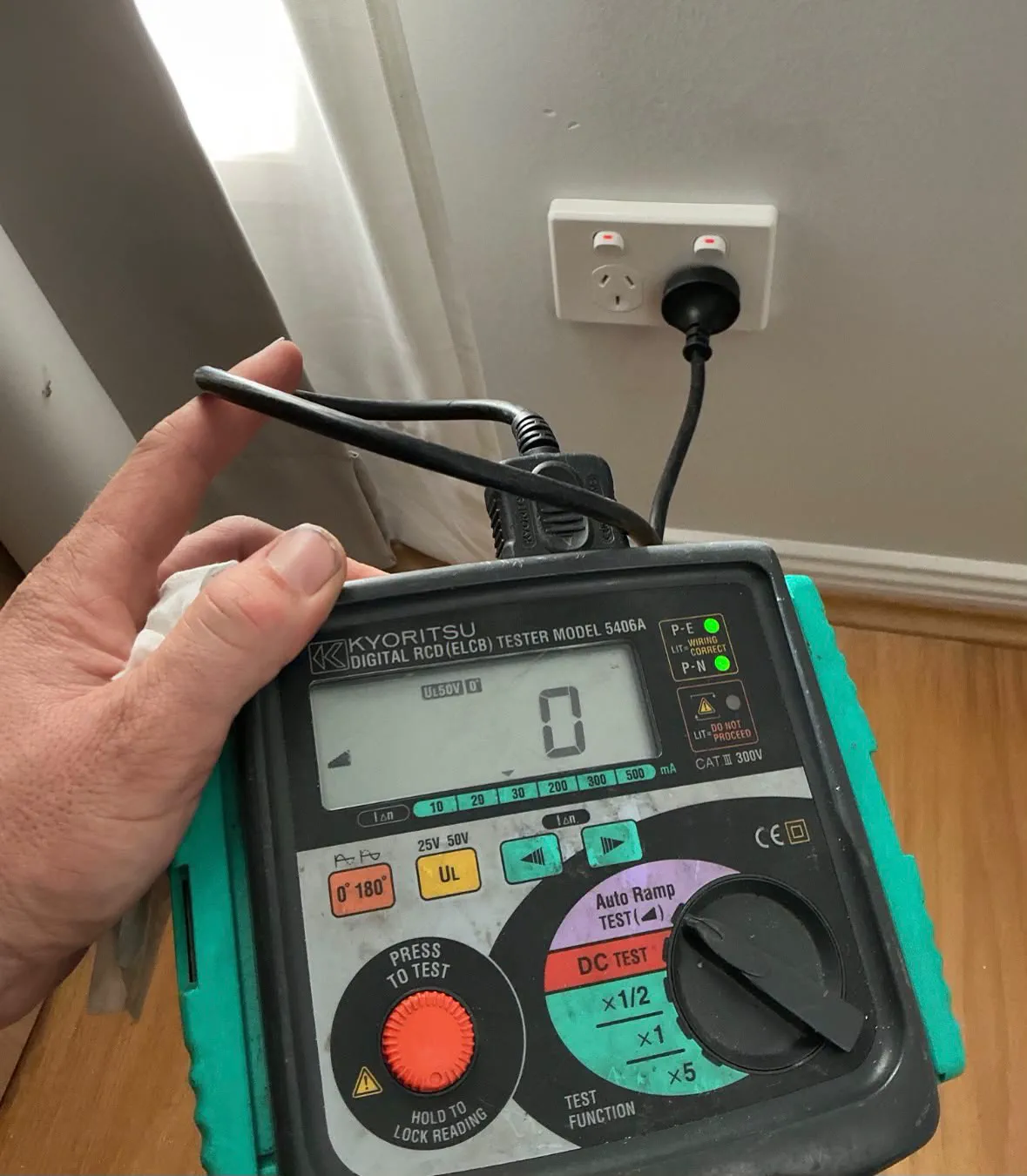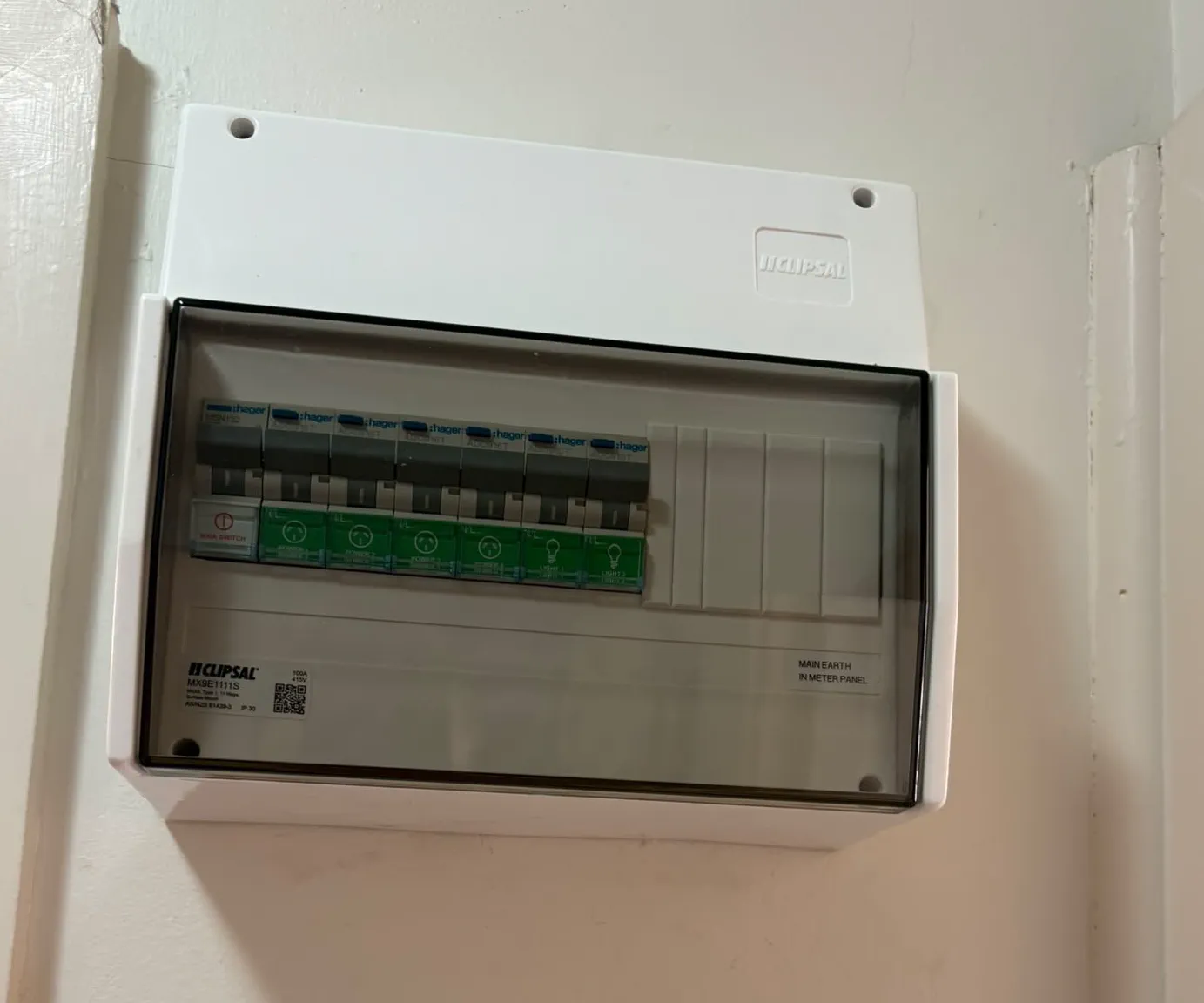
Plenty of older homes in the west have one safety switch covering the power points, or none at all, with lighting and fixed appliances left unprotected. We check what you've got, test that each safety switch trips the way it should, and add or replace them so your power and lighting circuits are covered. If the switchboard has no room or is too old to take them, we'll tell you and explain the options.
When to get it checked
Nothing on the board has a test button
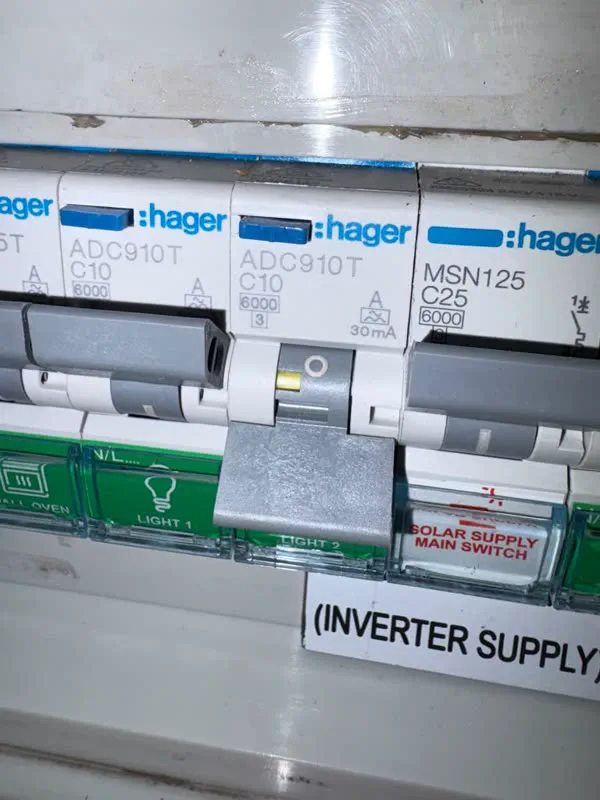
A board with only ceramic fuses, or a row of breakers and no test button anywhere, usually means there's no safety switch. Energy Safe Victoria says a safety switch always has a test button and '30mA' printed on it.
Some circuits stay on during a test
The power points go off when you press the test button, but the lights, oven or hot water keep running. Many older boards had one safety switch added for the power points, and nothing else was moved onto it.
The test button does nothing
Press it and the power on that circuit should cut out, often with a clunk. Energy Safe Victoria says that if lights or appliances don't lose power, the safety switch may have failed and a licensed electrician should investigate straight away.
Something new is going in
A new air conditioner, cooktop, spa or extension alters the installation, and the Wiring Rules add RCD requirements when that happens. It's the natural time to check what the rest of the board protects.
Why it happens
4 common causes
Wired before safety switches were routine
A house keeps whatever protection it was wired with until someone changes the board or alters the wiring. Plenty of older homes are still on their original board.
Circuits added over the years
A shed, a spa or an air conditioner gets a new breaker squeezed onto the board, sometimes outside any safety switch. After decades of additions, coverage comes down to who did each job.
Too many circuits on one device
Every appliance leaks a tiny amount of current to earth in normal use. Run many circuits through one safety switch and those amounts add up, so it trips more easily and takes more of the house with it.
Devices nobody has tested
A safety switch can go decades without anyone pressing its button, and a stiff mechanism doesn't show from outside. Outdoor meter boxes add heat, dust and damp. Only a test tells you whether it still works.
What the job covers
What we usually do on this job. Your quote confirms it for your place.
- Existing safety switches identified and labelled
- Each safety switch trip-tested with an RCD tester
- Faulty or slow safety switches replaced
- New safety switches fitted to cover power and lighting circuits
- Circuits split across more than one safety switch where the board allows
- RCBOs fitted where a circuit is better off with its own protection
- Switchboard labelling updated
- Test results explained, along with how to use the test button
- Advice if the board can't take them without an upgrade
Your options, explained
RCBO on each circuit
Medium disruption- Best for
- Boards with room, and homes where one fault shouldn't take out the fridge
- How it works
- Each circuit gets a combined safety switch and circuit breaker, so a fault only switches off its own circuit.
- Worth knowing
- More devices, but leakage no longer adds up across circuits and faults are easier to find.
Grouped safety switches
Low disruption- Best for
- Smaller boards with only a few circuits
- How it works
- Two or more safety switches each protect a group of breakers, with lights and power split so one trip doesn't leave the whole house dark.
- Worth knowing
- Fewer devices. A fault still switches off everything else in its group.
Replace a failed safety switch
Low disruption- Best for
- A device that won't reset or fails its test on an otherwise sound board
- How it works
- The faulty switch is swapped out and the circuits behind it are tested before the power goes back on.
- Worth knowing
- Fixes that device only. Circuits that were never on a safety switch stay unprotected unless they're added too.
Switchboard upgrade
High disruption- Best for
- Fuse boards, full enclosures or boards in poor condition
- How it works
- The board is replaced, and the Wiring Rules then require RCDs on all final sub-circuits.
- Worth knowing
- A new main switchboard stays off until a Licensed Electrical Inspector has checked it, but protection, labels and space are sorted together.
The people behind the work
Our own photos from jobs like this one. Family-run, based in Altona Meadows, with 19 years in the industry.
Licensed electrical contractor (REC 38187)See more team photos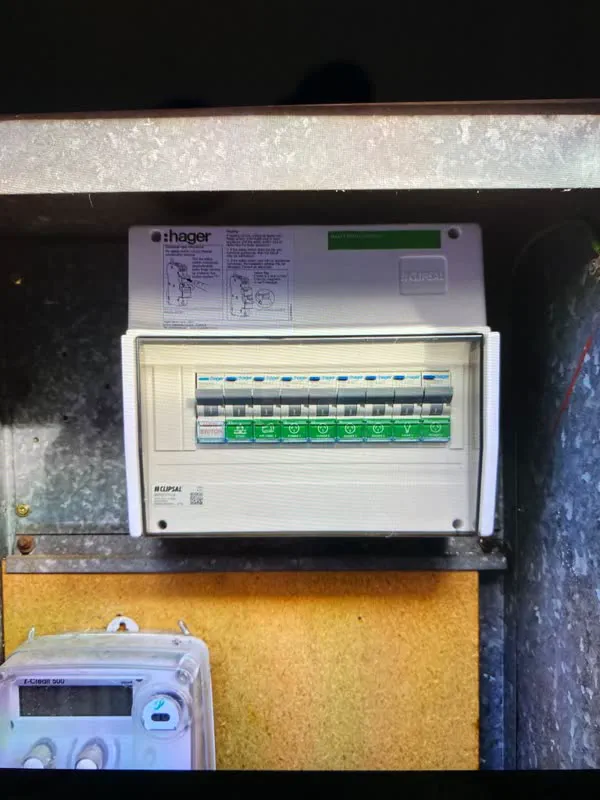
Worth knowing before you book
- Press the test button
- Energy Safe Victoria recommends test-button checks every three months. Follow the device instructions, let everyone know power will go off and plan for essential equipment first. A failed test needs a licensed electrician.
- A safety switch isn't a circuit breaker
- Circuit breakers protect the wiring from overloads and short circuits. Safety switches protect people from electric shock. Many homes have breakers on every circuit but safety switches on only some of them.
- Switchboard upgrades bring them in
- When a switchboard is replaced, the new board generally needs safety switches on the power and lighting circuits under current wiring rules. If your board is old, it can make sense to do both at once.
What affects the price?
The right scope depends on your installation. These are the details we check so your quote is useful, with any additional work explained before it proceeds.
How many circuits need protection
Each unprotected circuit needs a device, a test and a label. A four-circuit unit is a different job to a two-storey house with a shed and a spa.
Room on the board
If the enclosure has space, devices go straight in. If not, a larger enclosure, a sub-board or a new switchboard may be the only way to fit them.
RCBOs or shared safety switches
One device per circuit means more parts than a couple of shared ones. Where both would work, we can quote both.
Faults found in testing
A circuit that fails insulation testing has to be repaired before it can sit behind a safety switch. That repair is priced separately once we know what's involved.
The board and where it sits
Brittle cable, a backing panel that may contain asbestos, or a cramped outdoor meter box all change how the work is done. We check before quoting, not halfway through.
Before the visit
- Photograph the closed switchboard front if it is safe and accessible.
- Arrange for short power interruptions and save computer work.
- Explain whether the concern is missing protection, failed testing or repeated tripping.
How it runs
- 1
Look at the board
Send a photo of your switchboard with the door open, or we check it on site.
- 2
Test what's there
Each existing safety switch is tested to see whether it trips, and how fast.
- 3
Fit or replace
We add safety switches to unprotected circuits and replace any that failed the test.
- 4
Label and explain
Circuits are labelled, and we show you how the test button works.
Step by step, in more detail
5 steps
Start with a photo
Send a photo of your switchboard with the door open and no covers removed, if it's safe to reach. It shows us what's there and whether there's room, or we look on site.
Map what each device protects
On site we switch each safety switch off in turn and note which lights, points and appliances go dead. Wrong labels get corrected as we go.
Test the devices and the circuits
Each existing safety switch is trip-tested with an RCD tester, which shows whether it operates and how quickly. Circuits about to be protected are insulation-tested too, because a leaking circuit will trip a new safety switch straight away.
Add, split or replace
Unprotected circuits get safety switches or RCBOs, busy circuits are spread out, and any switch that failed its test is replaced. If the board has no room or is too old for new devices, we explain the options first.
Retest, label and explain
Every device is tested again and the board is labelled circuit by circuit. We show you the test button, go through the results and issue the Certificate of Electrical Safety.
What is safe to do, and what to leave to us
Safe for you to do
- Press the test button on each safety switch every three months, as Energy Safe Victoria recommends. Warn everyone first, and plan around anything that can't lose power.
- If a safety switch has tripped, unplug what was running on that circuit and reset it once.
- If it won't reset, or trips again, leave it off and call a licensed electrician.
- If the switchboard smells hot or burnt, switch off at the main switch only if it's dry and safe to reach. If there's smoke, sparking or flame, get everyone out and keep clear.
Leave these to us
- Taking off the switchboard cover or any panel to look behind it.
- Holding, taping or wedging a safety switch on when it keeps tripping.
- Letting anyone unlicensed fit a safety switch. Energy Safe Victoria says electrical work isn't a DIY job, even a small one.
- Treating a power board with a built-in safety switch as a substitute. It only covers what's plugged into it.
When to get us in
- A safety switch doesn't cut the power when you press its test button
- A safety switch won't reset, or trips again after one reset
- You can't find a test button, or only some circuits seem protected
- Anyone gets a tingle or shock from an appliance or tap
- You're adding an air conditioner, cooktop, outdoor power or an extension
More detail
Safety switch, circuit breaker or RCBO
A circuit breaker protects the cable from overloads and short circuits. A safety switch protects people, cutting the power when current leaks to earth. An RCBO does both for a single circuit. Energy Safe Victoria says circuit breakers and surge diverters don't act as safety switches, so a board full of breakers isn't enough on its own.
What the Wiring Rules ask for
Clause 2.6.3.2.2 of AS/NZS 3000 requires all final sub-circuits in a domestic installation to be RCD protected, hot water included. For existing homes, clause 2.6.3.2.5 adds RCD protection when alterations are made or the switchboard is replaced. An advisory note from the Electrical Regulatory Authorities Council gives an example: extend a power circuit with one extra outlet, and only that altered circuit needs an RCD.
Ovens, hot water and air conditioners
They're usually hard-wired on circuits of their own, and on older boards they're the circuits most often left outside a safety switch. If an air conditioner manufacturer's specifications require RCD protection, Energy Safe Victoria says they must be followed, so we read the manual before connecting a system. With one local team for electrical, heating and cooling, the circuit and the unit are planned together.
Why a new safety switch won't be Type AC
Under AS/NZS 3000, Type AC safety switches must not be installed from 30 April 2023, and Energy Safe Victoria says that includes like-for-like replacements. Existing ones installed, tested and certified before 1 May 2023 don't have to come out for that reason alone. When one fails its test, though, the replacement will be a newer type.
Local rules and conditions
Victorian requirements and local conditions that shape this job, with the sources listed at the foot of the page.
Post-war homes in Altona and Laverton
Hobsons Bay's planning scheme credits post-war industrial and residential expansion with transforming Altona and Laverton, and parts of Altona are zoned to preserve intact post-war brick and weatherboard homes. WorkSafe Victoria lists switchboards and their backing as a typical place for asbestos, particularly in buildings built or renovated before the late 1980s, so we check the backing before starting.
Bringing a rental board up to standard
When an existing rental switchboard is modified to comply, Energy Safe Victoria says all power circuits supplying socket outlets and all lighting circuits need RCD protection, but circuits with hard-wired appliances such as ovens and air conditioners need not be. An old panel-and-fuse board may have to be replaced instead, and then every circuit at the board needs protection, cooking, hot water and air conditioning included.
Newer homes in Wyndham's growth areas
New housing is planned in Wyndham's growth areas, including Truganina, Tarneit, Wyndham Vale and Manor Lakes, and Energy Safe Victoria says a safety switch is now compulsory on new residential installations. On a newer home, check anything added after handover, like a shed, a spa or another air conditioner.
A Victoria-only rule on some RCBOs
Since 3 July 2019 it has been an offence to supply a consumer in Victoria with a prohibited RCBO, and the prohibition applies only here. A device sold interstate may not be one that can be supplied on a Victorian job, so let your electrician supply the parts.
Useful reading
Guides to read before you decide, with checklists and questions to bring to the quote.
- How and when to test your safety switchesHow to run the push-button test at home, what an electrician’s trip-time test measures that the button can’t, and what to do when a switch fails.
- A safety switch keeps tripping: what to record and when to callUnderstand the difference between a protective device doing its job and a fault that needs investigation.
- Planning a switchboard upgrade without surprisesWhat the electrician needs to check, how to compare the scope and what to organise before the power goes off.
- Landlords: heating, cooling and electrical obligations in VictoriaA rental provider's map of the heating, switchboard, safety check and repair duties on a Victorian rental, and what the 2027 energy standards change.
Common questions
Questions people ask about this
- Why does my washing machine or dishwasher trip the safety switch?Water and worn heating elements are the usual causes.
- Why does the kettle or toaster trip the safety switch?Usually the appliance has a fault that lets a little current leak to earth.
- Is a safety switch power point the same as a safety switch on the board?No.
- What's the difference between a safety switch and a circuit breaker?A safety switch protects people.
- Why does my safety switch trip when the power comes back on?When the power comes back, everything restarts at once.
From the blog
- Are outdoor Christmas lights safe on your power points?Outdoor Christmas lights need outdoor-rated lights and leads, a safety switch and a dry spot for the plug. How to set them up, and why a trip means stop.
- Going away? What to switch off and what to leave onA pre-holiday checklist for fridges, hot water, heaters, chargers and security lighting, plus why testing your safety switches before you leave is worth five minutes.
- What electrical hazards hide in a post-war home in Altona or Laverton?Post-war brick and weatherboard homes in Altona, Laverton and Newport often hide original boards, tired wiring and DIY additions. What to look for and where to start.
Sources for the rules and local facts on this page
20 sources, with the date each was checked
- 1.Victorian Government, Hobsons Bay Planning Scheme (PDF snapshot, last updated by VC292 on 11/09/2025): The heritage places of Hobsons Bay reflect the key themes that have shaped the development of the city since the establishment of Williamstown in the 1840s as the first port of Melbourne, through the development of… Accessed 30 September 2026.
- 2.WorkSafe Victoria: A person who has management or control of a workplace, and employers or self-employed persons and employees should be aware of the typical uses and applications of ACMs, particularly in buildings constructed or… Accessed 30 September 2026.
- 3.Energy Safe Victoria: This means that when modifying an existing switchboard to comply, RCD protection shall be provided to all power circuits supplying socket outlets and all lighting circuits. Circuits with hard-wired appliances such as… Accessed 30 September 2026.
- 4.Consumer Affairs Victoria: Some properties do not have circuit breaker type switchboards, such as older properties that have a panel and fuse board or a federal fuse board. With these older fuse boards, an electrician may not have the option of… Accessed 30 September 2026.
- 5.Victorian Electoral Commission (2023 electoral structure review fact sheet): New housing developments are planned in residential growth areas including Truganina, Tarneit, Wyndham Vale and Manor Lakes, as well as near activity centres and public transport. Accessed 30 September 2026.
- 6.Energy Safe Victoria: Having a safety switch installed is now compulsory on new residential installations and a great step to electrical safety in your home, if you are unsure if a safety switch is installed at your property, contact a… Accessed 30 September 2026.
- 7.Energy Safe Victoria: After 3 July 2019, it is an offence for any person to supply a consumer in Victoria with a prohibited RCBO. No, the prohibition is only applicable in Victoria. Accessed 30 September 2026.
- 8.Energy Safe Victoria: monitors the flow of electricity through a circuit detects a problem that may pose a risk to personal safety turns the power off within 0.03 of a second always has a test button and '30ma' printed on them. Accessed 30 September 2026.
- 9.Energy Safe Victoria: Follow these steps to check your safety switch every three months: Press in the test buttons on each safety switch which will cut the power and trip the switch into the off position. You may hear a clunking sound. If… Accessed 30 September 2026.
- 10.Energy Safe Victoria: Locate your electricity box outside your home and check whether the safety switch has tripped. If it has tripped, reset the switch. If the switch won’t reset, call a licensed electrician. Accessed 30 September 2026.
- 11.Energy Safe Victoria: Clause 2.6.3.2.2 requires all final sub-circuits in a domestic installation be protected by a residual current device (RCD). A hot water service is included in this requirement Accessed 30 September 2026.
- 12.Energy Safe Victoria: Clause 2.6.3.2.5 of the Wiring Rules states: Additional protection by RCDs shall be provided in existing electrical installations where alterations or a switchboard replacement is completed. Accessed 30 September 2026.
- 13.Electrical Regulatory Authorities Council (ERAC): An existing final sub-circuit for socket outlets is extended and an additional socket outlet is installed. Only that circuit that is altered is required to have a RCD fitted. Accessed 30 September 2026.
- 14.Energy Safe Victoria: The electrician has eight business days after the work is completed to have that work inspected by a licensed electrical inspector (LEI). If an electrician replaces a main switchboard at a property, power cannot go back… Accessed 30 September 2026.
- 15.Energy Safe Victoria: Type AC RCDs must not be installed in Australia. This includes like for like replacement. We recommend that electrical contractors advise customers of the new requirements. However, it is not mandatory to replace… Accessed 30 September 2026.
- 16.Energy Safe Victoria: This means that if the manufacturer’s specifications require an air conditioner to be installed on a dedicated circuit or protected by a residual current device then they must be adhered to. Accessed 30 September 2026.
- 17.Energy Safe Victoria: Electrical work isn’t a DIY job, even for small jobs such as changing power points or light switches. Accessed 30 September 2026.
- 18.Energy Safe Victoria: Whenever a licensed electrician completes any electrical installation work, they must provide a Certificate of Electrical Safety (COES). Accessed 30 September 2026.
- 19.Consumer Affairs Victoria: From 29 March 2023 all power outlets and lighting circuits in a rental premises must connect to both a switchboard-type circuit breaker that complies with AS/NZS 3000 and a switchboard-type residual current device that… Accessed 30 September 2026.
- 20.Consumer Affairs Victoria: Mandatory gas and electrical safety checks every 2 years for all rental properties Rental providers and their agents must arrange gas and electrical safety checks by a qualified tradesperson every 2 years for all… Accessed 30 September 2026.