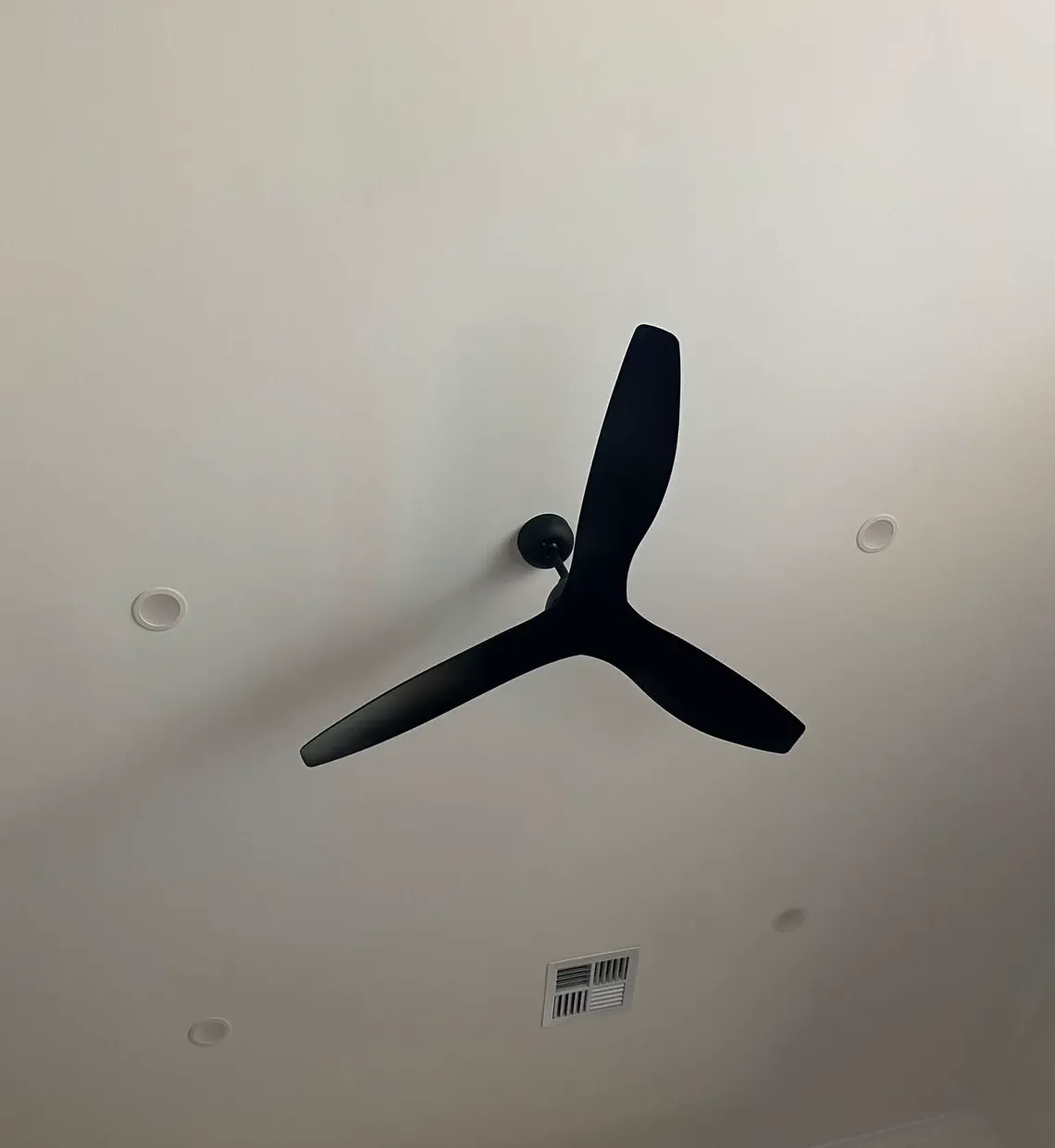
A ceiling fan costs little to run, keeps you cooler in summer and pushes warm air back down in winter. It also works well alongside air conditioning. We fix the fan to a ceiling joist or a timber brace, since plasterboard alone won't hold it, balance it so it doesn't wobble and check the blade height. If you're replacing a light with a fan, we can run a separate switch wire so you're not hunting for the remote every time.
When to get it checked
Bedrooms too warm to sleep in
The bedroom holds the day's heat, and running the air conditioner until morning feels like overkill. A fan on low keeps air moving across the bed quietly and costs little to run.
A fan that wobbles or ticks
The canopy shakes, the light glass rattles or there's a tick on every turn. It's usually balance or a loose fixing, and it only gets worse.
Controls that have given up
The pull cord has snapped, the remote is long gone or the fan is stuck on one speed. If the fan is old and noisy too, replace both.
Warm air stuck at the ceiling
In rooms with high or raked ceilings, the heating runs and the warmth collects up top while your feet stay cold. A fan in reverse brings it back down.
A renovation or a new patio
Extensions and covered alfresco areas are the easiest time to plan a fan, because the brace and cable go in before the ceiling is lined.
Why it happens
5 common causes
Hung from the plasterboard
Plasterboard isn't made to carry a spinning weight. A fan fixed to the sheet, or to the screws that held an old light, works loose and can pull through the ceiling.
Blades out of balance
A warped blade, a bent blade arm, a loose screw or a thick coat of dust is enough to start a wobble.
Mounts that have loosened
Every turn sends a little vibration into the bracket. Over the years that backs screws out and leaves the canopy crooked and rattling.
Worn motors and parts
Older AC motor fans rely on a capacitor for their speeds. When it weakens, the fan hums, starts slowly or loses a speed. Worn bearings grind, and no balancing fixes that.
The wrong control on the wall
An ordinary light dimmer is not a fan speed control, and a DC fan needs its own controller. Mismatched controls cause humming, a warm switch plate and fans that won't change speed.
What the job covers
What we usually do on this job. Your quote confirms it for your place.
- Fan position checked against joists and existing wiring
- Fan mounted to a joist or timber brace
- Blade height checked
- Separate switching for the fan and light where possible
- Wall controller or remote set up
- Fan balanced so it runs without wobbling
- Old light fitting removed and the ceiling opening tidied
- Fan tested on every speed and in reverse
Your options, explained
Fan on the existing light point, with a remote
Low disruption- Best for
- Bedrooms and living rooms where the light sits roughly central
- How it works
- The fan goes where the light was, and a receiver in the canopy takes speed, direction and light commands from a remote. The wall switch stays as the supply.
- Worth knowing
- Least disruptive, but the wall switch must stay on for the remote to work, and a lost remote means a stuck fan.
Fan and light on separate wall controls
Medium disruption- Best for
- Main bedrooms, family rooms and anyone tired of hunting for a remote
- How it works
- New cable runs from the ceiling down the wall cavity to a plate with a fan speed controller and a separate light switch.
- Worth knowing
- Simple in a single-storey home with roof access. Double brick, a second storey or a concrete ceiling makes the cable run harder.
New fan point on a lighting circuit
Medium disruption- Best for
- Rooms lit only by downlights, studies and extensions
- How it works
- Cable runs from a nearby lighting circuit to a braced point mid-room, with a new switch or controller.
- Worth knowing
- The fan goes where it works best. Altering a circuit can bring safety switch work at the board, which we explain when we quote.
Outdoor-rated patio fan
Medium disruption- Best for
- Verandahs, pergolas and covered alfresco areas
- How it works
- An outdoor or damp-rated fan is fixed to the patio framing, with weatherproof controls and protected cable.
- Worth knowing
- Indoor fans don't last outside, and the framing has to be solid enough to carry the fan.
The people behind the work
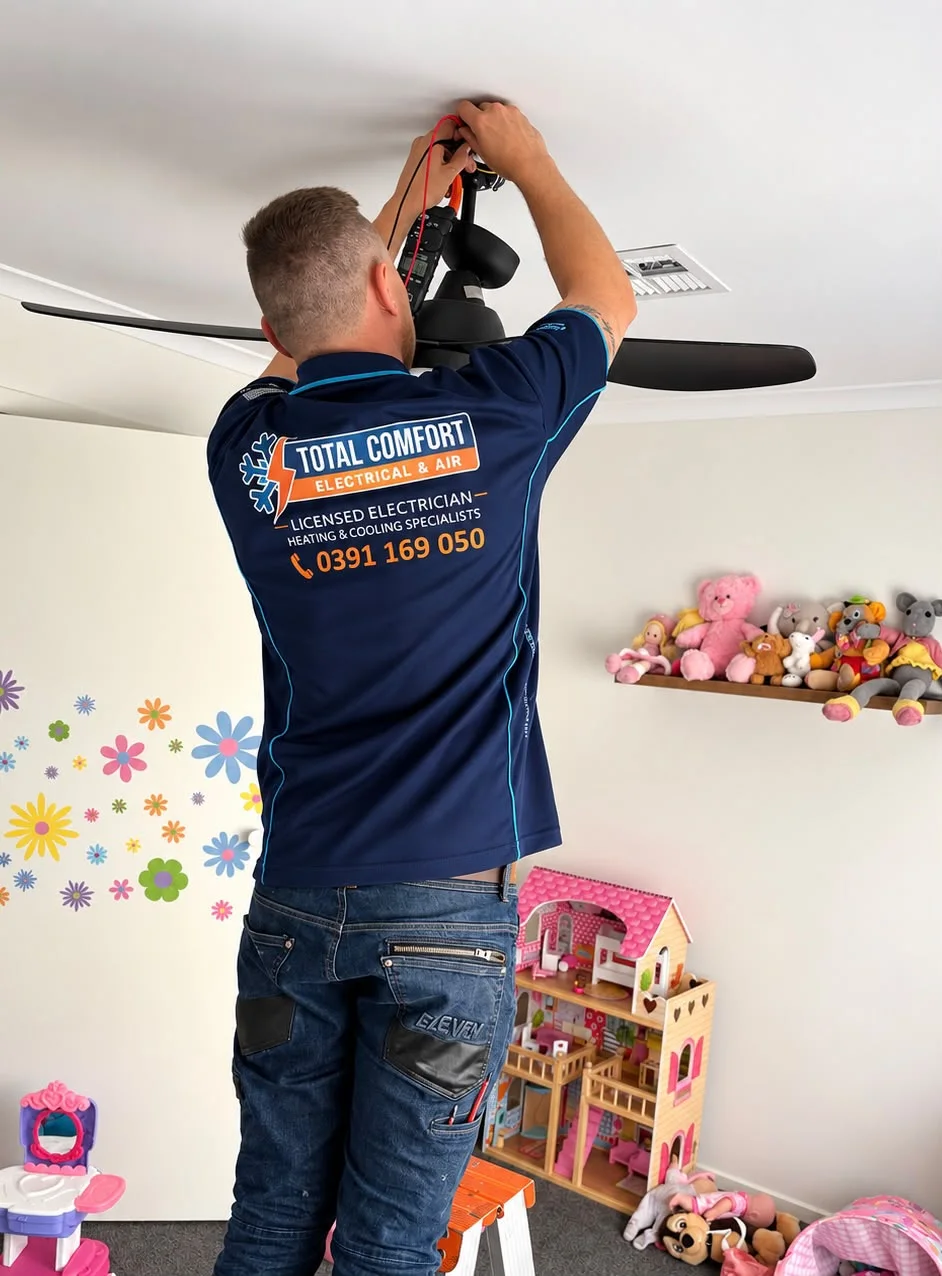
Our own photos from jobs like this one. Family-run, based in Altona Meadows, with 19 years in the industry.
Licensed electrical contractor (REC 38187)See more team photos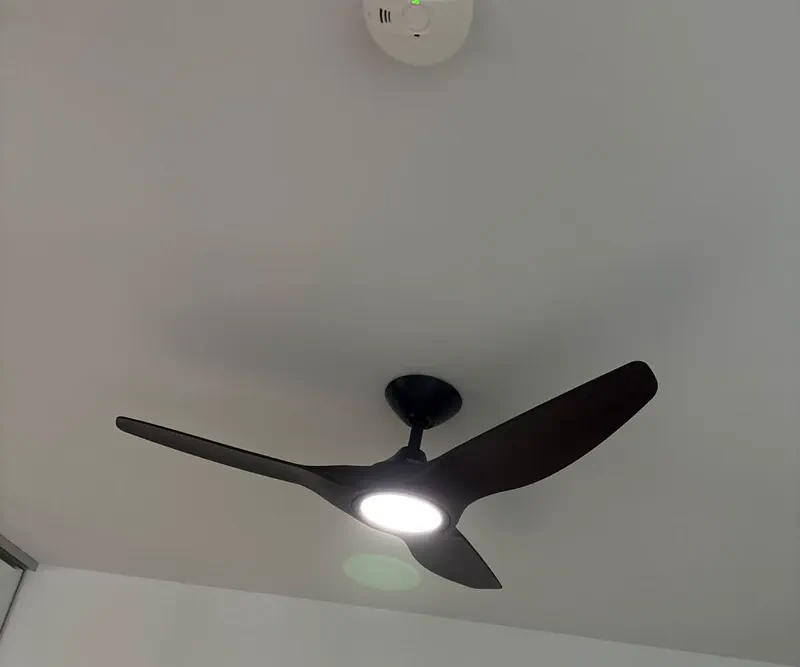
Worth knowing before you book
- Height matters
- Fan blades need to sit at least 2.1 metres above the floor. Rooms with low ceilings may need a close-mount fan.
- AC or DC motor
- DC motor fans are usually quieter, use less power and have more speed settings. AC motor fans are simpler and often cheaper to buy.
- Use it with the air con
- Running a fan with your split system or ducted system lets you set the thermostat a little higher and still feel comfortable.
What affects the price?
The right scope depends on your installation. These are the details we check so your quote is useful, with any additional work explained before it proceeds.
Existing point or a new one
An existing point is simpler than running cable to a new one, and swapping an old fan on a sound mount is simplest of all.
Getting into the roof
A roomy tiled roof is easy to work in. Low-pitched metal roofs, the space between storeys, raked ceilings and concrete apartment ceilings take more work to brace and cable.
How you want it switched
A remote on the existing switch needs no new cable. Separate wall controls need a run down to the switch, and the wall construction decides how easy that is.
The fan and its fittings
Some fans go together quickly and others arrive in dozens of parts. Extension rods, angled mounts for raked ceilings, light kits and outdoor models all change the work.
What we find at the point
Brittle old cable, no safety switch on the lighting circuit or a fitting screwed to nothing solid has to be sorted. We show you and agree it before going ahead.
Before the visit
- Send the fan model, ceiling height and a room photo.
- Check the planned fan position against wardrobes, doors and furniture.
- Choose a product suitable for the environment before purchase.
How it runs
- 1
Pick the fan
Tell us the room and the fan you like, or ask us what suits the space.
- 2
Check the ceiling
We find the joists and existing wiring and plan the switching.
- 3
Install and balance
Fan mounted, wired, balanced and tested on every setting.
Step by step, in more detail
5 steps
Talk through the room
We ask how you use the room and whether the fan needs a light. If you have picked one already, send us the model and we will check it suits the ceiling and the room.
Look above and below the ceiling
In the roof we find the joists, the cable and the insulation around the point. Below, we check blade height and clearance from doors, wardrobes, bunk beds and nearby lights.
Agree the scope and price
You get the price before we start, covering the mounting, the switching and anything we found that needs attention. It's a fixed price for the agreed scope.
Brace, mount and wire
With the circuit isolated, the old fitting comes out. If the point isn't beside a joist, a timber brace goes in so the bracket screws into solid timber. New cable runs to the switch if needed, then the fan is assembled and wired.
Balance, test and tidy
The fan runs on every speed, both directions and with the light on and off. We balance it until it runs steady, pair the remote, clean up and give you a Certificate of Electrical Safety.
What is safe to do, and what to leave to us
Safe for you to do
- If a fan wobbles hard, grinds or smells hot, switch it off at the wall and leave it off until it's checked.
- If the safety switch trips when the fan starts, reset it once. If it trips again, leave it off and call us.
- Switch the fan off and let the blades stop before dusting them or reaching near it.
- Keep the fan's box, manual and model number for us.
Leave these to us
- Wiring in a fan, controller or switch yourself. Energy Safe Victoria says electrical work isn't a DIY job, even for small jobs like changing light switches.
- Hanging a fan from the plasterboard or an old light fitting's screws.
- Using an ordinary light dimmer to slow a fan down.
- Running a fan with a cracked blade, a loose canopy or a bad wobble.
When to get us in
- A fan wobbles, rattles, hums or grinds
- The fan is stuck on one speed or the controls have failed
- You want a fan where the light is now, or where there's no point
- The safety switch trips or the lights flicker when the fan runs
- You're renovating and want fan points braced before the ceiling is lined
More detail
AC or DC motor
AC motor fans are the traditional design: simple, often cheaper to buy and run from a wall controller with a few fixed speeds. DC motor fans are usually quieter, use less power and have more speeds, with reverse on the remote. A DC fan must use its own remote or matched controller, so plan the switching around the fan you choose.
Size, height and where it hangs
Blade span should suit the room, and a long open-plan area may work better with two fans than one big one. Every fan's instructions set a minimum blade height, so a low ceiling may need a close-mount fan and a high one an extension rod. Keep downlights away from directly above the blades, or the light chopping through them makes a flicker.
Running a fan with the air conditioning
A fan doesn't cool the air. It moves air across your skin, which is why you feel cooler. The Victorian Government suggests setting cooling between 24 °C and 26 °C in living areas and says every degree lower adds around 10% to running costs. A fan on low makes the top of that range comfortable. Switch it off when you leave, since it only helps the people in the room.
Winter mode
Warm air rises, so on cold, still nights the heat gathers at the ceiling. July at Laverton has a mean minimum of 5.2 °C, and the heating works hard. Set the fan to reverse on its lowest speed and it eases the warm layer back down the walls without a breeze.
Older ceilings and older wiring
Putting a fan where an old light hangs means opening a point that may not have been touched in decades. The Hobsons Bay planning scheme traces Williamstown to the 1840s and Altona and Laverton to post-war growth, and Energy Safe Victoria says wiring should be checked in any house built more than 30 years ago. Brittle cable at the point gets replaced, not reused, and we show you before we do it.
Local rules and conditions
Victorian requirements and local conditions that shape this job, with the sources listed at the foot of the page.
Made for our hot days
The Laverton weather station averages 27.0 days a year at or above 30 °C and 9.4 at or above 35 °C, mostly between December and February. The Bureau of Meteorology notes warm northerly winds often arrive first, then a cold front can change things fast. A fan covers the warm evenings either side.
A working fan is part of a heat plan
Victoria's health department advises using air conditioning or a fan during extreme heat, and checking beforehand that both work. It lists people over 65, babies and young children among those most at risk, so sort the fan in a grandparent's room or a nursery before summer.
Rental cooling means more than a fan
From 1 March 2027, rental providers must install energy-efficient fixed cooling in the main living area when a new rental agreement starts, and all rentals need cooling from 1 July 2030. The definition names electric air conditioners and heat pumps that meet an efficiency rating. A ceiling fan isn't on that list, so it works alongside that cooling, not instead of it.
A certificate and a safety switch check
Every electrical installation job by a licensed electrician must come with a Certificate of Electrical Safety, and for non-prescribed work like lights you should get your copy within 30 days. The Wiring Rules also call for additional safety switch protection when an existing installation is altered.
Useful reading
Guides to read before you decide, with checklists and questions to bring to the quote.
- A room-by-room lighting plan that goes beyond more downlightsPlan task lighting, comfortable evening light and outdoor coverage around how each space is used.
- The electrical decisions to make before your renovation walls closePlan appliances, lighting, outlets and future upgrades while access and options are still available.
- What electrical work you can and can't do yourself in VictoriaWhere Victorian law draws the line on home electrical work, the short list of jobs that are yours, and what to do when a job goes past it.
- Getting your air conditioning ready for a heatwaveA spring test run, clean filters, a clear outdoor unit and a backup plan: how to find a tired air conditioner before the first hot northerly does.
Common questions
Questions people ask about this
- Why does my ceiling fan work but the light doesn't?If the fan runs but its light doesn't, the fault is on the light side: a failed globe or LED module, a light setting on the remote or wall control, or a loose connection…
- Why does my reverse-cycle heat the ceiling and leave my feet cold?Warm air rises, so a high-wall unit blowing gently forward can leave a warm layer at the ceiling and cool air at floor level.
From the blog
- Adding ceiling fans to an older home: what's involved?Yes, in most rooms. Roof access, a solid fixing to the joists, the switching you want and the cable route decide how simple it is in an older home.
- Can a ceiling fan make air conditioning more comfortable?Use fans as part of a room plan, with attention to the occupied area, sleeping preferences and the air conditioner's existing performance.
- How to look after exhaust fans and ceiling fansA few minutes of cleaning keeps exhaust and ceiling fans quiet and working. Here's what owners can do, the signs of wear, and when a fan needs repair or replacing.
Sources for the rules and local facts on this page
16 sources, with the date each was checked
- 1.Bureau of Meteorology: Mean number of days ≥ 30 °C 6.9 6.0 4.5 0.7 0.0 0.0 0.0 0.0 0.1 0.9 2.8 5.1 27.0 82 1943 2026 Mean number of days ≥ 35 °C 3.6 2.4 0.9 0.0 0.0 0.0 0.0 0.0 0.0 0.1 0.5 1.9 9.4 Accessed 30 September 2026.
- 2.Bureau of Meteorology (article issued 3 August 2026): To the north lies Australia's hot, dry interior, while to the south stretches the cold Southern Ocean. ... Warm northerly winds arrive first, bringing higher temperatures and clear skies. Then, as a cold front moves in… Accessed 30 September 2026.
- 3.Department of Health, Victoria (updated 3 February 2026): Use air conditioning or a fan, wear light and loose-fitting clothing, keep your skin wet (for example, with a spray bottle or damp sponge), and take cool showers or foot baths. ... People most at risk include those over… Accessed 30 September 2026.
- 4.Better Health Channel (Department of Health, Victoria): Check that your fan and air-conditioner works well. Have your air-conditioner serviced if needed. Ensure the filters, pads and air vents are clean. Accessed 30 September 2026.
- 5.Consumer Affairs Victoria: From 1 March 2027, rental providers must install an energy-efficient, fixed cooling system with an outlet in the main living area. This applies at the start of a new rental agreement. All rental properties must have… Accessed 30 September 2026.
- 6.Consumer Affairs Victoria: Definition: From 1 March 2027, energy efficient fixed cooling means: (a) a non-portable, non-ducted electric air conditioner or heat pump capable of cooling, with a GEMS 3-star or above cooling rating (for the climate… Accessed 30 September 2026.
- 7.Energy Safe Victoria: Whenever a licensed electrician completes any electrical installation work, they must provide a Certificate of Electrical Safety (COES). Accessed 30 September 2026.
- 8.Energy Safe Victoria: For electrical installation work performed within your electrical installation including but not limited to lights, power points, air conditioning, hot water service etc. Accessed 30 September 2026.
- 9.Energy Safe Victoria: Clause 2.6.3.2.5 of the Wiring Rules states: Additional protection by RCDs shall be provided in existing electrical installations where alterations or a switchboard replacement is completed. Accessed 30 September 2026.
- 10.Energy Safe Victoria: Gas and electricity are inherently dangerous and it’s illegal and potentially fatal for unlicensed and unqualified people to undertake any electrical or gasfitting work. Homeowners and consumers must always use… Accessed 30 September 2026.
- 11.Energy Safe Victoria: Electrical work isn’t a DIY job, even for small jobs such as changing power points or light switches. Accessed 30 September 2026.
- 12.Energy Safe Victoria: Locate your electricity box outside your home and check whether the safety switch has tripped. If it has tripped, reset the switch. If the switch won’t reset, call a licensed electrician. Accessed 30 September 2026.
- 13.Solar Victoria (updated 20 November 2025): To heat a room, try setting the temperature between 18°C to 20°C. Every 1°C higher will add around 10% to your heating bill. Set your air conditioner thermostat for cooling between 24°C and 26°C for living areas – every… Accessed 30 September 2026.
- 14.Victorian Government, Hobsons Bay Planning Scheme (PDF snapshot, last updated by VC292 on 11/09/2025): The heritage places of Hobsons Bay reflect the key themes that have shaped the development of the city since the establishment of Williamstown in the 1840s as the first port of Melbourne, through the development of… Accessed 30 September 2026.
- 15.Energy Safe Victoria: Old switchboards, particularly those without a safety switch Old power switches or power points, particularly broken ones Flickering lights Sparks from switchboards, switches or power points. If your house is over 30… Accessed 30 September 2026.
- 16.BlueScope, Technical Bulletin TB-35 Australian salt marine classifications (March 2026, Revision 9): Exposed Port Phillip Bay (Altona to Portsea Beaches) Calm Port Phillip Bay (Williamstown), Yarra River (Docklands and Melbourne CBD), Maribyrnong River Accessed 30 September 2026.