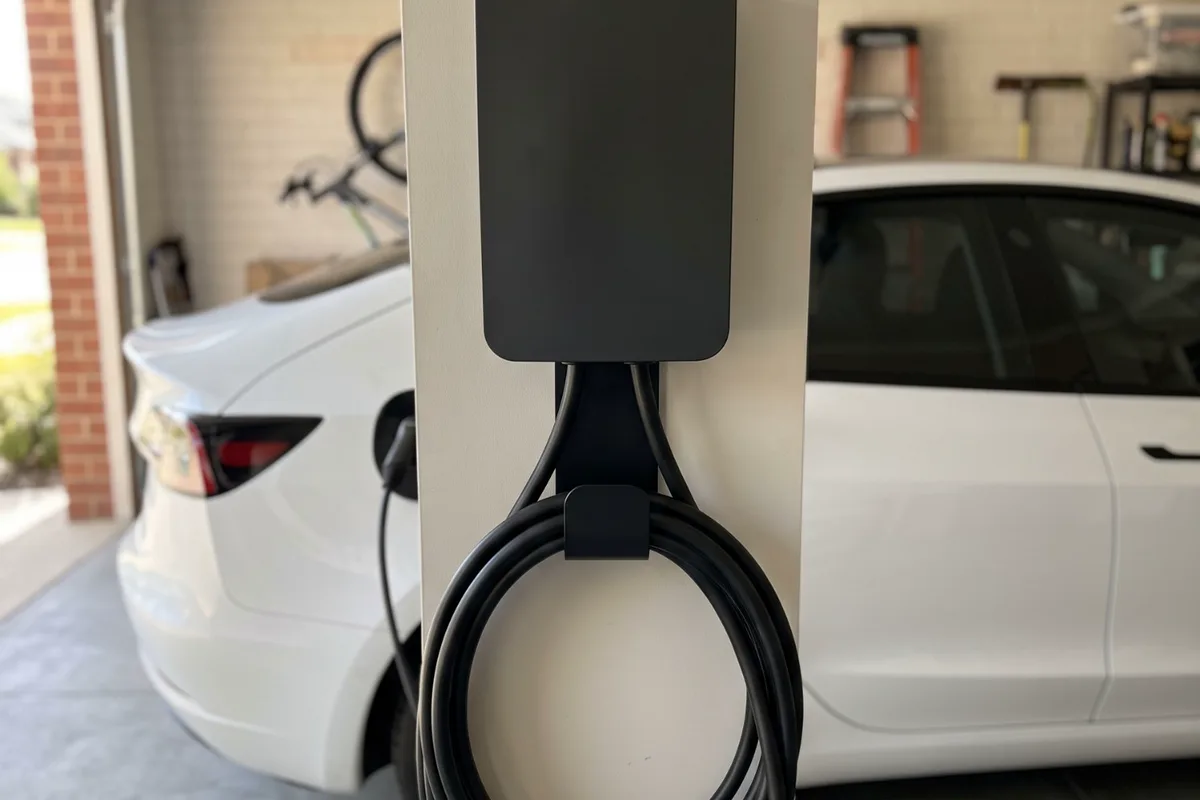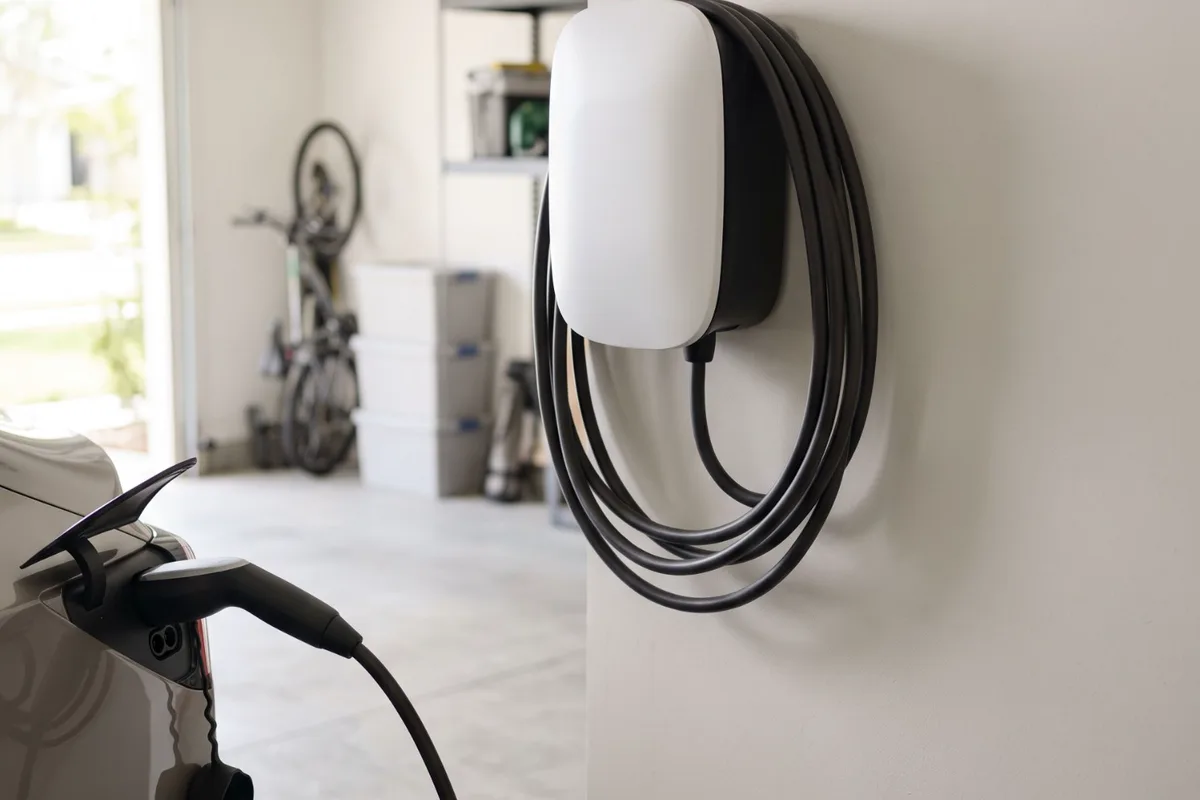
Charging from a normal power point with the portable lead works, but it's slow, and it asks that power point to run hard for hours every night. A wall charger on a dedicated circuit is faster and better suited to the job. Before quoting we look at your switchboard, how much capacity your supply has, where the car parks and how far the cable has to run. If you have solar, we can talk about chargers that use your surplus during the day.
When to get it checked
A new EV on order
The car is coming and you want a reliable way to charge it at home. It's easier to sort the charger before delivery than after.
The portable lead can't keep up
The car starts each morning with a little less range, because a normal power point can't put back a full day's driving overnight. A longer commute or a second driver makes it worse.
A power point that's warm or marked
The outlet the lead plugs into smells hot, or the plug face is turning brown. That connection is struggling under hours of steady load and needs checking before the next charge.
Trips partway through a charge
A breaker or safety switch drops while the car is charging, often in the early evening with cooking and heating on too. The circuit or the supply is at its limit.
Parking a long way from the board
The car lives in a carport, a detached garage or at the far end of the driveway, with no suitable outlet nearby. The cable route becomes the main part of the job.
Why it happens
5 common causes
Power points aren't built for all-night loads
A standard power point handles a kettle for a few minutes, not a car for hours on end. Worn contacts, loose terminals and tired wiring heat up under that steady load, and the plug face is usually where it shows first.
Connections set up before anyone owned an EV
Older homes can have a small single-phase supply, and the wire between the pole and the switchboard may not have room for a charger on top of everything else. That's where load management earns its place.
Everything on at once in the evening
Oven, heating or air conditioning, hot water and a charger can all land on the supply when everyone gets home. Without load management, that's when main switches and breakers give out.
Charger, car and supply not matched
A charger only delivers what the car's onboard charger will accept and what the supply can give. A bigger number on the box won't charge any faster if the car or the connection can't use it.
Protection paired wrongly with the charger
Under some faults a charger can leak a small DC current that some safety switch types don't handle well. Many chargers have DC detection built in; others need a particular safety switch type, and a wrong pairing means nuisance trips or weaker protection.
What the job covers
What we usually do on this job. Your quote confirms it for your place.
- Switchboard and supply capacity checked
- Charger mounted where the cable reaches the car's charge port
- Dedicated circuit run from the switchboard
- Safety switch protection suited to EV charging
- Cable run through the roof, walls or conduit and kept neat
- Load management set up where the supply is tight
- Charger connected to Wi-Fi or its app if it has one
- Charger tested with your car
- Scheduled charging and other settings explained
Your options, explained
Portable lead on an existing power point
Low disruption- Best for
- Plug-in hybrids and short daily drives
- How it works
- The lead that came with the car plugs into a wall outlet. We check the outlet and the wiring behind it will cope with long, steady charging.
- Worth knowing
- The slowest option, and only as sound as the power point it relies on.
Dedicated outlet for the portable lead
Low disruption- Best for
- Light use where a wall charger isn't needed yet
- How it works
- A heavy-duty weatherproof outlet on its own circuit where the car parks, so charging doesn't share a circuit with the fridge or garage tools.
- Worth knowing
- A smaller job than a wall charger, but still a slow charge.
Single-phase wall charger
Medium disruption- Best for
- Most houses and regular daily driving
- How it works
- A fixed charger on its own circuit, usually in the 7 kW class, and the usual choice for a single-phase home.
- Worth knowing
- With load management, it can share a modest supply with the house.
Three-phase wall charger
Medium disruption- Best for
- Homes with three-phase power, or a good case for upgrading to it, and cars that can use it
- How it works
- A higher-capacity charger on a three-phase supply. It only charges faster if your car's onboard charger can accept the extra power.
- Worth knowing
- Check the car's AC charging limit first. Plenty of cars can't take the full output.
The people behind the work
One local team for electrical, heating and cooling. Family-run, based in Altona Meadows, with 19 years in the industry.
Licensed electrical contractor (REC 38187)See more team photos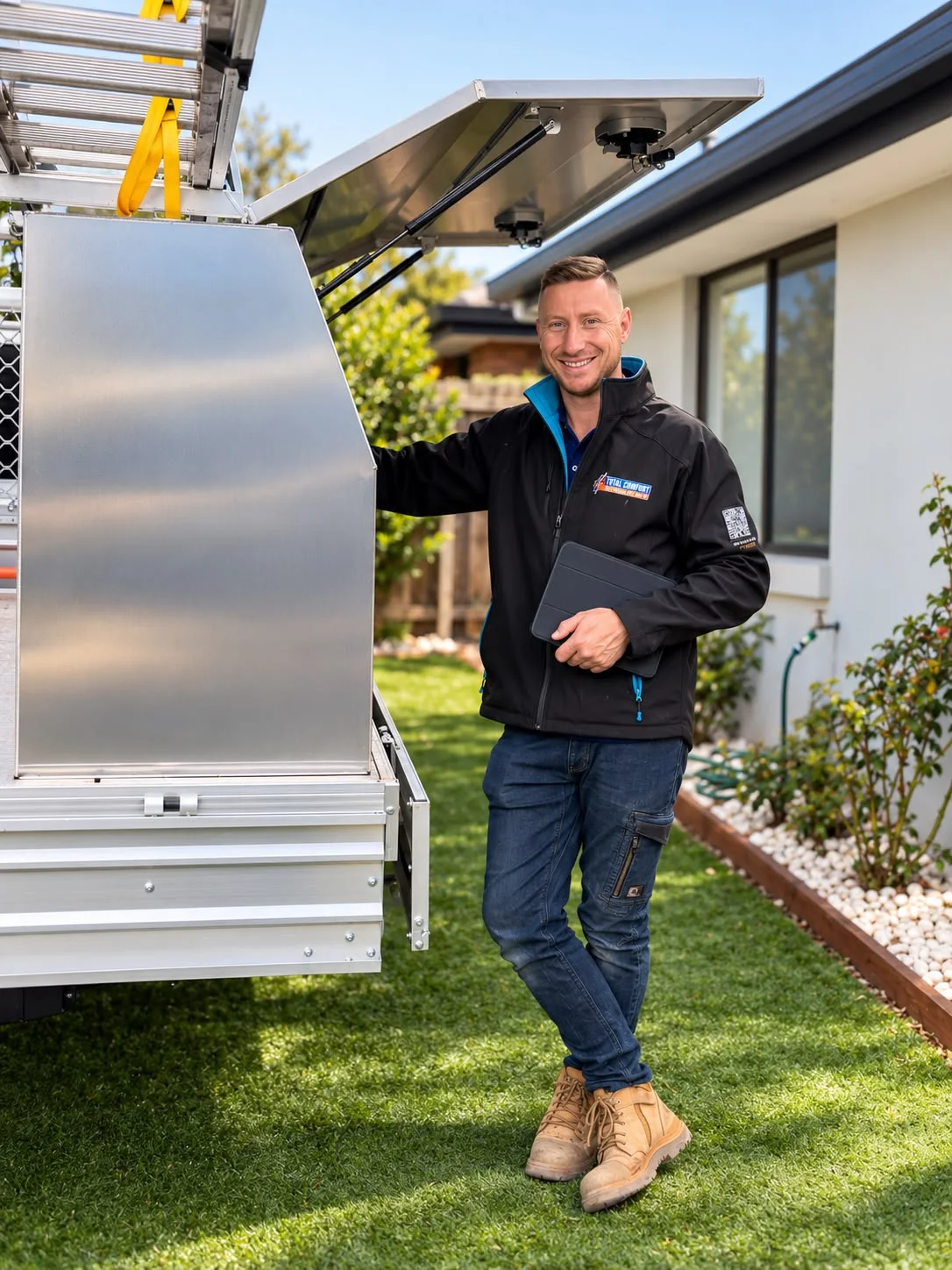
Worth knowing before you book
- Single phase or three phase
- Most homes have single phase power, which suits a 7 kW charger. Faster home chargers need three phase. We'll tell you what your supply can handle, and whether a move to three phase makes sense.
- Your switchboard matters
- If the board is old or full, it may need upgrading before a charger can go in. Better to find that out when we quote than on install day.
- Already bought a charger?
- Send us the make and model before we book. Different chargers have different requirements, and we'd rather check them before we arrive.
What affects the price?
The right scope depends on your installation. These are the details we check so your quote is useful, with any additional work explained before it proceeds.
Distance and route
A charger on the garage wall behind the board is a short run. A detached garage, a carport across the yard or finished walls in a double-storey home mean more cable and time.
Trenching and hard surfaces
Underground runs go in conduit, and getting past concrete, pavers and garden beds takes planning. Who reinstates the surface is agreed at quote time.
Switchboard space and supply
A board with a spare position and modern protection takes a new circuit easily. A full board, old fuses or a tight supply add work, which is priced as its own line so you can see it.
The charger and its mounting
Supplying a unit or fitting one you already own, tethered lead or socket, wall or pedestal mount, single or three phase: each one changes the scope.
Load management, Wi-Fi and solar
A load management sensor, a data cable to a garage beyond Wi-Fi range or an extra meter for solar charging all add parts and set-up. We confirm what your charger actually needs.
Before the visit
- Send the car model, expected parking position and charger preference.
- Include safe switchboard photos and a sketch of the cable route.
- Describe solar, battery equipment and other planned electric upgrades.
How it runs
- 1
Send some photos
The switchboard, where the car parks and the charger you have in mind.
- 2
Check and quote
We work out the cable run, supply capacity and any switchboard work, then give you an upfront price.
- 3
Install
Circuit run, charger mounted and connected, load management set up if needed.
- 4
Test with the car
We run a charge with your car and show you how to use the settings.
Step by step, in more detail
5 steps
Tell us about the car and the house
Send the car model, where it parks, a photo of the switchboard front and any charger you have in mind. Mention solar, a battery or other electric upgrades, because they all share the same supply.
Check the site and set the charge rate
We look at the board, main switch, incoming supply and the path to the parking spot, then add up what the house already runs. If the supply is tight, we set up load management before talking about a bigger connection.
Fixed price for the agreed scope
You get the price before we start, with the charger, cable route, protection, mounting and any load management set out. Exclusions such as paving or plaster repairs are listed up front.
Install the circuit and charger
A dedicated circuit goes in from the board with its own protection, the cable is run and fixed neatly, and the charger is mounted where the lead reaches the charge port without crossing the driveway.
Test with your car and hand over
We test the circuit, connect the charger to Wi-Fi or its app if it has one, run a charge with your car and show you the scheduling settings. You get a Certificate of Electrical Safety for the work.
What is safe to do, and what to leave to us
Safe for you to do
- Plug the car's portable lead straight into a wall power point in good condition.
- If the plug or outlet smells hot or looks scorched, stop the charge from the car or its app and leave it unplugged until it's checked.
- Reset a tripped safety switch once. If it won't reset or trips again, leave it off and call a licensed electrician.
- Schedule charging to start later if breakers trip around dinner time.
Leave these to us
- Charging through a power board, double adaptor or extension lead.
- Feeding the lead through a window or under a door where it gets pinched or wet.
- Using a lead with a cut cable, cracked plug or burnt pins.
- Wiring a charger or changing breakers yourself. Energy Safe Victoria says unlicensed electrical work is illegal and potentially fatal.
When to get us in
- Before you order the car or buy a charger
- When the outlet you charge from is warm, marked or loose
- When a breaker or safety switch trips during charging
- When you're adding solar, a battery or more electric appliances
- When you're building or renovating, before the walls are closed in
More detail
What the kilowatt rating means on your driveway
A charger's rating is the most it can deliver, not what your car will take. The car's onboard charger sets the ceiling for AC charging, and your supply and any load management set the rest. So the real question isn't the biggest charger on the market, but the right rate for your car, your supply and the hours it sits in the driveway.
Load management, in plain terms
A sensor on the incoming supply measures what the whole house is drawing. When the oven, heating and hot water are all on, the charger backs off, then picks up again as the load drops. On a modest supply it's often what makes a wall charger workable without touching the connection. Ask what the charger does if the sensor or Wi-Fi drops out.
Solar, schedules and apps
Some chargers can follow your solar and charge from power the house isn't using. That depends on the charger, the inverter and sometimes an extra meter, so bring the model numbers of both. Scheduling is simpler: most cars and chargers can start at a set time to suit your electricity plan. Check whether a feature needs an app, the internet or a subscription before relying on it.
Protection and paperwork
Energy Safe Victoria guidance says the Wiring Rules require every final sub-circuit in a home to have RCD protection, and Type AC safety switches can't be installed any more, even like for like. A licensed electrician must give you a Certificate of Electrical Safety for any electrical installation work. If the job also needs the main switchboard replaced or the consumer mains upgraded, that part is prescribed work and is inspected by a licensed electrical inspector.
Local rules and conditions
Victorian requirements and local conditions that shape this job, with the sources listed at the foot of the page.
Which network supplies you
Laverton, Altona Meadows, Point Cook, Hoppers Crossing, Tarneit, Werribee and Wyndham Vale are supplied by Powercor through Altona Terminal Station (West). Jemena's supply area reaches Williamstown and Footscray, and parts of Port Melbourne are on CitiPower. Whichever network you're on, we check your supply and switchboard before setting a charge rate.
Hot days and outdoor chargers
The Laverton weather station averages 27.0 days a year at or above 30 °C and 9.4 at or above 35 °C, mostly December to February. Many chargers slow down when they run hot, so where the lead allows, we mount them out of the afternoon sun.
Narrow blocks and shared parking
In 2021, 56.2% of Williamstown's occupied dwellings were separate houses, against 73.4% across Victoria, and Yarraville's heritage precinct is mostly small houses on narrow blocks. Where the car parks on the street, down a rear lane or in a shared car park, home charging takes more planning.
Useful reading
Guides to read before you decide, with checklists and questions to bring to the quote.
- Home EV charging: a checklist before ordering a chargerMatch daily driving and parking to the supply, cable route and charger features that matter.
- Planning a switchboard upgrade without surprisesWhat the electrician needs to check, how to compare the scope and what to organise before the power goes off.
- Going all-electric in a Melbourne homeHot water, heating and cooking don't have to go electric at once. How to stage the move off gas, check the switchboard once and time each step.
- Certificates of Electrical Safety explainedWhat a Victorian COES records, how prescribed and non-prescribed work differ, when your copy should arrive and why it belongs in your house file.
Common questions
Questions people ask about this
More in the Help centreFrom the blog
- Can one house charge two electric cars?Most homes can charge two EVs, because few cars need a full charge every night. Sharing, scheduling, load management and, for some homes, three-phase make it work.
- Can renters install an EV charger?Yes, with the rental provider's written consent and a licensed electrician. Here's how to ask, who might pay, and how to charge safely in the meantime.
- Installing an EV charger in an apartment or townhouseOwners corporation approval, which meter the charger runs from, the cable route through common property and the building's supply all need settling first.
Sources for the rules and local facts on this page
13 sources, with the date each was checked
- 1.Powercor Australia, Project Assessment Draft Report: Altona Terminal Station (West) (June 2025): It supplies part of Melbourne’s western growth corridor. This includes the areas of Laverton, Laverton North, Altona Meadows, Werribee, Wyndham Vale, Mount Cottrell, Eynesbury, Tarneit, Hoppers Crossing and Point Cook… Accessed 30 September 2026.
- 2.Jemena Electricity Networks (Vic) Ltd, 2025 Distribution Annual Planning Report (2 December 2025): Figure 1-1 shows the JEN supply area, which ranges from Gisborne South, Clarkefield and Mickleham in the north to Williamstown and Footscray in the south, and from Hillside, Sydenham and Brooklyn in the west to… Accessed 30 September 2026.
- 3.CitiPower, Distribution Annual Planning Report December 2024 (hosted by the Australian Energy Regulator): The zone substation in Fisherman’s Bend (E) is served by two sub-transmission lines from Fisherman Bend Terminal station (FBTS). The zone substation supplies areas of Fisherman’s Bend and Port Melbourne. Accessed 30 September 2026.
- 4.Bureau of Meteorology: Mean number of days ≥ 30 °C 6.9 6.0 4.5 0.7 0.0 0.0 0.0 0.0 0.1 0.9 2.8 5.1 27.0 82 1943 2026 Mean number of days ≥ 35 °C 3.6 2.4 0.9 0.0 0.0 0.0 0.0 0.0 0.0 0.1 0.5 1.9 9.4 Accessed 30 September 2026.
- 5.Australian Bureau of Statistics, 2021 Census QuickStats: Separate house 3,070 56.2 1,755,423 73.4 Accessed 30 September 2026.
- 6.Victorian Heritage Database (Heritage Council Victoria); entry maintained by Maribyrnong City Council: The general character of the Yarraville Residential Precinct is that of small Victorian & Edwardian single-storey detached housing with mainly weatherboard and some brick wall cladding, corrugated iron roofing, front… Accessed 30 September 2026.
- 7.Energy Safe Victoria: Clause 2.6.3.2.2 requires all final sub-circuits in a domestic installation be protected by a residual current device (RCD). A hot water service is included in this requirement Accessed 30 September 2026.
- 8.Energy Safe Victoria: Type AC RCDs must not be installed in Australia. This includes like for like replacement. We recommend that electrical contractors advise customers of the new requirements. However, it is not mandatory to replace… Accessed 30 September 2026.
- 9.Energy Safe Victoria: Whenever a licensed electrician completes any electrical installation work, they must provide a Certificate of Electrical Safety (COES). Accessed 30 September 2026.
- 10.Energy Safe Victoria: 'Prescribed' certificates are for electrical installation work that requires inspection by a Licensed Electrical inspector. This includes (but is not limited to): Consumer mains cables, main switchboard, meter box and… Accessed 30 September 2026.
- 11.Energy Safe Victoria: The electrician has eight business days after the work is completed to have that work inspected by a licensed electrical inspector (LEI). If an electrician replaces a main switchboard at a property, power cannot go back… Accessed 30 September 2026.
- 12.Energy Safe Victoria: Gas and electricity are inherently dangerous and it’s illegal and potentially fatal for unlicensed and unqualified people to undertake any electrical or gasfitting work. Homeowners and consumers must always use… Accessed 30 September 2026.
- 13.Energy Safe Victoria: Locate your electricity box outside your home and check whether the safety switch has tripped. If it has tripped, reset the switch. If the switch won’t reset, call a licensed electrician. Accessed 30 September 2026.