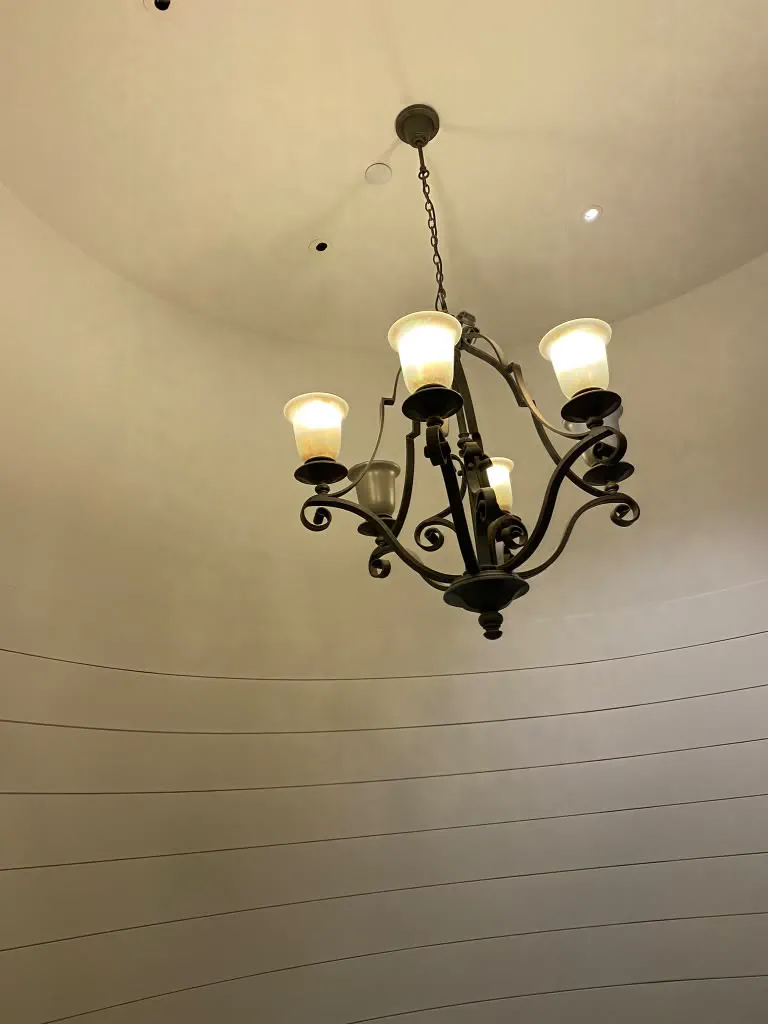
A pendant needs to line up with the furniture or benchtop below it, which is not always the centre of the ceiling. We discuss the table position, cabinetry, sightlines and the fitting’s weight before marking the point. Some lights need additional support or a new cable route. If you are renovating, getting these details settled before plastering gives you more freedom and a cleaner finish.
When to get it checked
The light misses the table
The point sits in the middle of the ceiling, but the table or island doesn't. The pendant hangs over a walkway or a chair back.
A fitting heavier than a standard light
You've picked a glass cluster, a chandelier or a long linear pendant, and its instructions call for more support than plaster gives.
Glare at the table or a dim bench
The light hangs so high the bench stays in shadow, or so low it shines into your eyes when you sit down.
A tired rose and brittle cord
The ceiling rose is cracked or yellowed, or the cord is stiff and discoloured. Old cable can crumble when disturbed.
The ceiling is open for a renovation
The kitchen or dining area is being rebuilt. It's the easiest time to put points and support exactly where they belong.
Why it happens
4 common causes
Rooms get rearranged
Many homes were built with one light in the centre of each room. Walls come out, kitchens gain islands and tables move, but the light point stays put.
Fittings are bigger and heavier
Glass, metal and concrete shades, multi-drop clusters and linear fittings weigh far more than an old batten and shade. Plasterboard isn't made to carry them.
The framing doesn't line up
Ceiling joists run one way, and the ideal spot over the table often lands between two of them. A timber noggin or bracket gives the fitting something solid to hang from.
Controls chosen for old globes
A dimmer fitted years ago for incandescent globes may not suit an LED pendant's driver. The result is flicker, buzzing or dimming that jumps instead of fading.
What the job covers
What we usually do on this job. Your quote confirms it for your place.
- Position checked against the table or benchtop
- Fitting weight and mounting instructions reviewed
- Ceiling support assessed
- Cable route and switch location agreed
- Drop height confirmed before final fitting
- Dimming compatibility checked if required
- Electrical connection and safety testing
- Packaging and work area tidied
Your options, explained
Replace at the same point
Low disruption- Best for
- A light that already sits over the table or bench
- How it works
- The old fitting comes down, the support above is checked, and the new pendant goes up in the same spot.
- Worth knowing
- The new canopy has to cover the old hole. A heavier fitting may still need a bracket.
Move or add a light point
Medium disruption- Best for
- A table or island that isn't under the existing light
- How it works
- A new point is cut in where the furniture needs it, cable runs through the ceiling space, and the old point is safely closed off.
- Worth knowing
- The abandoned hole needs patching and painting. Agree who does it before work starts.
Several pendants or one linear fitting
Medium disruption- Best for
- Long islands and rectangular dining tables
- How it works
- Two or three points are set out along the bench, or one feed supplies a linear fitting hung from two suspension points.
- Worth knowing
- The dimmer has to handle the combined load of every drop.
Point and support at rough-in
Low disruption- Best for
- Renovations and new builds with the ceiling open
- How it works
- Cable, blocking and a fixing point go in before the plaster, set out from the kitchen and furniture plans.
- Worth knowing
- The fitting can come later, but know roughly its weight so the support suits.
The people behind the work
Our own photos from jobs like this one. Family-run, based in Altona Meadows, with 19 years in the industry.
Licensed electrical contractor (REC 38187)See more team photos
Worth knowing before you book
- Have the furniture plan ready
- A table that moves later can leave the pendant in the wrong position. Mark your intended layout before the visit.
- Heavy fittings need support
- Plaster alone is not a mounting solution for every fitting. Send the product weight and installation instructions with your enquiry.
- Decoration may be a separate step
- Moving an existing light point may leave a hole to patch and paint. Ask for the electrical and finishing scope to be clear in the quote.
What affects the price?
The right scope depends on your installation. These are the details we check so your quote is useful, with any additional work explained before it proceeds.
The fitting itself
Weight, the number of drops, glass parts and assembly all add time. A single shade is quicker than a cluster with a dozen cords to set.
Ceiling height and access
Stairwell voids and raked or double-height ceilings need platform ladders or scaffold. A tight roof space or a storey above slows cabling.
Support work
Fixing to a nearby joist is simple. Adding a noggin or bracket, or working through an old plaster ceiling, takes longer.
Moving, adding or switching
A new point, switch position or dimmer adds cable and parts. The old point then needs patching and painting, by us or your painter, and the quote says which.
Bringing the circuit up to date
Altering a lighting circuit can bring safety switch work at the board. Brittle old cable found at the rose is quoted separately.
Before the visit
- Send the product link and installation instructions.
- Place or mark the furniture in its final position.
- Decide who will patch and paint any abandoned light point.
How it runs
- 1
Share the fitting
Send a product link, weight and photo of the room.
- 2
Set the position
We agree alignment, hanging height and switching.
- 3
Install and support
The fitting is securely mounted, connected and tested.
- 4
Final adjustment
Check the drop and dimming with the room in use.
Step by step, in more detail
5 steps
Look at the fitting first
Send the product link, weight and installation sheet. We check the canopy size, fixing method and whether it can be dimmed.
Set the position with the furniture in place
We measure from the table or bench, not the ceiling. For a row of pendants we space them along the island and agree a drop with you.
Find support and a cable route
Where there's roof access we locate the joists and plan the fixing. We trace the lighting circuit, agree the switch position and check its safety switch protection.
Install, connect and level
The bracket or noggin goes in, the fitting is connected and hung, and the drop is set. Linear fittings are levelled across both suspension points.
Test and hand over
We test the circuit and run the dimmer through its range. You get a Certificate of Electrical Safety for the work.
What is safe to do, and what to leave to us
Safe for you to do
- Send the product link, weight and installation sheet with your enquiry.
- Place or mark the table and island seating in their final positions before the visit.
- Turn a pendant off at the wall and leave it off if it buzzes, flickers or feels hot.
Leave these to us
- Taking down the old light or connecting the new one yourself. Energy Safe Victoria says electrical work isn't a DIY job, even small jobs like changing light switches.
- Hanging a heavy fitting from plasterboard alone, or letting the cord carry its weight.
- Putting a non-dimmable fitting on a dimmer.
- Standing on chairs or benchtops to reach a high fitting.
When to get us in
- You've bought a pendant or chandelier and want it fitted
- The light point doesn't line up with the table or island
- A fitting is heavy or comes with mounting instructions
- You're renovating and the ceiling is about to be plastered
- A pendant flickers, buzzes, sags, or has a cracked rose or brittle cord
More detail
Getting the height right
There's no single right drop. Over a dining table the shade should light the table, not the faces around it, and people should still see each other across it. Over an island it also has to clear heads. We follow the manufacturer's instructions, then mark the proposed height so you can judge it with the room in use.
Dimming and separate control
Pendants are often the lights you most want to turn down. The fitting's driver and the dimmer have to suit each other, or you get flicker and hum. Switching the pendants apart from the downlights lets you light the table without lighting the whole room.
Old ceilings, raked ceilings and apartments
A decorative plaster rose in an older home can crack if a heavy fitting is fixed straight to it. Raked ceilings need a sloped-ceiling adaptor so the drop hangs true. Apartment ceilings are often concrete, which limits where a point can move, so a swag hook can sometimes carry the light across to the table instead.
Local rules and conditions
Victorian requirements and local conditions that shape this job, with the sources listed at the foot of the page.
Period cottages in Yarraville and Seddon
Yarraville and Seddon's residential precincts are mostly small single-storey Victorian and Edwardian houses under iron or terracotta tile roofs. In homes like these, a moved pendant point is usually cabled from the roof space. Energy Safe Victoria says wiring should be checked in any house built more than 30 years ago.
Building in Wyndham's growth areas
Wyndham has new housing developments planned in Truganina, Tarneit, Wyndham Vale and Manor Lakes. If you're building there, settle the island and table positions before the ceiling is plastered, while cable and blocking are easy to add.
Moving a point and safety switches
Energy Safe Victoria notes that the Wiring Rules call for additional RCD protection in existing installations where alterations are made. If the lighting circuit you're changing has no safety switch, we explain what's needed before you approve the quote.
Useful reading
Guides to read before you decide, with checklists and questions to bring to the quote.
- A room-by-room lighting plan that goes beyond more downlightsPlan task lighting, comfortable evening light and outdoor coverage around how each space is used.
- The electrical decisions to make before your renovation walls closePlan appliances, lighting, outlets and future upgrades while access and options are still available.
- What electrical work you can and can't do yourself in VictoriaWhere Victorian law draws the line on home electrical work, the short list of jobs that are yours, and what to do when a job goes past it.
- Certificates of Electrical Safety explainedWhat a Victorian COES records, how prescribed and non-prescribed work differ, when your copy should arrive and why it belongs in your house file.
Common questions
From the blog
Sources for the rules and local facts on this page
8 sources, with the date each was checked
- 1.Victorian Heritage Database (Heritage Council Victoria); entry maintained by Maribyrnong City Council: The general character of the Yarraville Residential Precinct is that of small Victorian & Edwardian single-storey detached housing with mainly weatherboard and some brick wall cladding, corrugated iron roofing, front… Accessed 30 September 2026.
- 2.Victorian Heritage Database (Heritage Council Victoria); entry maintained by Maribyrnong City Council: The general character of the Seddon Residential and Commercial Precinct is of small Edwardian and Victorian period single-storey detached and some attached housing, with a dominance of weatherboard walling and… Accessed 30 September 2026.
- 3.Energy Safe Victoria: Old switchboards, particularly those without a safety switch Old power switches or power points, particularly broken ones Flickering lights Sparks from switchboards, switches or power points. If your house is over 30… Accessed 30 September 2026.
- 4.Victorian Electoral Commission (2023 electoral structure review fact sheet): New housing developments are planned in residential growth areas including Truganina, Tarneit, Wyndham Vale and Manor Lakes, as well as near activity centres and public transport. Accessed 30 September 2026.
- 5.Energy Safe Victoria: Clause 2.6.3.2.5 of the Wiring Rules states: Additional protection by RCDs shall be provided in existing electrical installations where alterations or a switchboard replacement is completed. Accessed 30 September 2026.
- 6.Energy Safe Victoria: Whenever a licensed electrician completes any electrical installation work, they must provide a Certificate of Electrical Safety (COES). Accessed 30 September 2026.
- 7.Energy Safe Victoria: Gas and electricity are inherently dangerous and it’s illegal and potentially fatal for unlicensed and unqualified people to undertake any electrical or gasfitting work. Homeowners and consumers must always use… Accessed 30 September 2026.
- 8.Energy Safe Victoria: Electrical work isn’t a DIY job, even for small jobs such as changing power points or light switches. Accessed 30 September 2026.