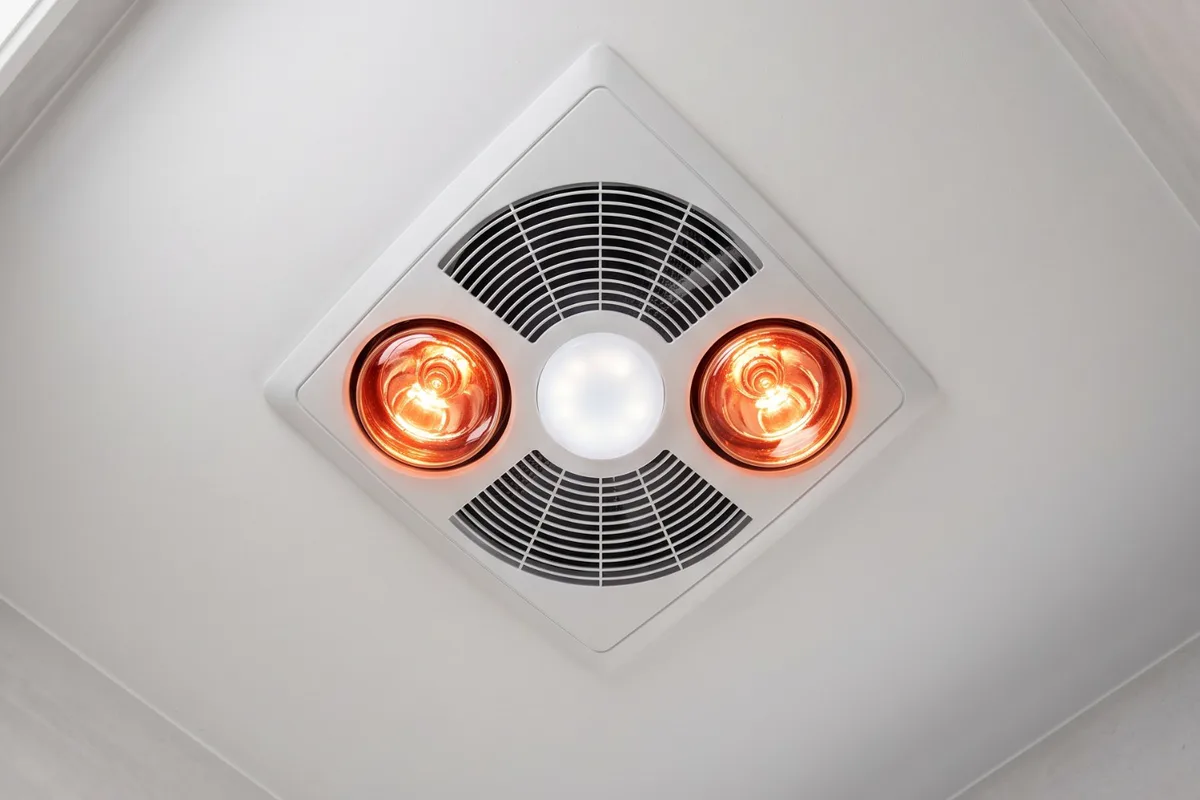
Heat lamp and 3-in-1 units are a heavy load in a wet room, so the circuit and switching matter as much as the unit. We check the bathroom's wiring, fix the unit between the joists, wire heat, light and fan separately and duct the fan outside. Then we test each function and certify the work.
When to get it checked
Stepping out of the shower into the cold
The bathroom never warms up on winter mornings, and a portable heater on the floor of a wet room is not the answer.
An old unit that's lost a function
The lamps work but the fan doesn't, or the fan rattles and the light flickers. Older units often fail one part at a time.
Lamps that blow early or a hot smell
Lamps failing early, a hot smell or brown marks on the fascia suggest heat or connection problems inside the unit.
Mould and a mirror that won't clear
Steam hangs around long after the shower because the fan is weak, vents into the roof or switches off with the light.
A bathroom renovation coming up
A new bathroom is the easiest time to choose the unit, set its position and run the switching it needs.
Why it happens
4 common causes
Heaters are a heavy load
Each heat lamp draws far more power than a light globe, and a four-lamp unit adds up quickly. On a shared lighting circuit, that can mean tripping or overheated connections.
Years of heat and steam
Heat dries out plastic fascias and lampholders, while steam works on the fan motor and terminals. The unit wears from both sides.
Fans vented into the roof
Plenty of older units blow straight into the roof space, where the moisture settles on timber and insulation instead of leaving the house.
Switching that doesn't suit
With everything on one switch, or the fan tied to the light, the heat runs when you only wanted light and the fan stops as you walk out.
What the job covers
What we usually do on this job. Your quote confirms it for your place.
- Bathroom, ceiling and roof access checked
- Circuit capacity and safety switch protection checked
- Unit chosen to suit the room and the opening
- Old unit removed and the opening tidied
- New unit fixed between joists with its clearances
- Heat, light and fan wired to separate switches
- Fan ducted to an outside vent
- Run-on timer for the fan if wanted
- Each function tested and a certificate issued
Your options, explained
Like-for-like 3-in-1 replacement
Low disruption- Best for
- Bathrooms with a unit that's tired or failing
- How it works
- The old unit comes out and a new one goes into the same opening, using the existing switching where it suits.
- Worth knowing
- Cut-out sizes vary between brands, so we measure first. A slightly larger fascia can cover the old opening.
3-in-1 with heat lamps
Medium disruption- Best for
- Quick, direct warmth while you're in the room
- How it works
- Infrared lamps warm you directly as soon as they're on, alongside a light and an exhaust fan.
- Worth knowing
- The heaviest load of the options, so the circuit matters. Lamps are replaced as they blow.
3-in-1 with a fan heater
Medium disruption- Best for
- Warming the room itself, without the red glow
- How it works
- A fan-forced heater warms the air, with a separate light and exhaust fan in the same unit.
- Worth knowing
- Spreads warmth through the room more evenly, but takes a little longer to feel than lamps.
Separate heater and exhaust fan
Medium disruption- Best for
- Larger bathrooms, or where one unit can't sit in the right spot
- How it works
- A ceiling heater goes over where you dry off and an exhaust fan goes near the shower, each on its own switch.
- Worth knowing
- Two openings and more switching, but each part works where it's most useful and can be replaced on its own.
The people behind the work
One local team for electrical, heating and cooling, based in Altona Meadows, with 19 years in the industry.
Licensed electrical contractor (REC 38187)See more team photos
Worth knowing before you book
- Heat is a heavy load
- We check the circuit before the unit goes in.
- Measure the old opening
- Cut-out sizes vary, so a photo and a measurement help us match the unit.
- Gas heater in the house?
- Energy Safe Victoria advises against running exhaust fans while a gas heater is on.
What affects the price?
The right scope depends on your installation. These are the details we check so your quote is useful, with any additional work explained before it proceeds.
A straight swap or a new position
Replacing a unit in the same opening is simpler than a new position, which needs a new opening between joists and the old one patched.
The circuit
A heater unit may need its own circuit from the switchboard. If the board is full or the bathroom circuit has no safety switch, that's priced as a separate line.
Switching
A new multi-gang switch, a run-on timer or moving the switch away from the door adds parts and cable work.
Ducting and roof access
A short duct to an eave is quick. A long run, a low-pitched roof or a bathroom under another floor takes more time.
The unit you choose
Lamps or fan heater, fan capacity, finish and features all change the cost of the unit itself.
How it runs
- 1
Send photos
The old unit, the switch plate and the ceiling.
- 2
Check and quote
Circuit, joists and duct route checked, with the price before we start.
- 3
Install and duct
Unit fitted, wired to separate switches and ducted outside.
- 4
Test and certify
Heat, light and fan tested, and a certificate issued.
Step by step, in more detail
5 steps
Look at the bathroom and the roof
We check the ceiling, the joist layout, roof access, the duct route outside and which circuit feeds the bathroom now. Photos of the old unit and the switch plate help.
Choose the unit and switching
Heat lamps or a fan heater, how many lamps, and how each function is switched. We usually suggest a run-on timer so the fan clears the steam after you leave.
Price before we start
You get the price for the agreed scope, including any new circuit, ducting and tidying of the opening.
Install, wire and duct
The unit is fixed between the joists with the clearances its manual sets, each function is wired to its own switch, and the fan is ducted to an outside vent.
Test and certify
Heat, light and fan are tested separately and airflow is checked at the outlet. You get a Certificate of Electrical Safety, and Energy Safe Victoria says your copy must reach you within 30 days.
What is safe to do, and what to leave to us
Safe for you to do
- Let heat lamps cool before touching them, and replace a blown lamp only with the type and wattage on the unit's label.
- Turn the heat off when you leave the bathroom.
- If the safety switch trips when the heat comes on, reset it once. If it trips again, leave it off and call us.
Leave these to us
- Using a portable heater in the bathroom, near water.
- Running the exhaust fan while a gas heater is on, which Energy Safe Victoria says can draw carbon monoxide into living spaces.
- Hanging towels or clothes close to heat lamps.
- Replacing or rewiring the unit yourself. Energy Safe Victoria says electrical work isn't a DIY job, even small jobs, and that unlicensed work is illegal.
When to get us in
- The bathroom is too cold to use comfortably in winter
- A lamp, light or fan in the unit has stopped working
- The unit smells hot, the fascia is marked or lamps blow early
- Steam lingers and mould is building on the ceiling
- You're renovating and want heat, light and extraction planned in
More detail
Heat lamps or a fan heater
Heat lamps warm you directly, a bit like sun on your skin, so they feel warm almost as soon as they're on. They suit people who want quick warmth while they shower and dry off. A fan heater warms the air instead, which spreads heat through the room more evenly but takes a little longer to feel.
Both draw much more power than the light or the fan, so the choice affects the circuit as well as comfort. We'll explain what your switchboard needs for each before you decide.
A separate switch for each job
The most common complaint about older units is the switching. With everything on one switch, the heat runs when you only wanted light. We wire heat, light and fan to separate switches, and put the fan on a run-on timer so it keeps clearing steam after you leave.
A multi-gang switch plate keeps it tidy, with the heat switch clearly marked so nobody leaves the lamps on by mistake.
The fan still has to go outside
The fan in a 3-in-1 unit is modest, and venting it into the roof only moves the moisture somewhere you can't see it. We duct it to an eave, wall or roof outlet with a short, taut run, the same way we would for any bathroom exhaust fan.
If steam is your main problem rather than cold, a dedicated exhaust fan may do a better job. Our bathroom exhaust fan page covers the options.
Position and clearances
The unit sits between the ceiling joists, so the joist layout decides where it can go. Heater units also need the clearances their manual sets from insulation and timber, and the heat should land where you stand after the shower.
In a renovation, we mark the position on the frame before plaster, so the heat, light and fan all end up where they're useful.
Local rules and conditions
Victorian requirements and local conditions that shape this job, with the sources listed at the foot of the page.
Cold mornings in the west
The Laverton weather station records a mean July minimum of 5.2 °C, with June and August close behind. That's when a bathroom heater earns its place, so we put the heat where you dry off rather than over the bath or the doorway.
Gas heaters and exhaust fans
Energy Safe Victoria advises against running bathroom exhaust fans or rangehoods while a gas heater is on, because the negative pressure can draw carbon monoxide into living spaces. It also warns that renovating or sealing up a home with an open-flued gas heater can change the ventilation that heater needs. Tell us if there's one in the house.
Useful reading
Guides to read before you decide, with checklists and questions to bring to the quote.
- The electrical decisions to make before your renovation walls closePlan appliances, lighting, outlets and future upgrades while access and options are still available.
- What electrical work you can and can't do yourself in VictoriaWhere Victorian law draws the line on home electrical work, the short list of jobs that are yours, and what to do when a job goes past it.
- Certificates of Electrical Safety explainedWhat a Victorian COES records, how prescribed and non-prescribed work differ, when your copy should arrive and why it belongs in your house file.
- An ageing gas heater: service, repair or plan an electric replacement?Separate immediate safety needs from a considered comparison of repair and reverse-cycle heating.
Common questions
Questions people ask about this
- Why does my bathroom heat lamp turn itself off?Most heat lamp and 3-in-1 units have a thermal cut-out that switches the heat off when the unit gets too hot, then lets it come back once it cools.
- Why isn't my bathroom exhaust fan clearing the steam?When the fan runs but the mirror still fogs, the air isn't getting out.
From the blog
- Heat lamp, 3-in-1 or heated towel rail: what actually warms a cold bathroom?Heat lamps warm you, fan heaters warm the room and towel rails warm the towels. Here's which one suits each bathroom on a cold July morning.
- How to look after exhaust fans and ceiling fansA few minutes of cleaning keeps exhaust and ceiling fans quiet and working. Here's what owners can do, the signs of wear, and when a fan needs repair or replacing.
Sources for the rules and local facts on this page
9 sources, with the date each was checked
- 1.Bureau of Meteorology: Mean minimum temperature (°C) 14.0 14.4 12.7 10.0 7.8 5.9 5.2 5.7 6.8 8.4 10.3 12.2 9.5 81 1943 2026 Accessed 30 September 2026.
- 2.Energy Safe Victoria: Don’t use kitchen rangehoods or bathroom exhaust fans at the same time as your heater. It can create a negative pressure environment, drawing carbon monoxide into living spaces. Accessed 30 September 2026.
- 3.Energy Safe Victoria: If you have renovated or weather-sealed your home and kept your open-flued gas heater, you may have inadvertently altered the ventilation your home needs to clear carbon monoxide from your gas heater. This might be… Accessed 30 September 2026.
- 4.Energy Safe Victoria: Electrical work isn’t a DIY job, even for small jobs such as changing power points or light switches. Accessed 30 September 2026.
- 5.Energy Safe Victoria: Gas and electricity are inherently dangerous and it’s illegal and potentially fatal for unlicensed and unqualified people to undertake any electrical or gasfitting work. Homeowners and consumers must always use… Accessed 30 September 2026.
- 6.Energy Safe Victoria: Locate your electricity box outside your home and check whether the safety switch has tripped. If it has tripped, reset the switch. If the switch won’t reset, call a licensed electrician. Accessed 30 September 2026.
- 7.Energy Safe Victoria: Whenever a licensed electrician completes any electrical installation work, they must provide a Certificate of Electrical Safety (COES). Accessed 30 September 2026.
- 8.Energy Safe Victoria: For electrical installation work performed within your electrical installation including but not limited to lights, power points, air conditioning, hot water service etc. Accessed 30 September 2026.
- 9.Energy Safe Victoria: Clause 2.6.3.2.5 of the Wiring Rules states: Additional protection by RCDs shall be provided in existing electrical installations where alterations or a switchboard replacement is completed. Accessed 30 September 2026.