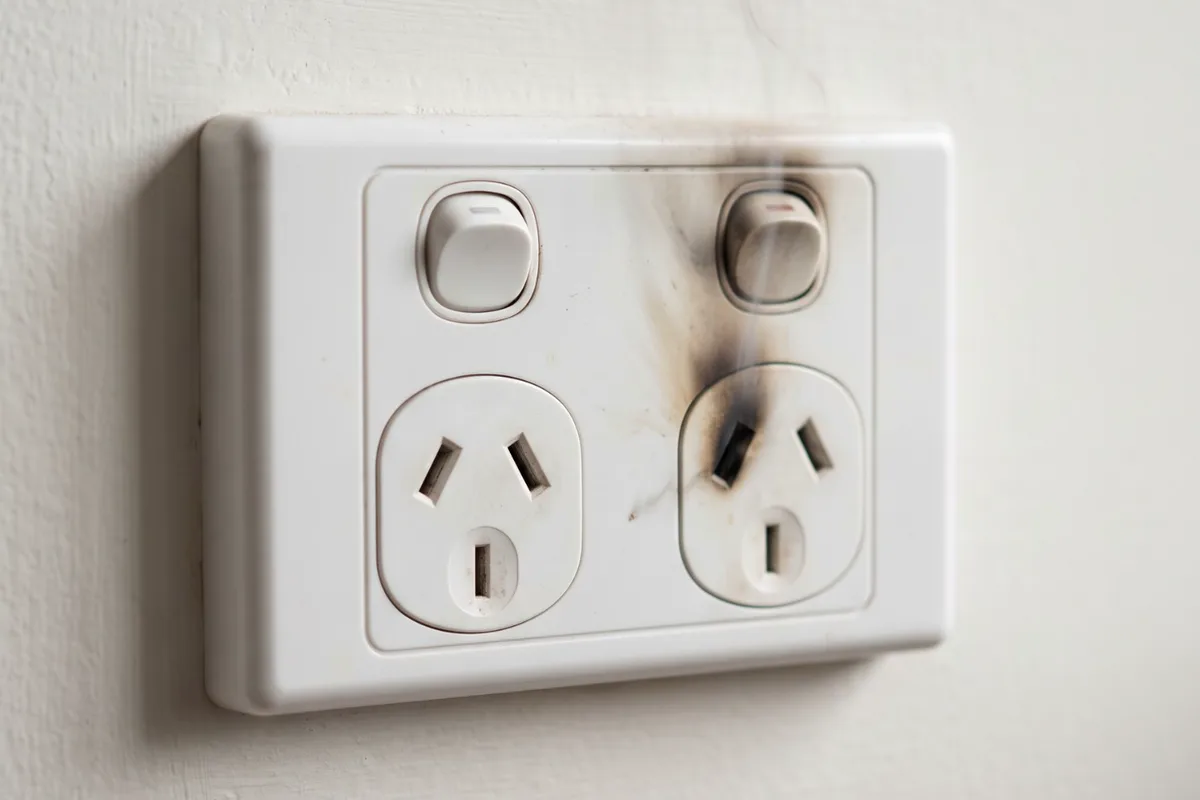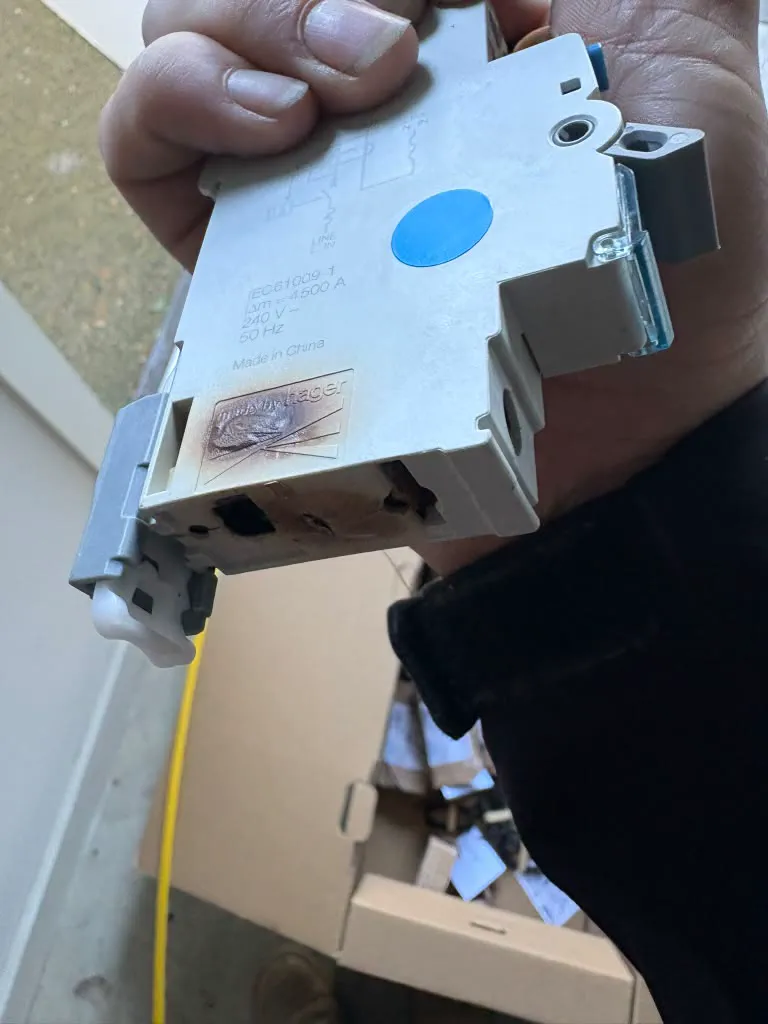
A burning or fishy smell from a point, switch, light or switchboard means something is overheating. We make the circuit safe, then trace and repair the cause. Fault work is booked in our business hours, Monday to Saturday, 7am to 5:30pm. If there's smoke, fire or immediate danger, get everyone out first.
When to get it checked
A fishy or acrid smell
Overheating fittings and cable insulation smell fishy or sharp well before anything melts. Most people check the kitchen bin first.
A warm plug or faceplate
A point or switch should never feel warmer than the wall around it. Warmth usually means a loose connection, a worn socket or too much load.
A smell that comes and goes
Strongest when the heater or dryer runs, gone when it's off. That points to a joint heating up under load, and it gets worse with every use.
Heat or humming at the switchboard
A hot smell in the board cupboard, a humming breaker or a warm cover. Every circuit runs through the board, so heat there takes priority.
Why it happens
5 common causes
Loose connections
A terminal or joint that has worked loose pushes current through a tiny contact patch, which heats and cooks the plastic around it, often long before the faceplate shows a mark.
Power boards and extension leads
A power board running a heater and kettle, or a heater on a lead still coiled on its reel, can overheat and cook the wall point with it.
Old or brittle wiring
Rubber and early plastic insulation harden and crack with age, letting conductors overheat inside the wall, where you smell trouble before you see it.
Downlights and transformers
Older halogen downlights and their transformers run hot, and insulation packed against them can scorch timber and plastic in the roof space.
Worn switchboard parts
A breaker that has carried heavy loads for years, a loose main connection or an old fuse holder can overheat at the board.
What the job covers
What we usually do on this job. Your quote confirms it for your place.
- The affected circuit isolated first
- Switchboard checked for heat and damage
- Every fitting on the circuit inspected
- Burnt or heat-damaged fittings replaced
- Circuit tested before power is restored
- A plain explanation of what failed and why
- Certificate of Electrical Safety for the work
Your options, explained
Replace the fitting
Low disruption- Best for
- One hot point, switch or light with sound wiring
- How it works
- The damaged fitting comes out and the cable ends are trimmed past any heat damage before a new one goes on.
- Worth knowing
- We still check the circuit's other joints.
Add a dedicated circuit
Medium disruption- Best for
- A heater or dryer that keeps cooking the same point
- How it works
- The heavy appliance gets its own circuit from the board.
- Worth knowing
- Otherwise a new fitting on an overloaded point can cook too.
Repair a length of cable
Medium disruption- Best for
- Heat damage inside a wall or ceiling
- How it works
- The damaged run is replaced between accessible points, or the circuit stays off until it can be rewired.
- Worth knowing
- Needs access to the cable run.
Switchboard repair or replacement
High disruption- Best for
- Heat at breakers, fuses or main connections
- How it works
- A damaged part is replaced, or the whole board if it's worn out.
- Worth knowing
- Energy Safe Victoria says power can't go back onto a replaced main switchboard until a licensed electrical inspector has inspected it.
The people behind the work
One local team for electrical, heating and cooling. Family-run, based in Altona Meadows, with 19 years in the industry.
Licensed electrical contractor (REC 38187)See more team photos
Worth knowing before you book
- Smoke or flames? Get out
- Get everyone out of the house first, and never use water on an electrical fire.
- A fading smell isn't a fix
- The joint degrades a little more each time the load comes back on.
- Old boards stay closed
- Ceramic fuses and pitch-based boards can contain asbestos. Leave the cover on.
What affects the price?
The right scope depends on your installation. These are the details we check so your quote is useful, with any additional work explained before it proceeds.
How hard the heat is to find
A smell that's there now is quicker to trace than one that comes and goes.
What's damaged
One burnt point is a small repair. Melted cable in a wall or a heat-damaged board takes more.
Access
Low roof spaces, tight subfloors and cramped board cupboards all slow the work.
Old boards
WorkSafe Victoria lists ceramic fuses and pitch-based switchboards among its examples of asbestos-containing materials, so they need extra care.
How it runs
- 1
Tell us what's happening
Where the smell is and what was running. We'll say what to switch off.
- 2
Make it safe and find it
The circuit is isolated and traced to the faulty fitting, cable or board part.
- 3
Repair and test
We fix the cause, price anything bigger first and test before power goes back on.
Step by step, in more detail
4 steps
Make it safe
Tell us where the smell was strongest and what was running. We isolate that circuit and check the board for heat, so the rest of the house can usually stay on.
Find the heat
Fittings and connections on that circuit are opened and tested to find the joint that has been cooking.
Repair the cause
Burnt fittings are replaced and heat-damaged cable ends are cut back to sound copper. Anything bigger is priced before we start.
Test and explain
Power goes back on only after testing. You hear what failed and why, and get a Certificate of Electrical Safety.
What is safe to do, and what to leave to us
Safe for you to do
- If you see smoke or flame, get everyone out of the house.
- Switch off at the switchboard if you can reach it without touching anything hot or wet.
- Keep children and pets away.
- Note where the smell was strongest and what was running.
Leave these to us
- Pulling out a plug that feels hot or looks discoloured.
- Touching or trying to repair a loose or cracked power point.
- Removing a switchboard cover to look for the source.
- Resetting a breaker that tripped as the smell appeared.
When to get us in
- A burning or fishy smell near a fitting or the switchboard
- A plug, faceplate or board cover that feels warm
- A smell that returns with one appliance or circuit
- A breaker that tripped when the smell started
More detail
A smell is often the first warning
A loose or overloaded connection rarely fails at once. It runs hotter with each use, cooking the plastic around it, and that's when you smell it. Energy Safe Victoria states fire brigades respond to more than 300 domestic electrical fires each year, many caused by old wiring that has degraded or can't cope with modern equipment.
Where the smell is coming from
Smells drift through wall cavities, so where you notice one isn't always where it starts. Near the ceiling, suspect downlights, transformers or a fan. In the kitchen or laundry, it's often the point behind the fridge or dryer. In the board cupboard, suspect the switchboard.
When it's the appliance, not the wiring
A heater idle all summer can burn off dust for a few minutes, and new appliances sometimes smell briefly. A smell at the plug or wall, or one that keeps returning, is different: switch the appliance off and have the circuit checked.
Local rules and conditions
Victorian requirements and local conditions that shape this job, with the sources listed at the foot of the page.
Older homes, older fittings
Seddon's heritage precinct is mainly small Edwardian and Victorian weatherboard houses. Energy Safe Victoria lists old switchboards and old power points among the tell-tale signs of faulty wiring, and says a house over 30 years old should have its wiring checked.
Cold nights, heavy loads
July is Laverton's coldest month, with a mean minimum of 5.2 °C. CFA and FRV counted 21 preventable residential fire deaths across Victoria in 2025, up from 18 in 2024, with the most in winter. That count covers residential fires generally, and winter is also when heaters load up the same few points.
Renting? Report it straight away
Consumer Affairs Victoria lists a dangerous electrical fault as an urgent repair, and rental providers must make urgent repairs immediately. Tell your agent or rental provider as soon as you notice the smell.
Useful reading
Guides to read before you decide, with checklists and questions to bring to the quote.
- A safety switch keeps tripping: what to record and when to callUnderstand the difference between a protective device doing its job and a fault that needs investigation.
- Downlights, ceiling insulation and fire riskWhy old halogen downlights and their transformers need space in the roof, what IC-rated LED fittings change, and why the lights come before the insulation.
- Ceramic fuses and old switchboards: what to look forA look-but-don't-touch guide to old switchboards: rewireable fuses, a missing safety switch, suspect backing panels, heat marks and what replacement involves.
- Renting and the power or heating has failed: what to doNo power or a dead heater in a Victorian rental? What to check safely, what counts as urgent, how to report it, and what to do if nobody responds.
Common questions
Questions people ask about this
- Why can I hear crackling in my walls or ceiling?Most creaks and ticks in walls and ceilings come from timber, roofing and pipes expanding and contracting, or from animals.
- Why is my power point warm?A plug that feels slightly warm after a heater or kettle has run for a while can be normal.
- Something seems unsafe while I wait for the visit. What should I do?Stop using whatever seems unsafe, switch it off at the switchboard if it's safe to reach, and keep people and pets away from it.
Sources for the rules and local facts on this page
11 sources, with the date each was checked
- 1.Victorian Heritage Database (Heritage Council Victoria); entry maintained by Maribyrnong City Council: The general character of the Seddon Residential and Commercial Precinct is of small Edwardian and Victorian period single-storey detached and some attached housing, with a dominance of weatherboard walling and… Accessed 30 September 2026.
- 2.Energy Safe Victoria: Old switchboards, particularly those without a safety switch Old power switches or power points, particularly broken ones Flickering lights Sparks from switchboards, switches or power points. If your house is over 30… Accessed 30 September 2026.
- 3.Bureau of Meteorology: Mean minimum temperature (°C) 14.0 14.4 12.7 10.0 7.8 5.9 5.2 5.7 6.8 8.4 10.3 12.2 9.5 81 1943 2026 Accessed 30 September 2026.
- 4.Fire Rescue Victoria: Across Victoria, in figures compiled by CFA and FRV, there were a total of 21 preventable residential fire fatalities in 2025. This compares to 18 equivalent fatalities in 2024, with the highest number of deaths… Accessed 30 September 2026.
- 5.Consumer Affairs Victoria: Anything on this list is legally defined as an urgent repair: burst water service blocked or broken toilet system serious roof leak gas leak dangerous electrical fault flooding or serious flood damage serious… Accessed 30 September 2026.
- 6.Energy Safe Victoria: Do not touch or attempt to repair a loose, cracked or broken power point switch – cover it immediately and arrange for a licensed electrician to replace it. Accessed 30 September 2026.
- 7.Energy Safe Victoria: Electrical work isn’t a DIY job, even for small jobs such as changing power points or light switches. Accessed 30 September 2026.
- 8.Energy Safe Victoria: Whenever a licensed electrician completes any electrical installation work, they must provide a Certificate of Electrical Safety (COES). Accessed 30 September 2026.
- 9.Energy Safe Victoria: The electrician has eight business days after the work is completed to have that work inspected by a licensed electrical inspector (LEI). If an electrician replaces a main switchboard at a property, power cannot go back… Accessed 30 September 2026.
- 10.WorkSafe Victoria: Fuse blankets and ceramic fuses in switchboards Pitch-based (eg Zelemite, Ausbestos, Lebah) electrical switchboards Accessed 30 September 2026.
- 11.Energy Safe Victoria: Fire brigades respond to more than 300 domestic electrical fires each year. Many of these fires are caused by old wiring that has degraded or is unable to cope with the demands of modern electrical equipment. Accessed 30 September 2026.