
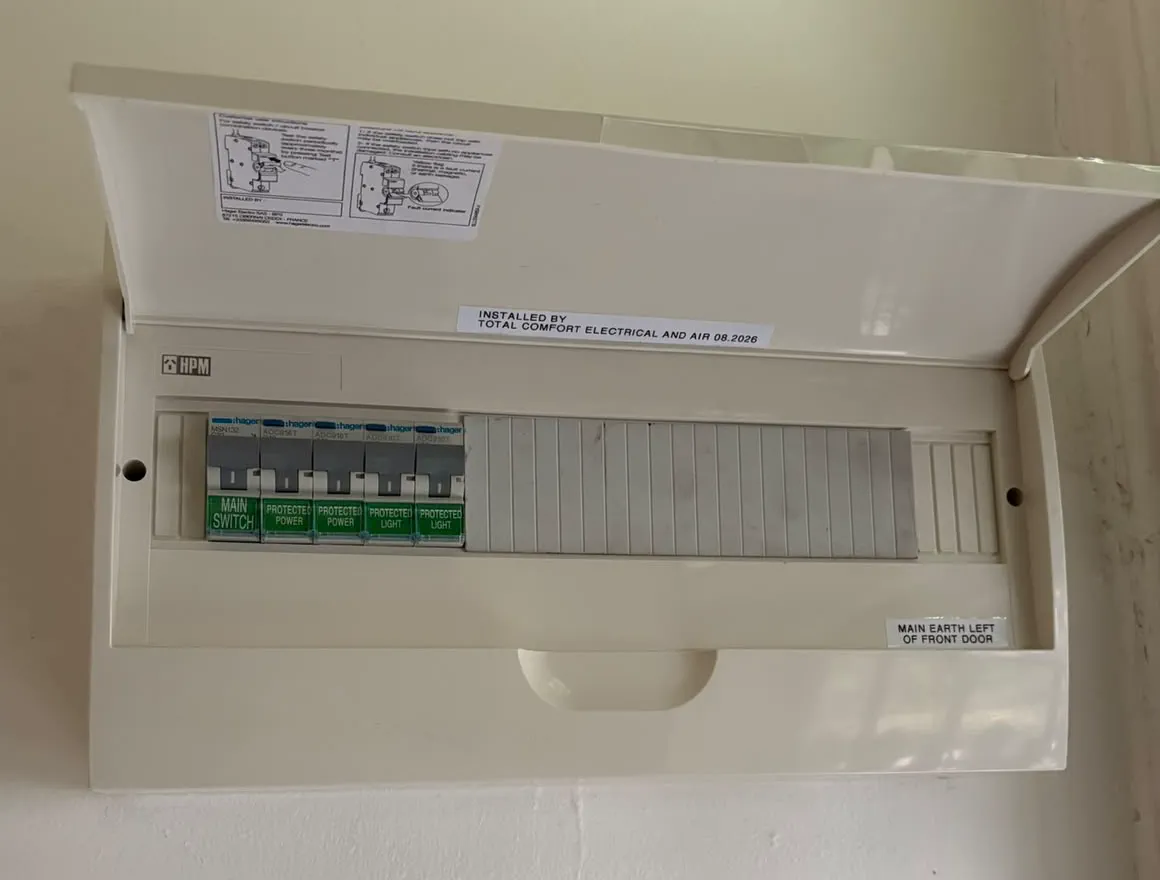
The key points
- Open the meter box door and look, but touch nothing inside.
- Scorching, buzzing or a burning smell mean it needs checking before anything else.
- No device with a test button and 30mA marking usually means no safety switch.
- Treat an old backing panel as possible asbestos and never drill or sand it.
- A replacement board needs safety switches on every final sub-circuit and an inspection before power goes back on.
Start at the meter box and keep your hands off
In most older homes around Melbourne's west, the switchboard sits in or beside the meter box on an outside wall. Newer houses often have it inside, in the garage, laundry or a hallway cupboard, and apartments usually have a small board in the unit. Find yours in daylight and open the door.
That is as far as the inspection goes. Energy Safe Victoria says it is illegal, and potentially fatal, for unlicensed people to do electrical work, even small jobs like changing a power point. Don't unscrew a cover or pull out a fuse carrier for a better view. Photos taken from where you're standing are enough to start with.
- The whole board, from a step back.
- Any ratings or labels you can read without touching.
- The panel the board is mounted on.
- Anything scorched, cracked or discoloured.
Check for heat before anything else
Before you study the fuses, use your eyes, ears and nose. Brown or black scorching around a carrier, plastic that has softened or changed shape, a buzz or crackle, or a hot, fishy or burning smell all point to a connection running hot. That doesn't settle down on its own.
Energy Safe Victoria lists sparks from switchboards, switches or power points, along with flickering lights, among the tell-tale signs of faulty wiring. If you notice any of this, close the door and keep people away. Switch off at the main switch only if you can reach it safely without touching anything damaged, then call an electrician.
If there's smoke or fire, get everyone out. Never put water on an electrical fire; for a small one, turn off power to the source if it's safe and use a fire blanket or dry chemical extinguisher.
How to recognise rewireable fuses
A rewireable fuse board is hard to mistake. You'll see a row of white ceramic carriers pushed into bases, sometimes with a coloured mark showing the rating. Each carrier holds a short piece of fuse wire that melts when a circuit draws too much current. A newer board has circuit breakers instead: slim devices with a toggle that drops when they trip.
Fuse wire is only as reliable as the last person who replaced it. When a fuse keeps blowing, it's common to find heavier wire fitted to stop the nuisance, and then the cable can overheat before the fuse ever melts. Old carriers also crack and their contacts loosen, and a loose contact makes heat of its own.
There's another reason to leave them alone. WorkSafe Victoria lists fuse blankets and ceramic fuses in switchboards among its examples of asbestos-containing materials.
Look for a safety switch
Fuses and breakers protect the wiring from overload, and Energy Safe Victoria is clear that circuit breakers don't act as safety switches against electric shock. A safety switch does that job: it monitors the current in a circuit and turns the power off within 0.03 of a second when it detects a problem that could put someone at risk.
Energy Safe Victoria says a safety switch always has a test button and 30mA printed on it, so that's what to look for. If nothing on the board carries both, assume those circuits have no shock protection until an electrician tells you otherwise. Old switchboards without a safety switch head Energy Safe Victoria's list of warning signs.
Finding one isn't the end of it. A safety switch only protects the circuits wired through it, and older boards sometimes had a single unit added for the power points while the lights and oven stayed on fuses. If you have them, press each test button every three months, as Energy Safe Victoria advises. If the power doesn't cut, call a licensed electrician.
What the board is mounted on
Look past the fuses to the sheet they're fixed to. Older boards were built on timber, a dark bitumen-like panel or a flat fibre sheet. You can't tell by eye what an old panel contains.
WorkSafe Victoria lists electrical switchboards and their backing boards as a typical location for asbestos-containing materials, particularly in buildings built or renovated before the late 1980s, and names pitch-based switchboards among its examples. Treat an old panel as if it might contain asbestos. Don't drill, screw, sand or scrape it, and don't fix anything new to it.
It's also why an old-board replacement is planned, not squeezed in. WorkSafe's asbestos compliance code says a licensed removalist may be needed if a mounting board has deteriorated or contaminated dust is present, and an asbestos-containing panel that has to come out must be replaced with non-asbestos material. A proper quote says how the panel will be handled.
An old board usually has old wiring behind it
The board is only the part you can see. Energy Safe Victoria says the wiring should be checked if a house was built more than 30 years ago, and that when buying a home built before the 1980s it's imperative to have it checked before moving in.
Plenty of Melbourne's west fits that description. The Hobsons Bay Planning Scheme ties the growth of Newport and Spotswood to the Federation and Interwar periods, and post-war expansion to Altona and Laverton. Yarraville's heritage precinct is mostly small Victorian and Edwardian houses. When a home like that has been extended, the new circuits are often hung off the original board.
Energy Safe Victoria says fire brigades respond to more than 300 domestic electrical fires each year, many caused by old wiring that has degraded or can't cope with modern equipment. A fuse board feeding a split system, a dishwasher and a home office is that kind of mismatch.
What replacing an old board involves
Adding safety switches to a fuse board is sometimes possible, but not always. Consumer Affairs Victoria notes that with older panel-and-fuse or federal fuse boards, an electrician may not have that option and may have to replace the entire switchboard. Once a switchboard is replaced, Energy Safe Victoria's guidance is that the Wiring Rules require safety switches on all final sub-circuits.
The electrician first assesses the board, backing panel, meter box, mains and main earth, and asks what you plan to add. On the day, the supply is isolated, the old gear comes out and a new enclosure goes in. Every circuit is tested before it's reconnected, and one that fails stays off until it's repaired.
A main switchboard is prescribed work, so a licensed electrical inspector has to check it. Energy Safe Victoria says power can't go back onto a new main switchboard until that inspection is done, so ask how it will be arranged. When the work is complete, you must be given a Certificate of Electrical Safety.
When it makes sense to get Total Comfort in
Ceramic fuses and no test button are worth acting on, and the timing is largely yours. It moves up the list if you're buying, letting the property, renovating, or adding an induction cooktop, air conditioning or an EV charger. Heat marks, sparking or a burning smell are different: that's a call now.
Total Comfort is a family-run licensed electrical contractor (REC 38187) based in Altona Meadows. We'll look at the board, the backing panel and the circuits, and give you honest advice on whether it needs replacing now or can wait. You get a fixed price for the agreed scope before we start, and quotes are free with no obligation.
Common questions
Quick answers
- Do I need to be home for a switchboard upgrade?Someone should be there at the start and at the end, and the electrician needs access to the switchboard and to the rooms inside for testing.
- Will my fridge and freezer be OK during a switchboard upgrade?Usually, with some planning.
- What is a sub-board, and do I have one?A sub-board is a smaller switchboard fed by its own cable from a circuit breaker on your main switchboard.
- Why does a Licensed Electrical Inspector need to check my new switchboard?Because replacing a main switchboard is prescribed work in Victoria.
Sources for this guide
13 sources, with the date each was checked
- 1.Energy Safe Victoria: Gas and electricity are inherently dangerous and it’s illegal and potentially fatal for unlicensed and unqualified people to undertake any electrical or gasfitting work. Homeowners and consumers must always use… Accessed 30 September 2026.
- 2.Energy Safe Victoria: Electrical work isn’t a DIY job, even for small jobs such as changing power points or light switches. Accessed 30 September 2026.
- 3.Energy Safe Victoria: Old switchboards, particularly those without a safety switch Old power switches or power points, particularly broken ones Flickering lights Sparks from switchboards, switches or power points. If your house is over 30… Accessed 30 September 2026.
- 4.WorkSafe Victoria: Fuse blankets and ceramic fuses in switchboards Pitch-based (eg Zelemite, Ausbestos, Lebah) electrical switchboards Accessed 30 September 2026.
- 5.Energy Safe Victoria: Surge diverters protect the property from voltage surges such as those resulting from a lightning strike. The surge diverter captures the voltage spikes in the wiring that would otherwise be transferred into the… Accessed 30 September 2026.
- 6.WorkSafe Victoria: If the condition of electrical mounting boards has deteriorated or ACD is present an asbestos removal licence holder may be required to undertake asbestos removal work For example, if an ACM electrical mounting panel… Accessed 30 September 2026.
- 7.Victorian Government, Hobsons Bay Planning Scheme (PDF snapshot, last updated by VC292 on 11/09/2025): The heritage places of Hobsons Bay reflect the key themes that have shaped the development of the city since the establishment of Williamstown in the 1840s as the first port of Melbourne, through the development of… Accessed 30 September 2026.
- 8.Victorian Heritage Database (Heritage Council Victoria); entry maintained by Maribyrnong City Council: The general character of the Yarraville Residential Precinct is that of small Victorian & Edwardian single-storey detached housing with mainly weatherboard and some brick wall cladding, corrugated iron roofing, front… Accessed 30 September 2026.
- 9.Consumer Affairs Victoria: Some properties do not have circuit breaker type switchboards, such as older properties that have a panel and fuse board or a federal fuse board. With these older fuse boards, an electrician may not have the option of… Accessed 30 September 2026.
- 10.Energy Safe Victoria: If a switchboard is required to be replaced then as per clause 2.6.3.2.5 (Alterations to installations and replacement of switchboards) of AS/NZS 3000: RCD’s are required on all final sub-circuits. Accessed 30 September 2026.
- 11.Energy Safe Victoria: 'Prescribed' certificates are for electrical installation work that requires inspection by a Licensed Electrical inspector. This includes (but is not limited to): Consumer mains cables, main switchboard, meter box and… Accessed 30 September 2026.
- 12.Energy Safe Victoria: The electrician has eight business days after the work is completed to have that work inspected by a licensed electrical inspector (LEI). If an electrician replaces a main switchboard at a property, power cannot go back… Accessed 30 September 2026.
- 13.Energy Safe Victoria: Whenever a licensed electrician completes any electrical installation work, they must provide a Certificate of Electrical Safety (COES). Accessed 30 September 2026.
Planning advice for homeowners. Installation requirements depend on the property and equipment. Where this guide refers to Victorian safety or rental rules, use the linked official guidance for the current requirements.