
The key points
- Test the cooling on a mild spring day, not the first scorching afternoon.
- Filters and the space around the outdoor unit are yours. Covers, wiring and refrigerant are not.
- Book a service if the test run turns anything up, and never accept a top-up in place of finding a leak.
- Know where you'd go and who is most at risk if the cooling stops mid-heatwave.
Why the first hot day is the wrong time to find out
Summer in Melbourne's west doesn't warm up politely. The Bureau of Meteorology describes Melbourne as sitting between the hot, dry interior and the cold Southern Ocean, with warm northerly winds often arriving ahead of a cold front. On those days an air conditioner goes from barely used to flat out in one afternoon.
The really hot days are few but they bunch up. The Bureau's Laverton station, with records back to 1943, averages 27 days a year at or above 30 °C and 9.4 at or above 35 °C, mostly between December and February. Its January record of 45.6 °C was set on 27 January 2026.
Victorians typically use more energy for heating than cooling, the Victorian Government notes, so cooling mode can go most of a year without a real workout. A slow drain, a tired fan motor or a small leak stays hidden until the system is asked to work hard.
Give it a proper test run on a mild day
Victoria's Department of Health advises checking, before extreme heat, that your fan and air conditioner work well, and having the air conditioner serviced if needed. Do the first part on a warm but ordinary spring day, when a problem is an inconvenience rather than a crisis.
Switch each unit to Cool, not Auto or Dry, and set it a few degrees below room temperature so the compressor has to start. Give it a good half hour. The air should feel properly cold and steady, not just moving. Outside, the fan should be turning and the unit should sound even, with no grinding, rattling or repeated clicking.
On a ducted system, try each zone from the controller and walk every room. On a split system, check the small drain pipe outside after a while on cooling; it should drip. Nothing on a humid day, or water appearing inside, means the drain needs attention now, not in January.
- Cold, steady air from every unit or outlet
- Outdoor fan turning, with no new noises
- Every zone responding to the controller
- Water draining outside, nothing dripping indoors
- No error codes or musty smell
The jobs that are yours, and the ones that aren't
Filters come first. The Victorian Government suggests cleaning the dust filters on a reverse-cycle unit about twice a year, more often with heavy use, following the manual. Dirty filters significantly reduce airflow and efficiency. A ducted system's filter sits in the return-air grille, often in a hallway ceiling, so only tackle it from a stable step.
Then give the outdoor unit room to breathe. It's where your house's heat ends up. Clear leaves and clippings, move the bins and the stack of pavers, and cut back shrubs to the clearances in the manual. Don't hose it, spray cleaner into it or throw a tarp over it for shade.
That's where homeowner maintenance stops. Energy Safe Victoria says electrical work isn't a DIY job, even small ones, so leave the isolator, covers and wiring alone. The Australian Refrigeration Council requires a Refrigerant Handling Licence for servicing that risks refrigerant escaping. Better Health's advice includes keeping evaporative pads clean, but on a roof-mounted cooler that's a service job, not a ladder job.
- Filters cleaned the way the manual describes
- Reachable grilles dusted
- A clear space around the outdoor unit
- Drain outlet not buried in mulch
What a pre-summer service should cover
If the test run turned anything up, or nobody remembers the last service, book one before the season. Federal bench testing found common faults caused average energy losses of 14% to 20% across most tests, and where several faults co-existed, energy use rose substantially, with a high likelihood of failure if they were left.
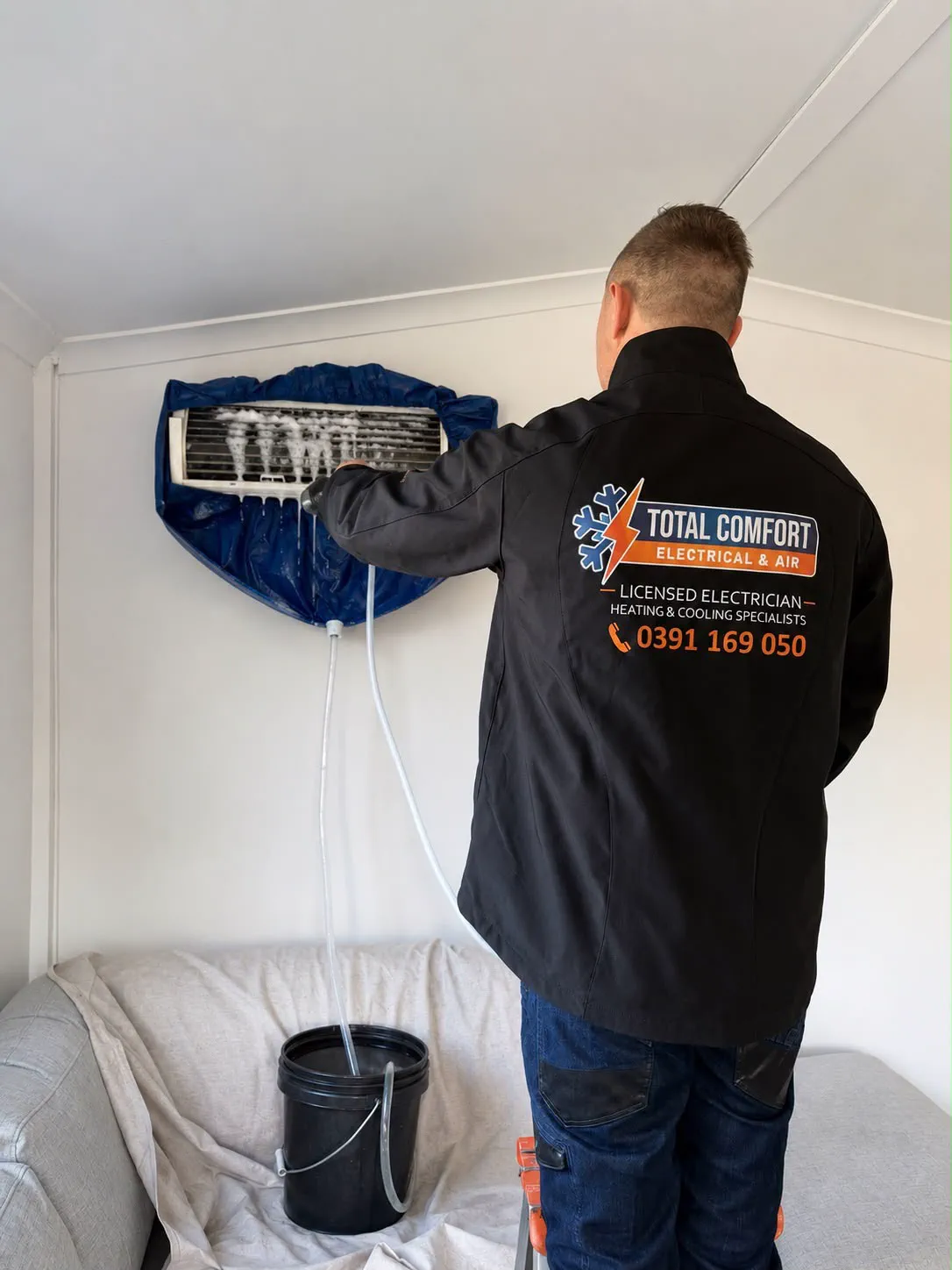
On a split system, a proper service goes well past a filter wash: indoor coil, fan wheel and louvres cleaned, the drain flow-tested to its outlet, the outdoor coil cleared, and brackets, pipe insulation, isolator and cable entries checked before a run in cooling. Ducted systems add the return-air filter, zone motors and controller. Evaporative coolers need pads, water distribution, pump and drain checked.
What a service shouldn't include is a routine refrigerant top-up. Refrigerant runs in a sealed loop and isn't used up, so a low system has a leak. The Australian Refrigeration Council says topping up before a system is fully tested and every identified leak repaired is illegal.
Running it well when the heat arrives
Every air conditioner has a limit, and a run of extreme days finds it. Start cooling in the morning before the house soaks up heat, rather than dragging a baking house down late in the afternoon. Close blinds on the sunny side early and shut doors to empty rooms.
The Victorian Government suggests 24 °C to 26 °C for living areas when cooling, and says every degree lower adds around 10% to running costs. On ducted systems, use the zones; the Victorian Government recommends them so each area can be heated or cooled on its own.
Evaporative cooling is different. It needs some windows or doors open so hot air can escape, and it works well in low-humidity inland regions, which is why it struggles on sticky days. Shut every window and it has nowhere to push the hot air.
Have a plan in case it stops
The Department of Health issues a heat health warning in response to a new Bureau severe or extreme heatwave warning. Hobsons Bay, Wyndham, Brimbank, Maribyrnong and Port Phillip are all in its Central district. Among those most at risk it lists people over 65, pregnant women, babies and young children, people with health problems and people with limited ways to keep cool.
If someone like that lives with you, decide now where you'd go if the cooling failed, and keep a fan you know works. The department's extreme heat advice is to use air conditioning or a fan.
If the unit stops, check the mode, set temperature, timer and remote first. If a safety switch has tripped, Energy Safe Victoria says to reset it and call a licensed electrician if it won't reset. Reset it once only. Ice on the pipes means switch off and let it thaw. A hot or burning smell means turn it off, switch its circuit off at the switchboard if that's safe, and if there's smoke or fire, get everyone out.
If you rent
A cooling appliance or service provided by the rental provider that isn't working is on Consumer Affairs Victoria's list of urgent repairs. Rental providers must make urgent repairs immediately, and they pay unless the renter caused the problem.
Report it in writing to the agent or rental provider straight away, noting what the unit is doing, any error code and whether a safety switch tripped. For rental providers, a spring service saves everyone a miserable week.
When it makes sense to get Total Comfort in
Book a service if your test run showed weak or warm air, a drain that isn't running, new noises, an error code or a dead zone, or if the system is simply overdue. Spring is the easy time: there's room to order a part, and nobody is sweltering while they wait.
Get in touch sooner for anything electrical: a unit that trips its circuit, a scorched isolator, a burning smell or a controller that goes dead. We're one local team for electrical, heating and cooling, so one visit can look at both the circuit and the unit.
If the system is getting on, plan a replacement on your own terms rather than in a heatwave. The Victorian Government says a reverse-cycle system more than 15 years old typically uses more than three times the energy of a modern one, and it's worth checking whether your switchboard needs an upgrade for a new system. Either way, you get honest advice and the price before we start.
Common questions
Quick answers
- How do I clean my split system filters?Turn the unit off, lift the front panel, slide the filters out and vacuum off the dust.
- Why is my air conditioner blowing out black specks?Black specks are almost always mould and grime from inside the unit.
- Who is responsible for servicing the air conditioner in a rental?The rental provider, for an air conditioner they supplied.
- How do I prepare for an air conditioning service or installation?Clear a working space around the indoor unit and the outdoor unit, make sure the roof manhole is easy to reach if you have a ducted system, and secure pets.
Sources for this guide
16 sources, with the date each was checked
- 1.Bureau of Meteorology (article issued 3 August 2026): To the north lies Australia's hot, dry interior, while to the south stretches the cold Southern Ocean. ... Warm northerly winds arrive first, bringing higher temperatures and clear skies. Then, as a cold front moves in… Accessed 30 September 2026.
- 2.Bureau of Meteorology: Mean number of days ≥ 30 °C 6.9 6.0 4.5 0.7 0.0 0.0 0.0 0.0 0.1 0.9 2.8 5.1 27.0 82 1943 2026 Mean number of days ≥ 35 °C 3.6 2.4 0.9 0.0 0.0 0.0 0.0 0.0 0.0 0.1 0.5 1.9 9.4 Accessed 30 September 2026.
- 3.Department of Energy, Environment and Climate Action (energy.vic.gov.au), page last updated 14/04/25: Victorians typically use more energy for heating than cooling, so look for a unit with a higher heating efficiency. Accessed 30 September 2026.
- 4.Better Health Channel (Department of Health, Victoria): Check that your fan and air-conditioner works well. Have your air-conditioner serviced if needed. Ensure the filters, pads and air vents are clean. Accessed 30 September 2026.
- 5.Solar Victoria (updated 20 November 2025): Check the manufacturer’s instructions or manual and have the air conditioner serviced regularly at the recommended frequency to ensure it continues to operate efficiently. Cleaning the filters regularly helps the system… Accessed 30 September 2026.
- 6.Energy Rating (GEMS Regulator / DCCEEW): Dirty filters significantly reduce the amount of airflow and the energy efficiency of the unit. It can also impact the effectiveness of its heating. Cleaning clogged filters, or replacing a worn one, can lower the… Accessed 30 September 2026.
- 7.Energy Safe Victoria: Electrical work isn’t a DIY job, even for small jobs such as changing power points or light switches. Accessed 30 September 2026.
- 8.Australian Refrigeration Council (ARC): A Refrigerant Handling Licence must be held by any person who carries out work in relation to refrigeration and air conditioning (RAC) equipment. Carrying out work in relation to RAC equipment means to do anything with… Accessed 30 September 2026.
- 9.energy.gov.au (Australian Government, DCCEEW): The findings indicated that on average there were energy losses between 14% and 20% across most tests. When several faults co-existed, energy use increased substantially, with a high likelihood of system failure if… Accessed 30 September 2026.
- 10.Australian Refrigeration Council (ARC), Fact Sheet 13 (ARC5225, 11/22): ‘Topping-up’ a system before the system has been fully tested and all identified leaks repaired by any individual is illegal. Accessed 30 September 2026.
- 11.YourHome (Australian Government): Evaporative coolers cool outside air and blow it into the house; some windows or doors will need to be left open when the cooler is in use to allow indoor air to exit. ... For central systems, water use can be 25 L or… Accessed 30 September 2026.
- 12.Department of Health, Victoria: In response to a new Bureau severe or extreme heatwave warning, we will issue a heat health warning. ... The following list shows all the local government areas in Victoria and what forecast district they belong to… Accessed 30 September 2026.
- 13.Department of Health, Victoria (updated 3 February 2026): Use air conditioning or a fan, wear light and loose-fitting clothing, keep your skin wet (for example, with a spray bottle or damp sponge), and take cool showers or foot baths. ... People most at risk include those over… Accessed 30 September 2026.
- 14.Energy Safe Victoria: Locate your electricity box outside your home and check whether the safety switch has tripped. If it has tripped, reset the switch. If the switch won’t reset, call a licensed electrician. Accessed 30 September 2026.
- 15.Consumer Affairs Victoria: a cooling appliance or service provided by the rental provider is not working the property does not meet minimum standards a safety-related device, such as a smoke alarm or pool fence, is not working Accessed 30 September 2026.
- 16.Solar Victoria (updated 2 October 2025): A system that is more than 15 years old for example will typically use more than three times the amount of energy than a modern reverse-cycle air conditioner. Accessed 30 September 2026.
Planning advice for homeowners. Installation requirements depend on the property and equipment. Where this guide refers to Victorian safety or rental rules, use the linked official guidance for the current requirements.