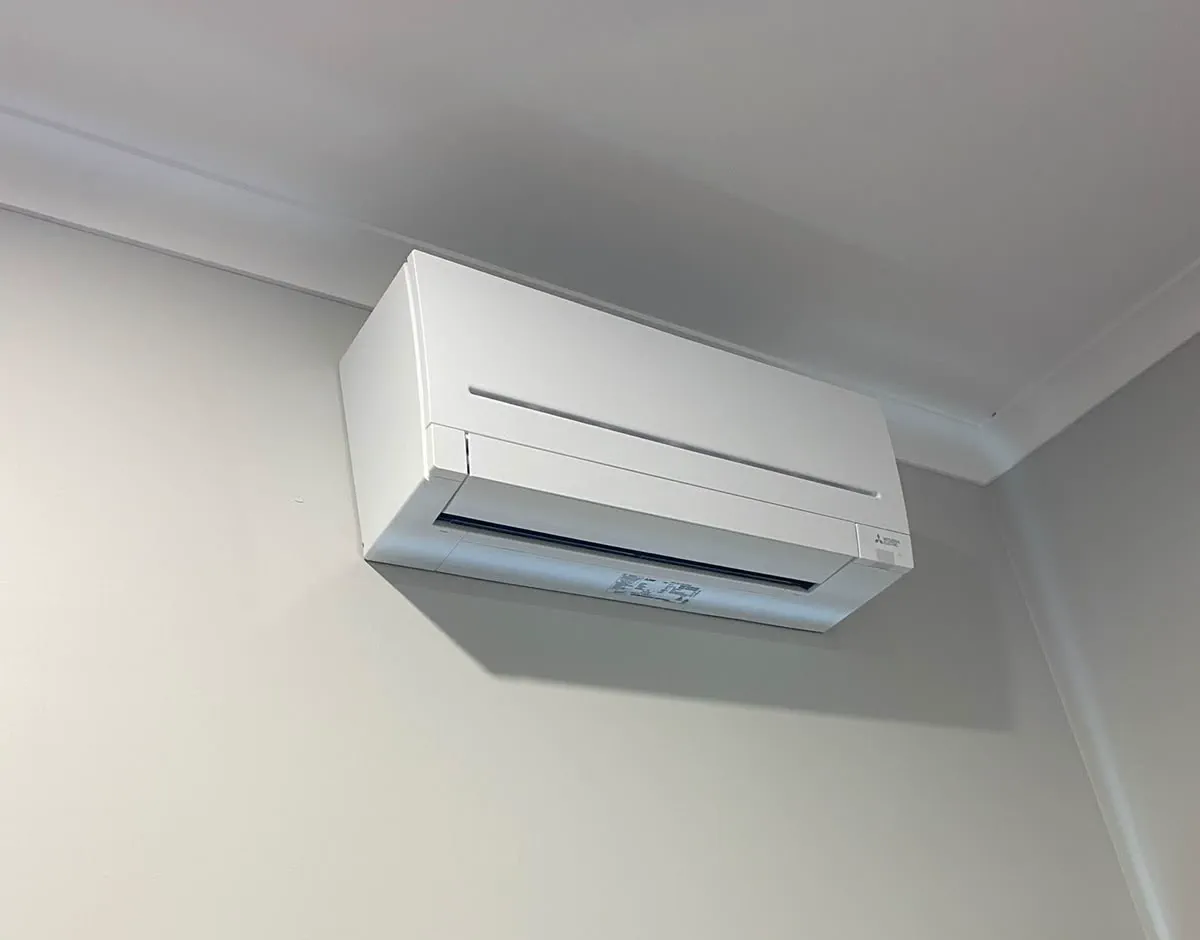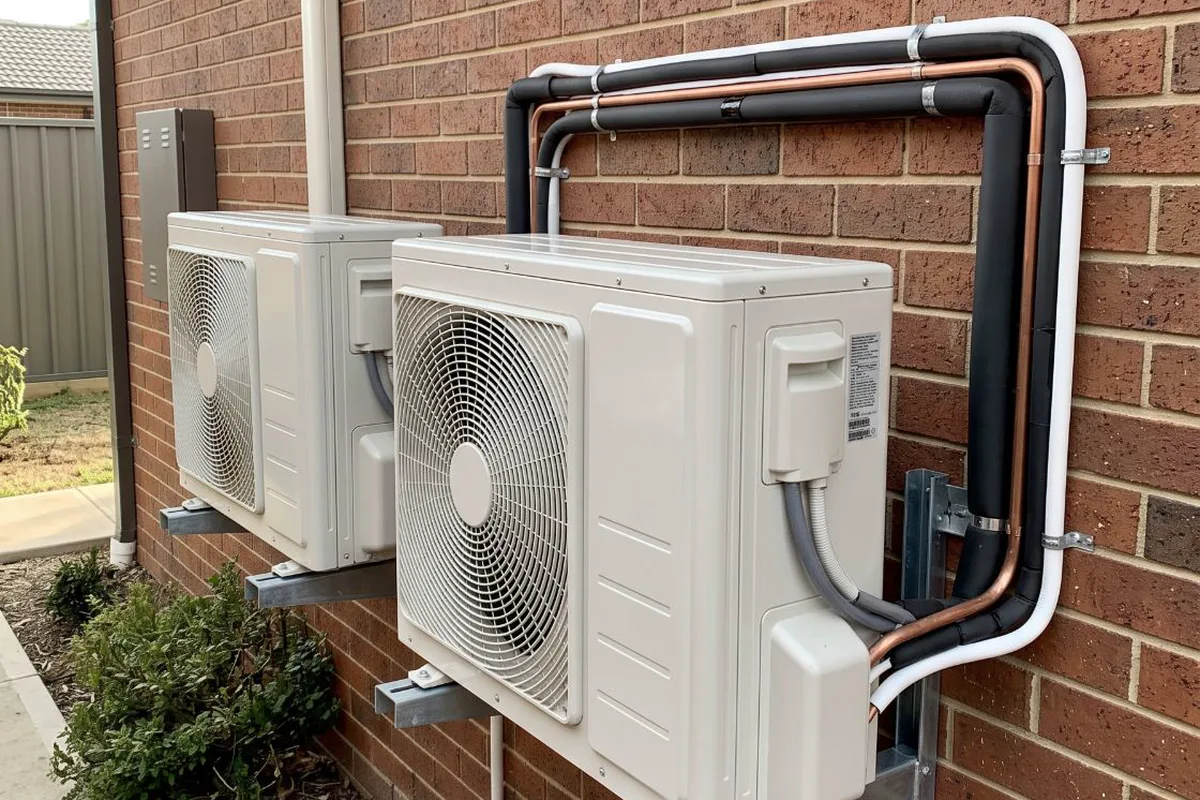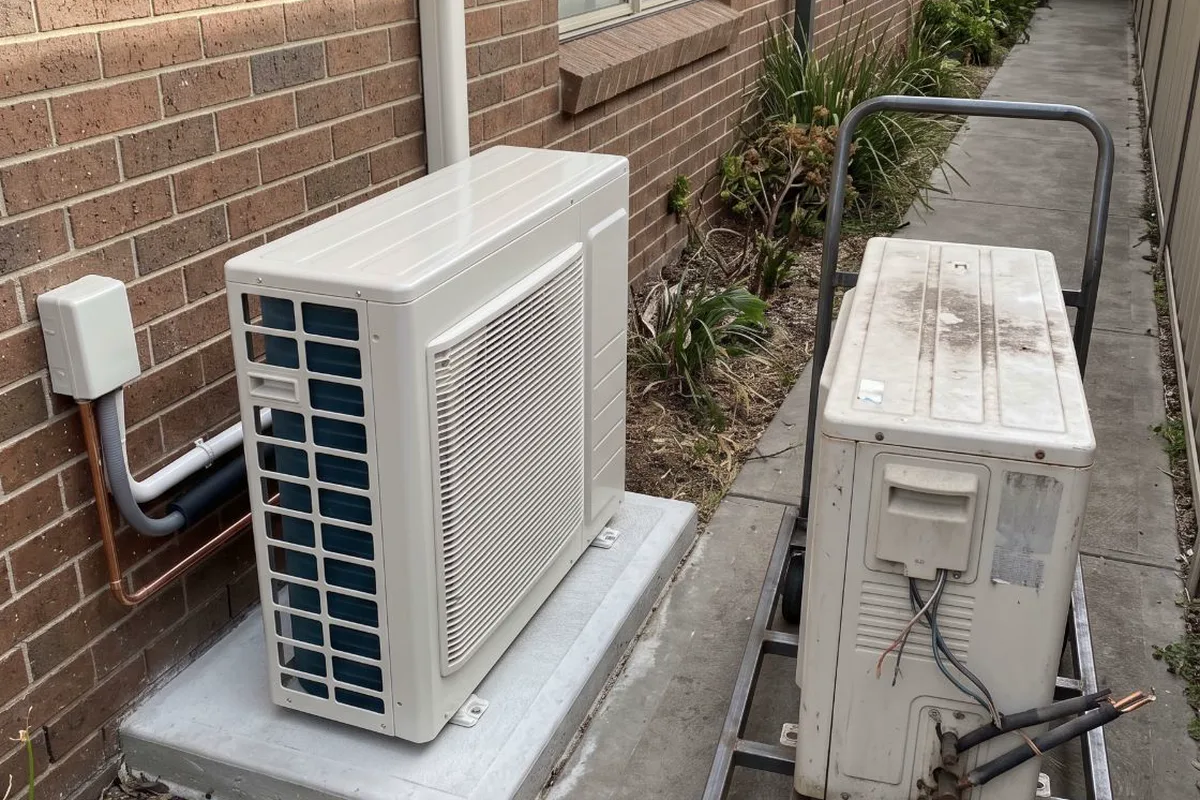
On a multi-head, whether one room or all of them has stopped tells us where to start. We test the electrical side first, then trace the fault to a head, a pipe run or the outdoor unit, and give you the price before any repair.
When to get it checked
Every room stopped at once
All the controllers show a fault, or nothing responds. The outdoor unit, its supply or the isolator is the usual suspect.
One head blowing room-temperature air
The others heat or cool fine, but one room gets nothing. That points to that head's pipe run, its valve in the outdoor unit, or its sensors.
A mode conflict warning
Lights flash or a head stops because another room is set to heating while it's on cooling. It's a setting, not always a fault.
Water from one head
Drips from the casing or a stain down the wall under one head usually means a blocked drain or a condensate pump that has stopped.
It trips the safety switch
The system starts, then the power drops. A wet isolator, damaged cable or failing component needs testing, not repeated resetting.
Noise or ice that won't clear
Rattling from the outdoor unit, a squealing fan, or ice on the pipes that's still there after a defrost cycle.
Why it happens
5 common causes
The supply and isolator
The isolator beside the outdoor unit sits in sun and rain for years. Water inside it, a loose terminal or a tripped circuit stops every head.
Wiring between the units
The heads talk to the outdoor unit over interconnecting cable. Damage in the roof space or a loose terminal can knock out one head or all of them.
Sensors, boards and fan motors
Each head has its own sensors, fan motor and board, and so does the outdoor unit. Any of them can fail on its own.
A leak on one run
Each head has its own pipe pair with joints at both ends. A leak on one run can starve that room first, then the whole system.
Blocked drains and dirty coils
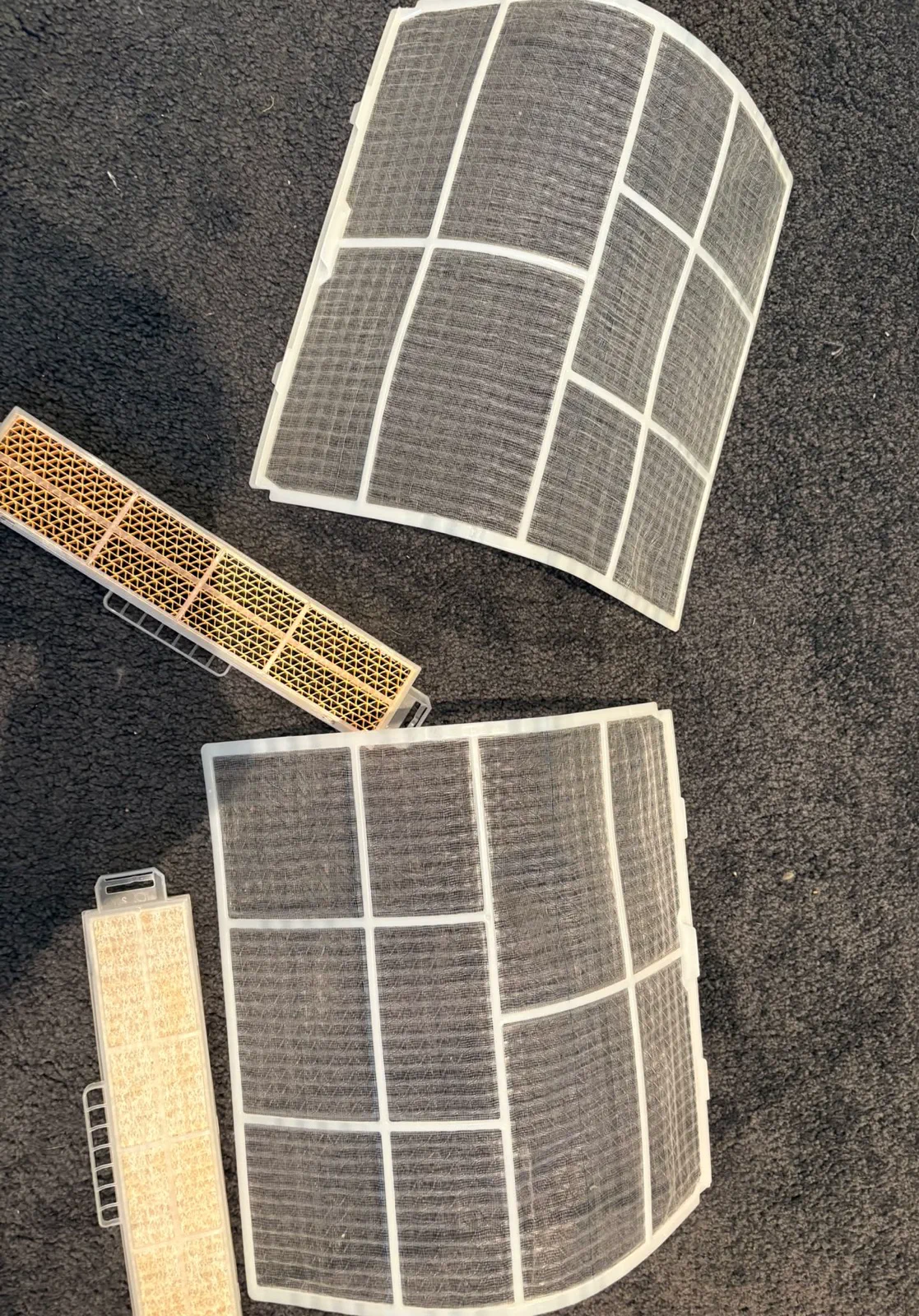
A slimy drain or a clogged filter on one head causes leaks, icing or weak airflow in that room.
What the job covers
What we usually do on this job. Your quote confirms it for your place.
- Codes read on every controller
- Circuit and isolator tested
- Interconnecting wiring checked
- Each head run on its own to isolate the fault
- Drain and filter checked on the affected head
- Leak checks where capacity has dropped
- Price agreed before the repair
- Every head retested after the repair
- Certificate of Electrical Safety for electrical work
Your options, explained
Repair the failed part
Low disruption- Best for
- A sensor, fan motor, board, drain or isolator on a sound system
- How it works
- The part is replaced and the affected head, or the whole system, is retested.
- Worth knowing
- The usual outcome. Parts for some older models can take time to arrive.
Find and repair a leak, then recharge
Medium disruption- Best for
- A head or the whole system losing capacity over weeks
- How it works
- The leak is found and repaired, then the system is pressure tested, vacuumed and recharged.
- Worth knowing
- Topping up without repairing the leak isn't allowed, and only hides the problem.
Replace the system
Medium disruption- Best for
- A major outdoor unit fault on an ageing system
- How it works
- The refrigerant is recovered, the old system removed and a matched new system installed.
- Worth knowing
- See our multi-head split system replacement page. If a repair still makes more sense, we say so.
The people behind the work
One local team for electrical, heating and cooling, based in Altona Meadows, with 19 years in the industry.
Licensed electrical contractor (REC 38187)See more team photos
Worth knowing before you book
- Check the modes first
- Every head must be on heating, or every head on cooling.
- Photograph the codes
- A photo of each controller's display helps us bring the right parts.
- No top-ups without a repair
- A leak is found and fixed before refrigerant goes in.
What affects the price?
The right scope depends on your installation. These are the details we check so your quote is useful, with any additional work explained before it proceeds.
How readily the fault shows
A fault that's present when we arrive is quicker to trace than one that comes and goes.
Which part has failed
An isolator or drain repair is a smaller job than an outdoor unit board or compressor.
Access
Heads on high walls, ceiling cassettes, roof-mounted outdoor units and long roof-space cable runs add time.
Refrigerant or wiring repairs
Finding and repairing a leak, then testing and recharging, takes longer than a part swap. Damaged interconnecting cable may need a new run.
How it runs
- 1
Tell us the symptoms
Which rooms, what codes, and since when.
- 2
Test and trace
Supply first, then the head or the outdoor unit.
- 3
Price and repair
The price agreed before the repair starts.
- 4
Retest every room
Each head alone, then all together.
Step by step, in more detail
4 steps
Hear what happened
Which heads are affected, what each controller shows, when it started, and whether anyone has worked in the roof or walls recently.
Test the supply first
We check the circuit at the switchboard, the isolator and the interconnecting wiring before blaming a board or the refrigerant.
Narrow it to a head or the outdoor unit
Codes, sensor readings and running each head on its own tell us whether the fault is shared or local to one room.
Price, repair and prove it
You get the fault and the price before we start. After the repair, every head runs again, alone and together.
What is safe to do, and what to leave to us
Safe for you to do
- Check every controller is set to the same mode. A head set to heat while another cools can stop the system.
- If the safety switch trips, reset it once. If it trips again or won't reset, leave it off and call a licensed electrician.
- If a head smells hot or you see smoke, switch the system off at the switchboard if it's safe to reach. If there is smoke, fire or immediate danger, get everyone out.
Leave these to us
- Opening the isolator, the outdoor unit or any head. Electrical work isn't a DIY job, even small ones.
- Accepting a refrigerant top-up before the leak is found and repaired.
- Running the system while water is dripping near power points or other electrical fittings.
When to get us in
- Every room on the multi-head has stopped
- One head runs but won't heat or cool
- The system trips a safety switch or breaker
- Water is leaking from a head or running down the wall
- Error codes keep coming back after a reset
More detail
One room or every room
This is the first fork in any multi-head repair. When every head stops, we start with the shared parts: the circuit, the isolator, the outdoor unit's board and compressor, and the cable that carries power and signals to the heads.
When one head misbehaves and the rest are fine, the fault is usually local to that room: its fan, sensors or board, its drain, its pipe run and joints, or the valve in the outdoor unit that meters refrigerant to that head. Running each head on its own is often the quickest way to tell which it is.
The wiring between the units
Energy Safe Victoria has classed the wiring between a split system's outdoor and indoor units as installation wiring, so repairing or replacing it is electrical installation work. A refrigeration mechanic's restricted electrical licence only covers like-for-like disconnection and reconnection.
On a multi-head, that cable runs to several rooms through the roof space and walls, where renovations, rodents and other trades can damage it. Our electricians test and repair it as part of the same diagnosis.
Refrigerant repairs, in the right order
A multi-head that's slowly losing capacity is usually leaking somewhere, often at a joint on one of the runs. Nobody is allowed to top up refrigerant until the system has been fully tested and every identified leak repaired, and releasing refrigerant into the air is illegal.
It's also an offence to charge a system with a refrigerant of higher global warming potential than it was designed for, so an R32 system can't be charged with R410A.
Repair or replace
A sensor, fan motor or drain on a sound system is almost always worth repairing. A compressor or main board on an ageing outdoor unit is a closer call, because it affects every room. The Victorian Government says a reverse-cycle system more than 15 years old typically uses more than three times the energy of a modern one, which is worth weighing alongside the repair price.
Local rules and conditions
Victorian requirements and local conditions that shape this job, with the sources listed at the foot of the page.
Faults show up on the first hot run
Laverton averages 27 days a year at or above 30 °C, mostly from December to February. A weak component often gives out on the first long, hot afternoon, when every head runs together. Victoria's health department advises checking your air conditioner works before extreme heat.
Renting with a broken multi-head
A cooling appliance supplied by the rental provider that isn't working is an urgent repair, and urgent repairs must be done immediately. The rental provider pays unless the renter caused the problem.
Defrost on cold mornings
July at Laverton averages a minimum of 5.2 °C. In heating mode the outdoor coil frosts over and the system pauses to clear it, so every head stops blowing warm air for a few minutes. Melbourne sits in the energy label's cold zone, where performance below 5.5 °C matters most.
Useful reading
Guides to read before you decide, with checklists and questions to bring to the quote.
- Air conditioner maintenance: what to watch between servicesKeep useful records, follow model-specific filter care and recognise symptoms that need a repair visit.
- Getting your air conditioning ready for a heatwaveA spring test run, clean filters, a clear outdoor unit and a backup plan: how to find a tired air conditioner before the first hot northerly does.
- A safety switch keeps tripping: what to record and when to callUnderstand the difference between a protective device doing its job and a fault that needs investigation.
- Renting and the power or heating has failed: what to doNo power or a dead heater in a Victorian rental? What to check safely, what counts as urgent, how to report it, and what to do if nobody responds.
Common questions
Questions people ask about this
More in the Help centreSources for the rules and local facts on this page
13 sources, with the date each was checked
- 1.Bureau of Meteorology: Mean number of days ≥ 30 °C 6.9 6.0 4.5 0.7 0.0 0.0 0.0 0.0 0.1 0.9 2.8 5.1 27.0 82 1943 2026 Mean number of days ≥ 35 °C 3.6 2.4 0.9 0.0 0.0 0.0 0.0 0.0 0.0 0.1 0.5 1.9 9.4 Accessed 30 September 2026.
- 2.Better Health Channel (Department of Health, Victoria): Check that your fan and air-conditioner works well. Have your air-conditioner serviced if needed. Ensure the filters, pads and air vents are clean. Accessed 30 September 2026.
- 3.Consumer Affairs Victoria: a cooling appliance or service provided by the rental provider is not working the property does not meet minimum standards a safety-related device, such as a smoke alarm or pool fence, is not working Accessed 30 September 2026.
- 4.Commonwealth of Australia (2019), 'The new zoned energy rating label for air conditioners—What installers and retailers need to know', hosted on energyrating.gov.au: Melbourne is in a black ‘COLD’ area—read the black Cold ratings. Accessed 30 September 2026.
- 5.Energy Safe Victoria (Industry alert, issued June 2017): The wiring installed between the outside unit and the indoor unit is classified as installation wiring and shall comply with the conductor insulation colours as specified in Table 3.4 of AS/NZS 3000:2007. Accessed 30 September 2026.
- 6.Energy Safe Victoria: This licence type only allows the disconnection and reconnection of ‘like for like’ equipment, for the purposes of repair, replacement or maintenance. The Restricted Electrical Worker’s licence does not allow a person… Accessed 30 September 2026.
- 7.Australian Refrigeration Council (ARC), Fact Sheet 13 (ARC5225, 11/22): ‘Topping-up’ a system before the system has been fully tested and all identified leaks repaired by any individual is illegal. Accessed 30 September 2026.
- 8.Department of Climate Change, Energy, the Environment and Water (DCCEEW): It's illegal to release regulated refrigerants into the air. This is because some refrigerants can stay in the atmosphere for decades or more and can be thousands of times worse for climate change than carbon dioxide… Accessed 30 September 2026.
- 9.Department of Climate Change, Energy, the Environment and Water (DCCEEW): You cannot charge refrigeration and air conditioning equipment with a higher global warming potential (GWP) refrigerant than the equipment was designed to use (the design refrigerant). To do so is an offence under the… Accessed 30 September 2026.
- 10.Solar Victoria (updated 2 October 2025): A system that is more than 15 years old for example will typically use more than three times the amount of energy than a modern reverse-cycle air conditioner. Accessed 30 September 2026.
- 11.Energy Safe Victoria: 'Prescribed' certificates are for electrical installation work that requires inspection by a Licensed Electrical inspector. This includes (but is not limited to): Consumer mains cables, main switchboard, meter box and… Accessed 30 September 2026.
- 12.Energy Safe Victoria: Locate your electricity box outside your home and check whether the safety switch has tripped. If it has tripped, reset the switch. If the switch won’t reset, call a licensed electrician. Accessed 30 September 2026.
- 13.Energy Safe Victoria: Electrical work isn’t a DIY job, even for small jobs such as changing power points or light switches. Accessed 30 September 2026.