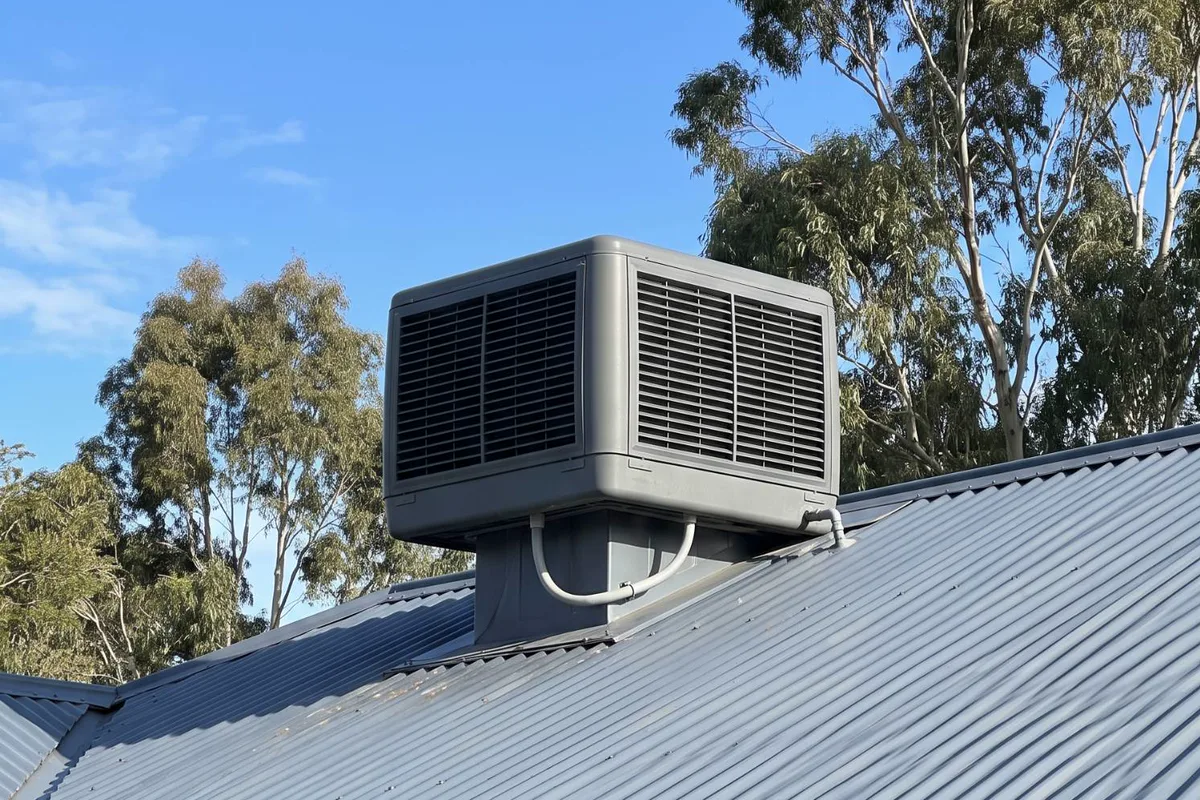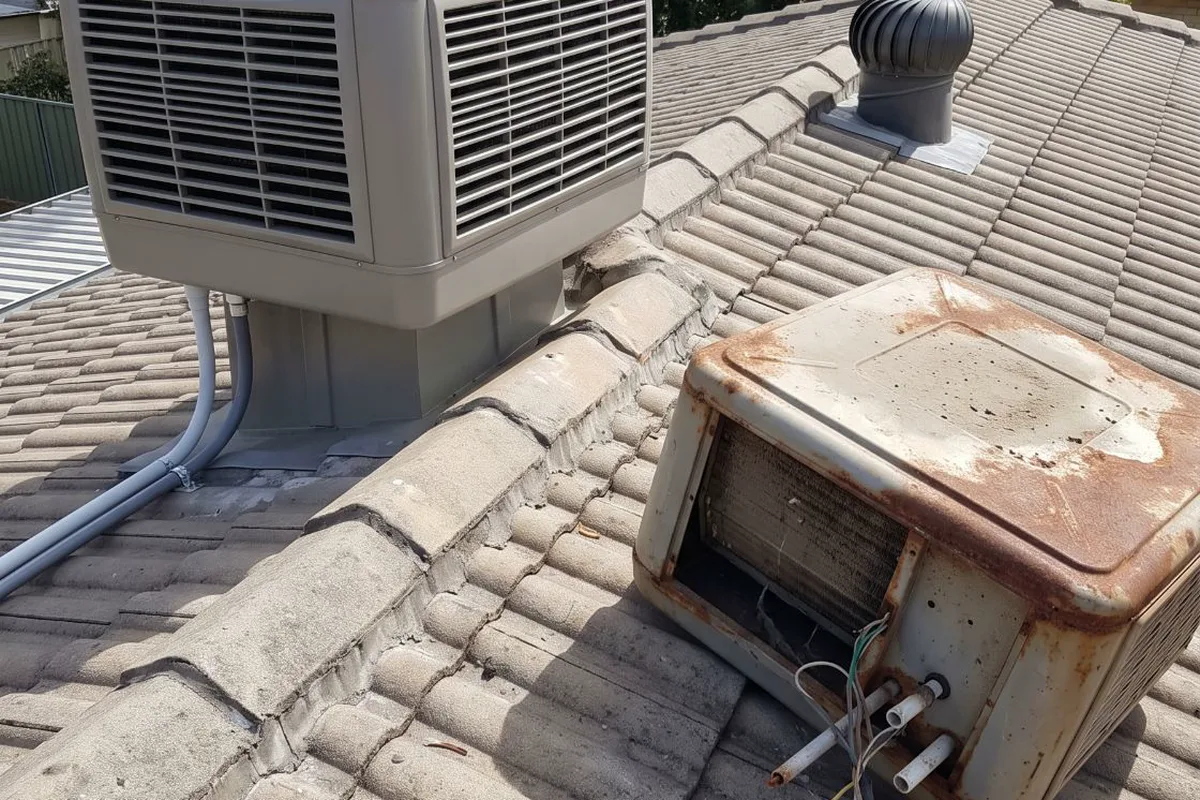
A cooler that's rusting, leaking or failing part by part is often better replaced than patched again. We check the base, opening, ducts, water and power first, reuse what's sound and size the new unit for the house as it is now.
When to get it checked
Rust, cracks or water on the roof
Older metal cabinets rust through at the tank and older plastic ones go brittle. A water stain near the main ceiling outlet can mean the unit or its roof seal is leaking.
The same parts keep failing
A pump one summer, a float valve the next, now the motor, and parts for older models are getting scarce. Price a replacement next to the next repair.
Weak air even after a service
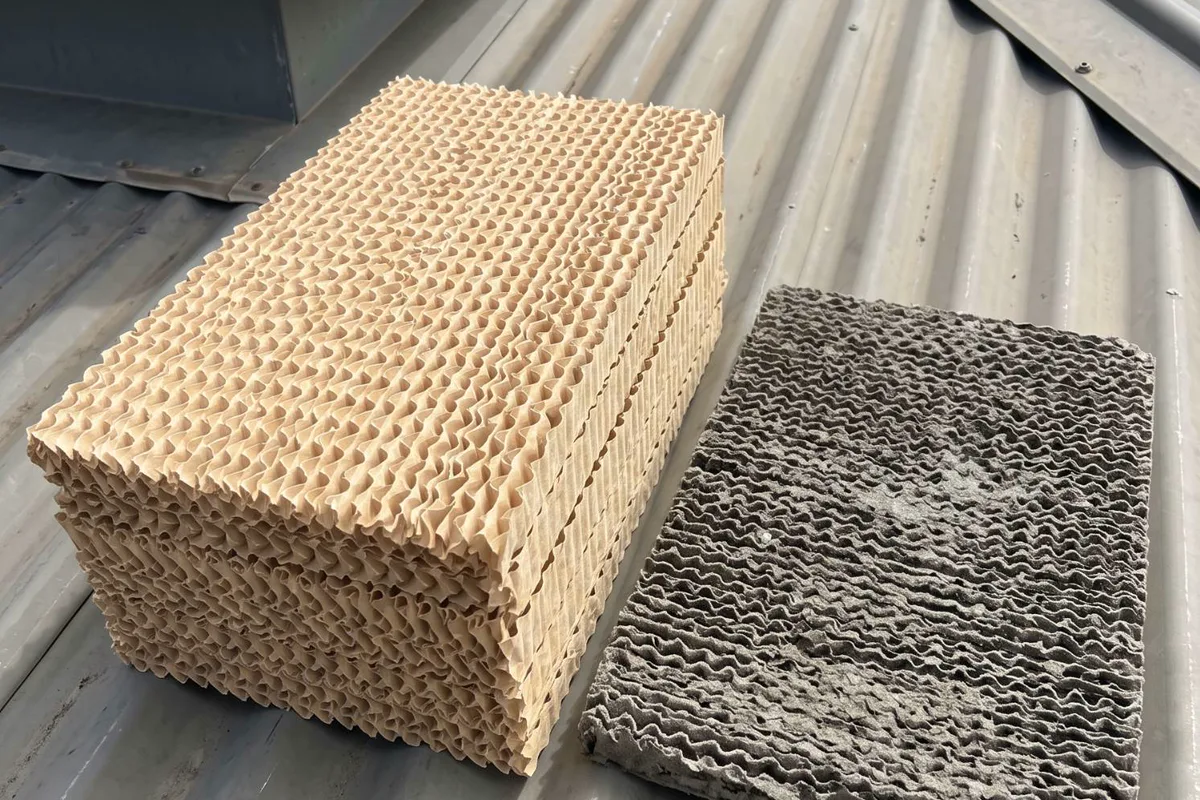
Fresh pads and a clean tank should bring the airflow back. If the outlets are still soft on a hot afternoon, the motor may be worn or the unit undersized.
The house has grown
An extension or converted garage added rooms the old cooler was never sized for, and those rooms stay hot.
Why it happens
4 common causes
Sun and salt air
The roof unit sits in full sun all year. Cabinets fade and crack, and metal parts corrode, often sooner close to the bay.
Minerals left behind
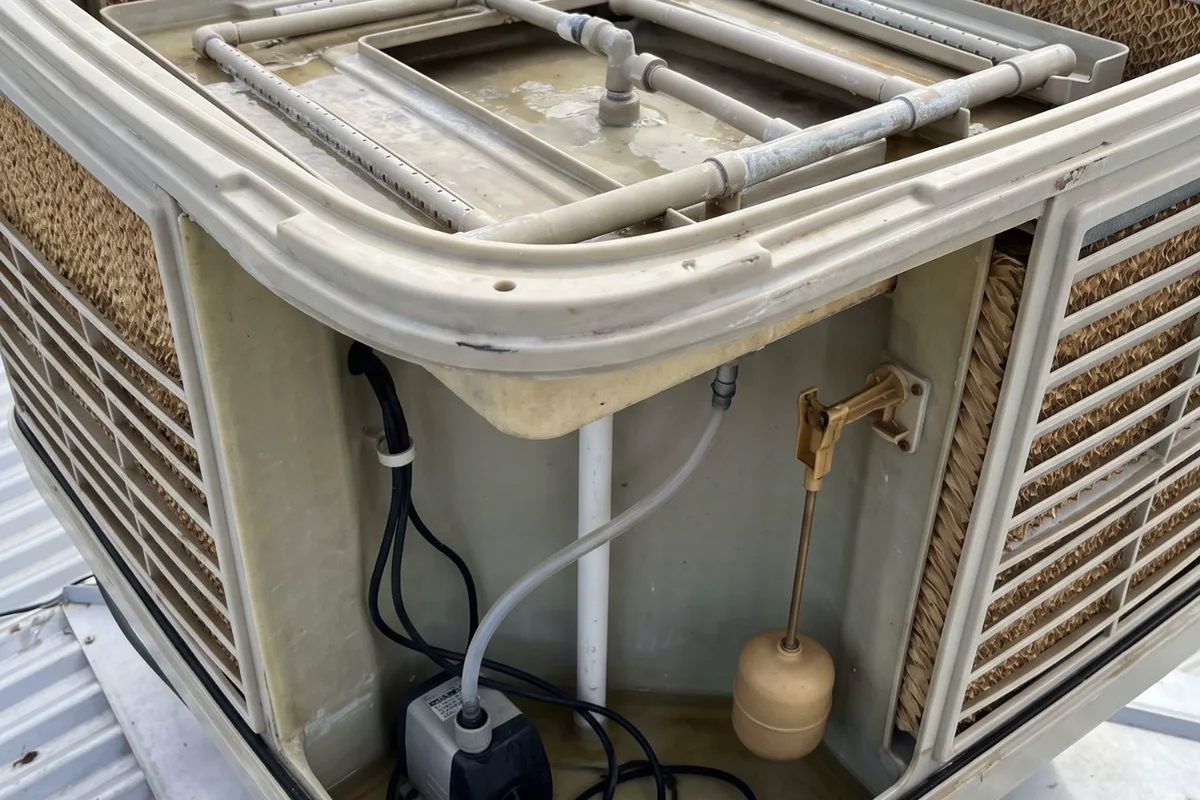
Evaporating water leaves its minerals behind as scale on the pads, tank and pump. Without a working bleed or drain cycle, every wet part wears faster.
Long idle winters
Months unused let pumps seize, float valves stick and seals perish. A cooler that starts harder each spring is often near the end.
Motor and fan wear
Hot spells mean long hours for the fan motor. Bearings wear, belts stretch on belt-driven models, and noise creeps in.
What the job covers
What we usually do on this job. Your quote confirms it for your place.
- Roof base, opening and flashing inspected
- Ducts and ceiling outlets checked
- New unit matched to the home's size
- Old unit drained, removed and taken away
- New cooler fitted, sealed and weatherproofed
- Water supply and drain connected and leak-checked
- Roof isolator and cable checked or replaced
- Airflow checked at every outlet
- Certificate of Electrical Safety provided
Your options, explained
Like-for-like swap
Low disruption- Best for
- A cooler that did its job and has simply worn out
- How it works
- A similar-sized unit goes in the same roof position, reusing the opening, ducts and outlets where they're sound.
- Worth knowing
- Cabinet footprints vary, so an adaptor or new flashing may still be needed.
Upsize or reposition
Medium disruption- Best for
- An extended house, or rooms that never cooled
- How it works
- A larger unit, a new roof position, or extra ducts and outlets for rooms the old system missed.
- Worth knowing
- More airflow only helps if the ducts can carry it and open windows let it out.
Repair instead
Low disruption- Best for
- A younger cooler with one diagnosed fault
- How it works
- The failed pump, float valve or motor is replaced and the unit is tested again.
- Worth knowing
- If both paths make sense, we price them side by side.
The people behind the work
One local team for electrical, heating and cooling. Family-run, based in Altona Meadows, with 19 years in the industry.
Licensed electrical contractor (REC 38187)See more team photos
Worth knowing before you book
- Photos save a trip
- The model label, controller and a roof shot from the ground tell us a lot before we visit.
- Windows still need to open
- A new cooler still needs open windows or doors to let the air out.
- Winter draughts can be fixed
- Many newer units seal when off. Otherwise, close the outlets or cover the roof unit in winter.
What affects the price?
The right scope depends on your installation. These are the details we check so your quote is useful, with any additional work explained before it proceeds.
The new unit
Airflow capacity, motor type, water management and the controller all change the equipment price.
Roof type and access
A single-storey tiled roof is the simplest. Two storeys, steep pitches, metal roofs needing new flashing or tight side access make the lift bigger.
Base, opening and ducts
A cabinet that suits the existing opening, and sound ducts, keep the job smaller. A new base, an adaptor, damaged ducts or extra outlets add to it.
Water, drain and power
A new water line, a longer drain, or a replacement isolator or cable run to the roof.
How it runs
- 1
Send photos
Model label, controller and a roof shot, plus which rooms stay hot.
- 2
Inspect and quote
Roof, ducts, water and power checked, then a fixed price for the agreed scope.
- 3
Swap and test
Old unit off, new unit sealed and connected, air checked at every outlet.
Step by step, in more detail
5 steps
Start with photos
The model label, wall controller and a roof shot taken from the ground tell us the age and type. Tell us which rooms feel weakest.
Check the roof and roof space
We look at the base, opening and flashing, then the ducts, outlets, water line, drain, isolator and cable.
Set the scope and price
Airflow is matched to the house as it is now. The quote lists what's reused and what's new, at a fixed price for the agreed scope.
Swap the unit
Power and water are isolated, and the old unit is drained, lifted off and taken away. The new one is sealed to the ducting and weatherproofed at the roof.
Commission and hand over
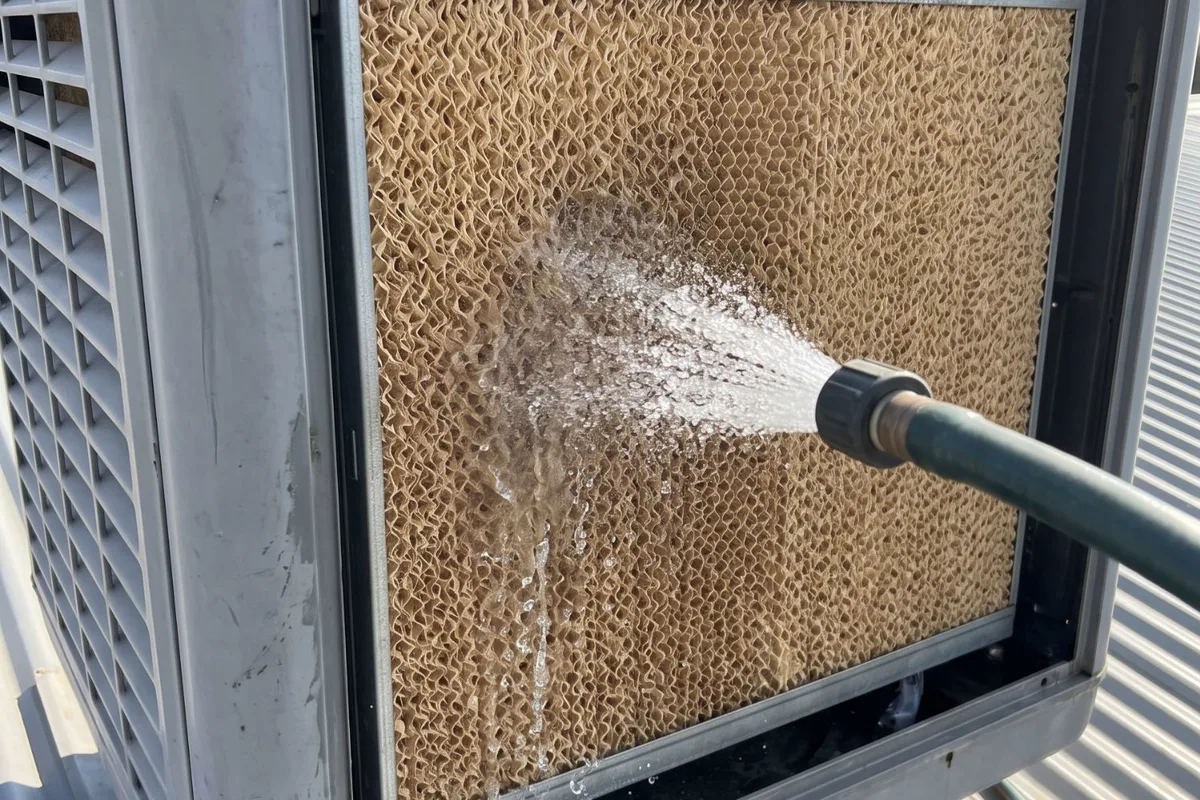
We check the pads wet evenly, test the pump and drain cycle, feel the air at every outlet and show you the controls.
What is safe to do, and what to leave to us
Safe for you to do
- Photograph the wall controller, and the roof unit from the ground.
- If it leaks indoors, rattles or smells hot, turn it off at the controller, and at the switchboard if that's safe.
- Note which rooms stay hot, and whether windows were open at the time.
Leave these to us
- Climbing onto the roof to inspect the unit.
- Disconnecting the power at the roof. Energy Safe Victoria says electrical work by unlicensed people is illegal and potentially fatal.
- Buying a unit before the opening, ducts and power have been checked.
When to get us in
- A major repair has been quoted on an older cooler
- The cabinet is rusting, cracked or leaking
- Rooms stay hot even after a service
- You've extended or reworked the house
More detail
What can be reused
The opening, ducts, outlets, water line and wiring stay if they're sound and suit the new unit. Evaporative systems move a lot of air, so their ducts are larger than a refrigerated system's, and a like-for-like swap usually keeps them.
Water use and winter draughts
Federal home-energy advice says central evaporative systems can use 25 litres of water or more an hour on hot, dry days. It notes many modern units seal themselves when off; otherwise, close off the ducts and cover the roof unit in winter.
The electrical side
The cable and isolating switch that power the cooler usually sit on the roof in full sun for years. We replace them if they've perished or don't suit the new unit. If the wiring is altered, Energy Safe Victoria notes the Wiring Rules require additional RCD protection.
Local rules and conditions
Victorian requirements and local conditions that shape this job, with the sources listed at the foot of the page.
Plan it before the heat
Laverton's weather station averages 27.0 days a year at or above 30 °C, mostly between December and February. Victoria's Department of Health advises checking that your air conditioner works before extreme heat and keeping filters, pads and vents clean.
Dry heat suits it, muggy days don't
The Bureau of Meteorology places Melbourne between Australia's hot, dry interior and the cold Southern Ocean, with warm northerly winds often arriving first as weather systems cross. Evaporative coolers work well in low-humidity regions, so a cooler that feels strong on a dry day can feel flat on a sticky one.
Rentals and the cooling standard
From 1 March 2027, a rental starting a new lease needs energy-efficient cooling in the living area, and evaporative cooling already installed meets that standard. By 1 July 2030, every rental needs efficient electric cooling there. The published definition lists electric air conditioners and heat pumps that meet a GEMS efficiency level, so check how a replacement is treated.
Useful reading
Guides to read before you decide, with checklists and questions to bring to the quote.
- Evaporative or refrigerated cooling for Melbourne's west?How evaporative and refrigerated cooling handle dry northerly days, muggy nights and winter, and what switching from one to the other really involves.
- Getting your air conditioning ready for a heatwaveA spring test run, clean filters, a clear outdoor unit and a backup plan: how to find a tired air conditioner before the first hot northerly does.
- Air conditioner maintenance: what to watch between servicesKeep useful records, follow model-specific filter care and recognise symptoms that need a repair visit.
- Landlords: heating, cooling and electrical obligations in VictoriaA rental provider's map of the heating, switchboard, safety check and repair duties on a Victorian rental, and what the 2027 energy standards change.
Common questions
Sources for the rules and local facts on this page
11 sources, with the date each was checked
- 1.Bureau of Meteorology: Mean number of days ≥ 30 °C 6.9 6.0 4.5 0.7 0.0 0.0 0.0 0.0 0.1 0.9 2.8 5.1 27.0 82 1943 2026 Mean number of days ≥ 35 °C 3.6 2.4 0.9 0.0 0.0 0.0 0.0 0.0 0.0 0.1 0.5 1.9 9.4 Accessed 30 September 2026.
- 2.Better Health Channel (Department of Health, Victoria): Check that your fan and air-conditioner works well. Have your air-conditioner serviced if needed. Ensure the filters, pads and air vents are clean. Accessed 30 September 2026.
- 3.Bureau of Meteorology (article issued 3 August 2026): To the north lies Australia's hot, dry interior, while to the south stretches the cold Southern Ocean. ... Warm northerly winds arrive first, bringing higher temperatures and clear skies. Then, as a cold front moves in… Accessed 30 September 2026.
- 4.energy.gov.au (Australian Government, DCCEEW): Evaporative coolers are not suitable for all regions. They work well in low-humidity inland regions. ... Purchase and installation can be expensive, but ducted evaporative coolers use less than half of the electricity… Accessed 30 September 2026.
- 5.Department of Energy, Environment and Climate Action (energy.vic.gov.au), page last updated 05/08/26: From 1 March 2027, at the start of a new lease, rental homes must include: energy-efficient cooling in the living area (noting that if evaporative cooling is already installed, it meets the standard) ... By 1 July 2030… Accessed 30 September 2026.
- 6.Consumer Affairs Victoria: Definition: From 1 March 2027, energy efficient fixed cooling means: (a) a non-portable, non-ducted electric air conditioner or heat pump capable of cooling, with a GEMS 3-star or above cooling rating (for the climate… Accessed 30 September 2026.
- 7.Energy Safe Victoria: Whenever a licensed electrician completes any electrical installation work, they must provide a Certificate of Electrical Safety (COES). Accessed 30 September 2026.
- 8.Energy Safe Victoria: The Registered Electrical Contractor or Licensed Electrical Worker will complete the COES and is required to provide you with a copy within 30 days. Accessed 30 September 2026.
- 9.YourHome (Australian Government): Evaporative coolers cool outside air and blow it into the house; some windows or doors will need to be left open when the cooler is in use to allow indoor air to exit. ... For central systems, water use can be 25 L or… Accessed 30 September 2026.
- 10.Energy Safe Victoria: Clause 2.6.3.2.5 of the Wiring Rules states: Additional protection by RCDs shall be provided in existing electrical installations where alterations or a switchboard replacement is completed. Accessed 30 September 2026.
- 11.Energy Safe Victoria: Gas and electricity are inherently dangerous and it’s illegal and potentially fatal for unlicensed and unqualified people to undertake any electrical or gasfitting work. Homeowners and consumers must always use… Accessed 30 September 2026.