
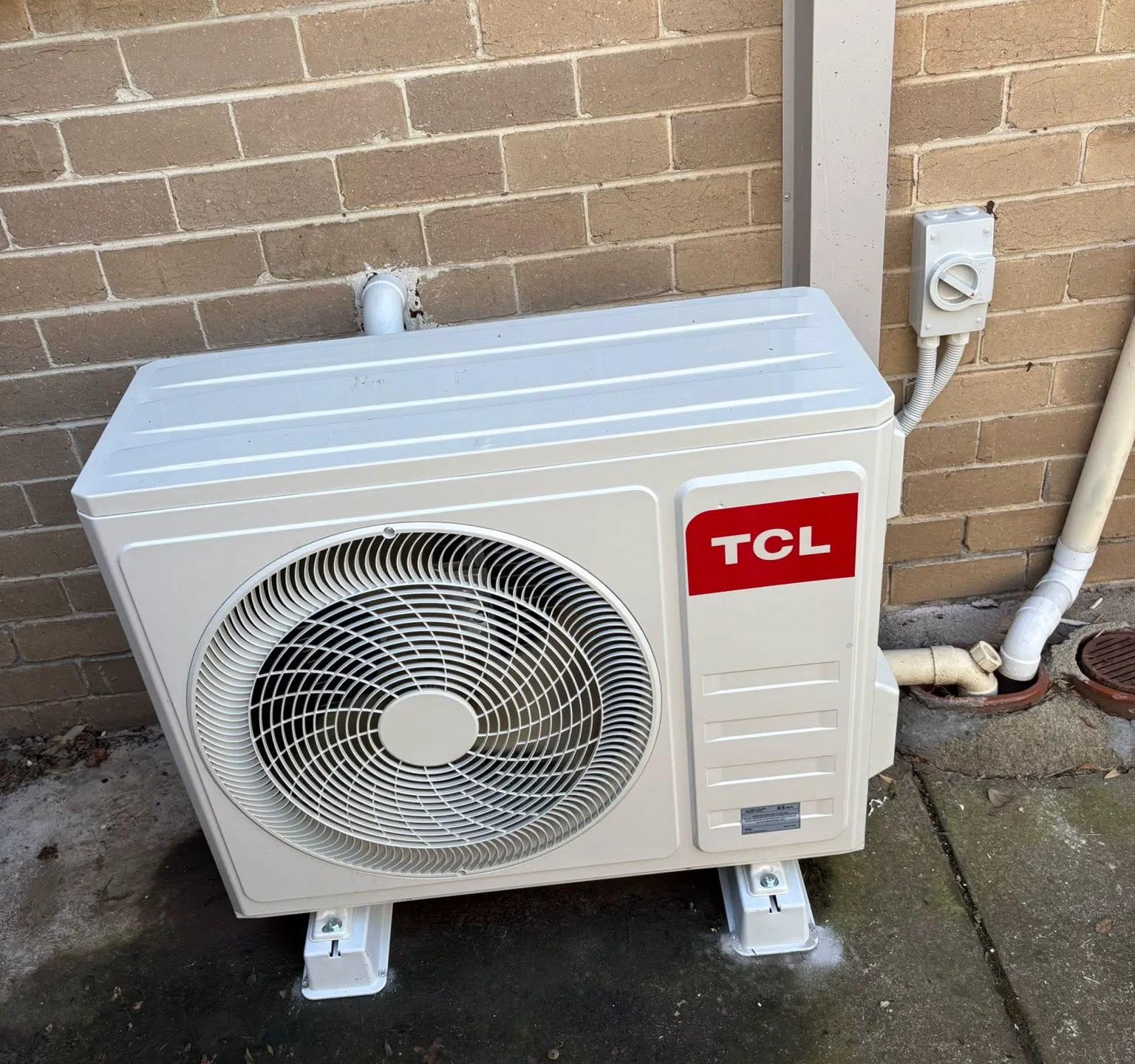
Refrigerant runs in a sealed loop, so a system that needs gas has a leak somewhere. Topping it up without fixing the leak means paying for the same gas again later, and the compressor works harder the whole time. Signs include weak cooling or heating, ice on the pipes, a hissing sound or a longer run time. We trace the leak, repair it, pressure test the system and then recharge it to the manufacturer's specification.
When to get it checked
Weaker heating and cooling
The air at the vents isn't as cold in summer or as warm in winter as it used to be, even with clean filters. A slow leak fades performance gradually, so it often gets blamed on the weather.
Longer run times
The system runs flat out for longer and struggles to hold the set temperature on hot afternoons or cold nights.
Frost on the pipes or coil
Ice on the thinner copper pipe at the outdoor unit, or frost on the indoor coil, can mean the charge is low. Poor airflow does the same, which is why we test before blaming the gas.
Oily, dusty stains at a joint
Refrigerant carries a little compressor oil around the system. Where gas escapes, the oil stays behind and collects dust, so a greasy patch on a flare nut, valve or coil often marks the leak.
A re-gas that didn't last
Someone topped it up last summer and it's weak again. That's the clearest sign there is that the leak was never found.
Why it happens
5 common causes
Flare joints behind the head
Most split systems connect to the indoor unit with flared copper joints hidden behind the head. A flare that was badly made at installation, or has worked loose with vibration and years of heating and cooling, is one of the most common leak points.
Corroded coils
Copper coils can develop pinholes with age, indoors and out. Outdoor coils near salt air or heavy industry corrode faster, and a leak mid-coil is harder to fix than one at a joint.
Vibration and worn valves
Thin tubes inside the outdoor unit can rub until they wear through. The service valves can also weep, especially when a cap has been left off or a valve core is worn.
Damaged pipework
A screw driven into a wall during a renovation, a pipe crushed in the roof space, or a run bumped by a mower can all hole the line.
Shortcuts at installation
A system that wasn't pressure tested and properly vacuumed when it went in can start leaking in its first few seasons, and moisture left inside shortens the compressor's life.
What the job covers
What we usually do on this job. Your quote confirms it for your place.
- System pressures checked
- Joints, flare nuts and coils checked for leaks
- Electronic leak detection or pressure testing to find the source
- Leaking joint or section repaired
- System pressure tested after the repair
- System vacuumed to remove air and moisture
- Recharged to the manufacturer's specification
- Heating and cooling performance tested
Your options, explained
Repair the leak and recharge
Medium disruption- Best for
- A leaking flare, valve or brazed joint on an otherwise sound system
- How it works
- The joint is remade or the part replaced, then the system is pressure tested, vacuumed and recharged to specification.
- Worth knowing
- The usual outcome. The indoor head may need to come off its bracket to reach the joints.
Replace a coil or component
Medium disruption- Best for
- A coil that has corroded through on a system still worth keeping
- How it works
- The leaking coil or valve is swapped for a matching part, then tested, vacuumed and recharged.
- Worth knowing
- Depends on parts being available for your model. We confirm that before you commit.
New pipework on a new route
High disruption- Best for
- Leaks in pipe runs buried in walls, floors or an awkward roof space
- How it works
- Instead of opening up a wall to chase the leak, a new pipe run goes in on a better path and the old run is sealed off.
- Worth knowing
- Often neater and more reliable than patching a joint nobody can reach later.
Replace the system
High disruption- Best for
- Ageing systems with coil corrosion, repeat leaks or an older refrigerant
- How it works
- The old system is decommissioned with its refrigerant recovered, and a new system sized for the space goes in.
- Worth knowing
- The Victorian Government says a reverse-cycle system more than 15 years old typically uses more than three times the energy of a modern one.
The people behind the work
One local team for electrical, heating and cooling. Family-run, based in Altona Meadows, with 19 years in the industry.
Licensed electrical contractor (REC 38187)See more team photos
Worth knowing before you book
- Re-gassing alone isn't a fix
- If someone offers to top up the gas without looking for the leak, it will likely be low again soon.
- Refrigerant needs a licence
- Handling refrigerant in Australia requires a licence. It's not a DIY job, and the gas must not be vented into the air.
- Sometimes replacement makes more sense
- If a coil has corroded through on an older unit, the repair can cost more than it's worth. We'll tell you if that's the case.
What affects the price?
The right scope depends on your installation. These are the details we check so your quote is useful, with any additional work explained before it proceeds.
Where the leak is
A loose flare at a reachable head is a very different job from a pinhole mid-coil. We find the leak before we price the repair, so you're not paying for guesswork.
Getting to it safely
Outdoor units on second-storey brackets or roofs, ducted units in tight roof spaces and pipework inside walls all take longer to reach and work on.
Refrigerant type and charge size
Bigger systems hold more gas, and some refrigerants are harder to get than others. The nameplate tells us both.
Parts for your model
Coils and valves for older or discontinued models can be hard to source, which can mean a second visit.
How stubborn the leak is
A slow or intermittent leak may need a longer standing pressure test, or a return visit, before it shows. We tell you up front when that's likely.
Damage from running low
A compressor that ran for months short of gas can overheat. If testing finds other damage, we price it separately and say plainly whether the system is still worth repairing.
Before the visit
- Share the model, previous repair report and any recharge history.
- Do not open refrigerant connections or attempt to add gas.
- If a leak is suspected, stop use and follow the manufacturer’s safety advice while arranging assessment.
How it runs
- 1
Check the symptoms
Tell us what the system is doing and when it started.
- 2
Find the leak
We test pressures and trace the leak to its source.
- 3
Repair and test
Fix the leak, pressure test and vacuum the system.
- 4
Recharge
Re-gas to specification and confirm it's heating and cooling properly.
Step by step, in more detail
6 steps
Start with the history
Tell us what the system is doing, when it started and whether it has been re-gassed before. A photo of the outdoor unit's nameplate shows the refrigerant type and factory charge.
Confirm it really is refrigerant
We check filters, coils, fans and the electrical supply, then measure temperatures and pressures. One local team covers electrical, heating and cooling, so the isolator and circuit get tested in the same visit.
Trace the leak
An electronic detector goes over every joint, valve and coil, and bubble solution pinpoints the spot. If the leak hides, the remaining gas is recovered and the system is pressurised with dry nitrogen, section by section.
Explain, price, repair
You see where the leak is and hear the options, with the price before we start. Then we remake the joint, replace the valve or part, or replace the coil.
Pressure test and vacuum
The repaired system has to hold nitrogen pressure to prove it's sealed. We then pull a deep vacuum to remove air and moisture, and check it holds before any refrigerant goes back in.
Recharge and prove it
The correct charge is weighed in to the manufacturer's specification for the system and its pipe length. We run it in cooling and heating and talk you through what we found and fixed.
What is safe to do, and what to leave to us
Safe for you to do
- Turn the system off at the controller if you suspect a leak, and follow the safety advice in the manufacturer's manual.
- Photograph the outdoor unit's nameplate and any error code on the controller.
- Find any paperwork from earlier repairs or re-gas visits.
- Clean the dust filters as the manual describes, if you can reach them safely, to rule out an airflow problem.
Leave these to us
- Adding refrigerant from a can or kit, or letting anyone top up the system before the leak is repaired.
- Touching flare nuts, valve caps or service ports. Only licensed technicians may handle refrigerant.
- Opening covers or touching wiring at either unit. It's illegal for unlicensed people to do electrical work in Victoria.
- Chipping ice off a coil or pipe, which can puncture it.
When to get us in
- Heating or cooling has faded and clean filters haven't helped
- Ice keeps forming on the outdoor pipes or indoor coil
- The system was re-gassed before and is weak again
- An oily stain at a joint, or a steady hiss
- Hot weather is forecast and someone at home is vulnerable to heat
More detail
Why a top-up is never the fix
A top-up puts back what leaked out without stopping the leak, so you pay for the same gas again and the system runs short in between. It's also illegal to top up a system before it has been fully tested and every identified leak repaired. And the escaped gas doesn't vanish: the federal environment department says 1 kg of R410A has the same greenhouse impact as 2 tonnes of carbon dioxide.
What a proper leak search involves
Electronic detectors are sensitive, but a breeze across the outdoor unit or a leak buried inside a coil can hide the source. Then we recover what's left and test with dry nitrogen, isolating the indoor unit, the pipe run and the outdoor unit in turn. A very slow leak may need the pressure held for longer before it shows a drop.
Older systems and older gases
Older systems often run on R22, newer ones on R410A or R32. It's an offence to charge a system with a refrigerant of higher global warming potential than it was designed for, so an R32 system can't be charged with R410A. Australia's HFC phase-down started on 1 January 2018, but consumers don't have to replace existing equipment because of it.
Who can work on the refrigerant side
Anyone who installs, services or maintains air conditioning equipment needs a Refrigerant Handling Licence from the Australian Refrigeration Council. The restricted split system licence some installers hold doesn't allow service, repair or maintenance that involves accessing or handling refrigerant. Ask to see a licence that covers repair work.
A leak costs more than the gas
A system short of refrigerant works harder for less output, and the compressor runs hotter. In federal bench tests, common faults in refrigeration and air conditioning equipment caused average energy losses of 14% to 20% in most tests, and several faults together made failure highly likely.
Local rules and conditions
Victorian requirements and local conditions that shape this job, with the sources listed at the foot of the page.
Leaks show up at both ends of the year
Laverton's weather station averages 9.4 days a year at or above 35 °C, mostly December to February, and July's mean minimum there is 5.2 °C. A system short of refrigerant struggles most at those extremes, so a slow leak often shows up in the first hot run or the first cold snap.
Close to the water
Hobsons Bay alone has more than 20 kilometres of bay frontage. Salt air is hard on outdoor units, and coil corrosion is a common source of slow leaks near the foreshore, so we look closely at outdoor coils on homes by the bay.
A second regulator in Victoria
In Victoria, repairing, testing and commissioning refrigerated air conditioning is a class of plumbing work under the Plumbing Regulations 2018, regulated by the Building and Plumbing Commission. That sits alongside the national refrigerant licensing scheme.
Renting with a leaking system
Consumer Affairs Victoria lists a cooling appliance supplied by the rental provider that isn't working, and a heating appliance that isn't working, as urgent repairs. The rental provider must organise and pay for repairs unless the renter caused the problem.
Useful reading
Guides to read before you decide, with checklists and questions to bring to the quote.
- Air conditioner maintenance: what to watch between servicesKeep useful records, follow model-specific filter care and recognise symptoms that need a repair visit.
- Getting your air conditioning ready for a heatwaveA spring test run, clean filters, a clear outdoor unit and a backup plan: how to find a tired air conditioner before the first hot northerly does.
- Split system or ducted: choose around the rooms you useCompare layouts, zoning, installation work and quote details before choosing equipment for your home.
- Landlords: heating, cooling and electrical obligations in VictoriaA rental provider's map of the heating, switchboard, safety check and repair duties on a Victorian rental, and what the 2027 energy standards change.
Common questions
Questions people ask about this
More in the Help centreFrom the blog
- Why is my split system leaking water inside?Stop the indoor leak becoming a larger problem, record what happened and arrange a diagnosis without dismantling the system.
- What affects the cost of an air conditioner repair?Diagnosis time, parts, refrigerant work, access and the system's type and age all shape a repair bill. Here's how they add up, and when replacement is the better spend.
Sources for the rules and local facts on this page
14 sources, with the date each was checked
- 1.Bureau of Meteorology: Mean number of days ≥ 30 °C 6.9 6.0 4.5 0.7 0.0 0.0 0.0 0.0 0.1 0.9 2.8 5.1 27.0 82 1943 2026 Mean number of days ≥ 35 °C 3.6 2.4 0.9 0.0 0.0 0.0 0.0 0.0 0.0 0.1 0.5 1.9 9.4 Accessed 30 September 2026.
- 2.Hobsons Bay City Council: Hobsons Bay has more than 20 kilometres of bay frontage, quality residential areas, a huge expanse of environmentally significant open space and a range of major industrial complexes, which contribute significantly to… Accessed 30 September 2026.
- 3.Building and Plumbing Commission (Victorian Building Authority, trading as the Building and Plumbing Commission): Under Part 4 of the Plumbing Regulations 2018, Refrigerated Air-conditioning work is: The construction, installation, replacement, repair, alteration, maintenance, testing or commissioning of refrigerated… Accessed 30 September 2026.
- 4.Australian Refrigeration Council (ARC): A Refrigerant Handling Licence must be held by any person who carries out work in relation to refrigeration and air conditioning (RAC) equipment. Carrying out work in relation to RAC equipment means to do anything with… Accessed 30 September 2026.
- 5.Consumer Affairs Victoria: a cooling appliance or service provided by the rental provider is not working the property does not meet minimum standards a safety-related device, such as a smoke alarm or pool fence, is not working Accessed 30 September 2026.
- 6.Australian Refrigeration Council (ARC), Fact Sheet 13 (ARC5225, 11/22): ‘Topping-up’ a system before the system has been fully tested and all identified leaks repaired by any individual is illegal. Accessed 30 September 2026.
- 7.Australian Refrigeration Council (ARC): However, state authorities no longer issue licences for refrigerant purchase or handling. To legally undertake either of these activities you must hold the national licence / authorisation, issued by ARC. Accessed 30 September 2026.
- 8.Australian Refrigeration Council (ARC): The Ozone Protection and Synthetic Greenhouse Management Regulations 1995 provide that persons or businesses that acquire, store or dispose of refrigerants must hold a current Refrigerant Trading Authorisation issued by… Accessed 30 September 2026.
- 9.Department of Climate Change, Energy, the Environment and Water (DCCEEW): It's illegal to release regulated refrigerants into the air. This is because some refrigerants can stay in the atmosphere for decades or more and can be thousands of times worse for climate change than carbon dioxide… Accessed 30 September 2026.
- 10.Department of Climate Change, Energy, the Environment and Water (DCCEEW): You cannot charge refrigeration and air conditioning equipment with a higher global warming potential (GWP) refrigerant than the equipment was designed to use (the design refrigerant). To do so is an offence under the… Accessed 30 September 2026.
- 11.Department of Climate Change, Energy, the Environment and Water (DCCEEW): Australia’s HFC phase-down started on 1 January 2018. The HFC phase-down is a gradual reduction in the total amount of HFCs allowed into Australia. The amount will be reduced to 15% of baseline level by 1 January 2036… Accessed 30 September 2026.
- 12.energy.gov.au (Australian Government, DCCEEW): The findings indicated that on average there were energy losses between 14% and 20% across most tests. When several faults co-existed, energy use increased substantially, with a high likelihood of system failure if… Accessed 30 September 2026.
- 13.Solar Victoria (updated 2 October 2025): A system that is more than 15 years old for example will typically use more than three times the amount of energy than a modern reverse-cycle air conditioner. Accessed 30 September 2026.
- 14.Energy Safe Victoria: Gas and electricity are inherently dangerous and it’s illegal and potentially fatal for unlicensed and unqualified people to undertake any electrical or gasfitting work. Homeowners and consumers must always use… Accessed 30 September 2026.