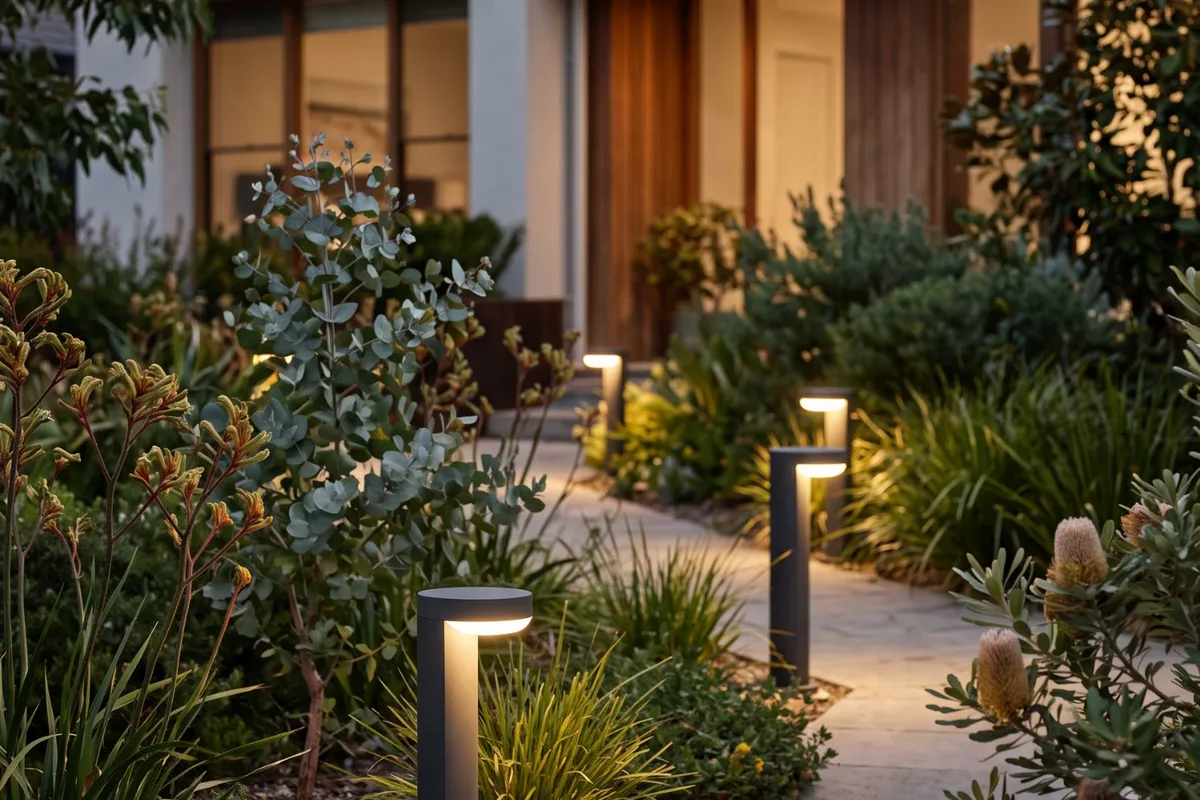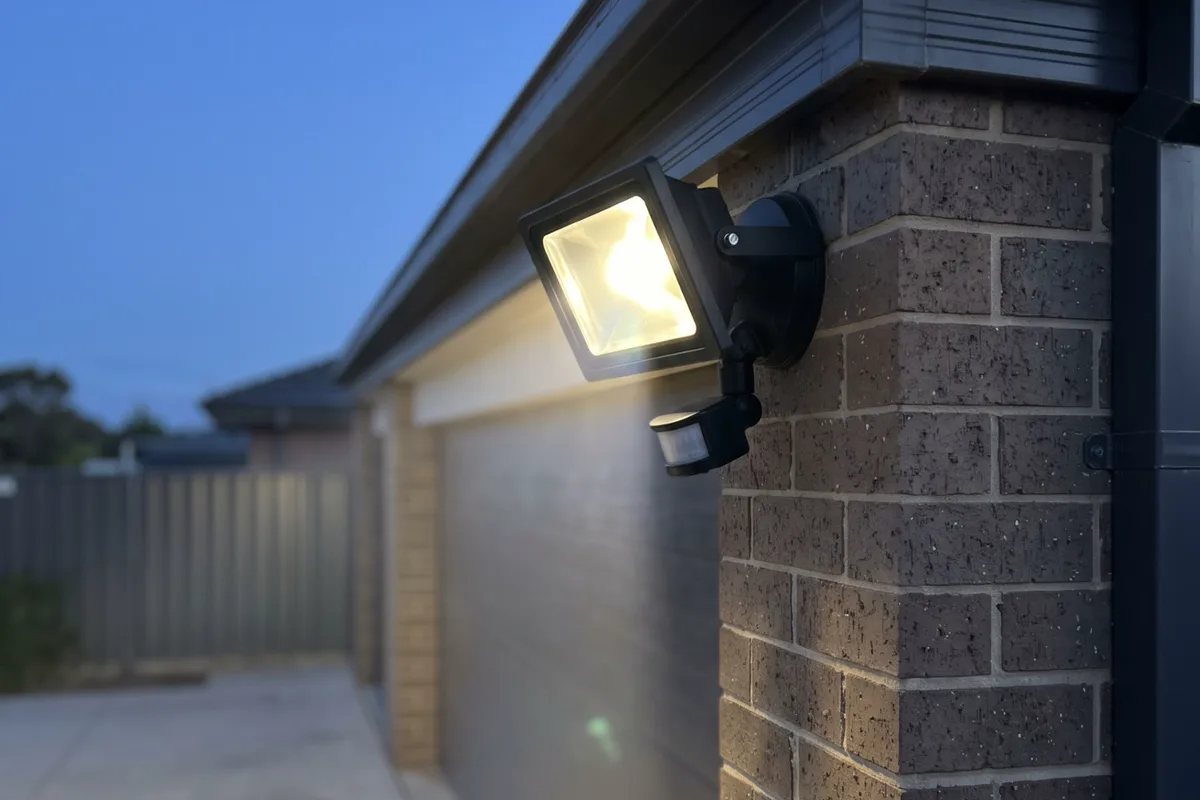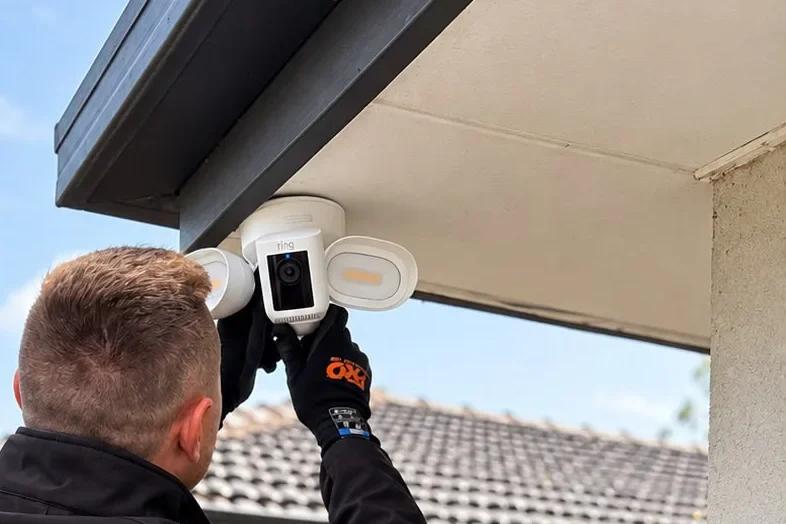
A light that points at the neighbours or switches on every time a tree moves is frustrating to live with. We plan the position, detection area and power supply around the entrance you actually use. A standalone sensor light suits paths and garages; a floodlight camera can add a view of the entry when your Wi-Fi reaches it. The electrical installation and the device setup are separate things, and we explain both before you buy.
When to get it checked
Dark between the car and the door
The porch light covers the step, but the drive, the side gate and the bins stay black. A wall light can't throw that far. That's floodlight territory.
An old halogen that glares
It dazzles you on the way in and lights the house next door, yet still leaves shadows by the fence. Often the lens has fogged or the housing has rust streaks running down the wall.
Your phone buzzes all night
Every passing car, headlight sweep and moth sets off a camera alert. After a week of that, most people stop looking, which defeats the point of the camera.
The camera keeps dropping out
The app shows it offline in the morning, or a clip starts after the person has already gone. Power at the fitting or Wi-Fi at the eave is nearly always behind it.
A camera with nowhere to connect
You've bought a hardwired floodlight camera, or you're sick of charging a battery one, and there's no suitable power where it needs to go.
Why it happens
4 common causes
Tilted up to reach further
A floodlight angled up to cover more ground throws light over the fence and into people's eyes instead of onto the driveway. Mounted high and pointed down, the same fitting lights more of the drive with far less glare.
A camera on a switched point
Most outdoor lights run from a wall switch inside. Put a floodlight camera on that switch and it goes offline, and stops recording, whenever someone turns it off out of habit.
Detection zones that take in the street
Cameras often come set to watch everything in view, footpath and road included. At night their infrared also draws moths and spiders to the lens, and a web moving in the breeze reads as motion.
Budget housings on a hot wall
Cheap fittings bake on a west-facing wall all summer, then cop driving rain. Once a seal cracks or a cable entry is left open, water gets in and the safety switch starts tripping.
What the job covers
What we usually do on this job. Your quote confirms it for your place.
- Entry, driveway or side path assessed for coverage
- Existing lighting circuit and protection checked
- Outdoor-rated fitting and mounting position agreed
- New cable run where the existing point is unsuitable
- Weatherproof mounting and cable entries
- Sensor range, direction and run time adjusted
- Camera powered and basic connection checked where included
- Operation demonstrated in manual and sensor modes
Your options, explained
LED floodlight with sensor
Low disruption- Best for
- Drives, side paths and back yards where you want light, not footage
- How it works
- A hardwired LED floodlight with motion and dusk sensing that comes on as someone approaches after dark.
- Worth knowing
- No app, account or Wi-Fi to look after. Small door and path lights are covered under sensor lights.
Hardwired floodlight camera
Low disruption- Best for
- Front entries and drives you want to check from your phone
- How it works
- Camera, lights and motion detection in one unit on an outdoor light point, sending alerts and footage to an app.
- Worth knowing
- Needs constant power, a strong signal at the eave and an account with the maker. Some features need a paid plan.
Separate floodlight and camera
Medium disruption- Best for
- Long drives and corner blocks
- How it works
- The light goes where it lights the path best. The camera goes where it sees faces, on its own supply.
- Worth knowing
- More work, but neither device has to compromise on position.
Battery or solar camera
Low disruption- Best for
- Sheds and rear gates a long way from any supply
- How it works
- Runs from a rechargeable battery, sometimes topped up by a small solar panel. Nothing connects to your wiring.
- Worth knowing
- The light is weaker than a hardwired flood, and short winter days are hard on solar charging. A flat battery means no light and no footage.
The people behind the work
One local team for electrical, heating and cooling. Family-run, based in Altona Meadows, with 19 years in the industry.
Licensed electrical contractor (REC 38187)See more team photos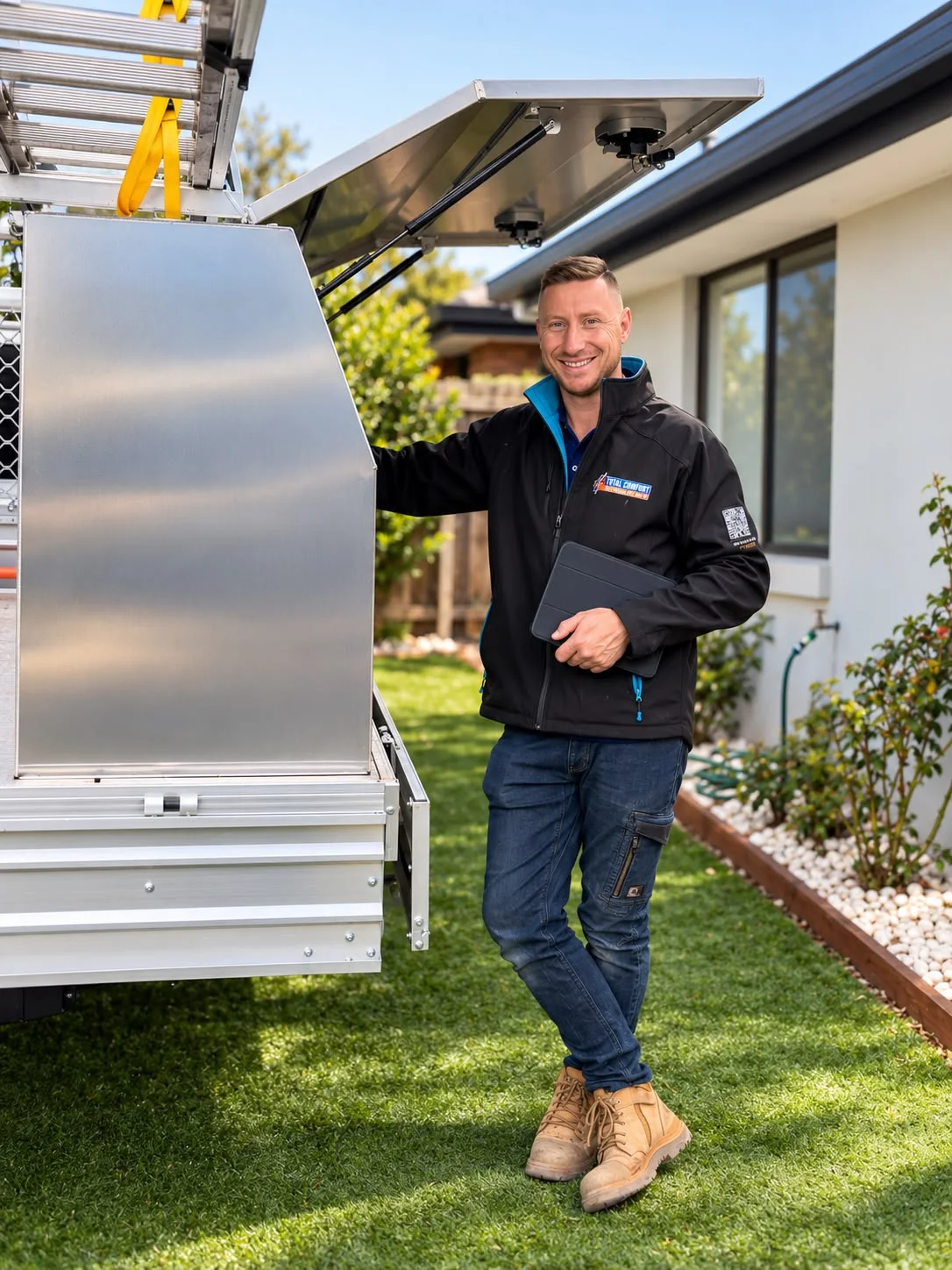
Worth knowing before you book
- Check Wi-Fi at the fitting
- An indoor signal test does not always reflect reception under an outside eave. Check your device requirements and discuss a weak signal before installation.
- Aim within your property
- We discuss the view and light direction so doors and paths are covered without unnecessary glare or a camera aimed into neighbouring private spaces.
- Subscriptions are separate
- Some camera features need a paid account with the device manufacturer. Confirm storage, notifications and account costs when choosing the product.
What affects the price?
The right scope depends on your installation. These are the details we check so your quote is useful, with any additional work explained before it proceeds.
Existing point or new cable
A suitable existing point is the simplest job. A new position on a side wall or rear corner needs a new cable run.
Height and mounting surface
Double-storey eaves need more access gear. Brick, weatherboard, render and thin eave linings all mount differently, and some need a backing block first.
Getting the cable through
An open roof space is straightforward. Flat roofs, raked ceilings and finished render take longer to do neatly.
Constant power and protection
A switched point may need rewiring so a camera stays powered. Energy Safe Victoria notes the Wiring Rules require additional RCD protection in existing installations where alterations are made.
Device and setup scope
Which fitting you choose, whether you supply it and how much app setup is included all change the work.
Before the visit
- Send the device model and entrance photos.
- Check Wi-Fi reception at the proposed position.
- Have your own account and phone ready for any agreed app setup.
How it runs
- 1
Choose the entrance
Send a photo of the wall or eave, the existing light and the area you want covered.
- 2
Confirm the device
We check power, mounting and access, then quote the installation.
- 3
Fit and adjust
The fitting is connected, weatherproofed and aimed, with the sensor set for the site.
- 4
Try it together
Walk the approach and check the light behaviour and any agreed device setup.
Step by step, in more detail
5 steps
Photos and the model first
Send photos of the wall or eave, the existing light and the area you want covered. If you've already bought a camera, send the exact model so we can check what it needs.
Walk the approach
We walk the route a visitor would take. Then we check the lighting circuit, its safety switch protection, the mounting surface and the Wi-Fi signal at the proposed spot.
Agree the scope and price
You get the price before we start. We write down which parts are electrical work and which app setup, if any, we're doing.
Mount, seal and aim
The fitting goes onto a solid fixing with sealed cable entries, and a camera gets a supply that no wall switch can cut. The light is aimed down onto the ground you use, not over the fence.
Set, show and certify
We set the detection area and on-time, then show you the override and any app settings we agreed to. You get a Certificate of Electrical Safety for the work.
What is safe to do, and what to leave to us
Safe for you to do
- Adjust sensitivity, motion zones and privacy zones in the camera's app.
- Clear spider webs off the camera lens with a soft broom from the ground.
- Stand where the camera will go and make a video call on your phone before you buy.
- If the safety switch trips when the light comes on or in rain, reset it once. If it won't stay on, leave it off and call us.
Leave these to us
- Swapping a light for a floodlight camera yourself. Energy Safe Victoria says electrical work isn't a DIY job, even small jobs such as changing light switches.
- Powering an outdoor camera from an extension lead run through a window or door.
- Opening, drying out or resealing a floodlight that has water inside.
- Holding a safety switch on, or resetting it over and over.
When to get us in
- The safety switch trips in wet weather or when the floodlight comes on
- Water, rust or scorch marks in or around an outdoor fitting
- Your camera goes offline whenever someone turns off the light switch
- You've bought a hardwired floodlight camera and need it connected
- A driveway, side path or rear gate has no light at all
More detail
Light and camera want different spots
A floodlight works best high and to one side, throwing light down and across the path. A camera works best lower and facing the approach, so it sees faces rather than the tops of heads. A combined unit suits most front doors and garages, but on a long drive a separate light and camera usually do better.
Test the Wi-Fi at the eave, not the lounge
A camera needs a steady signal where it's mounted, not where the router sits. Brick veneer, foil insulation and metal roofing all cut signal, so full bars in the kitchen can mean dropouts outside. If a video call breaks up at the spot, sort the network out first or pick another position.
Brighter isn't always better
A very bright flood casts hard black shadows beside its beam and washes out any camera looking back towards it. Two moderate fittings lighting the drive from different angles usually leave fewer dark corners than one big one. Swapping an old halogen for LED also cuts the heat on the eave and the running cost.
Accounts, recordings and privacy
The account and recordings sit with the camera's maker, and saved clips or longer history often need a paid plan, so check that before you buy. If app setup is part of the job, set the account up in your name on your own phone. Keep the camera on your own property and use privacy zones to blank out a neighbour's windows or yard.
Local rules and conditions
Victorian requirements and local conditions that shape this job, with the sources listed at the foot of the page.
Open frontages in Altona
Hobsons Bay's planning scheme aims to keep the post-war brick and weatherboard homes in Altona's special character areas, with generous front and side setbacks and low front fences. Over a low fence, a camera on the front corner easily takes in the footpath, so we frame it on the drive and door.
Basalt walls in Williamstown
Williamstown's Government Survey heritage precinct includes early basalt houses, a type its heritage statement calls less common elsewhere in Melbourne. Solid stone takes masonry fixings and has no cavity to hide a cable in, so mounting under the eave and feeding from the roof space is usually the neater route.
Verandahs in Yarraville and Newport
The Yarraville Residential Precinct is mostly small single-storey houses with front verandahs on narrow blocks, and Newport's Estate precinct is largely single-storey weatherboards, often with a verandah or porch. A verandah beam keeps a camera dry and close to the door, but the verandah roof can block a floodlight's throw to the gate.
Pre-wiring in Wyndham's new estates
New housing developments are planned in Wyndham's growth areas, including Truganina, Tarneit, Wyndham Vale and Manor Lakes. If you're building there, an unswitched point for a floodlight camera is far easier to add before the eaves are lined and the render goes on.
Useful reading
Guides to read before you decide, with checklists and questions to bring to the quote.
- A room-by-room lighting plan that goes beyond more downlightsPlan task lighting, comfortable evening light and outdoor coverage around how each space is used.
- Planning the electrical in a new build or extensionMark up the power and lighting plan, decide the dedicated circuits, pre-wire air conditioning and EV charging, then walk the frame before plaster.
- A safety switch keeps tripping: what to record and when to callUnderstand the difference between a protective device doing its job and a fault that needs investigation.
- What electrical work you can and can't do yourself in VictoriaWhere Victorian law draws the line on home electrical work, the short list of jobs that are yours, and what to do when a job goes past it.
Common questions
Questions people ask about this
- Why does my sensor light stay on or keep turning on all night?A sensor light that stays on or keeps triggering all night is usually seeing something: swaying plants, pets, possums, insects drawn to the light, or warm air from an…
- Why is there water inside my outdoor light?Water gets into outdoor lights through perished seals, cracked lenses, unsealed cable entries or a fitting that isn't rated for where it's mounted.
Sources for the rules and local facts on this page
11 sources, with the date each was checked
- 1.Victorian Government, Hobsons Bay Planning Scheme (PDF snapshot, last updated by VC292 on 11/09/2025): SPECIAL CHARACTER AREAS, ALTONA 1.0 24/02/2022 C131hbay Neighbourhood character objectives To preserve the characteristics of the neighbourhood, comprising intact post-war brick and weatherboard dwellings with… Accessed 30 September 2026.
- 2.Victorian Heritage Database (Heritage Council Victoria); entry maintained by Hobsons Bay City Council from the Hobsons Bay Heritage Study 2006: Unusual or rare early building styles and types such as the basalt houses and the timber duplex houses with no dividing wall that are characteristic of this part of Williamstown but less common elsewhere in the… Accessed 30 September 2026.
- 3.Victorian Heritage Database (Heritage Council Victoria); entry maintained by Maribyrnong City Council: The general character of the Yarraville Residential Precinct is that of small Victorian & Edwardian single-storey detached housing with mainly weatherboard and some brick wall cladding, corrugated iron roofing, front… Accessed 30 September 2026.
- 4.Victorian Heritage Database (Heritage Council Victoria); entry maintained by Hobsons Bay City Council from the Hobsons Bay Heritage Study 2006: Aesthetically, it is significant for the groups of relatively intact examples of representative housing, from the Victorian, Federation and Interwar periods. They are notable for their consistent character, which is… Accessed 30 September 2026.
- 5.Victorian Electoral Commission (2023 electoral structure review fact sheet): New housing developments are planned in residential growth areas including Truganina, Tarneit, Wyndham Vale and Manor Lakes, as well as near activity centres and public transport. Accessed 30 September 2026.
- 6.Victorian Legislation (legislation.vic.gov.au) - Electricity Safety Act 1998, authorised version 089 (effective 8 Sep 2026): electrical installation work means installation, alteration, repair or maintenance of an electrical installation; Accessed 30 September 2026.
- 7.Energy Safe Victoria: Whenever a licensed electrician completes any electrical installation work, they must provide a Certificate of Electrical Safety (COES). Accessed 30 September 2026.
- 8.Energy Safe Victoria: For electrical installation work performed within your electrical installation including but not limited to lights, power points, air conditioning, hot water service etc. Accessed 30 September 2026.
- 9.Energy Safe Victoria: Electrical work isn’t a DIY job, even for small jobs such as changing power points or light switches. Accessed 30 September 2026.
- 10.Energy Safe Victoria: Locate your electricity box outside your home and check whether the safety switch has tripped. If it has tripped, reset the switch. If the switch won’t reset, call a licensed electrician. Accessed 30 September 2026.
- 11.Energy Safe Victoria: Clause 2.6.3.2.5 of the Wiring Rules states: Additional protection by RCDs shall be provided in existing electrical installations where alterations or a switchboard replacement is completed. Accessed 30 September 2026.