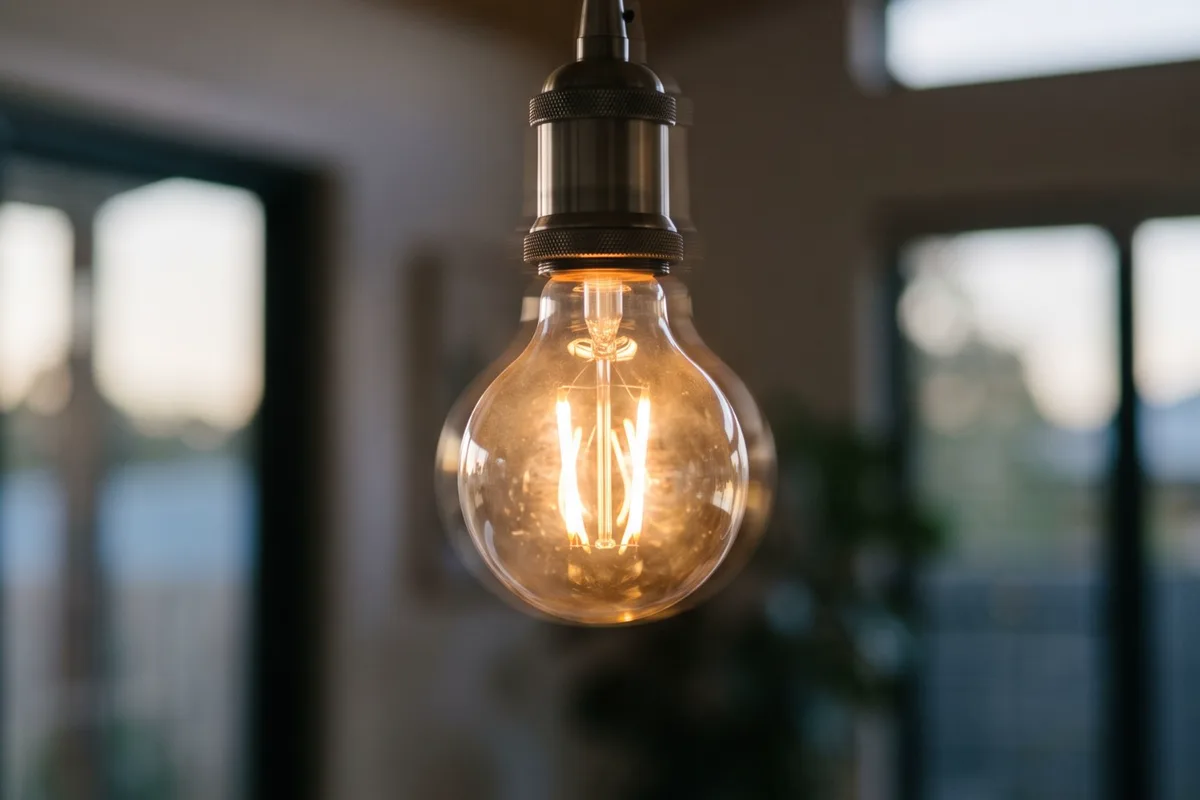
Flickering lights are easy to misread. A new globe often won't fix them, because the fault is in a driver, dimmer, loose terminal or the main connections. We test back to the switchboard and fix the cause.
When to get it checked
Still flickering after a new globe
The light still strobes or cuts out, so the fault is in the fitting, driver, switch or wiring.
Lights sag when something big starts
Lights dip whenever the oven, a heater or the air conditioner kicks in.
A glow or blink when switched off
LED downlights glow faintly or blink with the switch off. A small current is still reaching them.
Some lights brighten as others dim
Lights in one area run unusually bright, or globes and chargers keep failing. Both can point to a neutral fault.
Buzzing, warmth or a hot smell
A warm switch plate, a humming fitting or a hot-plastic smell with the flicker usually means a connection is heating up.
Why it happens
4 common causes
A failing driver or old transformer
LED drivers often flicker before they fail, and cheap ones go first. So does an LED globe on an old halogen transformer that needs more load than the globe draws.
A dimmer that doesn't suit LEDs
Old dimmers were built for halogen globes. LED drivers draw far less, so the pair shimmers at low settings, hums or cuts out before the lights get dim.
A joint making and breaking contact
A loose joint opens and closes as it moves, and each break shows as a flicker. That's why a slammed door or footsteps in the roof can set it off.
Strain at the main connections or supply
When every light dims as a heavy appliance starts, the weak point is something every circuit shares: the main switch, main neutral, service line or supply.
What the job covers
What we usually do on this job. Your quote confirms it for your place.
- Lamp, driver, transformer and lampholder checked
- Dimmer or smart switch checked for LED compatibility
- Switch and junction terminals checked for heat
- Voltage measured at the board and light under load
- Main switch, main neutral and board connections checked
- Faulty parts or joints repaired or replaced
- Certificate of Electrical Safety for the electrical work
Your options, explained
Fitting-level repair
Low disruption- Best for
- One light or one dimmed group
- How it works
- The faulty lamp, driver, transformer or dimmer is replaced with matched parts. The wiring stays.
- Worth knowing
- Doing a whole room at once avoids mismatched colour and brightness.
Circuit repair
Medium disruption- Best for
- Flicker on several lights, or flicker with heat
- How it works
- Loose or burnt joints at switches, junctions and the board are remade, and damaged cable is replaced.
- Worth knowing
- Brittle old cable is quoted separately.
Main connection work
High disruption- Best for
- Whole-house dimming traced to the main connections
- How it works
- The failing main connection or component is repaired or replaced, then tested.
- Worth knowing
- Consumer mains and main switchboard work is generally prescribed, so it must be inspected before it's switched on.
The people behind the work
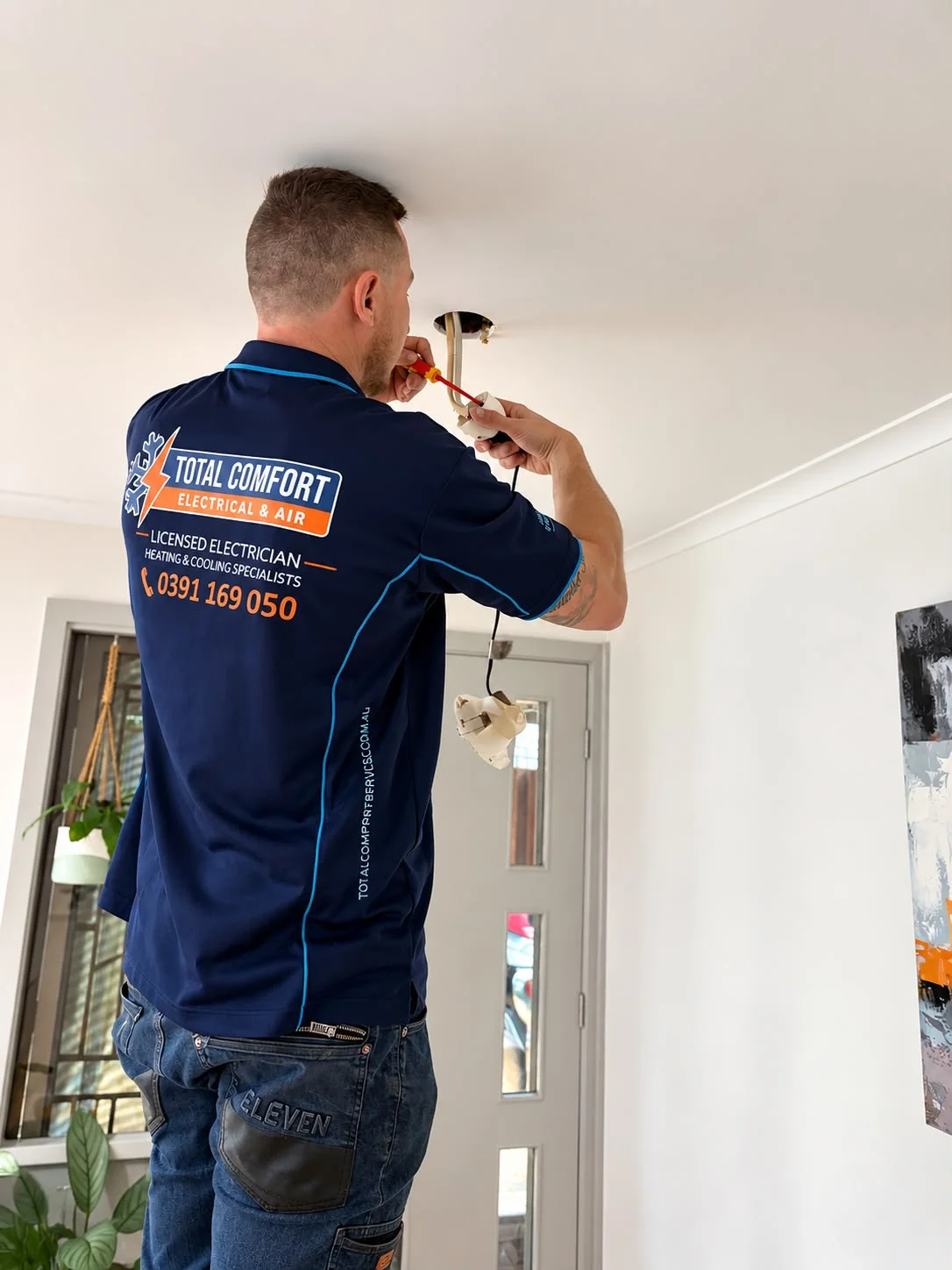
Our own photos from jobs like this one. Family-run, based in Altona Meadows, with 19 years in the industry.
Licensed electrical contractor (REC 38187)See more team photos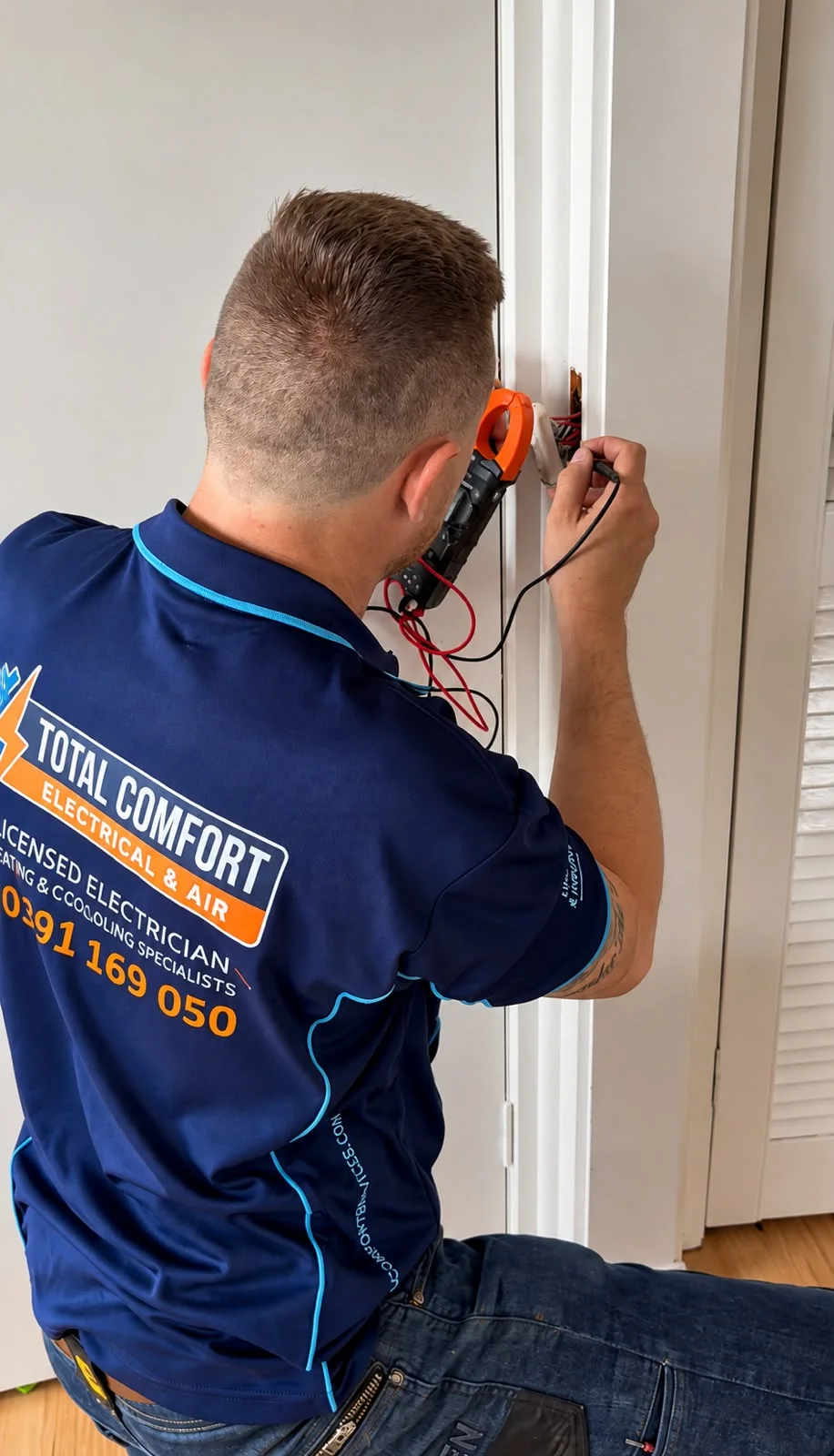
Worth knowing before you book
- Film it when it happens
- A short video, noting what was running, can save testing time.
- Dimmers and LEDs are a pair
- Moving to LED often means a new dimmer too, or the lights buzz and shimmer.
- Ask the neighbours
- If the street flickers too, it's likely the network.
What affects the price?
The right scope depends on your installation. These are the details we check so your quote is useful, with any additional work explained before it proceeds.
Whether it shows up on the day
A light that flickers on cue is quicker to diagnose than one that acts up weekly.
How many fittings are involved
One downlight is a small job. A room of old fittings on the wrong dimmer is bigger.
Getting to the wiring
Low roof spaces, raked ceilings and fittings under insulation take longer to reach safely.
Where the fault sits
A driver or dimmer is a smaller repair than a failing main switch or main neutral.
How it runs
- 1
Test and trace
We check fittings and controls, then test under load.
- 2
Price and repair
You get the price before we start, then we fix the cause.
- 3
Retest and explain
Lights are retested and we explain what was wrong.
Step by step, in more detail
4 steps
Start with the pattern
We ask which lights, how often and what was running. If the neighbours' lights flicker too, it's probably the network, not your home.
Check the fitting and its control
We look at the lamp, driver, transformer and lampholder, then the switch, dimmer or sensor. Most single-light faults turn up here.
Test under load
We measure voltage at the board and the light with heavy appliances running, then check terminals, the main neutral and insulation.
Repair, retest and explain
We fix the cause, retest and show you what failed. Electrical work comes with a Certificate of Electrical Safety. If readings point to the street, we tell you what to report to your distributor.
What is safe to do, and what to leave to us
Safe for you to do
- Note which lights flicker, when, and what was running. A short video helps.
- Turn off a light that buzzes, feels warm or smells hot, and leave it off.
- If lights are dull or flickering through the whole house, keep away from the switchboard and anything metal. Turn off power points you can easily reach, unplug appliances and let your electricity distributor know.
- If a tap or appliance gives you a tingle, stop using it, let your electricity distributor know and have a licensed electrician check the wiring.
- If there's smoke, fire or immediate danger, get everyone out of the house.
Leave these to us
- Opening or swapping a switch, dimmer or fitting yourself. Energy Safe Victoria says electrical work isn't DIY, even changing a light switch.
- Flicking circuits off and on at the board to chase the flicker.
- Buying globe after globe for a fitting that keeps killing them.
When to get us in
- A light still flickers after a new globe
- Every light dims hard, or some brighten as others dim
- A switch or fitting buzzes, smells or feels warm
More detail
One light, one room or the whole house
How far the flicker spreads tells us where to start. One fitting points to its driver or lampholder, one switch to the control or its cable, and the whole house to the board, main connections or supply.
Why LEDs show faults older globes hid
A hot filament smoothed over small voltage wobbles. An LED responds almost instantly, and its driver decides how well it copes. That's why a house that seemed fine with halogens can flicker after an LED upgrade.
A normal dip versus a fault
Motors draw a surge as they start, so a brief dip when the fridge or air conditioner kicks in is common. Dimming you can clearly see, that lingers or worsens over weeks, points to resistance in a connection. Resistance means heat.
Local rules and conditions
Victorian requirements and local conditions that shape this job, with the sources listed at the foot of the page.
Where your wiring meets the network
Flicker or dimming that affects the whole street usually starts on the network, so check with your electricity distributor first. The owner is responsible for repairs from the point of supply, where the network meets the installation. Powercor's Altona Terminal Station (West) supplies Altona Meadows, Point Cook and Werribee; Jemena's area reaches Williamstown and Footscray; CitiPower supplies parts of Port Melbourne.
Older and newer homes flicker differently
Brimbank has both: pre- and post-war homes in Sunshine and Deer Park, contemporary housing in Derrimut. In an older house, Energy Safe Victoria says to have the wiring checked once it's over 30 years old. In newer homes, drivers and dimmers are the usual suspects.
Heatwaves are hard on downlight drivers
Laverton's weather station set its January record, 45.6 °C, on 27 January 2026. A roof space runs hotter than the air outside, and LED drivers in it age faster. Downlights that flicker after a hot spell often have a cooked driver.
Useful reading
Guides to read before you decide, with checklists and questions to bring to the quote.
- Power out? How to tell if it's the network or your houseDark street or just your place? A few checks from the front window to the meter box tell you who to contact first, without opening anything.
- Downlights, ceiling insulation and fire riskWhy old halogen downlights and their transformers need space in the roof, what IC-rated LED fittings change, and why the lights come before the insulation.
- What electrical work you can and can't do yourself in VictoriaWhere Victorian law draws the line on home electrical work, the short list of jobs that are yours, and what to do when a job goes past it.
- A room-by-room lighting plan that goes beyond more downlightsPlan task lighting, comfortable evening light and outdoor coverage around how each space is used.
Common questions
Questions people ask about this
- Why do my lights dim when the air conditioner or fridge starts?A brief dip as a motor starts is common.
- Why do my lights flicker on windy days?If your lights flicker when the wind blows, the overhead line to your house is the first suspect.
- Why does my light switch buzz or feel warm?A dimmer can hum faintly and feel a little warm, because it is an electronic device that sheds some heat while it works.
- One downlight has stopped working. Is it the globe or the fitting?Check whether it has a removable globe.
Sources for the rules and local facts on this page
12 sources, with the date each was checked
- 1.Energy Safe Victoria: The point of supply is the changeover point from the electricity distribution network to the electrical installation, where the property owner becomes responsible for the maintenance and repair of the electrical… Accessed 30 September 2026.
- 2.Powercor Australia, Project Assessment Draft Report: Altona Terminal Station (West) (June 2025): It supplies part of Melbourne’s western growth corridor. This includes the areas of Laverton, Laverton North, Altona Meadows, Werribee, Wyndham Vale, Mount Cottrell, Eynesbury, Tarneit, Hoppers Crossing and Point Cook… Accessed 30 September 2026.
- 3.Jemena Electricity Networks (Vic) Ltd, 2025 Distribution Annual Planning Report (2 December 2025): Figure 1-1 shows the JEN supply area, which ranges from Gisborne South, Clarkefield and Mickleham in the north to Williamstown and Footscray in the south, and from Hillside, Sydenham and Brooklyn in the west to… Accessed 30 September 2026.
- 4.CitiPower, Distribution Annual Planning Report December 2024 (hosted by the Australian Energy Regulator): The zone substation in Fisherman’s Bend (E) is served by two sub-transmission lines from Fisherman Bend Terminal station (FBTS). The zone substation supplies areas of Fisherman’s Bend and Port Melbourne. Accessed 30 September 2026.
- 5.Victorian Electoral Commission (2023 electoral structure review fact sheet): Pre- and post-war homes characterise the established suburbs of Sunshine, St Albans and Deer Park. The more recently developed suburbs of Cairnlea, Sydenham, Hillside, and Derrimut feature more contemporary housing. Accessed 30 September 2026.
- 6.Energy Safe Victoria: Old switchboards, particularly those without a safety switch Old power switches or power points, particularly broken ones Flickering lights Sparks from switchboards, switches or power points. If your house is over 30… Accessed 30 September 2026.
- 7.Bureau of Meteorology: Highest temperature (°C) 45.6 47.5 41.4 35.5 27.3 24.3 23.5 26.8 31.3 37.2 42.4 45.2 47.5 82 1943 2026 Date 27 Jan 2026 07 Feb 2009 Accessed 30 September 2026.
- 8.Energy Safe Victoria: Electrical work isn’t a DIY job, even for small jobs such as changing power points or light switches. Accessed 30 September 2026.
- 9.Energy Safe Victoria: Whenever a licensed electrician completes any electrical installation work, they must provide a Certificate of Electrical Safety (COES). Accessed 30 September 2026.
- 10.Energy Safe Victoria: 'Prescribed' certificates are for electrical installation work that requires inspection by a Licensed Electrical inspector. This includes (but is not limited to): Consumer mains cables, main switchboard, meter box and… Accessed 30 September 2026.
- 11.Energy Safe Victoria: Surge diverters protect the property from voltage surges such as those resulting from a lightning strike. The surge diverter captures the voltage spikes in the wiring that would otherwise be transferred into the… Accessed 30 September 2026.
- 12.Consumer Affairs Victoria: The rental provider must organise and pay for all repairs if they are not the renter’s fault. Accessed 30 September 2026.