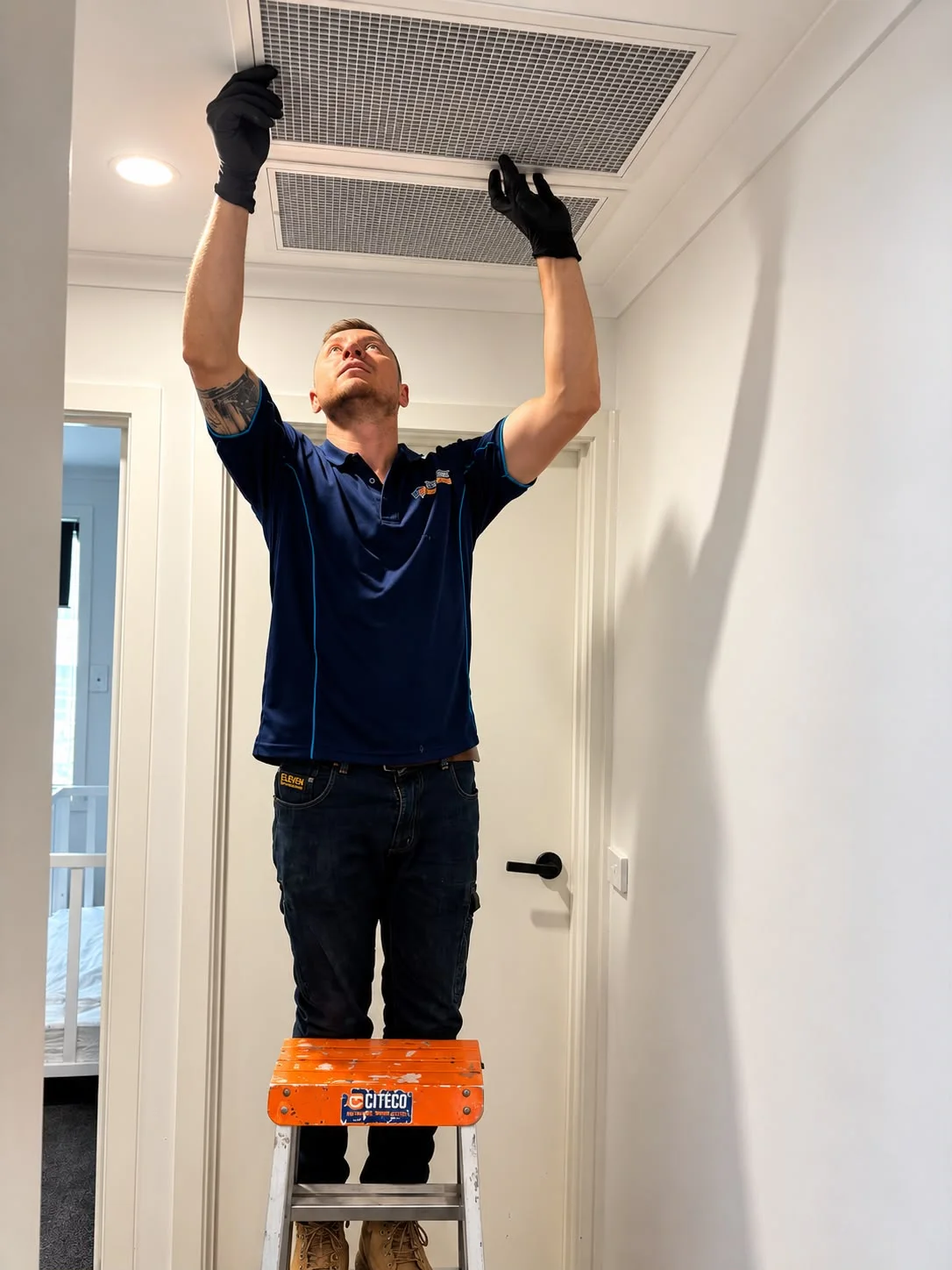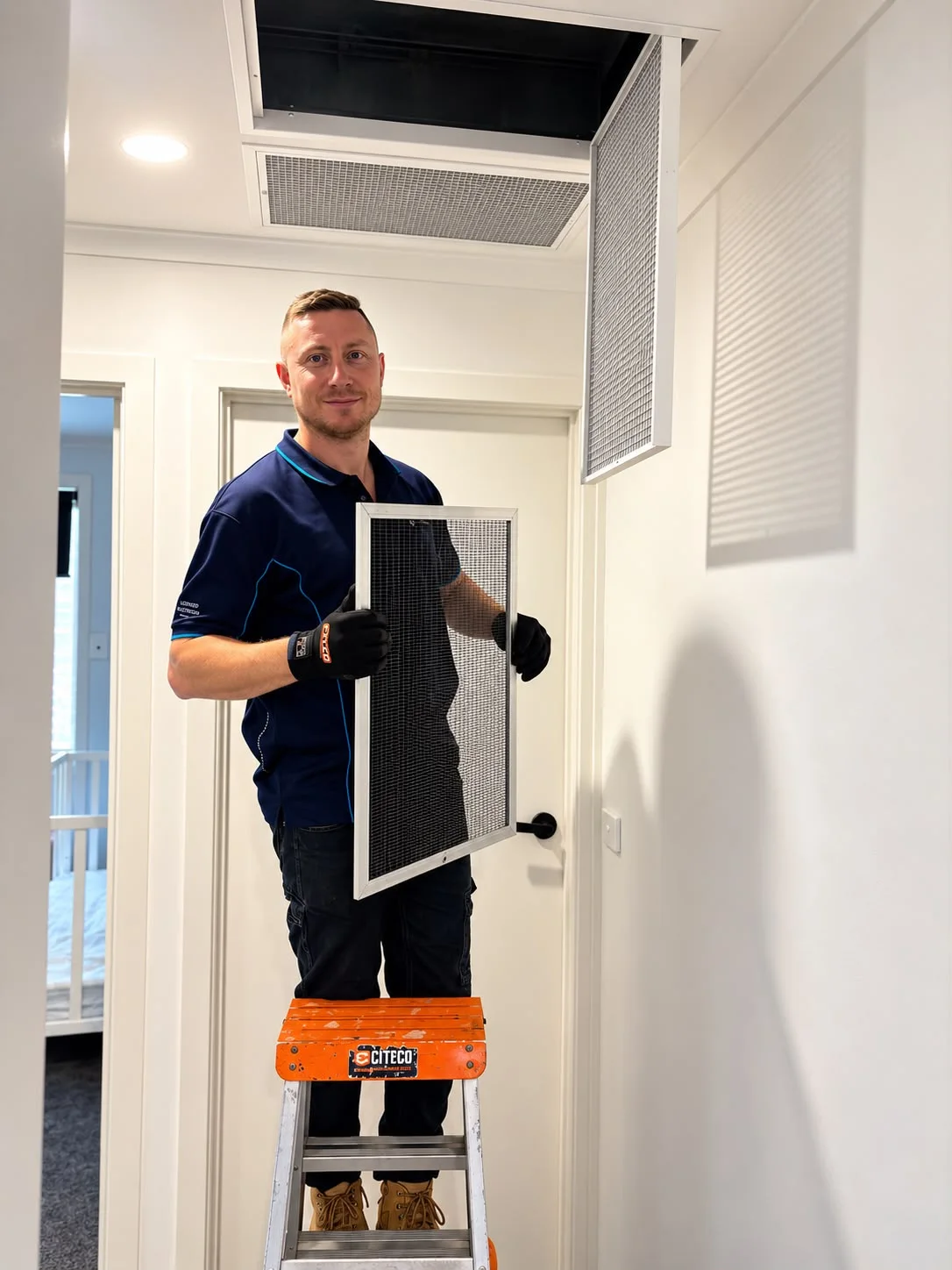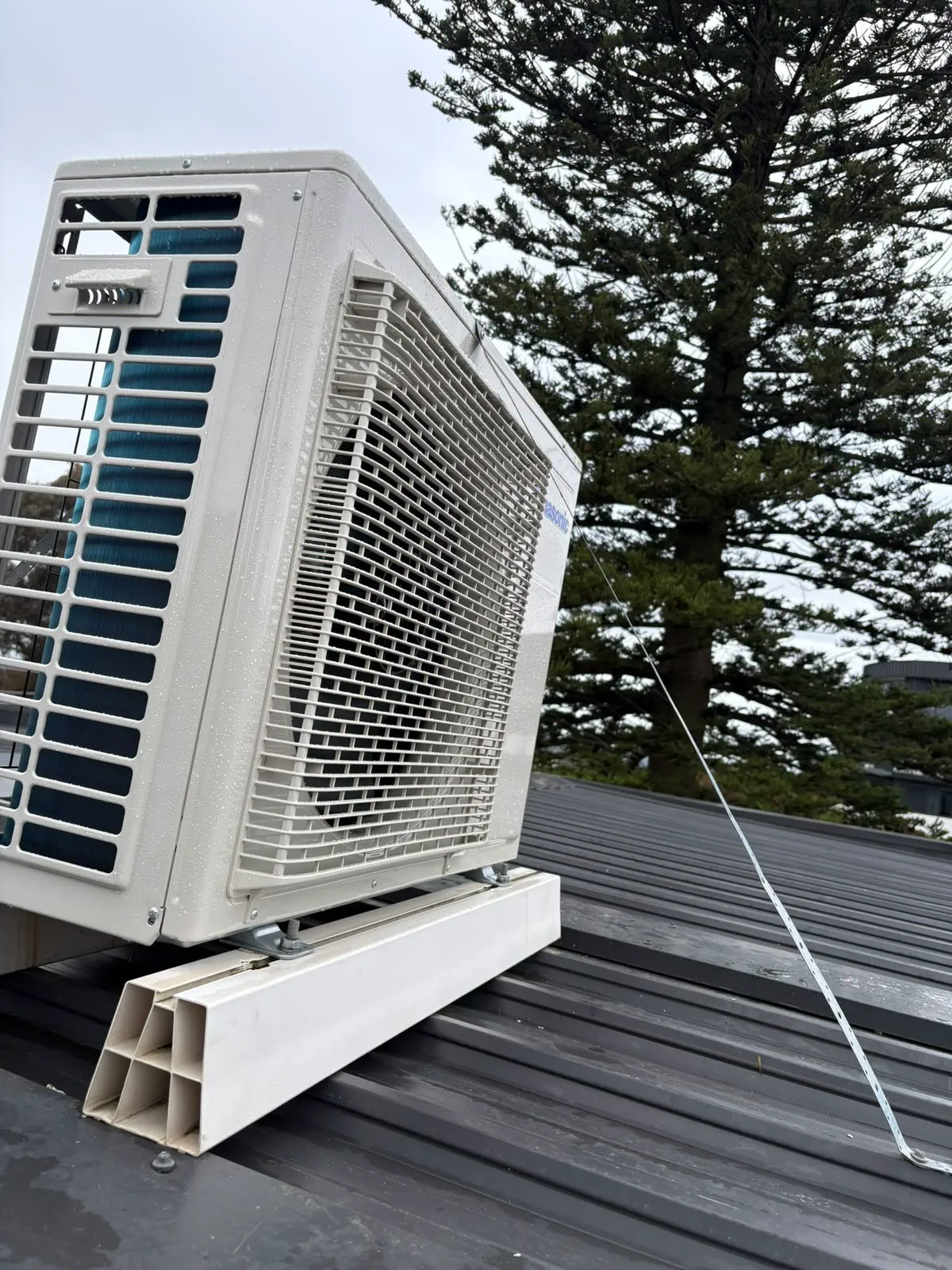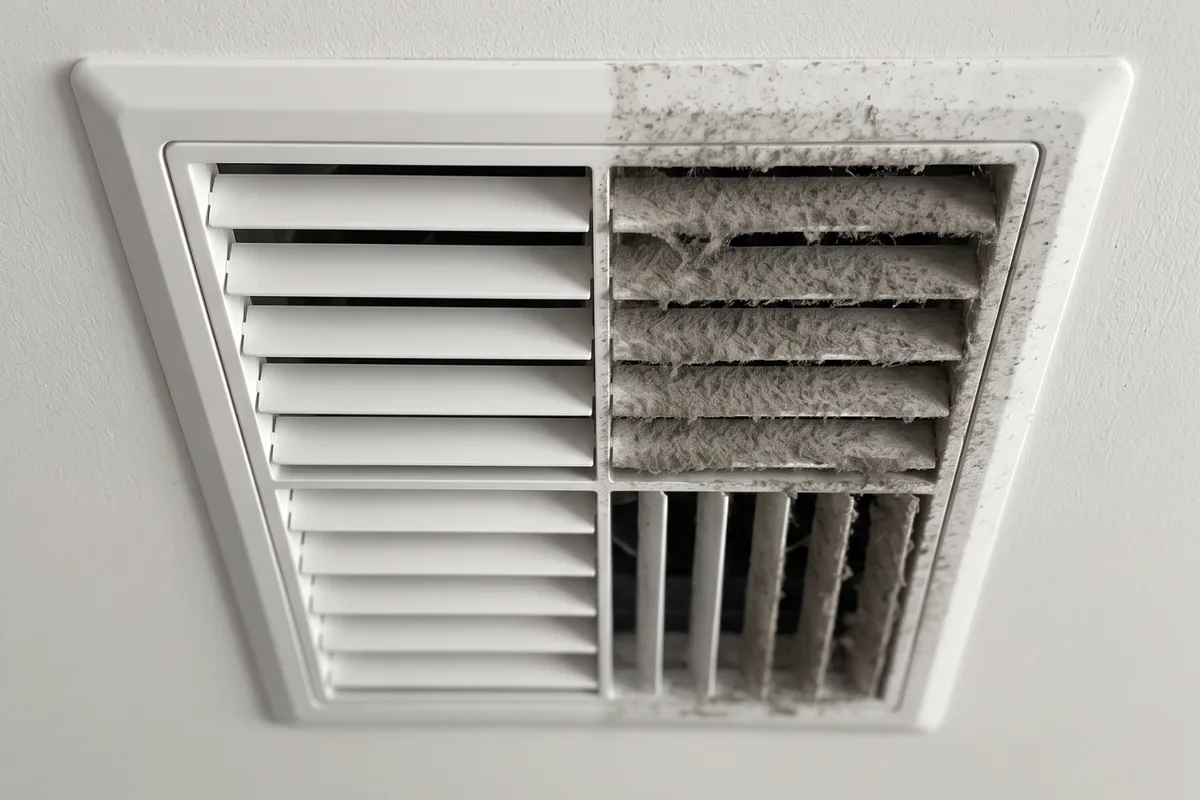
A ducted reverse-cycle system has a lot of parts between the switchboard and the vents, and a breakdown can start in any of them. Our team tests the supply and controls first, then works through the roof unit and the outdoor unit. You get the fault and the price before we fix it.
When to get it checked
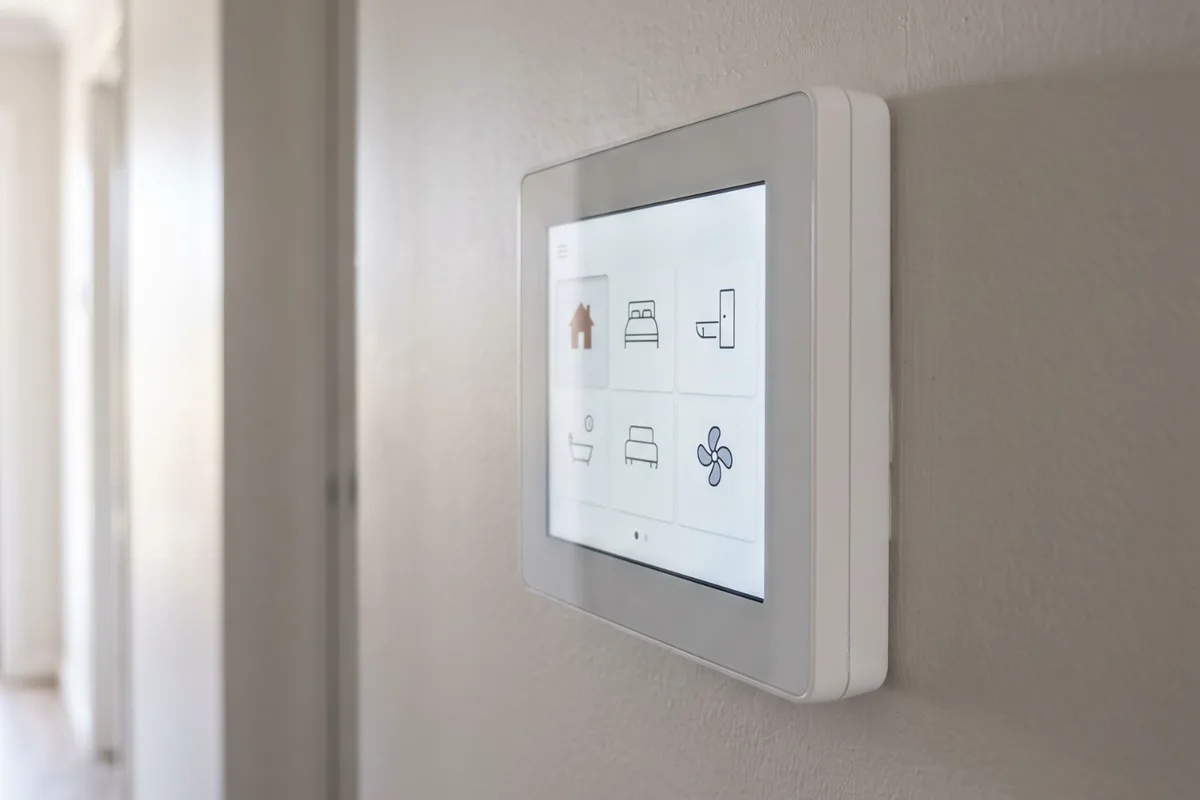
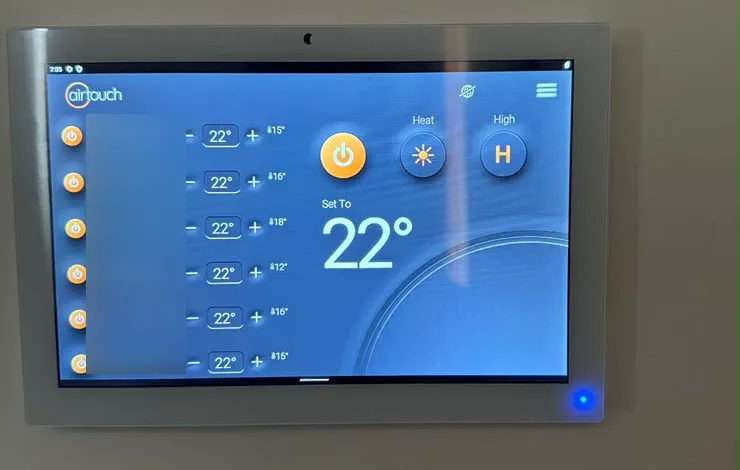
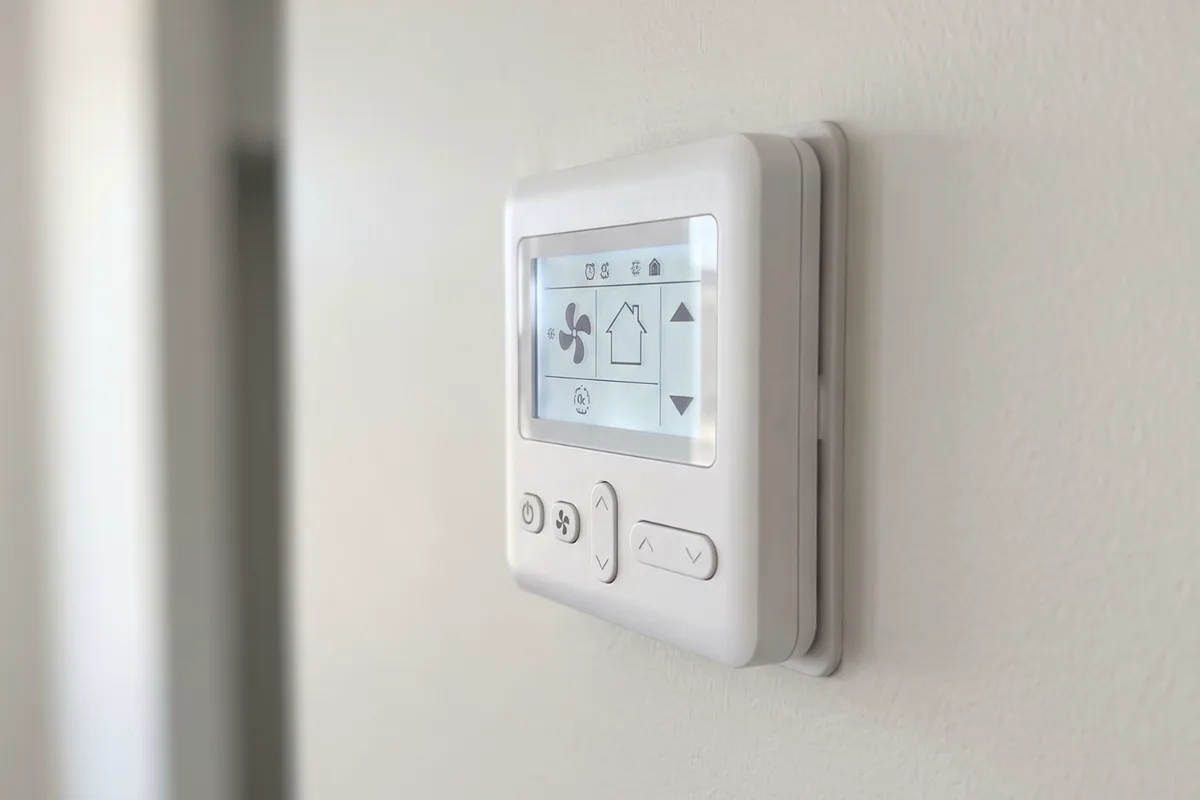
Nothing happens at the controller
The screen is blank, or it turns on but the roof unit never starts. That points at the supply, the controller cable or the indoor control board before anything bigger.
Air moves, but it isn't hot or cold
Air comes through the vents at room temperature. The outdoor unit may have stopped, iced up or be short of refrigerant.
An error code on the wall controller
A flashing code or fault light. Take a photo before resetting anything, because many systems clear the code from the screen once restarted.
The safety switch trips when it starts
The power drops as the compressor or fan kicks in. Reset it once; if it trips again, leave it off. Repeated tripping is a fault to find, not a switch to keep resetting.
Water through the ceiling
A stain or drip near the return grille or under the roof unit in cooling mode usually means a blocked drain, a cracked tray or a failed condensate pump.
Why it happens
5 common causes
Supply and protection faults
A tripped breaker, a failed isolator or a loose connection at the outdoor unit stops everything. We check these first because they're quick to rule in or out.
Controller and communication faults
The wall controller talks to the roof unit over a thin cable. A crushed cable, a dead controller or a failed board in the unit breaks that link, and the system shows an error or does nothing.
Worn fan motors and start-up parts
The indoor and outdoor fans run for thousands of hours, the indoor one in a roof that bakes in summer. Bearings wear and start-up components fail, often after a run of hot days.
Refrigerant leaks
A system that slowly lost its heating and cooling over a season or two may have a leak. No-one may top it up until it has been fully tested and every leak repaired.
A blocked drain
Dust and slime build up in the drain tray and pipe under the indoor coil. When the drain backs up, the water ends up in the ceiling.
What the job covers
What we usually do on this job. Your quote confirms it for your place.
- Error code and fault history read
- Circuit, safety switch and isolator tested
- Wall controller and cable checked
- Indoor unit in the roof inspected where safe
- Outdoor unit, fans and connections checked
- Drain tray and condensate line checked
- Fault explained and repair priced first
- Heating and cooling tested after the repair
Your options, explained
Electrical or control repair
Low disruption- Best for
- A system that won't start, trips the power or shows a communication error
- How it works
- We find and fix the fault in the supply, isolator, controller, cable or control board, using parts made for your unit.
- Worth knowing
- Often sorted on the first visit when the part is common. Boards and controllers for some units have to be ordered in.
Fan, motor or drain repair
Medium disruption- Best for
- Noisy fans, a failed fan motor, a blocked drain or a dead condensate pump
- How it works
- The worn or failed part is replaced in the roof unit or the outdoor unit, then the system is run and checked.
- Worth knowing
- Roof access decides how long it takes. A unit squeezed behind trusses takes longer to work on safely.
Refrigerant leak repair
Medium disruption- Best for
- A system that has slowly lost heating or cooling
- How it works
- The leak is found and repaired, then the system is pressure tested, evacuated and recharged by a technician holding a refrigerant handling licence.
- Worth knowing
- Topping up without finding the leak is illegal, and it only delays the next breakdown.
Repair priced against replacement
High disruption- Best for
- An older system with a major failure, such as the compressor or a coil
- How it works
- We price the repair alongside a replacement unit so you can compare them side by side.
- Worth knowing
- If the ducts and outlets are sound, a replacement can often reuse them. Our ducted replacement page explains how.
The people behind the work
One local team for electrical, heating and cooling, based in Altona Meadows, with 19 years in the industry.
Licensed electrical contractor (REC 38187)See more team photos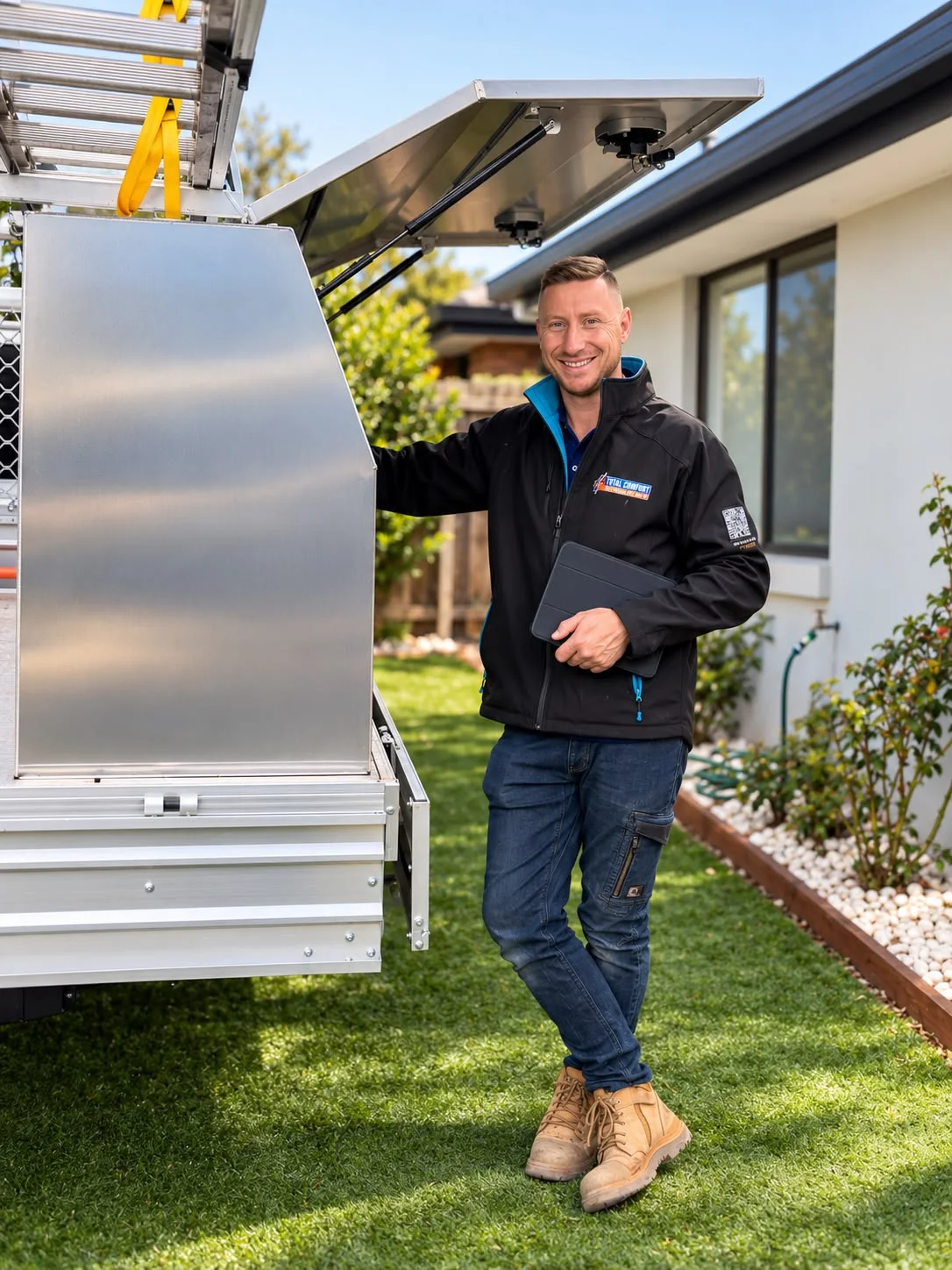
Worth knowing before you book
- Photograph the error code
- Many systems clear it once they're reset.
- Clear the manhole
- We need safe access to the unit in the roof.
- Old unit, big fault?
- We'll price replacement alongside the repair.
What affects the price?
The right scope depends on your installation. These are the details we check so your quote is useful, with any additional work explained before it proceeds.
Finding the fault
A clear error code and a common part is quick. An intermittent fault that only shows up on hot afternoons can take longer to pin down.
The part and its availability
Fan motors, sensors and boards vary a lot between makes and models. Parts for older or discontinued units can be harder to source.
Roof and outdoor access
A tight manhole, a low-pitched roof or an outdoor unit on a high bracket adds time, and sometimes extra equipment.
Refrigerant work
Finding a leak, repairing it, pressure testing and recharging is more involved than an electrical or fan repair.
Other faults found along the way
A damaged duct, a stuck zone damper or a worn drain line found during the repair is priced separately before we touch it.
How it runs
- 1
Tell us the symptoms
Mode, error code and when it started.
- 2
Test and diagnose
Power and controls first, then both units.
- 3
Price the repair
The fault and the price before any parts.
- 4
Fix and test
Repaired, then run in heating and cooling.
Step by step, in more detail
5 steps
Tell us what it's doing
When you book, tell us the mode, what the controller shows and when it started. A photo of the error code and the unit labels helps us bring the right gear.
Start at the power
We check the circuit, the breaker and safety switch, the isolator at the outdoor unit and the connections. Electrical faults are common and quick to confirm or rule out.
Work through the system
Controller and cable, then the indoor unit in the roof where access is safe, then the outdoor unit. We read the fault history where the system stores one and test the parts the code points to.
Explain and price
You get a plain explanation of the fault, what fixing it involves and the price before any parts are ordered or fitted. If the repair isn't worth doing, we say so.
Repair and test both modes
Once the part is in, we run heating and cooling, check air at the outlets and confirm the drain is clear. Any electrical installation work comes with a Certificate of Electrical Safety.
What is safe to do, and what to leave to us
Safe for you to do
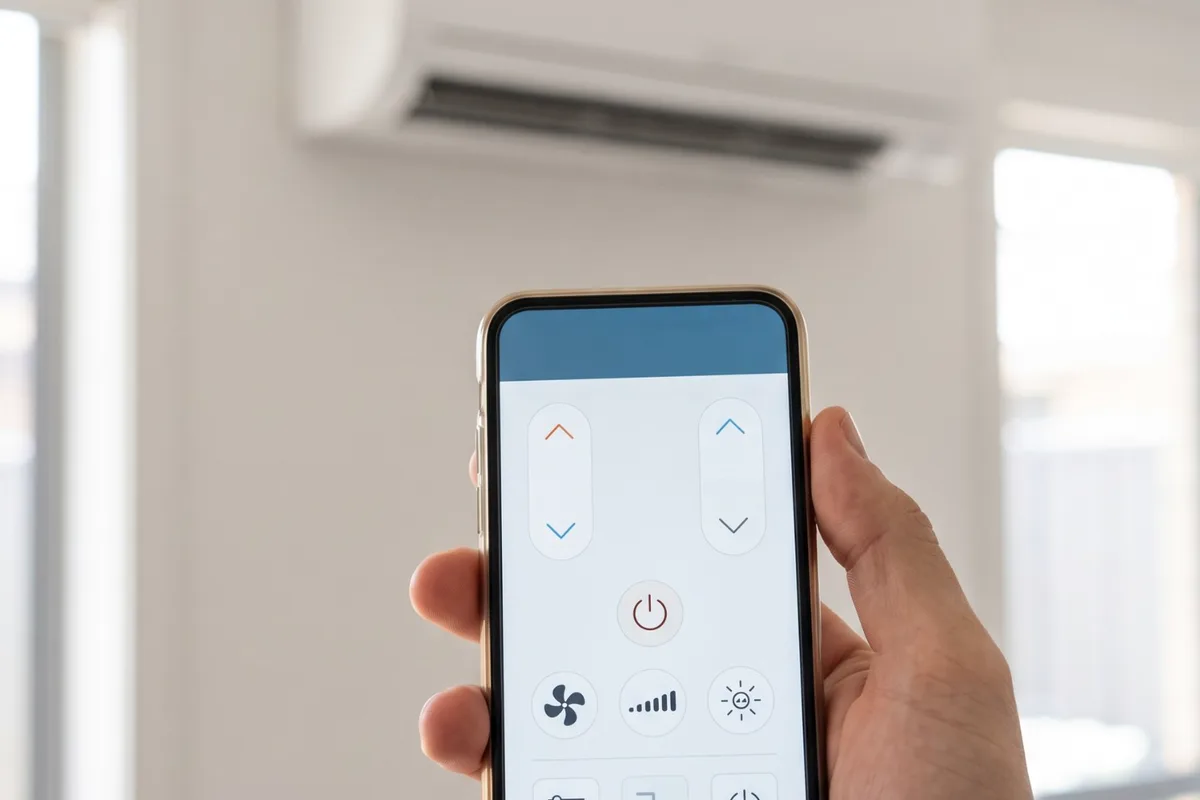
- Check the controller is in the right mode, the set temperature is sensible and no timer or schedule is overriding you.
- Photograph any error code before resetting the system.
- If a safety switch trips, reset it once. If it trips again or won't reset, leave it off and call a licensed electrician.
- If water comes through the ceiling, turn the system off, keep clear of nearby light fittings and switch off at the switchboard if it's safe to reach.
Leave these to us
- Climbing into the roof space to look at the indoor unit.
- Opening either unit, the isolator or the controller wall plate. Electrical work isn't a DIY job, even for small jobs.
- Letting anyone add refrigerant before the system has been leak tested and repaired.
- Restarting the system again and again while it trips the power or smells hot.
When to get us in
- The controller is blank or the system won't start
- Air blows but it isn't heating or cooling
- The same error code keeps coming back after a reset
- The safety switch trips when the system starts
- Water is dripping from the ceiling near the unit or return grille
- A burning smell from a vent or the outdoor unit (turn it off, and switch off at the switchboard if it's safe to reach)
More detail
Error codes are a starting point
Most ducted systems show a code on the wall controller when they detect a fault, and many keep a history of past faults. A code tells us which protection tripped, not always which part failed. A high-pressure fault in cooling, for example, can come from a failed outdoor fan, a blocked coil or a refrigerant problem.
That's why we test before ordering parts. Replacing the board a code points at, without checking the sensor and wiring that feed it, is an expensive way to guess.
Repair or replace an older system
The Victorian Government says a reverse-cycle system more than 15 years old typically uses more than three times the energy of a modern one. That doesn't mean every older unit should go, but it changes the sums when a major part fails.
Refrigerant rules matter too. Australia is phasing down imports of HFC refrigerants, though consumers don't have to replace existing equipment, and it's an offence to charge a system with a refrigerant of higher global warming potential than it was designed for. We explain what that means for your unit before you decide.
Who does which part of the repair
Circuits, isolators and controller cabling are electrical installation work for a licensed electrician, and our electricians handle that side directly. A refrigeration mechanic's restricted electrical licence only covers like-for-like disconnection and reconnection.
Anything that involves the refrigerant is for a technician holding a refrigerant handling licence. Releasing refrigerant into the air is illegal, so it's recovered, never vented.
Local rules and conditions
Victorian requirements and local conditions that shape this job, with the sources listed at the foot of the page.
Breakdowns follow the heat
On the hottest days a ducted system runs flat out for hours, and that's when tired fan motors and start-up parts give up. Laverton averages 9.4 days a year at or above 35 °C, and set its January record of 45.6 °C on 27 January 2026. Victoria's health department advises checking your air conditioner works before extreme heat, so a test run in spring finds faults while there's time to fix them.
Rentals: heating and cooling are urgent repairs
Failed heating, and failed cooling the rental provider supplied, are both on Victoria's list of urgent repairs, which rental providers must do immediately. The rental provider organises and pays for the repair unless the renter caused the problem, so renters should report it to their provider or agent first.
Useful reading
Guides to read before you decide, with checklists and questions to bring to the quote.
- Air conditioner maintenance: what to watch between servicesKeep useful records, follow model-specific filter care and recognise symptoms that need a repair visit.
- Renting and the power or heating has failed: what to doNo power or a dead heater in a Victorian rental? What to check safely, what counts as urgent, how to report it, and what to do if nobody responds.
- Getting your air conditioning ready for a heatwaveA spring test run, clean filters, a clear outdoor unit and a backup plan: how to find a tired air conditioner before the first hot northerly does.
- Ducted zoning explainedZones, dampers, controllers and room sensors in plain terms, plus the airflow limits that decide whether zoning will fix your comfort problem.
Common questions
Questions people ask about this
More in the Help centreFrom the blog
Sources for the rules and local facts on this page
14 sources, with the date each was checked
- 1.Bureau of Meteorology: Mean number of days ≥ 30 °C 6.9 6.0 4.5 0.7 0.0 0.0 0.0 0.0 0.1 0.9 2.8 5.1 27.0 82 1943 2026 Mean number of days ≥ 35 °C 3.6 2.4 0.9 0.0 0.0 0.0 0.0 0.0 0.0 0.1 0.5 1.9 9.4 Accessed 30 September 2026.
- 2.Better Health Channel (Department of Health, Victoria): Check that your fan and air-conditioner works well. Have your air-conditioner serviced if needed. Ensure the filters, pads and air vents are clean. Accessed 30 September 2026.
- 3.Consumer Affairs Victoria: Anything on this list is legally defined as an urgent repair: burst water service blocked or broken toilet system serious roof leak gas leak dangerous electrical fault flooding or serious flood damage serious… Accessed 30 September 2026.
- 4.Solar Victoria (updated 2 October 2025): A system that is more than 15 years old for example will typically use more than three times the amount of energy than a modern reverse-cycle air conditioner. Accessed 30 September 2026.
- 5.Department of Climate Change, Energy, the Environment and Water (DCCEEW): Australia’s HFC phase-down started on 1 January 2018. The HFC phase-down is a gradual reduction in the total amount of HFCs allowed into Australia. The amount will be reduced to 15% of baseline level by 1 January 2036… Accessed 30 September 2026.
- 6.Department of Climate Change, Energy, the Environment and Water (DCCEEW): You cannot charge refrigeration and air conditioning equipment with a higher global warming potential (GWP) refrigerant than the equipment was designed to use (the design refrigerant). To do so is an offence under the… Accessed 30 September 2026.
- 7.Department of Climate Change, Energy, the Environment and Water (DCCEEW): It's illegal to release regulated refrigerants into the air. This is because some refrigerants can stay in the atmosphere for decades or more and can be thousands of times worse for climate change than carbon dioxide… Accessed 30 September 2026.
- 8.Energy Safe Victoria: This licence type only allows the disconnection and reconnection of ‘like for like’ equipment, for the purposes of repair, replacement or maintenance. The Restricted Electrical Worker’s licence does not allow a person… Accessed 30 September 2026.
- 9.Australian Refrigeration Council (ARC): A Refrigerant Handling Licence must be held by any person who carries out work in relation to refrigeration and air conditioning (RAC) equipment. Carrying out work in relation to RAC equipment means to do anything with… Accessed 30 September 2026.
- 10.Australian Refrigeration Council (ARC), Fact Sheet 13 (ARC5225, 11/22): ‘Topping-up’ a system before the system has been fully tested and all identified leaks repaired by any individual is illegal. Accessed 30 September 2026.
- 11.Energy Safe Victoria: Locate your electricity box outside your home and check whether the safety switch has tripped. If it has tripped, reset the switch. If the switch won’t reset, call a licensed electrician. Accessed 30 September 2026.
- 12.Energy Safe Victoria: Electrical work isn’t a DIY job, even for small jobs such as changing power points or light switches. Accessed 30 September 2026.
- 13.Energy Safe Victoria: Whenever a licensed electrician completes any electrical installation work, they must provide a Certificate of Electrical Safety (COES). Accessed 30 September 2026.
- 14.Energy Safe Victoria: Type A appliances include domestic and light commercial type appliances such cookers, space heaters, central heaters, water heaters, catering equipment and leisure appliances. So, when looking to service and repair your… Accessed 30 September 2026.