
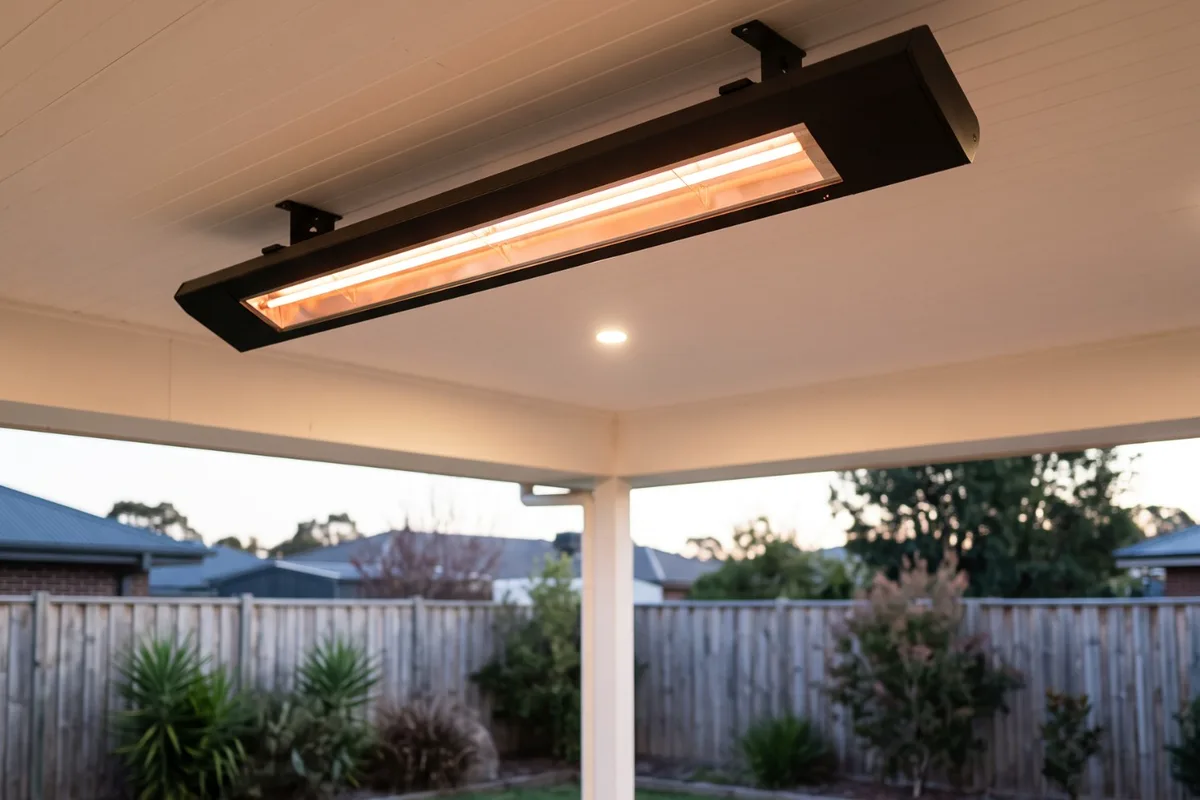
Radiant heaters warm people rather than the air, so they work in open outdoor areas where other heaters struggle. We plan how many heaters you need and where, mount them at the height and clearance their manual sets, run a dedicated circuit with safety switch protection and fit the controls you want.
When to get it checked
Too cold to sit outside
The alfresco gets a few months' use a year because evenings turn cold the moment the sun goes down.
Gas bottles and portable heaters
Swapping gas bottles, or dragging a portable heater out with a lead running across the deck.
A heater that trips the power
An outdoor heater on a power point that trips the safety switch, or a plug that gets warm.
Building a patio or pergola
A new outdoor area, where wiring for heaters, lights and power can go in while the roof is going up.
Heat that doesn't reach the table
An existing heater mounted too high or in the wrong spot, so the seats stay cold.
Why it happens
4 common causes
Warming air that blows away
Fan heaters warm the air, and outdoors the air moves on. Radiant heaters warm whatever they're aimed at.
Mounted too high or too far
Radiant heat drops off with distance, so a heater mounted well above the table loses most of its effect.
On a shared circuit
A large heater on an outdoor power point shares the circuit with everything else on it and trips under the load.
Wind and weather
Heaters and controls not rated for outdoor exposure fail early, especially on open decks near the bay.
What the job covers
What we usually do on this job. Your quote confirms it for your place.
- Outdoor area and seating layout assessed
- Heater size and positions planned
- Mounting height and roof clearance checked
- Dedicated circuit with safety switch protection
- Weatherproof switch, timer or remote fitted
- Heaters mounted and aimed at the seating
- Cable run neatly or in conduit
- Each heater tested before we leave
- Certificate of Electrical Safety issued
Your options, explained
Infrared strip heater under the roof
Low disruption- Best for
- Covered alfresco and patio areas
- How it works
- A slim radiant heater mounted under the roof or on a beam, aimed at the seating area.
- Worth knowing
- The most common choice. Needs the clearance from the roof lining that its manual sets.
Wall-mounted radiant heater
Low disruption- Best for
- Smaller patios against the house
- How it works
- A radiant heater on the wall, angled down towards where people sit.
- Worth knowing
- Often simple to wire from inside when the wall backs onto a room.
Several heaters on one control
Medium disruption- Best for
- Large or long outdoor areas
- How it works
- Two or more heaters on a shared switch, timer or remote, each on a suitable circuit.
- Worth knowing
- Larger setups may need switchboard space or a capacity check.
Plug-in portable heater
Low disruption- Best for
- Occasional use only
- How it works
- A freestanding electric heater plugged into an outdoor power point.
- Worth knowing
- Flexible, but the lead and the outlet carry the load. A fixed heater is safer for regular use.
The people behind the work
One local team for electrical, heating and cooling, based in Altona Meadows, with 19 years in the industry.
Licensed electrical contractor (REC 38187)See more team photos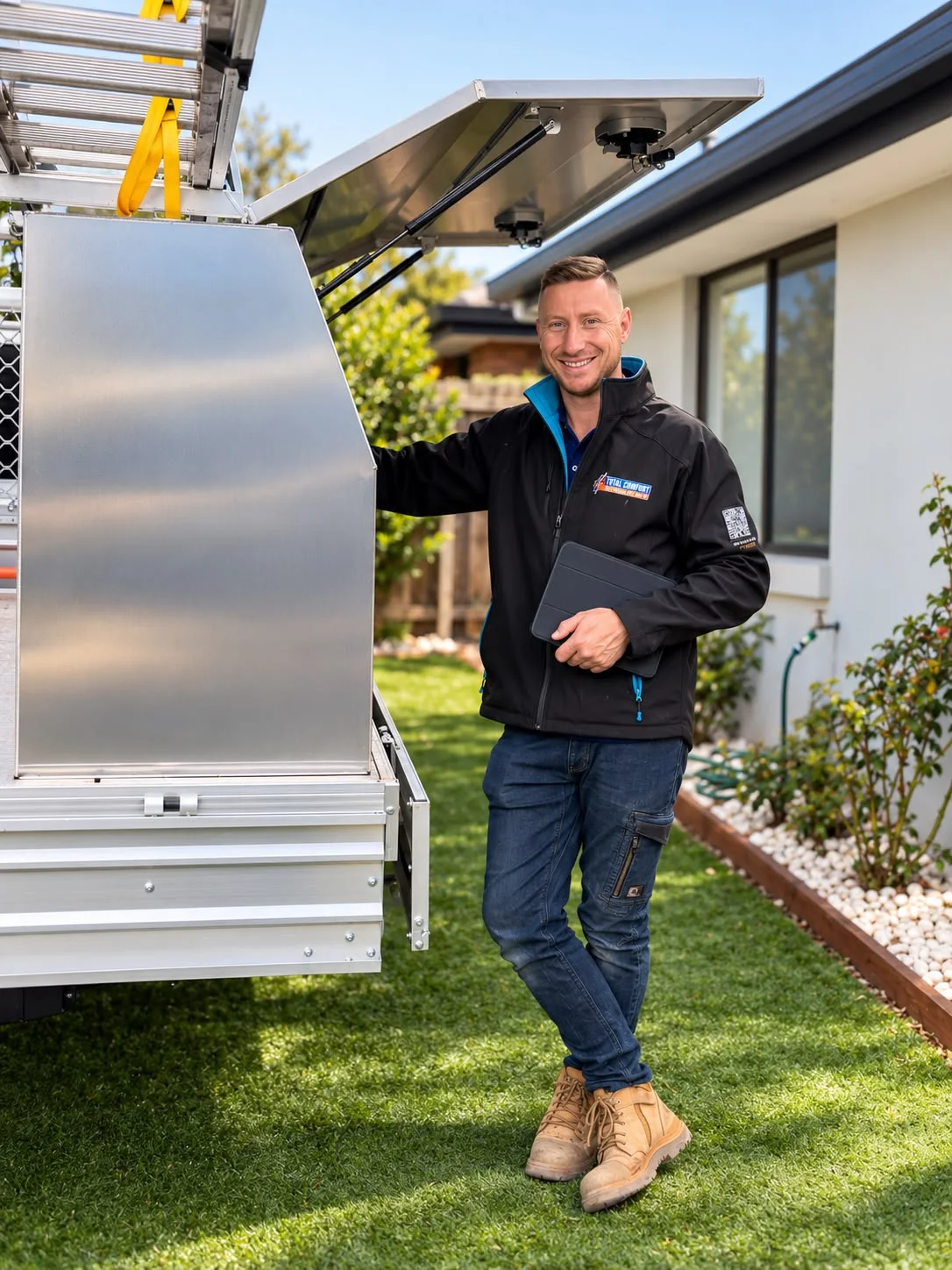
Worth knowing before you book
- Radiant, not fan
- Radiant heat warms people even when the breeze picks up.
- Mind the roof
- Every heater has a clearance from the roof lining in its manual.
- Building a patio?
- Wire for heaters while the roof is going up.
What affects the price?
The right scope depends on your installation. These are the details we check so your quote is useful, with any additional work explained before it proceeds.
Number and size of heaters
Each heater adds a mounting point and load, and larger heaters need more capacity.
Distance from the switchboard
A patio on the switchboard wall is a short run. A pergola across the yard needs cable in underground conduit.
Roof construction
A lined ceiling with roof space above is easy to cable. Open beams, flat roofs or polycarbonate roofing change the mounting and the cable route.
Controls
A simple switch, a timer, a remote or a multi-zone controller each change the scope.
Switchboard capacity
A full board or a tight supply may need extra work, priced as its own line.
How it runs
- 1
Send photos
The patio, the roof and where people sit.
- 2
Plan and quote
Heaters, positions and circuit, priced before we start.
- 3
Install
Circuit run, heaters mounted and controls fitted.
- 4
Test
Each heater tested and the controls explained.
Step by step, in more detail
5 steps
Tell us about the outdoor area
Send photos of the patio or pergola, the roof and its height, where people sit, and where your switchboard is.
Plan the heaters
We work out how many heaters you need, where they go, and the clearances the manual sets from the roof lining and walls.
Price before we start
You get the price for the agreed scope: the heaters, the circuit, the controls and any switchboard work.
Install
We run a dedicated circuit with safety switch protection, mount and aim the heaters, and fit weatherproof controls.
Test and show you
We test each heater and control, check the safety switch, and show you how to use the timer or remote.
What is safe to do, and what to leave to us
Safe for you to do
- Keep the clearances in the heater's manual from roof linings, umbrellas, blinds and plants.
- Switch the heaters off at the control when nobody is using the area.
- Reset a tripped safety switch once. If it won't reset or trips again, leave it off and call a licensed electrician.
Leave these to us
- Running a heater through an extension lead or power board outdoors.
- Hanging washing, blinds or decorations close to a radiant heater.
- Using an indoor heater outdoors.
- Installing or wiring an outdoor heater yourself. Energy Safe Victoria says unlicensed electrical work is illegal and potentially fatal.
When to get us in
- You want to use the alfresco in the cooler months
- A heater keeps tripping the power or the plug runs warm
- You're building a patio, pergola or deck
- You're replacing gas bottles with electric heating
- Existing heaters don't warm the seating area
More detail
Why radiant heat works outdoors
Outdoors, warm air drifts away as fast as a heater can make it. A radiant heater works like the sun: it warms the people, the table and the floor it's aimed at, so you feel it even when there's a breeze.
That's why electric infrared heaters are the usual choice for a covered alfresco or pergola, and why aiming them matters more than raw power.
Height and clearances
Every heater's manual sets its mounting height and the clearance it needs from the roof lining, walls and anything that could scorch. We follow it, and we choose the heater size and position so the warmth reaches the seats rather than the roof.
Some roofing materials need more room than others, so we check the manual against your roof before anything is mounted.
Its own circuit, properly protected
A fixed outdoor heater draws a steady load, so it goes on its own circuit rather than an outdoor power point shared with everything else. Energy Safe Victoria guidance says the Wiring Rules require a safety switch on every final sub-circuit in a home, and the new heater circuit gets that protection.
If your switchboard is full or the supply is tight, we'll tell you before quoting and price any extra work separately.
Switches, timers and remotes
Heaters can run from a weatherproof switch outside, a switch or timer inside the house, or a remote. Larger areas can be split into zones so you only heat the end of the table you're using.
A timer is worth having: it turns the heaters off after a set time if someone forgets.
Local rules and conditions
Victorian requirements and local conditions that shape this job, with the sources listed at the foot of the page.
Evenings that turn quickly
The Bureau of Meteorology says warm northerly winds often reach Melbourne ahead of a cold front, and the front can change conditions within minutes. An evening that starts mild can turn cold fast, and radiant heat is what keeps an open patio usable when the wind picks up.
Patios near the bay
BlueScope's marine-environment guide classes Port Phillip Bay from Altona to Portsea beaches as exposed marine, and Williamstown as calm marine. On patios close to the water, we choose heaters and controls rated for outdoor exposure and mount them under cover.
Useful reading
Guides to read before you decide, with checklists and questions to bring to the quote.
- Outdoor electrical safety: leads, garden tools, digging and wet weatherSafe habits for outdoor leads, power tools, digging near buried cables, wet weather and patio appliances, and what makes outdoor power fit for purpose.
- Outdoor lights and power points near the bay: choosing fittings that lastHow salt air in Altona, Williamstown and other bayside streets wears out outdoor fittings, and the materials, ratings and positions that hold up longer.
- Electric heating options compared: reverse-cycle, panel, oil and underfloorHow reverse-cycle compares with panel, oil-column, fan and underfloor electric heating on running cost, comfort and installation in a Melbourne home.
Common questions
Sources for the rules and local facts on this page
7 sources, with the date each was checked
- 1.Bureau of Meteorology (article issued 3 August 2026): To the north lies Australia's hot, dry interior, while to the south stretches the cold Southern Ocean. ... Warm northerly winds arrive first, bringing higher temperatures and clear skies. Then, as a cold front moves in… Accessed 30 September 2026.
- 2.BlueScope, Technical Bulletin TB-35 Australian salt marine classifications (March 2026, Revision 9): Exposed Port Phillip Bay (Altona to Portsea Beaches) Calm Port Phillip Bay (Williamstown), Yarra River (Docklands and Melbourne CBD), Maribyrnong River Accessed 30 September 2026.
- 3.Energy Safe Victoria: Gas and electricity are inherently dangerous and it’s illegal and potentially fatal for unlicensed and unqualified people to undertake any electrical or gasfitting work. Homeowners and consumers must always use… Accessed 30 September 2026.
- 4.Energy Safe Victoria: Locate your electricity box outside your home and check whether the safety switch has tripped. If it has tripped, reset the switch. If the switch won’t reset, call a licensed electrician. Accessed 30 September 2026.
- 5.Energy Safe Victoria: Whenever a licensed electrician completes any electrical installation work, they must provide a Certificate of Electrical Safety (COES). Accessed 30 September 2026.
- 6.Energy Safe Victoria: A Registered Electrical Contractor or Licensed Electrical Worker cannot refuse to issue a COES for any reason including payment issues or contract disputes. Accessed 30 September 2026.
- 7.Energy Safe Victoria: Clause 2.6.3.2.2 requires all final sub-circuits in a domestic installation be protected by a residual current device (RCD). A hot water service is included in this requirement Accessed 30 September 2026.