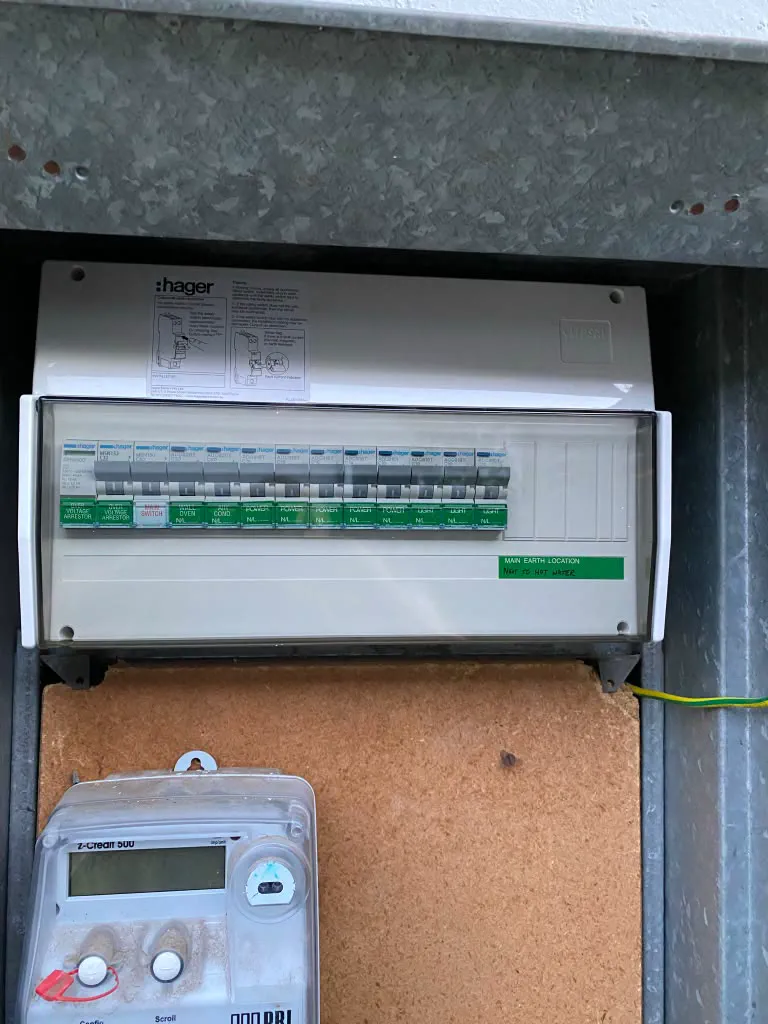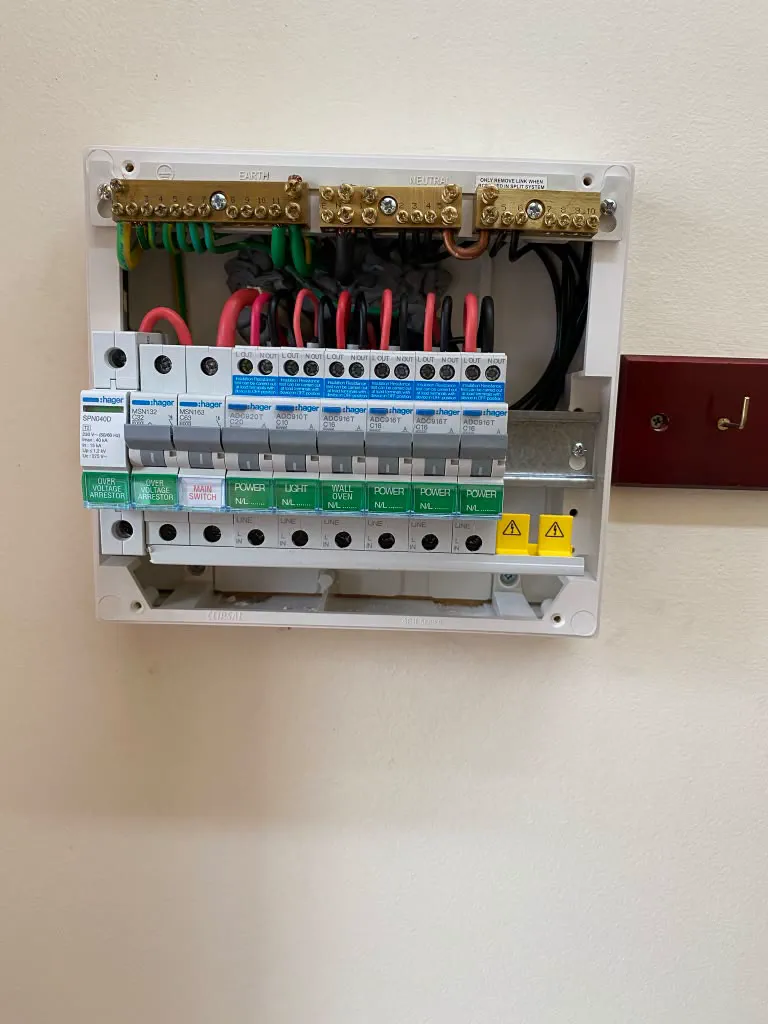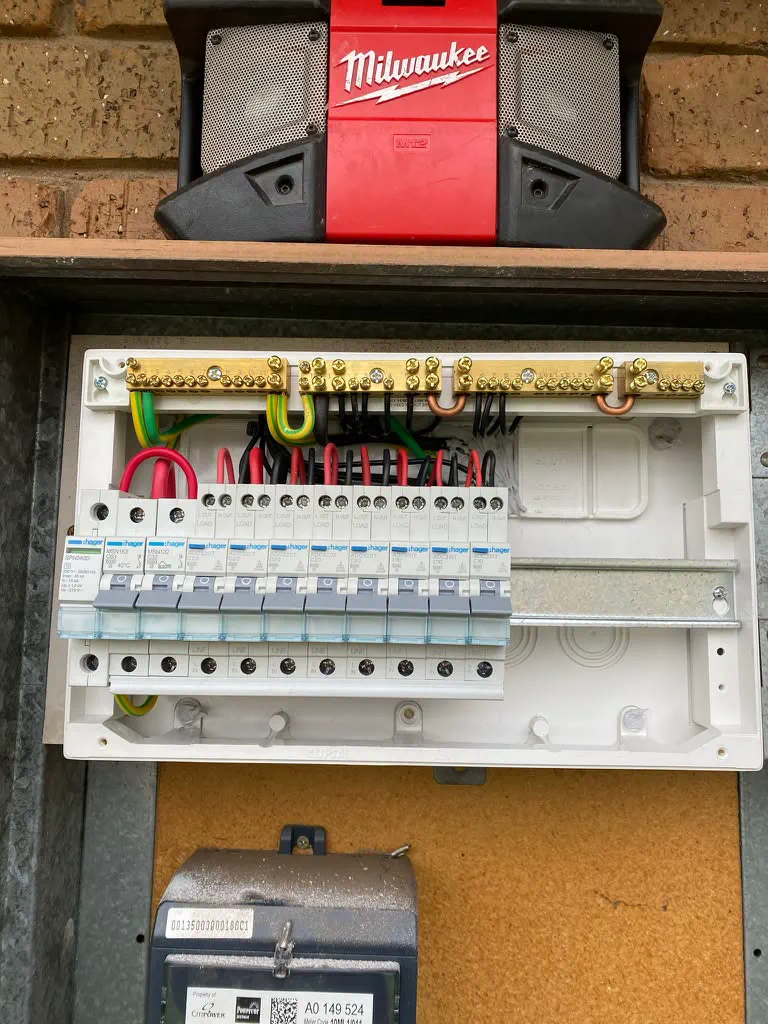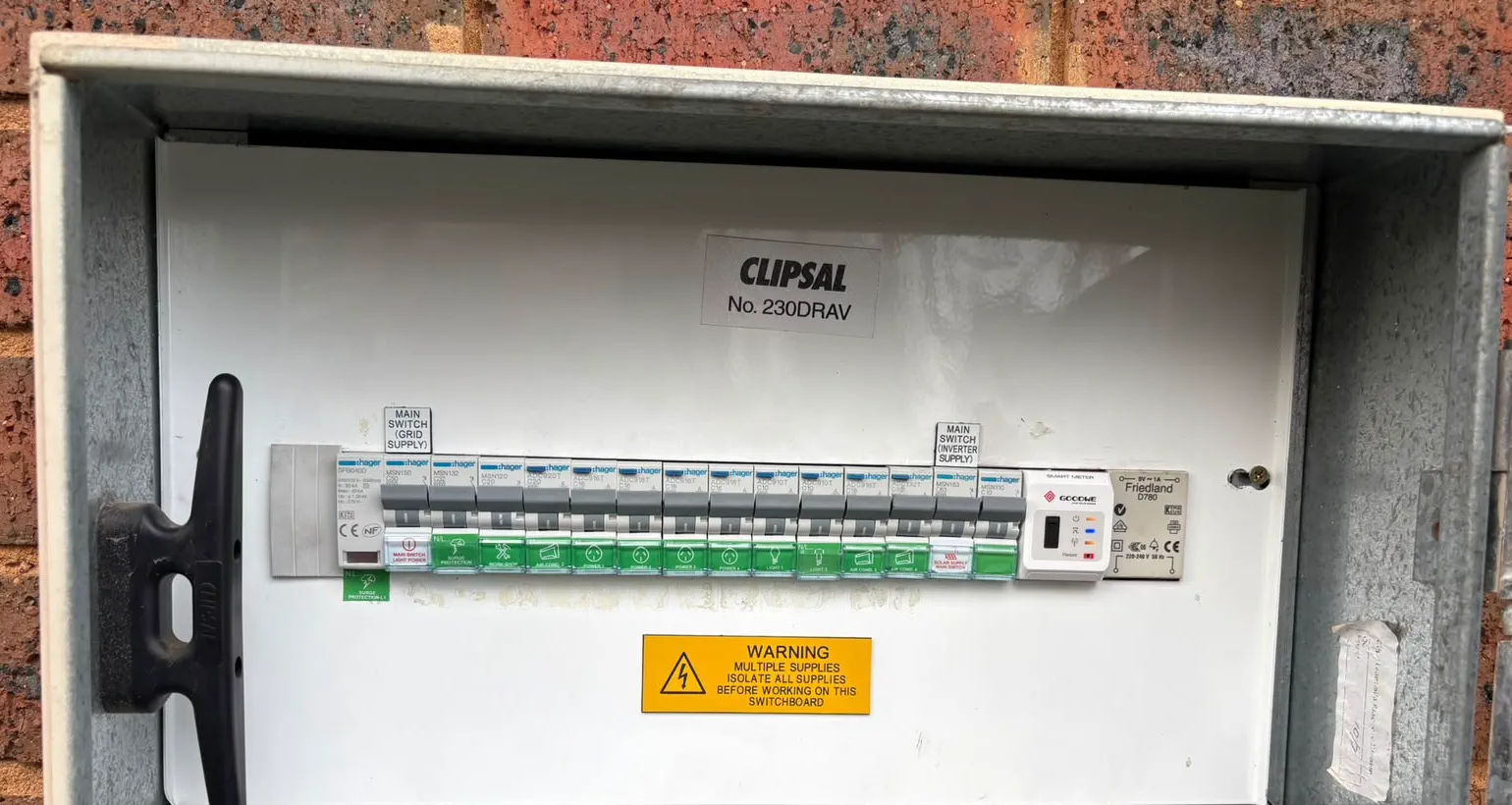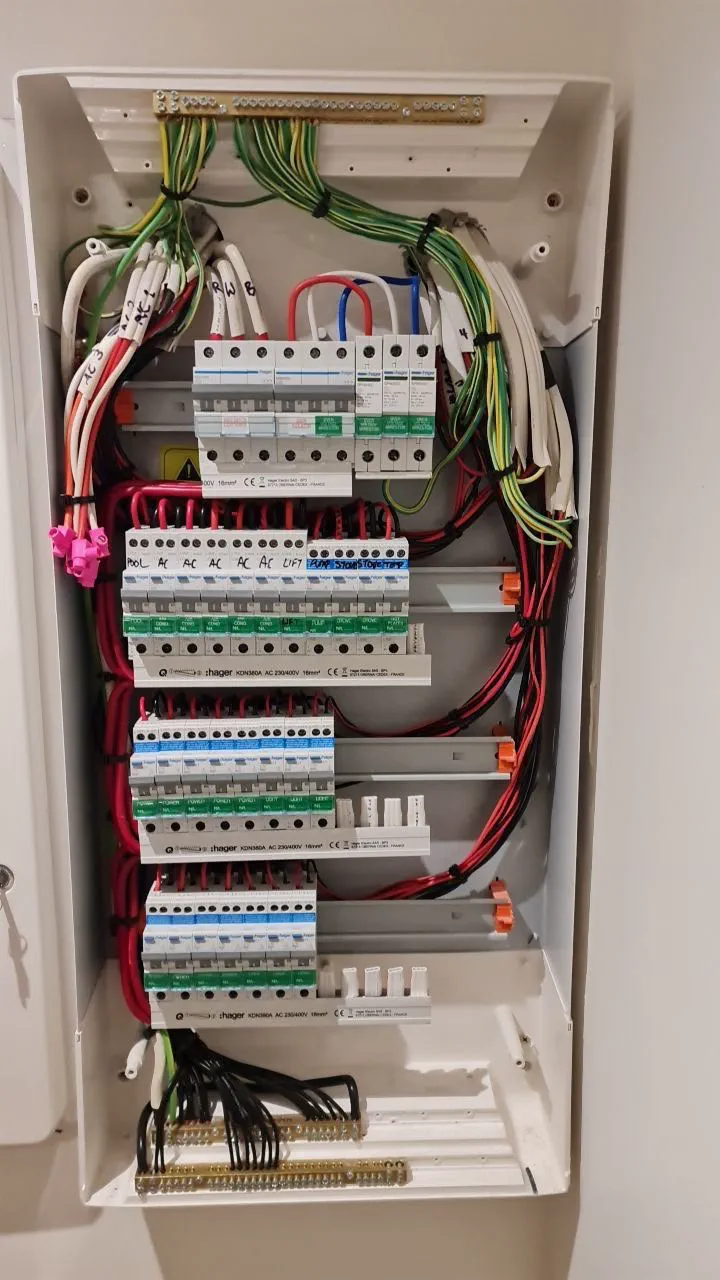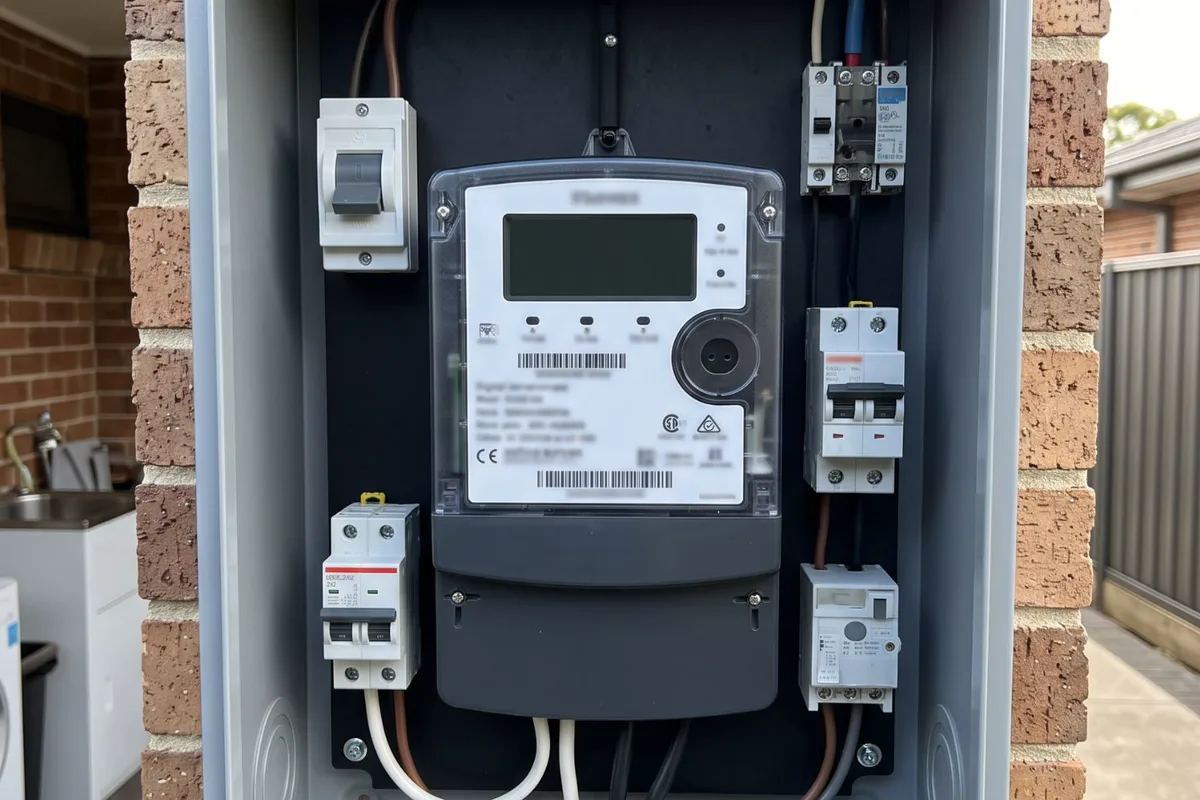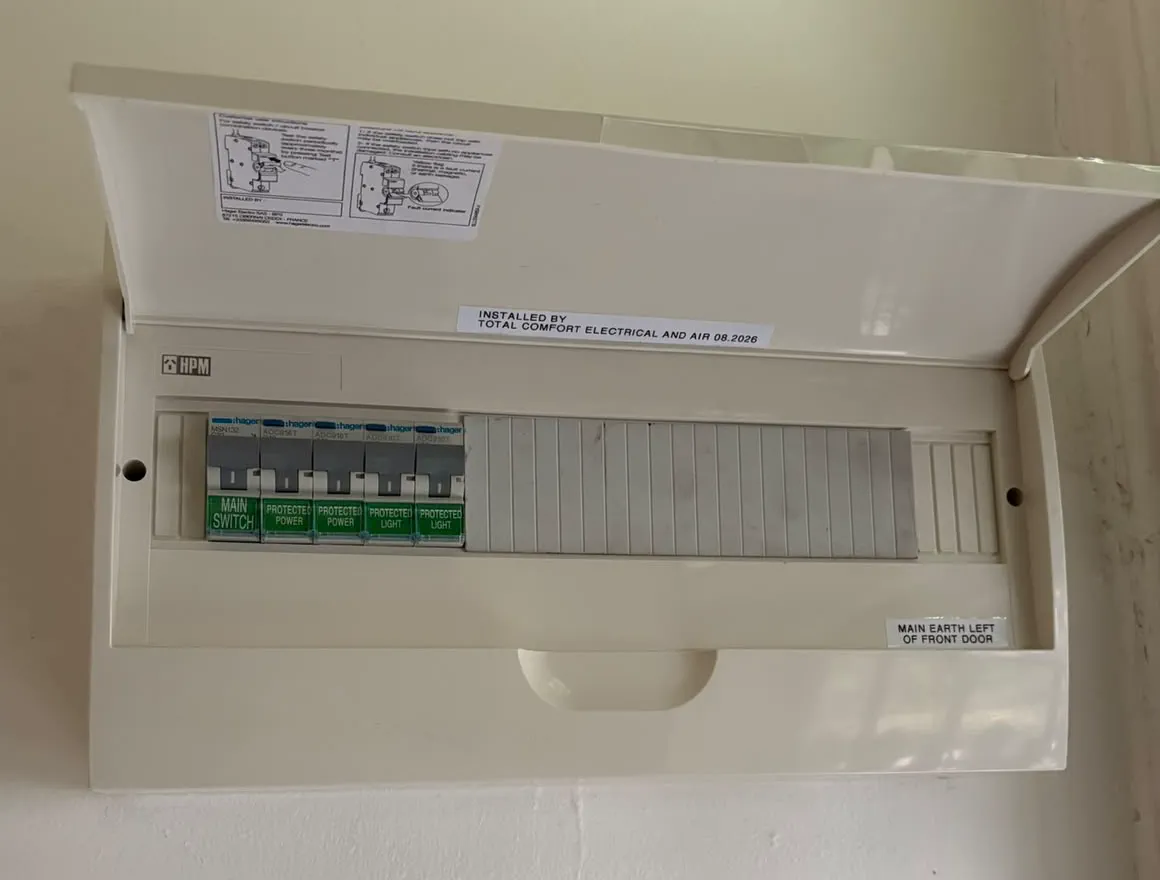
Plenty of older homes in Melbourne's west still have their original fuse box: ceramic carriers, fuse wire and often no safety switch. We replace it with circuit breakers and safety switches, check the backing panel for possible asbestos first, and test every circuit before the power goes back on.
When to get it checked
Ceramic carriers and fuse wire
White ceramic carriers pull out of the board, each bridged by a length of fuse wire. A card of spare wire often hangs nearby.
No test button anywhere
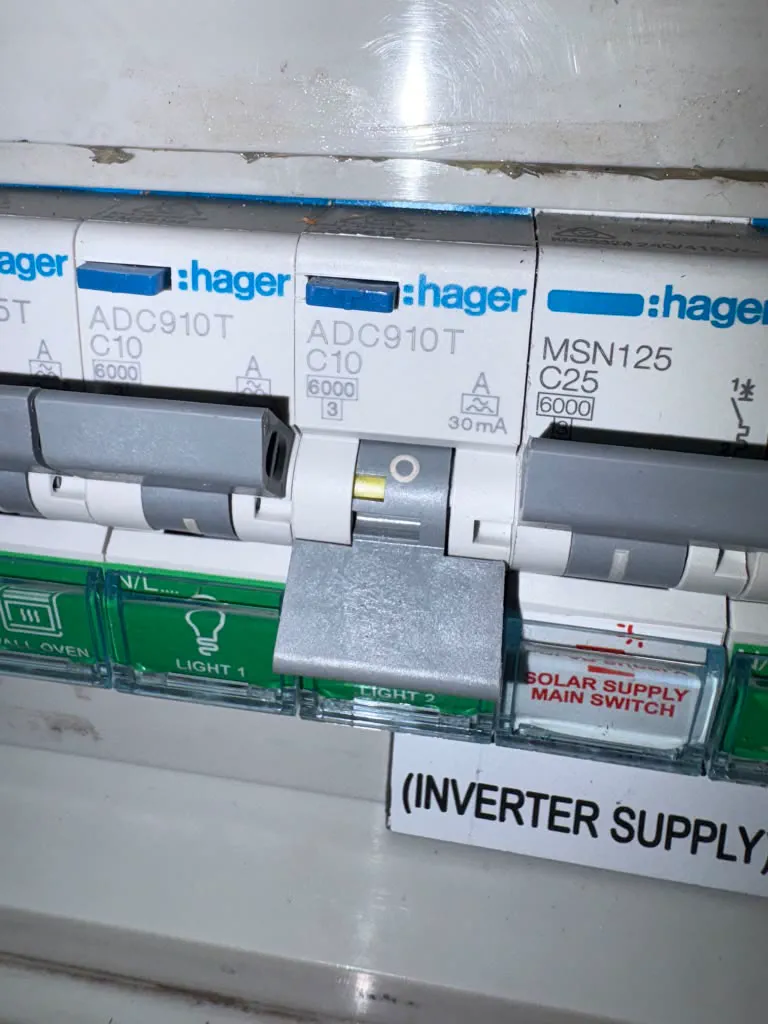
Energy Safe Victoria says safety switches always have a test button and 30mA printed on them. See neither, and the house probably has none.
The same fuse keeps blowing
It goes whenever the heater and kettle run together. The circuit is overloaded or faulty, and heavier wire would only hide it.
Scorching, cracks or a hot smell
Brown marks near a carrier, a cracked holder, buzzing or a burnt smell mean connections are overheating. Don't put that one off.
Why it happens
4 common causes
It's the original board
Plenty of post-war weatherboards and brick veneers still run on their first fuse board. Circuits were added; the fuses never changed.
Fuse wire gets swapped
When a fuse blows often, someone fits thicker wire to stop it. The protection is gone, and the cable can overheat before anything melts.
More load than anyone planned for
Plug-in heaters, a dryer and a bench of kitchen appliances weren't around when the fuses went in.
A sale, lease or renovation
A pre-purchase report flags the fuses, a rental must meet the minimum standard, or a renovation adds circuits the old board can't take.
What the job covers
What we usually do on this job. Your quote confirms it for your place.
- Old fuses, carriers and fuse wire removed
- New enclosure and main switch fitted
- A circuit breaker on every circuit
- Safety switches on all final sub-circuits
- Backing panel checked for possible asbestos
- Every circuit tested and labelled
- Licensed electrical inspection arranged
- Certificate of Electrical Safety issued
Your options, explained
New board, one combined device per circuit
Medium disruption- Best for
- Most family homes
- How it works
- Each circuit gets its own combined breaker and safety switch (RCBO), so a fault cuts only that circuit.
- Worth knowing
- More devices, but a faulty toaster won't black out the lights.
New board, grouped safety switches
Medium disruption- Best for
- Units and small homes with few circuits
- How it works
- Two or more safety switches each cover a group of breakers.
- Worth knowing
- Fewer parts, but one fault trips its whole group.
Keep the fuses, add safety switches
Low disruption- Best for
- Sound wiring, with a full change planned soon
- How it works
- Safety switches go in ahead of the power and lighting circuits; the fuses stay.
- Worth knowing
- Not always possible, and it fails the rental standard, which needs circuit breakers too. A stopgap at best.
The people behind the work
Our own photos from jobs like this one. Family-run, based in Altona Meadows, with 19 years in the industry.
Licensed electrical contractor (REC 38187)See more team photos
Worth knowing before you book
- Plan for the power being off
- Power stays off until the new board is inspected.
- Mention what's coming next
- Planning air conditioning, induction or an EV charger? Say so and we'll leave room.
- Old panels may contain asbestos
- We check before anything comes off the wall.
What affects the price?
The right scope depends on your installation. These are the details we check so your quote is useful, with any additional work explained before it proceeds.
Circuits and devices
Each circuit needs a breaker, shock protection, testing and a label. An RCBO on every circuit costs more in parts than grouped safety switches.
The backing panel
A panel that may contain asbestos changes how the board comes off, and a deteriorated one may need a licensed removalist.
The meter box
An old meter box that's too small, cracked or letting in weather may need replacing too.
Testing and the supply
Failed circuits need repair first. Some older homes also have a small supply from the street, which may need upgrading for today's loads.
How it runs
- 1
Look at the board
Fuses, panel, meter box, mains and earthing checked.
- 2
Price and date
A fixed price for the agreed scope.
- 3
Change over and test
New board in, every circuit tested and labelled.
- 4
Inspect and certify
Inspected, switched on and certified.
Step by step, in more detail
5 steps
Look at the board
We identify the fuse type, count circuits, check the backing panel, meter box, mains and main earth, and ask what you plan to add.
Fixed price and a plan
You get a fixed price for the agreed scope before we start, with a date and a plan for the power-off and any asbestos.
Change over the board
With the supply isolated, the new board goes in with safety switches on all final sub-circuits. None are Type AC, which Energy Safe Victoria says must not be installed in Australia.
Test every circuit
Insulation, earth continuity and polarity are tested before reconnection. A circuit that fails stays off until it's repaired.
Inspect and hand over
A licensed electrical inspector checks the board before the power goes back on. Then come labels, your certificate and a run-through of the test buttons.
What is safe to do, and what to leave to us
Safe for you to do
- If a fuse blows, switch off and unplug what was running on that circuit, then call us.
- Press each safety switch's test button every three months, as Energy Safe Victoria advises. If the power doesn't cut, call a licensed electrician.
- If there's smoke or fire, get everyone out of the house. Never use water on an electrical fire.
Leave these to us
- Rewiring a fuse yourself, or using heavier wire, a nail or foil.
- Drilling, cutting or sanding the old backing panel.
- Using extension leads from another room to get around a fuse that keeps blowing.
- Any unlicensed electrical work, which Energy Safe Victoria says is illegal and potentially fatal.
When to get us in
- Your board has ceramic fuses and no safety switch
- A fuse keeps blowing, or a carrier looks scorched or cracked
- Burning smell or buzzing at the board (switch off at the main switch if safe)
- You're buying, selling, leasing out or renovating
More detail
What a fuse board can't do
A rewireable fuse protects its cable only if it holds the right wire, and anyone can fit the wrong one. It does nothing for a person touching a live fault. A safety switch does: Energy Safe Victoria says it turns the power off within 0.03 of a second when it detects a risk to personal safety, though it won't prevent every shock.
Handling an old backing panel
You can't tell by looking whether a backing panel contains asbestos, so we check it when we quote. WorkSafe Victoria's compliance code says a licensed removalist may be needed if a mounting board has deteriorated or asbestos-contaminated dust is present. A removed asbestos panel must be replaced with non-asbestos material.
Why the new board may trip when the fuses never did
Fuses react only to overloads and short circuits. Safety switches also react to current leaking to earth, so faults the old board ignored can surface: a worn kettle element, water in an outdoor light, damp in an old cable. Testing before switch-on catches many wiring faults. Reset a tripped safety switch once; if it goes again, leave it off and call us.
Local rules and conditions
Victorian requirements and local conditions that shape this job, with the sources listed at the foot of the page.
Rental fuse boards
Victoria's rental electrical safety standard began on 29 March 2023. With a panel-and-fuse or federal fuse board, Consumer Affairs Victoria says the electrician may have to replace the whole board, and then every circuit needs circuit breaker components, including fixed cooking, hot water and air conditioning. The rental provider engages the electrician.
Post-war homes and old fuses
Hobsons Bay's planning scheme aims to preserve intact post-war brick and weatherboard homes in Altona's special character areas. WorkSafe Victoria lists fuse blankets and ceramic fuses in switchboards as examples of asbestos-containing materials, and flags buildings built or renovated before the late 1980s.
Useful reading
Guides to read before you decide, with checklists and questions to bring to the quote.
- Ceramic fuses and old switchboards: what to look forA look-but-don't-touch guide to old switchboards: rewireable fuses, a missing safety switch, suspect backing panels, heat marks and what replacement involves.
- Planning a switchboard upgrade without surprisesWhat the electrician needs to check, how to compare the scope and what to organise before the power goes off.
- A safety switch keeps tripping: what to record and when to callUnderstand the difference between a protective device doing its job and a fault that needs investigation.
- Certificates of Electrical Safety explainedWhat a Victorian COES records, how prescribed and non-prescribed work differ, when your copy should arrive and why it belongs in your house file.
Common questions
Questions people ask about this
- Do I need to be home for a switchboard upgrade?Someone should be there at the start and at the end, and the electrician needs access to the switchboard and to the rooms inside for testing.
- Will my fridge and freezer be OK during a switchboard upgrade?Usually, with some planning.
From the blog
- What electrical hazards hide in a post-war home in Altona or Laverton?Post-war brick and weatherboard homes in Altona, Laverton and Newport often hide original boards, tired wiring and DIY additions. What to look for and where to start.
- Is it worth upgrading the switchboard before you sell?A working board with breakers and safety switches rarely needs replacing to sell. An old fuse board with no safety switches is a different story, and timing matters.
Sources for the rules and local facts on this page
13 sources, with the date each was checked
- 1.Consumer Affairs Victoria: The electrical safety rental minimum standard commenced on 29 March 2023. Rental properties must have modern switchboards, with circuit breakers and electrical safety switches installed. Electrical safety switches are… Accessed 30 September 2026.
- 2.Victorian Government, Hobsons Bay Planning Scheme (PDF snapshot, last updated by VC292 on 11/09/2025): SPECIAL CHARACTER AREAS, ALTONA 1.0 24/02/2022 C131hbay Neighbourhood character objectives To preserve the characteristics of the neighbourhood, comprising intact post-war brick and weatherboard dwellings with… Accessed 30 September 2026.
- 3.WorkSafe Victoria: Fuse blankets and ceramic fuses in switchboards Pitch-based (eg Zelemite, Ausbestos, Lebah) electrical switchboards Accessed 30 September 2026.
- 4.Energy Safe Victoria: If a switchboard is required to be replaced then as per clause 2.6.3.2.5 (Alterations to installations and replacement of switchboards) of AS/NZS 3000: RCD’s are required on all final sub-circuits. Accessed 30 September 2026.
- 5.Energy Safe Victoria: The electrician has eight business days after the work is completed to have that work inspected by a licensed electrical inspector (LEI). If an electrician replaces a main switchboard at a property, power cannot go back… Accessed 30 September 2026.
- 6.Energy Safe Victoria: Whenever a licensed electrician completes any electrical installation work, they must provide a Certificate of Electrical Safety (COES). Accessed 30 September 2026.
- 7.Energy Safe Victoria: Type AC RCDs must not be installed in Australia. This includes like for like replacement. We recommend that electrical contractors advise customers of the new requirements. However, it is not mandatory to replace… Accessed 30 September 2026.
- 8.Energy Safe Victoria: monitors the flow of electricity through a circuit detects a problem that may pose a risk to personal safety turns the power off within 0.03 of a second always has a test button and '30ma' printed on them. Accessed 30 September 2026.
- 9.WorkSafe Victoria: If the condition of electrical mounting boards has deteriorated or ACD is present an asbestos removal licence holder may be required to undertake asbestos removal work For example, if an ACM electrical mounting panel… Accessed 30 September 2026.
- 10.Energy Safe Victoria: Old switchboards, particularly those without a safety switch Old power switches or power points, particularly broken ones Flickering lights Sparks from switchboards, switches or power points. If your house is over 30… Accessed 30 September 2026.
- 11.Consumer Affairs Victoria: From 29 March 2023 all power outlets and lighting circuits in a rental premises must connect to both a switchboard-type circuit breaker that complies with AS/NZS 3000 and a switchboard-type residual current device that… Accessed 30 September 2026.
- 12.Consumer Affairs Victoria: a cooling appliance or service provided by the rental provider is not working the property does not meet minimum standards a safety-related device, such as a smoke alarm or pool fence, is not working Accessed 30 September 2026.
- 13.Energy Safe Victoria: Gas and electricity are inherently dangerous and it’s illegal and potentially fatal for unlicensed and unqualified people to undertake any electrical or gasfitting work. Homeowners and consumers must always use… Accessed 30 September 2026.