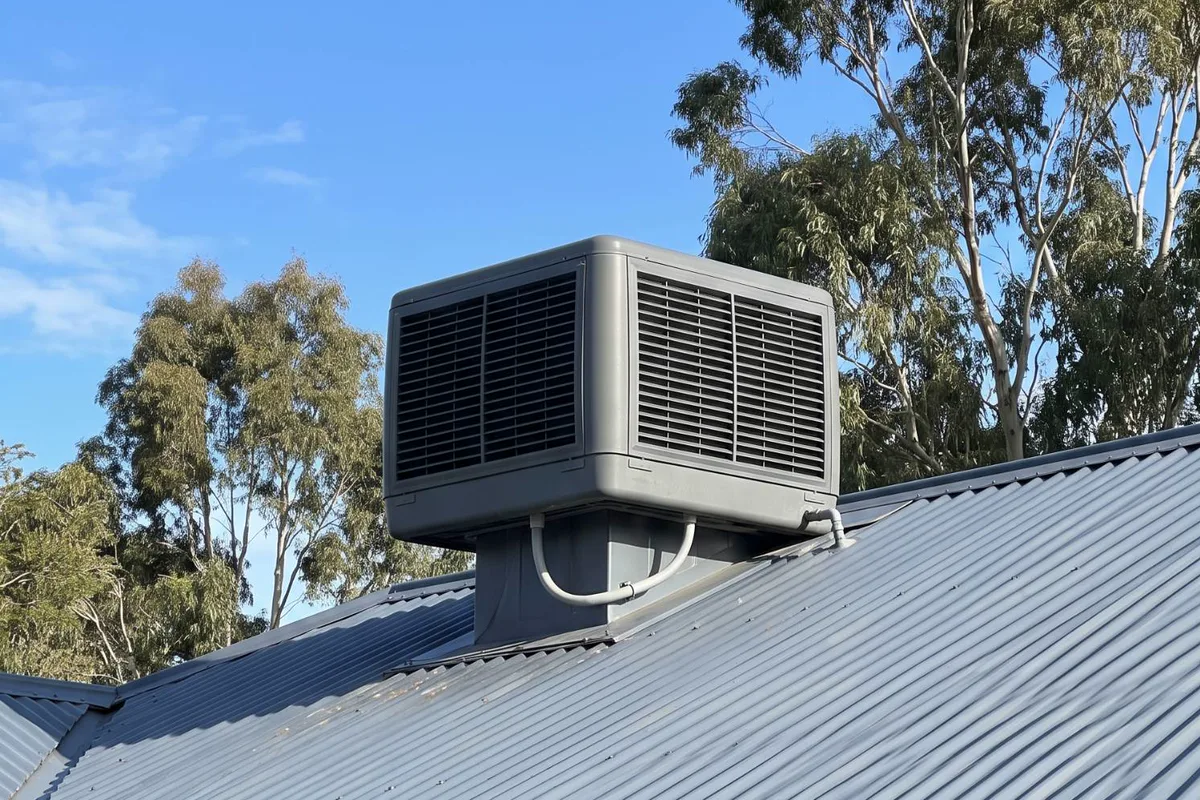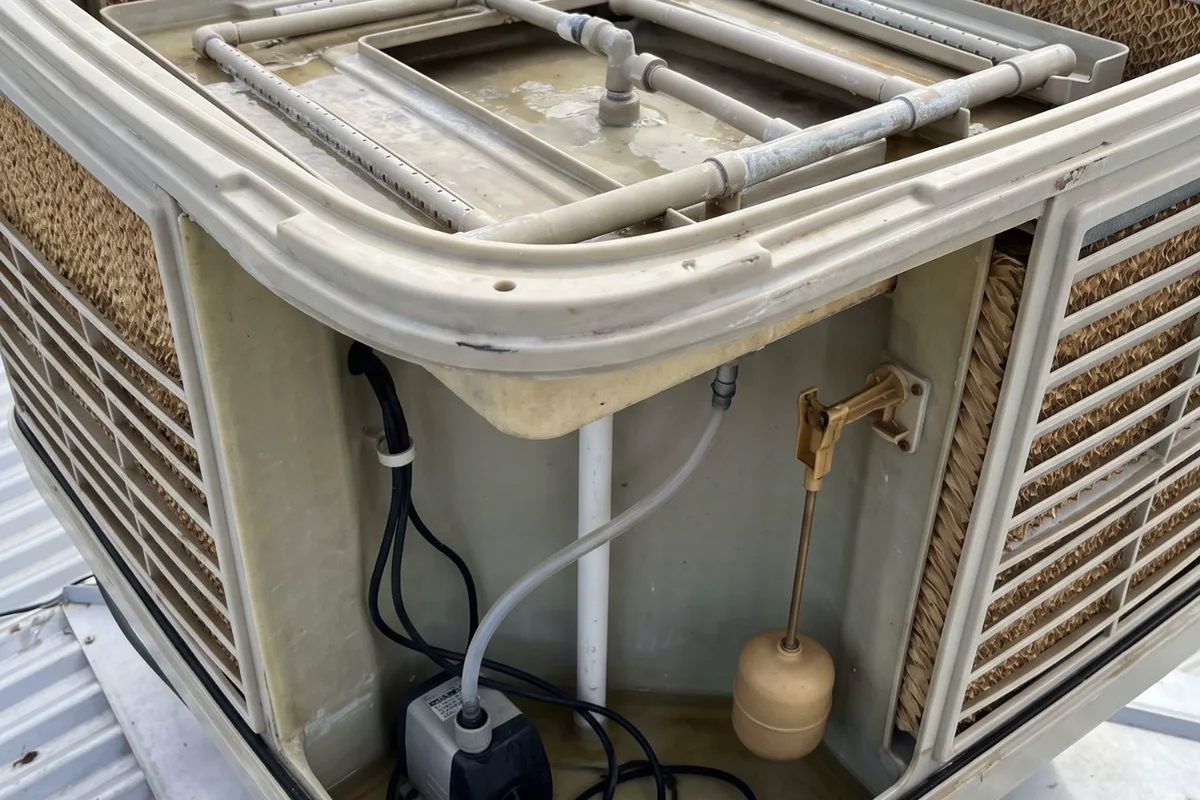
Most evaporative cooler faults come down to a few parts on the roof and the power that runs them. We test the supply first, find the failed part and fix it, and tell you honestly if the cooler is past repairing.
When to get it checked
The fan runs, but the air is warm
The fan works but the pads stay dry or only wet in patches. The pump, its distributor lines or the water supply have stopped doing their job.
Water running off the roof
A steady flow from the drain or overflow, while the cooler runs or after it's switched off, usually means a float or drain valve has stuck.
Drips or stains on the ceiling
Water at a ceiling outlet, or a stain spreading across the plaster, can come from the tank, a perished fitting or the seal where the unit meets the roof.
Nothing happens at the controller
A blank screen, or the cooler ignores every button. The circuit, the roof isolator, the controller and its cable all need testing.
It trips the power when it starts
A safety switch drops as soon as the pump or fan kicks in. That's an electrical fault to trace, often moisture in a motor, pump or isolator.
Squealing, rattling or grinding
A squeal on start-up is often a worn belt. Grinding usually means the fan or motor bearings are on the way out.
Why it happens
6 common causes
A seized or worn pump
Pumps sit in the tank all winter and can seize, clog with scale or simply wear out. No pump, no wet pads.
Float valve faults
The float valve tops up the tank. Stuck shut, the tank runs dry. Stuck open, it overflows down the roof.
Drain and bleed valves
These dump some of the water to keep salts down. One that sticks open wastes water; one that sticks shut lets scale and smells build up.
Belt, bearings and motor
Belts stretch and crack, bearings wear, and motors fail with age, heat and moisture.
Supply, isolator and controls
Moisture in the roof isolator, a loose terminal, a failed wall controller or a damaged control cable can stop the whole system.
Brittle plastics and perished seals
Years of sun make plastic brittle and rubber perish, until a tank, tray or hose fitting starts to weep.
What the job covers
What we usually do on this job. Your quote confirms it for your place.
- Circuit, roof isolator and controller tested
- Pump and distributor lines checked
- Float valve and water supply checked
- Drain or bleed valve checked
- Belt, fan and motor bearings checked
- Tank and fittings inspected for leaks
- Failed part replaced at the agreed price
- Test run with water coverage checked on every pad
- Certificate of Electrical Safety for electrical work
Your options, explained
Replace the failed part
Low disruption- Best for
- A sound cooler with one part that has let go
- How it works
- The pump, float, drain valve, belt, motor or isolator is replaced and the cooler tested.
- Worth knowing
- The usual outcome. On older models, parts supply can decide it.
Repair plus a service
Low disruption- Best for
- A cooler that hasn't been serviced in a while
- How it works
- The repair, plus a tank clean, a pad check and a look at everything else that wears.
- Worth knowing
- Saves a second trip onto the roof when more is close to failing. See our evaporative cooler servicing page.
Replace the cooler
Medium disruption- Best for
- A cracked cabinet, a failed motor on an old unit, or parts that aren't made any more
- How it works
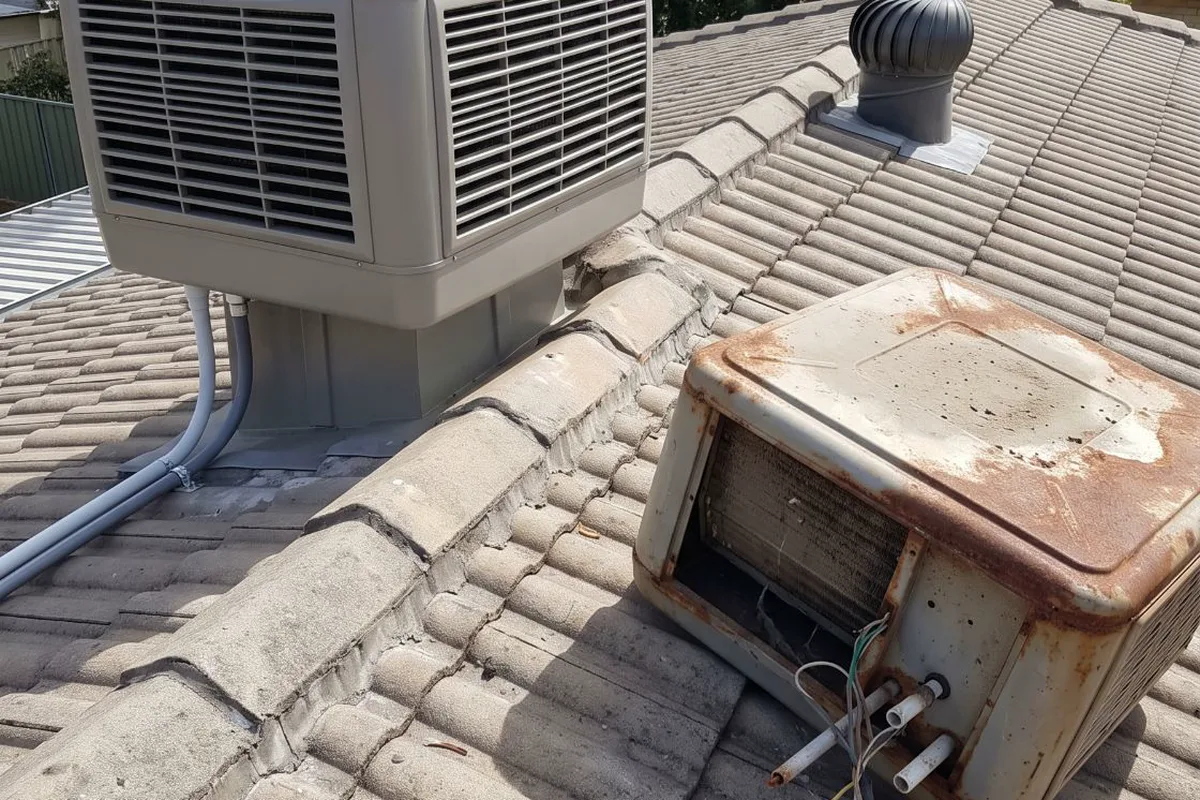
- The old unit comes off the roof and a new one goes on, reusing ducts and wiring where they suit.
- Worth knowing
- If another repair doesn't make sense, we say so and price the replacement alongside it.
The people behind the work
One local team for electrical, heating and cooling, based in Altona Meadows, with 19 years in the industry.
Licensed electrical contractor (REC 38187)See more team photos
Worth knowing before you book
- Stay off the roof
- Note what it's doing and leave the climbing to us.
- Humid days are different
- Weak cooling on a muggy day isn't always a fault.
- Send a photo
- The wall controller and any label help us bring the right parts.
What affects the price?
The right scope depends on your installation. These are the details we check so your quote is useful, with any additional work explained before it proceeds.
What has failed
A float valve or belt is a smaller job than a motor, a pump assembly or a controller.
Parts for your model
Common parts are easy to get. Some older or less common models need parts ordered in.
Roof access
A single-storey roof with easy access is simpler than a steep pitch or a double-storey house.
Electrical repairs
A wet isolator, perished roof cable or damaged control wiring is priced as its own line.
Damage inside
Repairing a ceiling stained or softened by a leak is building work, separate from the cooler repair.
How it runs
- 1
Tell us the symptom
What it's doing, the make and its age.
- 2
Test and inspect
Power first, then the roof unit.
- 3
Price and repair
The price agreed before the repair starts.
- 4
Run it with you
Windows open, water coverage checked.
Step by step, in more detail
4 steps
Start with the symptom
Tell us what it's doing, the make and roughly how old it is. A photo of the wall controller and any label you can see from the ground helps.
Test the power
We check the circuit at the switchboard, the roof isolator, the controller and its cable. Faults found there are repaired by our electricians on the same visit.
Find the failed part on the roof
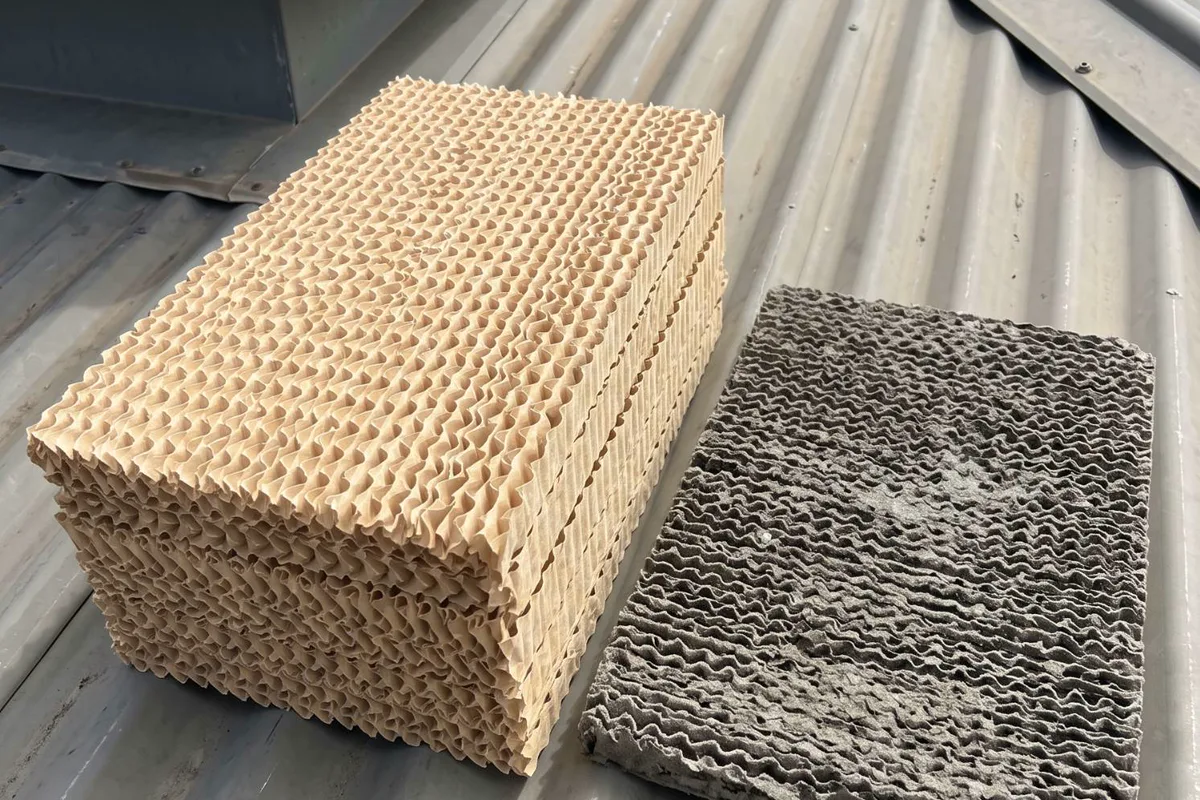
With the power isolated, we inspect the pump, float, drain valve, distributor, belt, fan, motor and tank, then run it to see how water covers each pad.
Price, repair and test
You get the price before we start. After the repair it runs with you, windows open, and we note anything else that's close to wearing out.
What is safe to do, and what to leave to us
Safe for you to do
- If water is dripping from a ceiling outlet, switch the cooler off at the controller and keep clear of any light fittings nearby.
- If the safety switch trips when the cooler starts, reset it once. If it trips again, leave it off and call a licensed electrician.
- Note what the controller shows and what the cooler was doing before it stopped.
Leave these to us
- Climbing onto the roof to check the cooler yourself. Leave it to someone with the right access gear.
- Opening the roof isolator, the controller or the motor cover. Electrical work isn't a DIY job, even small ones.
- Running the cooler with the windows shut to make it work harder. It only makes the house clammy.
When to get us in
- The fan runs but the air is warm
- Water is running off the roof or dripping from an outlet
- The controller is blank or the cooler won't start
- A safety switch trips when the cooler starts
- It squeals, grinds or rattles
- You're renting and the cooler has stopped
More detail
Why the power gets tested first
The pump, fan motor and controls all run on a supply that lives on the roof with the heat, rain and dust. A cooler that seems dead is often a tripped circuit, water inside the isolator or a loose terminal, and a cooler that trips the safety switch usually has moisture or a failing component somewhere.
Any electrical repair, from a new isolator to a replaced control cable, is electrical installation work and comes with a Certificate of Electrical Safety. If the wiring is altered, Energy Safe Victoria notes the Wiring Rules require additional RCD protection.
No water on the pads
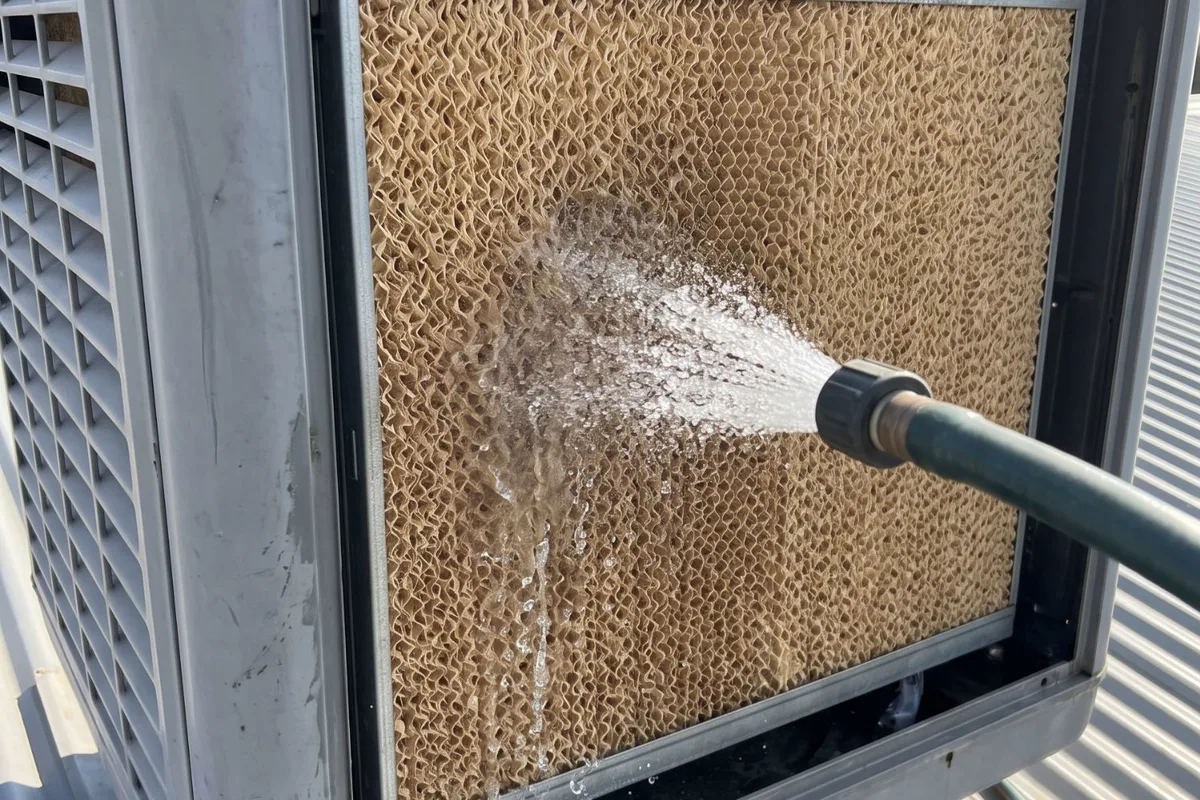
The pump lifts water from the tank to a distributor that spreads it across the top of each pad. When the air comes through warm, we check the water supply and float first, then the pump, then the distributor lines, which block easily with scale.
A pump that hums but moves no water may be jammed with debris or scale. One that's silent may have failed, or may not be getting power at all, which is why the electrical test comes first.
Leaks on the roof and through the ceiling
Some water leaving the cooler is normal: the bleed or drain valve deliberately dumps salty water to keep scale down. A steady flow with the cooler switched off usually means the float valve is letting water in when it shouldn't, or a drain valve has stuck open.
Water inside the house is different. It can come from an overfilled tank, a cracked tray, a perished fitting or the seal where the unit meets the roof, and the stain doesn't always sit directly under the source. We trace it on the roof and in the roof space before quoting.
Getting the most from a repaired cooler
An evaporative cooler blows outside air over wet pads and pushes it through the house and out through open windows and doors, so leave some open in the rooms you want cool. YourHome says central systems can use 25 litres or more of water an hour on hot, dry days, which is why a stuck valve is worth fixing quickly. In winter, close off the ducts and cover the roof unit if it has no automatic seals.
Local rules and conditions
Victorian requirements and local conditions that shape this job, with the sources listed at the foot of the page.
When it fails, it's usually hot
Laverton's highest recorded temperature is 47.5 °C, set on 7 February 2009, and the station averages 9.4 days a year at or above 35 °C. A cooler that has sat idle all winter often shows its fault on the first of those days, so a test run in spring is worth doing.
Rentals with an evaporative cooler
A cooling appliance supplied by the rental provider that isn't working is on Consumer Affairs Victoria's list of urgent repairs, which must be done immediately. The Victorian Government says existing evaporative cooling meets the 2027 rental cooling standard, so repairing a sound cooler is a real option for rental providers.
Dry northerlies, humid changes
The Bureau of Meteorology says warm northerly winds often arrive first as a weather system crosses Melbourne. Evaporative coolers work best in low humidity, so weak cooling on a muggy day isn't always a fault, while weak cooling on a hot, dry northerly usually is.
Useful reading
Guides to read before you decide, with checklists and questions to bring to the quote.
- Evaporative or refrigerated cooling for Melbourne's west?How evaporative and refrigerated cooling handle dry northerly days, muggy nights and winter, and what switching from one to the other really involves.
- Getting your air conditioning ready for a heatwaveA spring test run, clean filters, a clear outdoor unit and a backup plan: how to find a tired air conditioner before the first hot northerly does.
- Renting and the power or heating has failed: what to doNo power or a dead heater in a Victorian rental? What to check safely, what counts as urgent, how to report it, and what to do if nobody responds.
- A safety switch keeps tripping: what to record and when to callUnderstand the difference between a protective device doing its job and a fault that needs investigation.
Common questions
Questions people ask about this
- My evaporative cooler won't start. What can I check?Start with the wall controller and the power: check the controller's display, the circuit breaker and safety switch at the switchboard, and any winter or off-season…
- Why is my evaporative cooler noisy?Most cooler noise comes from wear and loose parts: fan bearings that grind or squeal, a worn or slipping belt, panels and pad frames rattling in the wind, a pump humming…
Sources for the rules and local facts on this page
11 sources, with the date each was checked
- 1.Bureau of Meteorology: Highest temperature (°C) 45.6 47.5 41.4 35.5 27.3 24.3 23.5 26.8 31.3 37.2 42.4 45.2 47.5 82 1943 2026 Date 27 Jan 2026 07 Feb 2009 Accessed 30 September 2026.
- 2.Consumer Affairs Victoria: a cooling appliance or service provided by the rental provider is not working the property does not meet minimum standards a safety-related device, such as a smoke alarm or pool fence, is not working Accessed 30 September 2026.
- 3.Department of Energy, Environment and Climate Action (energy.vic.gov.au), page last updated 05/08/26: From 1 March 2027, at the start of a new lease, rental homes must include: energy-efficient cooling in the living area (noting that if evaporative cooling is already installed, it meets the standard) ... By 1 July 2030… Accessed 30 September 2026.
- 4.Bureau of Meteorology (article issued 3 August 2026): To the north lies Australia's hot, dry interior, while to the south stretches the cold Southern Ocean. ... Warm northerly winds arrive first, bringing higher temperatures and clear skies. Then, as a cold front moves in… Accessed 30 September 2026.
- 5.energy.gov.au (Australian Government, DCCEEW): Evaporative coolers are not suitable for all regions. They work well in low-humidity inland regions. ... Purchase and installation can be expensive, but ducted evaporative coolers use less than half of the electricity… Accessed 30 September 2026.
- 6.YourHome (Australian Government): Evaporative coolers cool outside air and blow it into the house; some windows or doors will need to be left open when the cooler is in use to allow indoor air to exit. ... For central systems, water use can be 25 L or… Accessed 30 September 2026.
- 7.Energy Safe Victoria: Whenever a licensed electrician completes any electrical installation work, they must provide a Certificate of Electrical Safety (COES). Accessed 30 September 2026.
- 8.Victorian Legislation (legislation.vic.gov.au) - Electricity Safety Act 1998, authorised version 089 (effective 8 Sep 2026): electrical installation work means installation, alteration, repair or maintenance of an electrical installation; Accessed 30 September 2026.
- 9.Energy Safe Victoria: Clause 2.6.3.2.5 of the Wiring Rules states: Additional protection by RCDs shall be provided in existing electrical installations where alterations or a switchboard replacement is completed. Accessed 30 September 2026.
- 10.Energy Safe Victoria: Locate your electricity box outside your home and check whether the safety switch has tripped. If it has tripped, reset the switch. If the switch won’t reset, call a licensed electrician. Accessed 30 September 2026.
- 11.Energy Safe Victoria: Electrical work isn’t a DIY job, even for small jobs such as changing power points or light switches. Accessed 30 September 2026.