
The key points
- Evaporative cooling flushes the house with cooled outside air through open windows. Refrigerated cooling works on the same air with the house shut.
- Evaporative does its best work in dry air and loses ground on muggy days. That's the method, not a fault.
- Ducted evaporative uses less than half the electricity of a similar-capacity air conditioner, but it uses water and doesn't heat.
- Victorians typically use more energy for heating than cooling, so winter often decides the question.
- Converting to ducted reverse-cycle means a new system, not a swap on the roof.
Two very different ways of cooling a house
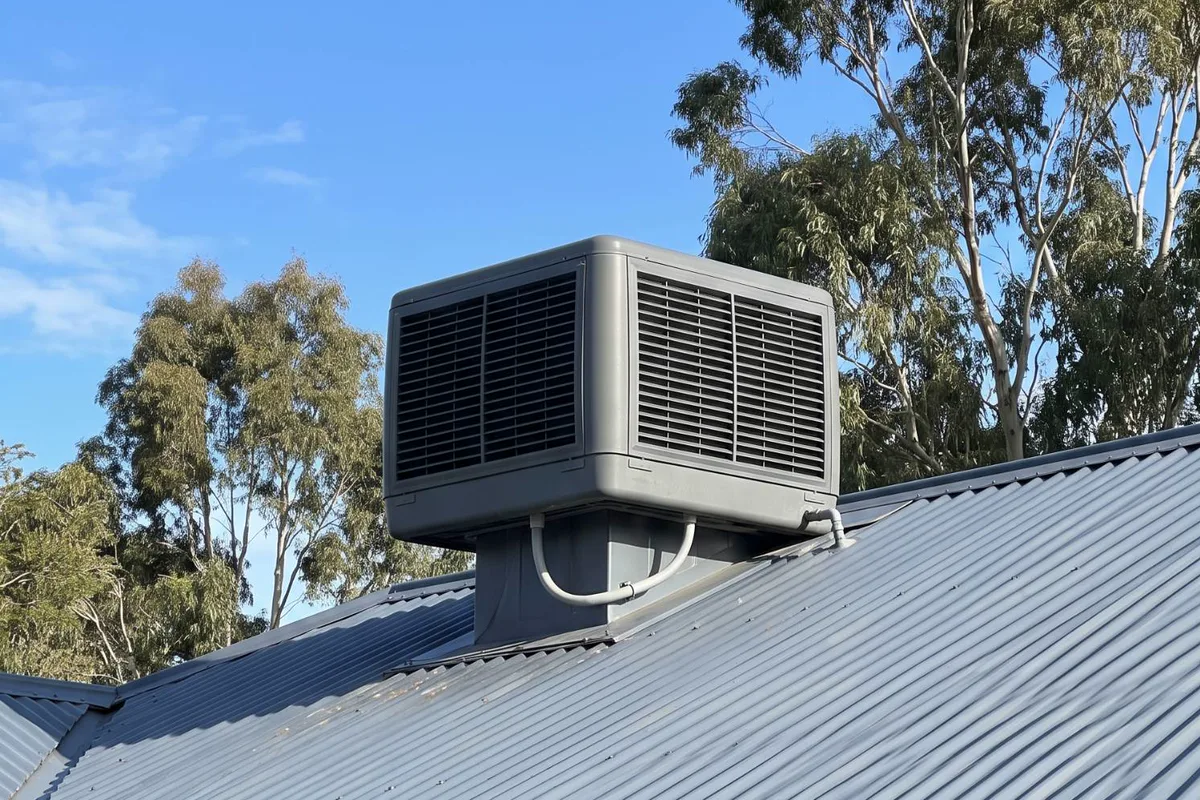
An evaporative cooler sits on the roof and draws outside air through wet pads. As the water evaporates, the air cools, and a fan pushes it down through ceiling outlets. The warm indoor air leaves through the windows and doors you've left open. Nothing is recirculated.
Refrigerated cooling covers split, multi-head and refrigerated ducted systems. A reverse-cycle unit is a heat pump: in cooling mode it absorbs heat from the indoor air and releases it outside, and in heating mode it does the reverse. The same air goes round with the house closed, and some of its moisture condenses on the indoor coil and drains away.
That's the decision in miniature. One system wants the house open, the other wants it shut, and most of what follows comes back to that.
Hot, dry days are evaporative cooling's home ground
The Bureau of Meteorology describes Melbourne as sitting between the hot, dry interior to the north and the cold Southern Ocean to the south. Warm northerly winds often arrive first with higher temperatures and clear skies, then a cold front can change conditions within minutes. The Bureau's Laverton station averages 27.0 days a year at or above 30°C and 9.4 days at or above 35°C, mostly between December and February.
The Australian Government's energy advice says evaporative coolers work well in low-humidity inland regions and aren't suited to every region. Dry air takes up more water from the pads, so a clean, well-sized system can feel very good on a dry afternoon, and ducted units use less than half the electricity of an air conditioner of similar capacity. The catch: the pads cool outside air rather than replace it, so as the afternoon climbs, the air from the outlets warms up too.
Muggy days and warm nights favour refrigerated air
The same physics works against a cooler when the air is already damp. The pads can only put so much water into air that's carrying plenty, so the air comes out less cool and the house can feel clammy rather than fresh.
Refrigerated cooling doesn't lean on the outdoor air that way. It cools and dries the air with the windows shut, which matters most at night. If you sleep with windows locked, live on a busy road or have a bedroom that holds the day's heat, a unit that cools a closed room is easier to live with.
One warning first. If your cooler used to cope and now struggles on dry days as well, worn pads, a tired pump or blocked water lines are more likely than the weather. Have it serviced, then judge it.
- Bedrooms need cooling overnight with windows shut
- Muggy days bother the household more than dry heat
- Leaving windows open while you're out isn't practical
- You'd like one system to heat in winter too
What each system asks of you through the year
Evaporative cooling needs some windows or doors open while it runs. YourHome puts a central system's water use at 25 L or more an hour on hot, dry days, which can matter during water restrictions. Many modern units seal themselves when off; others need the ducts closed off and the roof unit covered in winter to cut heat loss.
A refrigerated system keeps the house shut and uses no water. The Victorian Government suggests cleaning the dust filters about twice a year, more with heavy use, and servicing at the frequency the manufacturer recommends. It also suggests cooling living areas to 24°C to 26°C, as each degree lower adds around 10% to running costs.
Neither is maintenance-free. One needs its pads, pump and drain looked after up on the roof; the other needs its refrigerant circuit and electrics checked. None of that is homeowner work.
Winter usually settles the question
An evaporative cooler doesn't heat. In a lot of homes it is paired with a gas ducted heater: two systems, two service schedules and often two sets of outlets.
The Victorian Government notes that Victorians typically use more energy for heating than cooling, and Laverton's coldest month, July, has a mean minimum of 5.2°C. A reverse-cycle system covers both seasons. Because it moves heat rather than making it, the Australian Government puts reverse-cycle efficiency at 300% to 600%, and says ducted systems, though less efficient than wall units, are still more cost-efficient than gas heating.
So judge the two over twelve months, not one hot week. If your gas heating is sound and you mainly want cooling that's light on power for dry days, a well-kept evaporative system still earns its place. If the heater is ageing too, one reverse-cycle system doing both jobs deserves a proper price. Owner-occupiers aren't required to switch gas space heating to electric, so it's your call. When comparing units, the Zoned Energy Rating Label puts Melbourne in the Cold zone, so read the Cold ratings.
What moving from evaporative to refrigerated involves
A conversion is a new system, not a new box on the old base. The cooler comes off and the roof opening is closed. An indoor unit goes into the roof space, an outdoor unit goes outside, and every duct run is checked. Evaporative ducts push outside air one way; refrigerated air needs a return path and ducts insulated to at least R1.5 with sealed joints to prevent condensation and leakage.
Plan zones from the start. Victorian Government guidance recommends them for ducted systems, so living areas and bedrooms can be run separately. Check whether your switchboard needs an upgrade before a new reverse-cycle system goes in too; in an older home that's a real question.
In Victoria, refrigerated air-conditioning work is a class of plumbing work regulated by the Building and Plumbing Commission, and installing or commissioning the system needs a refrigerant handling licence. The new circuit is electrical work, which is illegal for unlicensed people to do. Air conditioning is non-prescribed work, so the electrician completes a Certificate of Electrical Safety and must give you a copy within 30 days.
It needn't happen at once. Some households keep the cooler and add a split in the main bedroom; others convert and keep or retire the gas heater.
- Which ducts, if any, are reused, and why
- Where the return air grille and outdoor unit go
- How many zones, and which rooms share one
- Whether the switchboard was checked for the new load
- What happens to the roof opening and gas heater
If the house is a rental
From 1 March 2027, at the start of a new lease, a Victorian rental must include energy-efficient cooling in the living area, and the Victorian Government notes that existing evaporative cooling meets that standard. By 1 July 2030, efficient electric cooling must be installed in the living area of every rental, whatever the lease status.
If an old cooler in a rental is due for replacement anyway, check the new system against both dates before committing.
When it's worth getting Total Comfort in
If you're still weighing it up, a look at the house usually settles it faster than more reading: the roof space and existing ducts, the age of any gas heater, the switchboard, where an outdoor unit could sit, and which rooms matter at which time of day.
Total Comfort is one local team for electrical, heating and cooling, based in Altona Meadows, so the switchboard check and the system design come from the same visit. Quotes are free and no-obligation, and you get the price before we start. If the honest answer is a serviced cooler and one split system, that's the advice you'll get.
Common questions
Quick answers
- Can one reverse-cycle air conditioner meet both rental heating and cooling standards?Yes.
- What is the switch next to my outdoor unit for?It's an isolating switch that cuts all power to the air conditioner, so a technician can work on the system safely without relying on the switchboard.
- My rental has no fixed heater in the living area. Is that allowed?No.
- What happens if the heater in my rental breaks after March 2027?If it can be repaired, it's repaired as an urgent repair, as it is now.
Sources for this guide
12 sources, with the date each was checked
- 1.energy.gov.au (Australian Government, DCCEEW): Evaporative coolers work by blowing air over a film of water on a filter or sponge, cooling the sponge and the air through the process of evaporation. Outside air is drawn through the evaporative unit (generally on the… Accessed 30 September 2026.
- 2.YourHome (Australian Government): A reverse cycle air-conditioner is a type of heat pump that uses electricity to warm your home in winter and cool it in summer (refer to Heat pumps below). In heating mode, the system absorbs heat from the outside air… Accessed 30 September 2026.
- 3.Bureau of Meteorology (article issued 3 August 2026): To the north lies Australia's hot, dry interior, while to the south stretches the cold Southern Ocean. ... Warm northerly winds arrive first, bringing higher temperatures and clear skies. Then, as a cold front moves in… Accessed 30 September 2026.
- 4.Bureau of Meteorology: Mean number of days ≥ 30 °C 6.9 6.0 4.5 0.7 0.0 0.0 0.0 0.0 0.1 0.9 2.8 5.1 27.0 82 1943 2026 Mean number of days ≥ 35 °C 3.6 2.4 0.9 0.0 0.0 0.0 0.0 0.0 0.0 0.1 0.5 1.9 9.4 Accessed 30 September 2026.
- 5.Solar Victoria (updated 20 November 2025): Check the manufacturer’s instructions or manual and have the air conditioner serviced regularly at the recommended frequency to ensure it continues to operate efficiently. Cleaning the filters regularly helps the system… Accessed 30 September 2026.
- 6.Department of Energy, Environment and Climate Action (energy.vic.gov.au), page last updated 14/04/25: Victorians typically use more energy for heating than cooling, so look for a unit with a higher heating efficiency. Accessed 30 September 2026.
- 7.Commonwealth of Australia (2019), 'The new zoned energy rating label for air conditioners—What installers and retailers need to know', hosted on energyrating.gov.au: Melbourne is in a black ‘COLD’ area—read the black Cold ratings. Accessed 30 September 2026.
- 8.Department of Energy, Environment and Climate Action (Victoria): From 1 March 2027, if a gas hot water appliance breaks and cannot be repaired, it must be replaced with an electric alternative. No requirement to upgrade gas space heating or stovetop gas cooking to electric, however… Accessed 30 September 2026.
- 9.Building and Plumbing Commission (Victorian Building Authority, trading as the Building and Plumbing Commission): Under Part 4 of the Plumbing Regulations 2018, Refrigerated Air-conditioning work is: The construction, installation, replacement, repair, alteration, maintenance, testing or commissioning of refrigerated… Accessed 30 September 2026.
- 10.Australian Refrigeration Council (ARC): A Refrigerant Handling Licence must be held by any person who carries out work in relation to refrigeration and air conditioning (RAC) equipment. Carrying out work in relation to RAC equipment means to do anything with… Accessed 30 September 2026.
- 11.Energy Safe Victoria: Gas and electricity are inherently dangerous and it’s illegal and potentially fatal for unlicensed and unqualified people to undertake any electrical or gasfitting work. Homeowners and consumers must always use… Accessed 30 September 2026.
- 12.Energy Safe Victoria: 'Prescribed' certificates are for electrical installation work that requires inspection by a Licensed Electrical inspector. This includes (but is not limited to): Consumer mains cables, main switchboard, meter box and… Accessed 30 September 2026.
Planning advice for homeowners. Installation requirements depend on the property and equipment. Where this guide refers to Victorian safety or rental rules, use the linked official guidance for the current requirements.