
The key points
- Refrigerant isn't used up. A system that needs more gas has a leak.
- You'll mainly see R22 on older units, R410A on units from the 2000s and 2010s, and R32 on most current split systems.
- Gases can't be swapped to suit what's on hand. A system is charged with the refrigerant it was designed for.
- The HFC phase-down doesn't require you to replace working equipment.
- Topping up before every leak is found and repaired is illegal, and only licensed technicians can handle refrigerant.
What refrigerant does
Refrigerant is the working fluid that carries heat between the indoor and outdoor units. It boils at a very low temperature, so as it evaporates in one coil it soaks up heat, and when the compressor squeezes it and it condenses in the other coil, it gives that heat off. In cooling, the indoor coil absorbs heat and the outdoor coil releases it; in heating, a reverse-cycle unit runs the other way.
It travels in a sealed loop of copper pipe, coils and the compressor. It doesn't get used up or wear out, and a healthy system holds the same charge for its whole working life. A system that's short of gas has a leak somewhere.
The gases on the nameplate
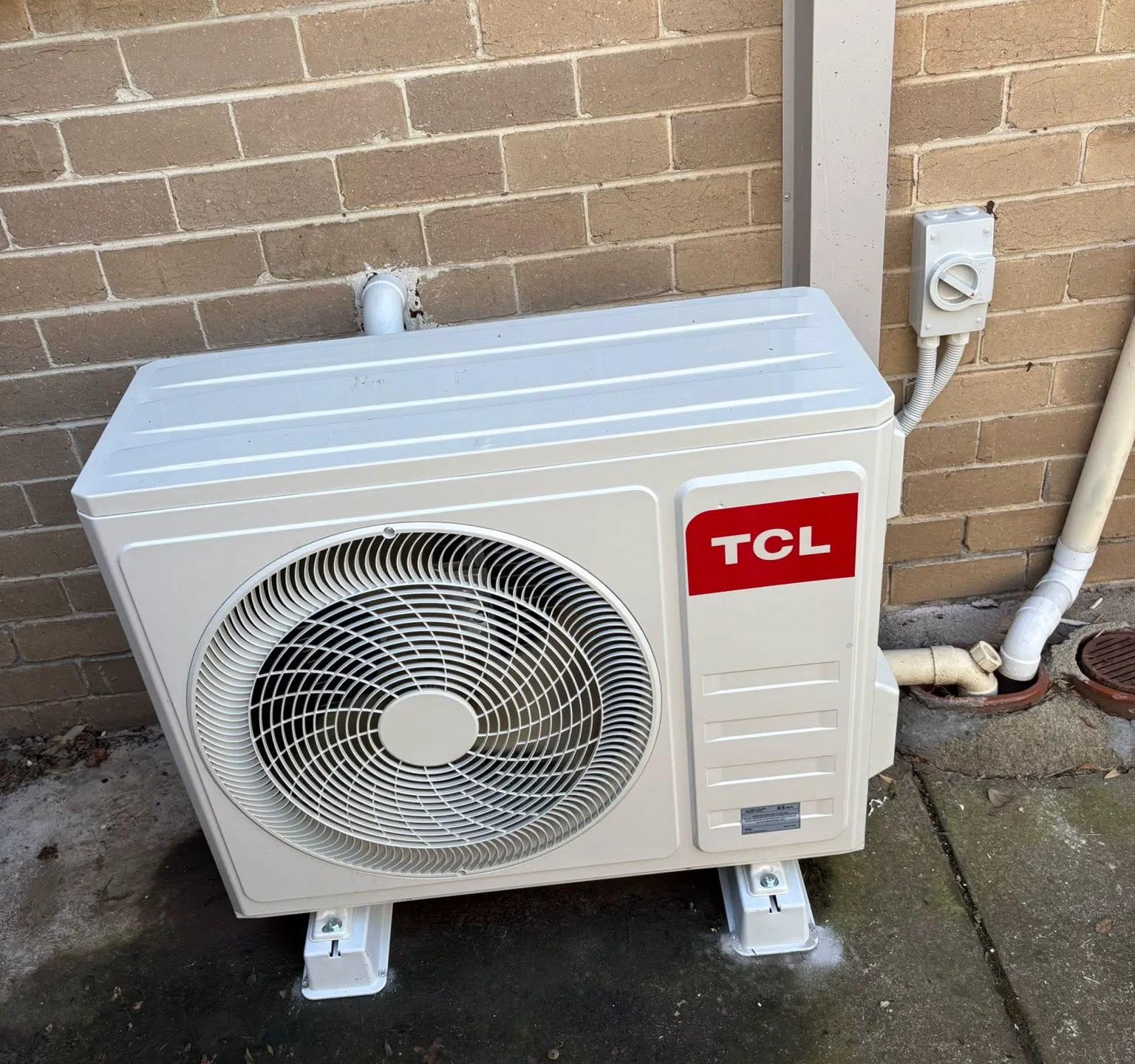
The refrigerant type and charge are printed on the outdoor unit's nameplate, usually on the side. In Australian homes you'll mainly see the gases below.
The federal environment department says 1 kg of R410A has the same greenhouse impact as 2 tonnes of carbon dioxide. That's why letting it escape matters, and why lower-impact gases are taking over.
- R22: an older HCFC gas found on many units from before the switch to R410A. It damages the ozone layer and is no longer used in new air conditioners.
- R410A: the HFC that replaced R22 and was standard through the 2000s and 2010s. It doesn't harm the ozone layer but is a strong greenhouse gas.
- R32: the gas in most current split systems. Its global warming potential is much lower than R410A's, and it's classed as mildly flammable, so it's handled to specific procedures.
- Others: some newer heat pumps and heat pump water heaters use natural refrigerants such as R290 (propane) or carbon dioxide (R744).
Why the gas matters on an older system
R22 is harder to get than it once was, and a repair that opens the refrigerant circuit on an R22 unit is more involved. A leak repair on an old R22 system can be done, but it often doesn't stack up against replacement once the gas, the labour and the unit's age are counted.
Age matters as much as the gas. The Victorian Government says a reverse-cycle system more than 15 years old will typically use more than three times the energy of a modern one. If an older system has a major leak, a failing compressor or a corroded coil, replacement usually makes more sense than another round of repairs.
R410A systems are still widely serviced and repaired. There's no reason to replace a sound R410A unit because of the gas in it.
Why gases can't simply be swapped
Each system is designed around one refrigerant, with pressures, oil, valves and charge to suit. Under the federal regulations it's an offence to charge equipment with a refrigerant that has a higher global warming potential than the one it was designed for, so an R32 system can't be charged with R410A. The ban doesn't apply when charging older HCFC equipment, such as R22 systems, with an HFC, but that's a technician's call made with the manufacturer's guidance, not a routine fix.
Going the other way isn't a simple swap either. Manufacturers design and test each unit for its own gas, so an R410A unit isn't refilled with R32. When an older unit is replaced with an R32 one, the practical question is whether the existing pipework can stay, which depends on the manufacturer's rules, the pipe sizes, their condition and how they're cleaned.
What the HFC phase-down means for owners
Australia's HFC phase-down started on 1 January 2018 and will cut HFC imports to 15% of the baseline level by 1 January 2036. It's a big part of why the market has moved from R410A to lower-impact gases such as R32.
It doesn't ask you to do anything with equipment you already own. The federal environment department says consumers don't have to replace their existing equipment, and a working R410A system can be serviced and repaired as normal.
Where it matters is when you're buying. A new system on a current, lower-impact gas is the sensible choice, and if an older unit is near the end of its life, the gas becomes one more factor alongside efficiency and repair history.
Leaks, top-ups and the law
Signs a system may be short of gas: air that isn't as cold or warm as it used to be, longer running times, ice on the pipes or coil, or a hiss or gurgle. Dirty filters and fan faults cause similar symptoms, so a technician tests before blaming the refrigerant.
No-one is allowed to top up a system with refrigerant until it has been fully tested and every identified leak repaired. A top-up without a repair puts back gas that will leak out again, so you pay twice and the escaped gas adds to emissions. Releasing regulated refrigerants into the air is illegal.
A proper repair finds the leak, recovers the remaining gas, fixes the joint or part, pressure tests the circuit with nitrogen, pulls a vacuum, then charges the system with the correct weight of the right refrigerant.
Who can handle refrigerant
Under the national scheme run by the Australian Refrigeration Council, anyone who installs, commissions, services, maintains or decommissions air conditioning equipment needs a Refrigerant Handling Licence, which covers all fluorocarbon refrigerants, including R22 and R410A. Businesses that acquire, store or dispose of refrigerant need a Refrigerant Trading Authorisation.
The restricted split system licence covers installing and decommissioning single-head splits under 18 kW. It doesn't allow service, repair or maintenance that involves accessing or handling refrigerant, so when someone quotes a leak repair, it's fair to ask which licence they hold. When an old system is removed, its refrigerant should be recovered into a cylinder, never vented.
Common questions
Quick answers
More in the Help centreSources for this guide
10 sources, with the date each was checked
- 1.YourHome (Australian Government): A reverse cycle air-conditioner is a type of heat pump that uses electricity to warm your home in winter and cool it in summer (refer to Heat pumps below). In heating mode, the system absorbs heat from the outside air… Accessed 30 September 2026.
- 2.Department of Climate Change, Energy, the Environment and Water (DCCEEW): In fact, one kilogram of refrigerant R410a has the same greenhouse impact as 2 tonnes of carbon dioxide, which is the equivalent of driving your car for 10,000 km. Accessed 30 September 2026.
- 3.Solar Victoria (updated 2 October 2025): A system that is more than 15 years old for example will typically use more than three times the amount of energy than a modern reverse-cycle air conditioner. Accessed 30 September 2026.
- 4.Department of Climate Change, Energy, the Environment and Water (DCCEEW): You cannot charge refrigeration and air conditioning equipment with a higher global warming potential (GWP) refrigerant than the equipment was designed to use (the design refrigerant). To do so is an offence under the… Accessed 30 September 2026.
- 5.Department of Climate Change, Energy, the Environment and Water (DCCEEW): Australia’s HFC phase-down started on 1 January 2018. The HFC phase-down is a gradual reduction in the total amount of HFCs allowed into Australia. The amount will be reduced to 15% of baseline level by 1 January 2036… Accessed 30 September 2026.
- 6.Australian Refrigeration Council (ARC), Fact Sheet 13 (ARC5225, 11/22): ‘Topping-up’ a system before the system has been fully tested and all identified leaks repaired by any individual is illegal. Accessed 30 September 2026.
- 7.Australian Refrigeration Council (ARC): A Refrigerant Handling Licence must be held by any person who carries out work in relation to refrigeration and air conditioning (RAC) equipment. Carrying out work in relation to RAC equipment means to do anything with… Accessed 30 September 2026.
- 8.Australian Refrigeration Council (ARC): The refrigerant handling licence and refrigerant trading authorisation cover all fluorocarbon refrigerants: chlorofluorocarbons, hydrochlorofluorocarbons and hydrofluorocarbons. Examples of these include R12, R22… Accessed 30 September 2026.
- 9.Australian Refrigeration Council (ARC): The Ozone Protection and Synthetic Greenhouse Management Regulations 1995 provide that persons or businesses that acquire, store or dispose of refrigerants must hold a current Refrigerant Trading Authorisation issued by… Accessed 30 September 2026.
- 10.Australian Refrigeration Council (ARC): RSS03 - Refrigerant handling licence – qualified persons (Restricted heat pump – split systems – installation and decommissioning licence: 2 & 3 years) To handle any refrigerant and install and decommission any of the… Accessed 30 September 2026.
Planning advice for homeowners. Installation requirements depend on the property and equipment. Where this guide refers to Victorian safety or rental rules, use the linked official guidance for the current requirements.