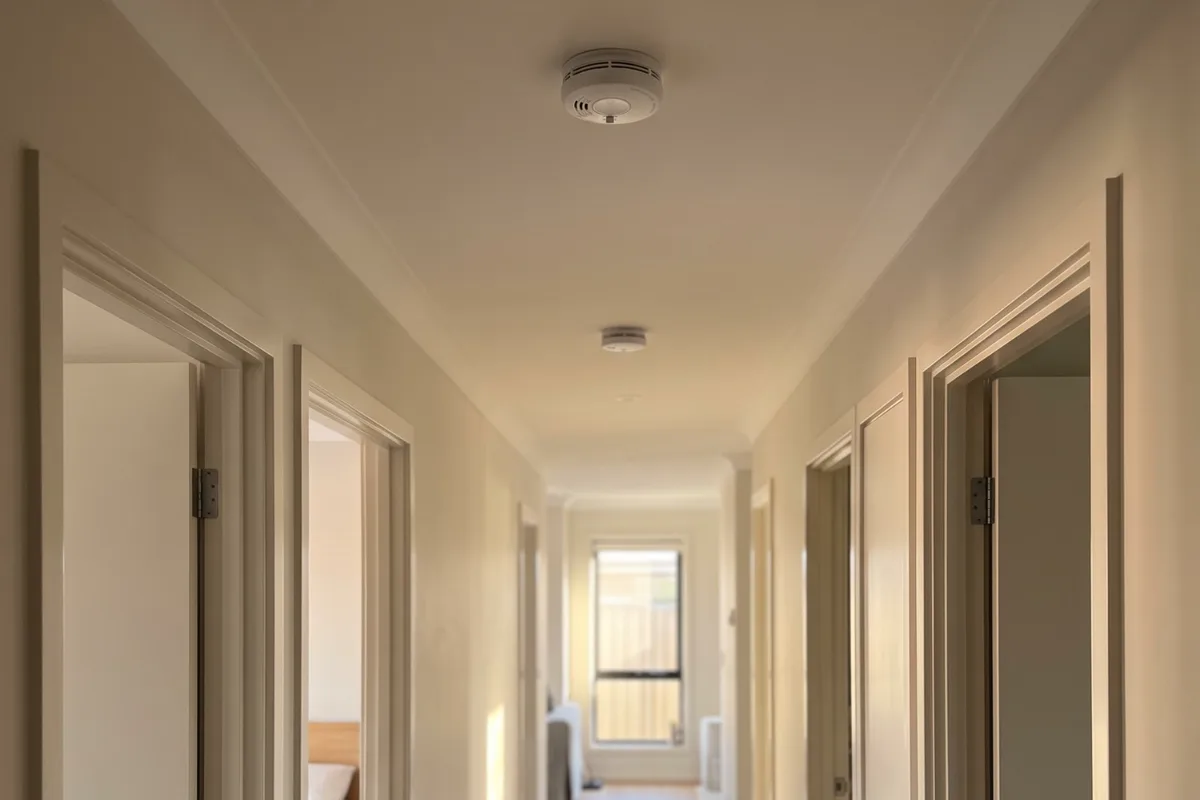
When alarms are linked, smoke at one end of the house wakes people asleep at the other. We check whether yours can link, connect them by cable or radio and test each against the rest.
When to get it checked
Only one alarm sounds on test
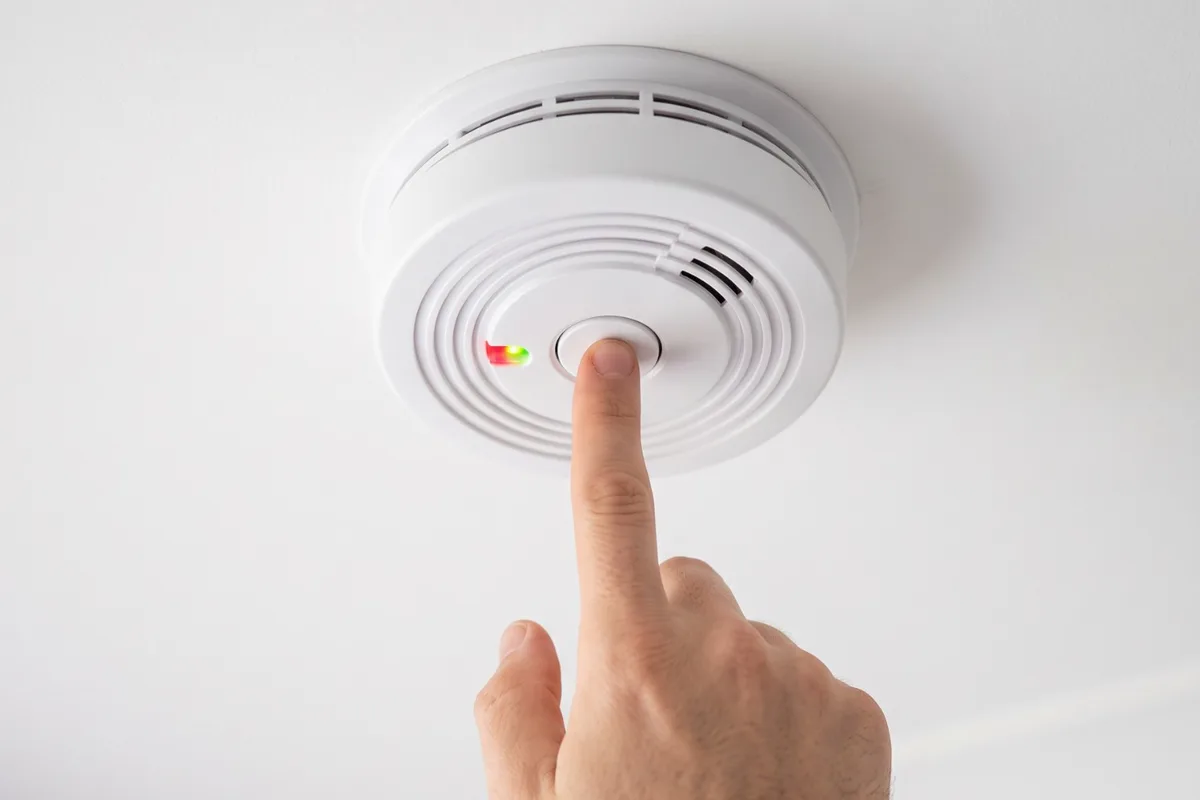
Press test on the hallway alarm and listen from the far end of the house. If the rest stay quiet, they were never linked or the link has failed.
Two storeys, two separate alarms
An unlinked alarm downstairs can be sounding while the one upstairs waits for smoke to climb the stairs.
A mixed set on the ceiling
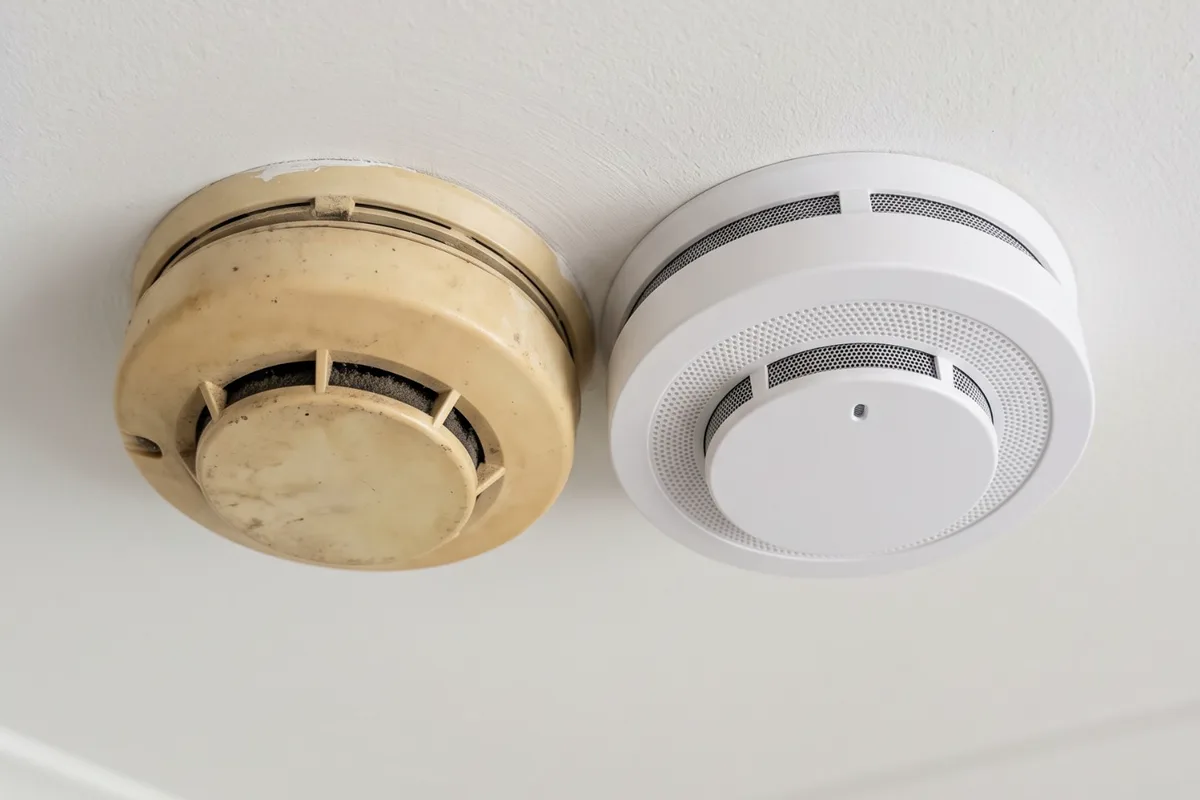
Different brands, shapes or date stamps mean alarms were replaced one at a time, and they may not talk to each other.
A room outside the system
An extension, loft bedroom or backyard studio has its own alarm, or none, that doesn't sound with the rest.
Why it happens
5 common causes
Alarms that were never linked
Plenty of hardwired alarms went in as stand-alone units, each on mains power but sounding only for itself.
One-off replacements
A failed alarm swapped for a different make, or even a newer model, can quietly drop out of the link and sound alone.
Wireless alarms never paired
Radio-linked alarms have to be paired as one system. One that missed pairing, or lost it later, won't pass the warning on.
The building blocks the signal
Double brick, foil insulation or a slab between floors can weaken a radio link until alarms miss each other.
Cable cut during other work
Ceiling repairs, new downlights or renovation work can cut a wired link in the roof without anyone noticing.
What the job covers
What we usually do on this job. Your quote confirms it for your place.
- Existing alarms checked for brand, age, power and link
- Cable, radio or combined linking to suit the house
- Photoelectric alarms from one compatible range
- Hardwired alarms kept on mains with battery backup
- Wireless alarms paired and range-checked in place
- Every alarm tested against the others
- Install date recorded, and a certificate for hardwired work
Your options, explained
Wired interconnection
Medium disruption- Best for
- Single-storey homes with roof access, and renovations with open ceilings
- How it works
- An extra conductor runs between hardwired alarms, so one alarm triggers the rest.
- Worth knowing
- Nothing to drop out, but every alarm needs a cable path. Hard between floors of a finished double-storey.
Hardwired, linked by radio
Low disruption- Best for
- Double-storey homes, extensions, garages and studios
- How it works
- Alarms stay on mains power with battery backup, and a radio module carries the link.
- Worth knowing
- No new cable between alarms. Every alarm must come from one compatible range.
Wireless battery alarms
Low disruption- Best for
- Older homes where battery alarms are allowed
- How it works
- Sealed long-life battery alarms link by radio, with no wiring at all.
- Worth knowing
- Allowed in homes built before 1 August 1997, the Building and Plumbing Commission says. Later homes need mains power with a backup battery.
The people behind the work
One local team for electrical, heating and cooling. Family-run, based in Altona Meadows, with 19 years in the industry.
Licensed electrical contractor (REC 38187)See more team photos
Worth knowing before you book
- One range, one set
- Alarms generally only link within one manufacturer's range, so one mismatched replacement breaks the chain.
- Double-storey homes
- Cable between finished floors is hard, so radio-linked hardwired alarms often suit better.
- Renovating or extending
- Fire Rescue Victoria's summary says homes extended after 1 May 2014 need interconnected, hardwired alarms.
What affects the price?
The right scope depends on your installation. These are the details we check so your quote is useful, with any additional work explained before it proceeds.
How many alarms
Every alarm is fitted, joined to the set and tested against the others, so each extra storey or bedroom area adds work.
Cable or radio
Cable depends on roof access and distances. Radio skips the cable, but linkable alarms and modules add to the parts.
What can be kept
Existing alarms stay only if their range links and they're well inside their service life.
Distance and construction
Double brick, raked ceilings, floor slabs and a garage or studio to reach all add time and range checks.
How it runs
- 1
Tell us about the house
Bedrooms, levels and extensions, plus a photo of the alarms as they sit on the ceiling.
- 2
Check and quote
We test what's there, recommend cable or radio and give you an upfront price.
- 3
Fit, link and test
One compatible set goes up, and every alarm is tested against the rest.
Step by step, in more detail
5 steps
Map where people sleep
Bedrooms, levels and rooms added later. The Building and Plumbing Commission says alarms go on or near the ceiling of every storey, between each bedroom area and the rest of the house.
Check what's there
We note each alarm's make, age, power and link, then test what sounds together. On newer units, the expiry date under the battery shows whether the set is worth keeping.
Choose the link and price it
Cable where the roof space allows, radio where it doesn't. You get a fixed price for the agreed scope before we start.
Fit and link one set
Mismatched and expired alarms come down and one compatible set goes up, with wireless alarms paired and checked where they'll stay.
Test each link
We set off each alarm in turn and confirm the rest sound, then note the install date. Hardwired work comes with a Certificate of Electrical Safety.
What is safe to do, and what to leave to us
Safe for you to do
- Press test once a month and walk the house to check every alarm joins in.
- If there's smoke or fire, get everyone out of the house.
- Once you're sure it's only cooking smoke, press hush on the alarm that started it.
Leave these to us
- Unplugging, rewiring or moving a hardwired alarm or its link wiring. That's work for a qualified electrician.
- Pulling batteries or disconnecting the link to stop nuisance alarms.
- Adding an alarm from a different range to a linked set.
- Putting a stand-alone alarm in a new room and assuming it's part of the set.
When to get us in
- Testing one alarm doesn't set off the others
- You're renovating, extending or adding a bedroom
- One alarm in a linked set has failed or expired
- Cooking keeps setting off the whole house
More detail
What linking changes
Each alarm still senses smoke on its own; the link only shares the warning. Many models flash a light on the alarm that detected smoke, so you can find the source while the whole set sounds.
Why the set has to match
Interconnection isn't shared between brands, and sometimes not between generations of one range. Each range also limits how many alarms one system can hold. Whichever range we use, every alarm must meet the Australian Standard AS 3786.
Adding to a linked set later
A new bedroom, extension or studio needs an alarm that joins the existing set. If your range is still made, a matching alarm can usually be wired or paired in; if not, or the set is near its date, replacing the lot is often simpler.
Local rules and conditions
Victorian requirements and local conditions that shape this job, with the sources listed at the foot of the page.
Stone walls in Williamstown
Williamstown's Government Survey heritage precinct has early basalt houses, a type less common elsewhere in metropolitan Melbourne. Stone walls can weaken a radio link, so we check range in place and run cable through the roof where radio won't hold.
Linked sets reaching ten years
Truganina, Tarneit, Wyndham Vale and Manor Lakes are among Wyndham's growth areas. Homes built after 1 May 2014 should have linked, hardwired alarms, which the Building and Plumbing Commission says are generally replaced after ten years. A set fitted in 2014 or 2015 is past that, and the new set must link too.
Winter nights, doors shut
CFA and FRV figures show 21 preventable residential fire deaths across Victoria in 2025, with the highest number in winter. Bedroom doors shut against the cold are when a lone alarm down the hall is hardest to hear.
Useful reading
Guides to read before you decide, with checklists and questions to bring to the quote.
- Smoke alarm rules for Victorian homesWhat Victoria expects of the alarms in the home you own: the type your build date calls for, where they go, interconnection and when to replace them.
- The electrical decisions to make before your renovation walls closePlan appliances, lighting, outlets and future upgrades while access and options are still available.
- Planning the electrical in a new build or extensionMark up the power and lighting plan, decide the dedicated circuits, pre-wire air conditioning and EV charging, then walk the frame before plaster.
- Rental electrical and smoke alarm checks in VictoriaKnow which records to gather, how to arrange access and where to verify the current Victorian requirements.
Common questions
Questions people ask about this
More in the Help centreFrom the blog
- Electrical upgrades that make a home safer for older parentsBetter lighting on paths and stairs, sensor lights, interconnected smoke alarms, easier switches and safer heating: practical upgrades that help with ageing in place.
- Upgrading battery smoke alarms to hardwired: what's involved?Alarm positions, cable paths, cable or radio interconnection and what changes day to day when an older home moves from battery alarms to mains power.
Sources for the rules and local facts on this page
7 sources, with the date each was checked
- 1.Victorian Heritage Database (Heritage Council Victoria); entry maintained by Hobsons Bay City Council from the Hobsons Bay Heritage Study 2006: Unusual or rare early building styles and types such as the basalt houses and the timber duplex houses with no dividing wall that are characteristic of this part of Williamstown but less common elsewhere in the… Accessed 30 September 2026.
- 2.Victorian Electoral Commission (2023 electoral structure review fact sheet): New housing developments are planned in residential growth areas including Truganina, Tarneit, Wyndham Vale and Manor Lakes, as well as near activity centres and public transport. Accessed 30 September 2026.
- 3.Fire Rescue Victoria: Residential home constructed, largely renovated, or extended after 1 May 2014 Interconnected, hard wired smoke alarms that are connected to 240 volt mains power and have a back-up battery. Accessed 30 September 2026.
- 4.Building and Plumbing Commission (formerly Victorian Building Authority): replace the smoke alarm in accordance with manufacturer's specifications – generally after ten years. New units have an expiry date located under the battery. Accessed 30 September 2026.
- 5.Fire Rescue Victoria: Across Victoria, in figures compiled by CFA and FRV, there were a total of 21 preventable residential fire fatalities in 2025. This compares to 18 equivalent fatalities in 2024, with the highest number of deaths… Accessed 30 September 2026.
- 6.Consumer Affairs Victoria: A hard-wired smoke alarm must be installed by a qualified electrician, but anyone can change a smoke alarm battery. Accessed 30 September 2026.
- 7.Energy Safe Victoria: Whenever a licensed electrician completes any electrical installation work, they must provide a Certificate of Electrical Safety (COES). Accessed 30 September 2026.