
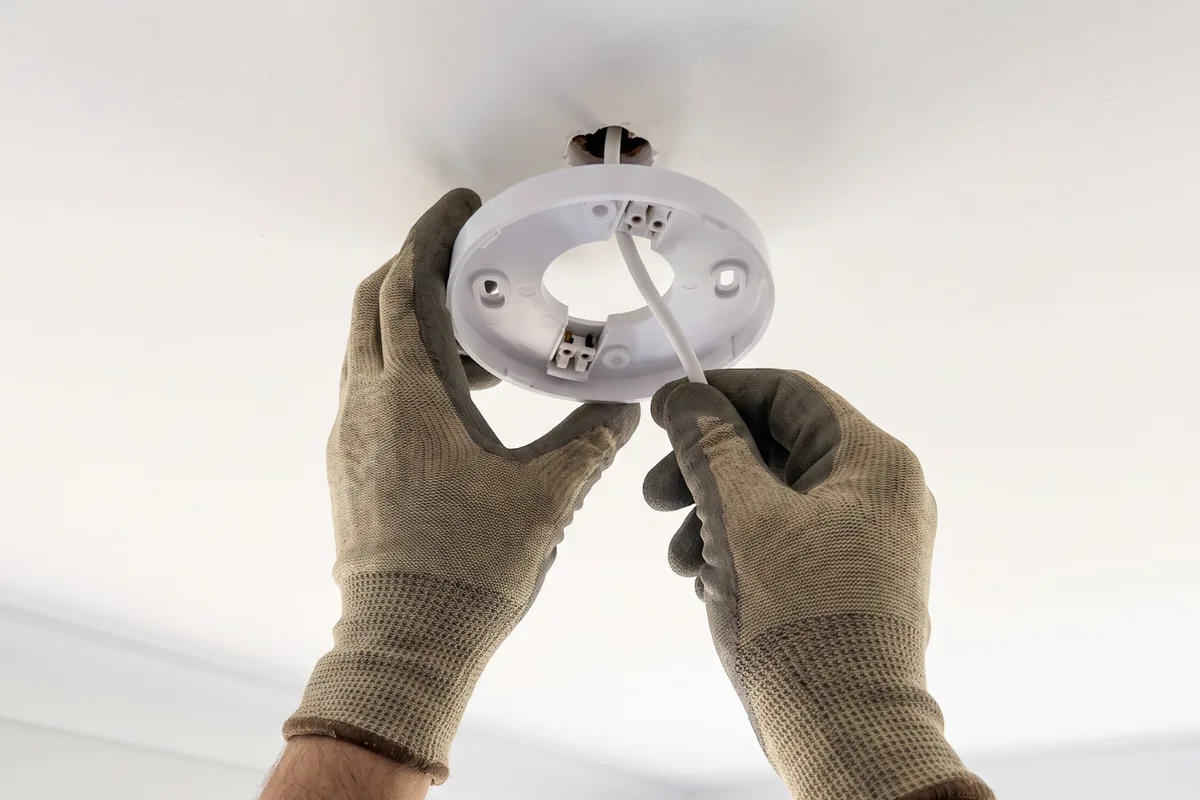
How do you upgrade from battery smoke alarms to hardwired interconnected alarms?
- Homes built before 1 August 1997 can keep battery alarms, but mains-powered alarms don't depend on someone remembering a battery.
- Settle positions first: every storey, and between each bedroom area and the rest of the house.
- Interconnection can be by cable or by radio. Radio often suits finished homes with a second storey or little roof access.
- Hardwired alarms must be installed by a qualified electrician, and the work comes with a Certificate of Electrical Safety.
Why upgrade if the rules don't require it
The Building and Plumbing Commission says homes built after 1 August 1997 must have alarms connected to 240V mains power with a backup battery, while older homes may use battery alarms. Fire Rescue Victoria's summary adds that homes built, largely renovated or extended after 1 May 2014 need interconnected hardwired alarms. An unextended post-war home can meet the minimum with good battery alarms.
The case for upgrading is reliability. A battery-only alarm protects you only while its battery lasts, and a chirping alarm at 2am is easy to silence and forget. A hardwired alarm runs from the home's supply and falls back to its battery in a power cut. Linked together, one alarm sets them all off, which matters on a cold night with bedroom doors shut and the heating running.
Where the alarms go
Before any cable is run, settle the positions. The Commission says alarms must be on or near the ceiling of every storey and between each bedroom area and the rest of the house. In a home with bedrooms down one hallway, that may be one or two alarms. With a separate main bedroom wing or an upstairs, it's more.
An upgrade is a chance to fix poor positions. Battery alarms often end up wherever was convenient: beside a bathroom door where steam sets them off, near the kitchen, or in a corner where still air keeps smoke away from the sensor. Each model's instructions give clearances from walls, vents, fans and cooking areas, and the new layout should follow them.
How the cable gets there
Each hardwired alarm needs a mains supply. In a single-storey home with a roof space, the electrician runs cable across the ceiling joists to each alarm position and cuts a small hole for each new base. Most of the work happens above the ceiling, with little mess below.
Where there's no roof space, such as the ground floor of a double storey, cable has to be fished between floor joists or brought in from a wall, which takes longer. Ornate plaster ceilings in older homes also call for care in choosing where each base goes.
While someone is up in the roof, other things sometimes show up: old cable, a scorched downlight or a switchboard with no spare room. Those are worth knowing about, and we'll point out anything that affects the alarms.
Cable or radio interconnection
Cable interconnection uses an extra conductor between the alarms, run alongside the mains cable. It's simple and reliable when there's good roof access and the alarms are on one level.
Radio interconnection links the alarms wirelessly through a module in each alarm or base, so only power has to reach each one. It's common in finished homes and double storeys, where a link cable would mean opening walls. Linked alarms generally need to come from a compatible range, so the whole set is usually replaced together.
What changes day to day
Many current hardwired alarms have a sealed backup battery made to last the life of the alarm, so the yearly battery swap disappears. You still test them: Fire Rescue Victoria says to press and hold the test button every month until the alarm beeps three times. On a linked system, every alarm should sound when you test one.
A nuisance alarm from cooking or steam now sets off the whole house, which is another reason to get positions right. The Commission's advice is to replace alarms in line with the manufacturer's specifications, generally after ten years, and new units carry an expiry date.
Consumer Affairs Victoria says a hardwired smoke alarm must be installed by a qualified electrician, though anyone can change a battery where the model has a replaceable one. Anything involving the wiring or mounting base is electrician work.
Questions that come next
Sources for this article
4 sources, with the date each was checked
- 1.Building and Plumbing Commission (formerly Victorian Building Authority): Homes constructed after 1st August 1997 must have smoke alarms connected to 240V mains power and have a backup battery. Homes constructed before 1st August 1997 may have smoke alarms powered by a battery. Accessed 30 September 2026.
- 2.Fire Rescue Victoria: Residential home constructed, largely renovated, or extended after 1 May 2014 Interconnected, hard wired smoke alarms that are connected to 240 volt mains power and have a back-up battery. Accessed 30 September 2026.
- 3.Consumer Affairs Victoria: A hard-wired smoke alarm must be installed by a qualified electrician, but anyone can change a smoke alarm battery. Accessed 30 September 2026.
- 4.Energy Safe Victoria: Whenever a licensed electrician completes any electrical installation work, they must provide a Certificate of Electrical Safety (COES). Accessed 30 September 2026.