
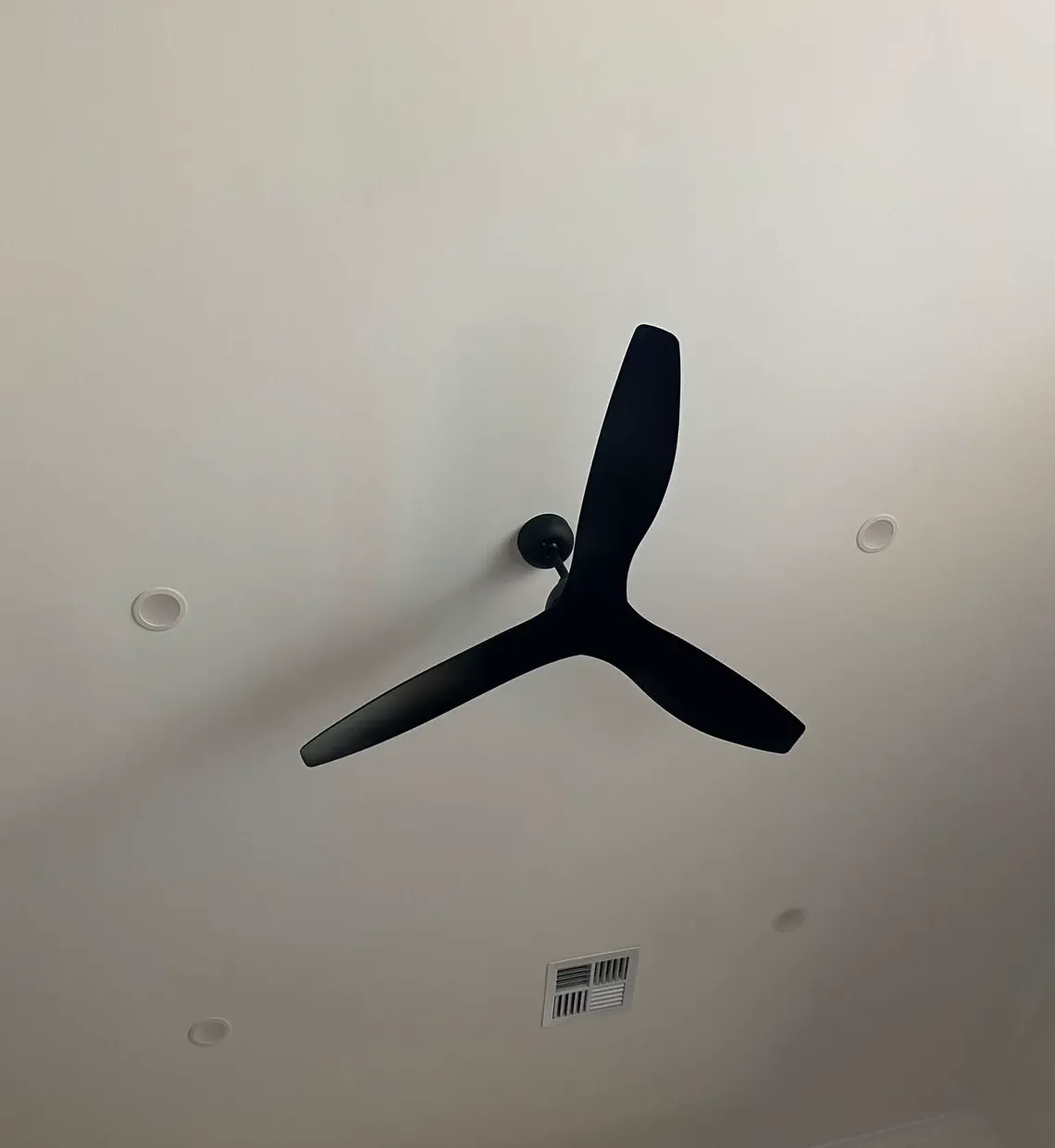
Can ceiling fans be added to rooms with no fan wiring?
- Most rooms can take a fan even with no fan wiring. The power usually comes from the room's lighting circuit.
- A fan must hang from a joist or a timber brace between joists, never from the ceiling lining alone.
- Roof access makes the job simple. Tight roofs, old plaster ceilings and the ground floor of a double storey take more planning.
- Decide the switching before you buy: a wall controller, a remote or both, and whether the light stays separate.
Where the power comes from
A room with no fan point almost always has a light point, and the lighting circuit is normally where a fan's power comes from. The electrician runs new cable from that circuit to the fan position and down to the wall switch or controller.
In an older home, look at that circuit first. Energy Safe Victoria advises owners of houses over 30 years old to have their wiring checked, and adding a fan is a good moment to find out whether the lighting circuit is fit to extend. Altering a circuit also brings in safety switch protection, because Energy Safe Victoria notes the Wiring Rules require additional RCD protection when alterations are made to an existing installation.
Roof access makes or breaks the job
In a single-storey home with a pitched roof and a manhole, most of the work happens from above. The electrician can see the joists, choose a fixing point, fit a brace if needed and run cable to the wall without disturbing the ceiling. Many of the post-war brick and weatherboard homes around Altona are like this.
Period cottages can be harder. Victorian and Edwardian houses in Yarraville, Seddon and Footscray are mostly single-storey with corrugated iron roofs, and their roof spaces can be tight to move in. Older plaster ceilings crack if they're pushed from above, so the work is slower and sometimes needs a small access hole cut and patched below.
In a double-storey home, the ground-floor ceiling has no roof space above it. Cable has to be fished between floor joists or through a wall from below, and the fan position may be limited by which way the joists run.
What the fan hangs from
A ceiling fan is heavy and moves, so it must hang from structure: a ceiling joist or a timber brace fixed between joists. Plasterboard or old plaster alone can't hold it. If the best spot falls between joists, a brace goes in from the roof space, which is another reason access matters.
High ceilings in older homes need a longer downrod so the blades sit low enough to move air while still clearing the minimum height in the fan's instructions. If there's an ornate ceiling rose where the old light hangs, the fan can often go there, but the rose isn't structural, so the fixing still has to reach a joist or brace above it.
Switching: wall controller, remote or both
The simplest setup is a fan speed controller beside the existing light switch, often on a shared plate, with the fan's light on its own switch. That needs new cable from the fan down the wall to the switch position.
DC motor fans usually run from their own remote or a matched wall control from the same maker, not a standard fan controller. Even a remote-controlled fan needs power at the ceiling and a way of switching it off, so check what the fan's instructions call for before you settle on a remote only.
If the room has downlights, keep them out from directly above the blades, or the light flickers through them. If the room has one central light, a fan with a light kit keeps the ceiling tidy.
Getting cable down the walls
Weatherboard and timber-framed walls usually have a cavity the cable can drop through, from a hole drilled in the top plate in the roof space. A noggin partway down can block the run, and the electrician may need a small hole in the wall to get past it.
Solid masonry, such as the basalt houses in parts of Williamstown, has no cavity. The choice there is a groove chased into the wall and plastered over, or a neat surface-mounted conduit. Installing a fan is licensed electrical work even where a light point already exists, and it comes with a Certificate of Electrical Safety.
Questions that come next
Sources for this article
9 sources, with the date each was checked
- 1.Energy Safe Victoria: Old switchboards, particularly those without a safety switch Old power switches or power points, particularly broken ones Flickering lights Sparks from switchboards, switches or power points. If your house is over 30… Accessed 30 September 2026.
- 2.Energy Safe Victoria: Clause 2.6.3.2.5 of the Wiring Rules states: Additional protection by RCDs shall be provided in existing electrical installations where alterations or a switchboard replacement is completed. Accessed 30 September 2026.
- 3.Victorian Government, Hobsons Bay Planning Scheme (PDF snapshot, last updated by VC292 on 11/09/2025): SPECIAL CHARACTER AREAS, ALTONA 1.0 24/02/2022 C131hbay Neighbourhood character objectives To preserve the characteristics of the neighbourhood, comprising intact post-war brick and weatherboard dwellings with… Accessed 30 September 2026.
- 4.Victorian Heritage Database (Heritage Council Victoria); entry maintained by Maribyrnong City Council: The general character of the Yarraville Residential Precinct is that of small Victorian & Edwardian single-storey detached housing with mainly weatherboard and some brick wall cladding, corrugated iron roofing, front… Accessed 30 September 2026.
- 5.Victorian Heritage Database (Heritage Council Victoria); entry maintained by Maribyrnong City Council: The general character of the Seddon Residential and Commercial Precinct is of small Edwardian and Victorian period single-storey detached and some attached housing, with a dominance of weatherboard walling and… Accessed 30 September 2026.
- 6.Victorian Heritage Database (Heritage Council Victoria); entry maintained by Maribyrnong City Council: The general character of the Precinct is one of small Edwardian single-storey detached housing with mainly weatherboard wall cladding, corrugated iron roofing, similar front and side setbacks and narrow block frontages… Accessed 30 September 2026.
- 7.Victorian Heritage Database (Heritage Council Victoria); entry maintained by Hobsons Bay City Council from the Hobsons Bay Heritage Study 2006: Unusual or rare early building styles and types such as the basalt houses and the timber duplex houses with no dividing wall that are characteristic of this part of Williamstown but less common elsewhere in the… Accessed 30 September 2026.
- 8.Energy Safe Victoria: Whenever a licensed electrician completes any electrical installation work, they must provide a Certificate of Electrical Safety (COES). Accessed 30 September 2026.
- 9.Solar Victoria (updated 20 November 2025): To heat a room, try setting the temperature between 18°C to 20°C. Every 1°C higher will add around 10% to your heating bill. Set your air conditioner thermostat for cooling between 24°C and 26°C for living areas – every… Accessed 30 September 2026.