
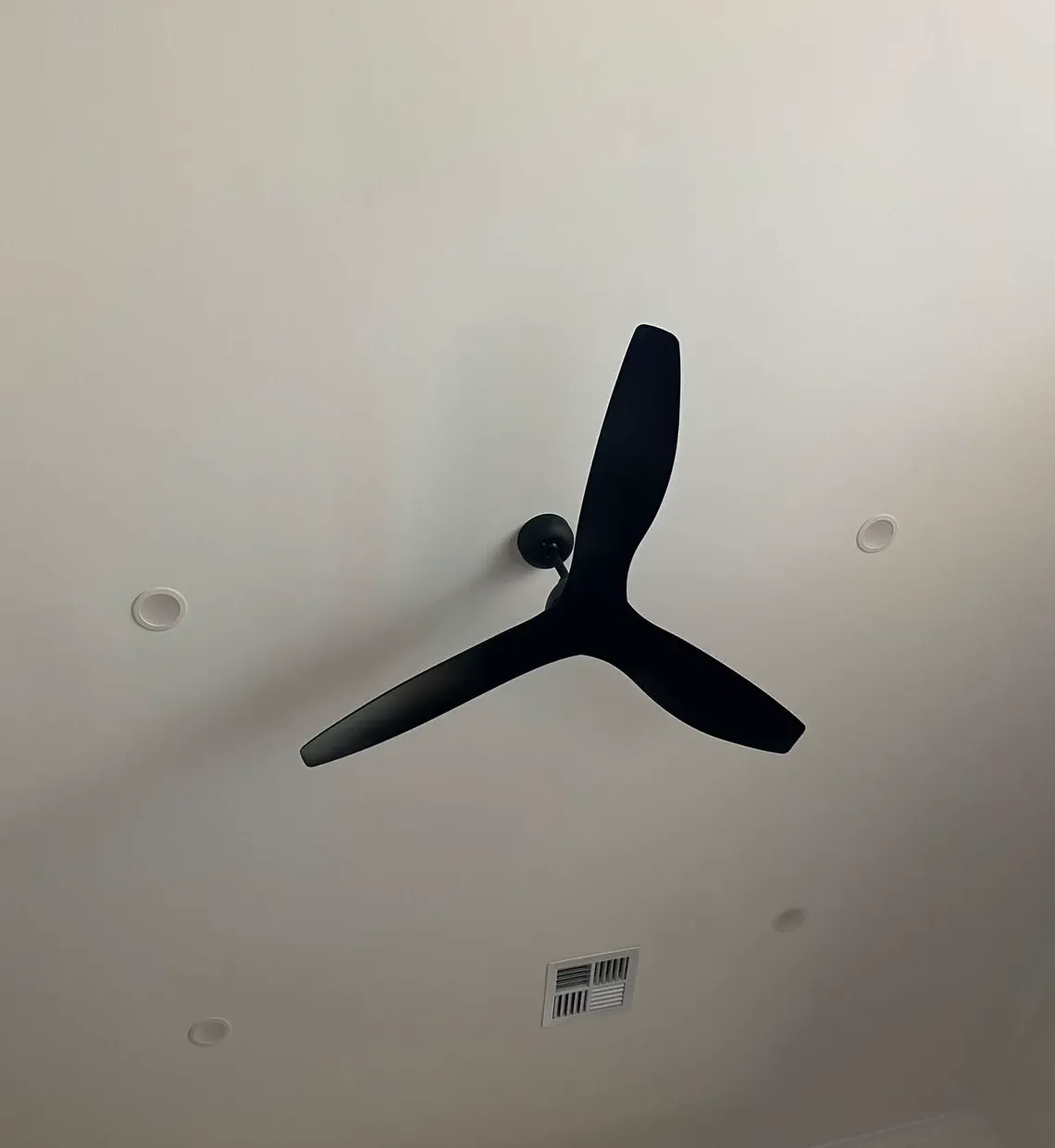
The key points
- Size the blade span to the room, and use two fans in a long open-plan space rather than one oversized fan.
- DC motors are usually quieter, use less power and offer more speeds, but they need their own remote or a matched wall control.
- Ceiling height sets the mount: close-mount for low ceilings, a longer rod for high or raked ones. The manual's minimum blade height isn't negotiable.
- Outdoor and near-bay spots need a fan rated for damp or coastal conditions, not an indoor fan under a roof.
- Send us the model before you buy so we can check it suits the ceiling, the room and the switching you want.
Blade span: match the fan to the room
Blade span is measured tip to tip, and it's the first number on the box. A fan that's too small for the room moves air in a narrow column under itself and leaves the edges still. One that's too big for a small bedroom feels like a gale even on low and crowds the ceiling.
Most makers print a room-size guide on the box or in the brochure, and it's a sensible starting point. Small bedrooms and studies suit the smaller spans, main bedrooms and lounges the middle of the range, and the largest spans are for big living areas. Check the guide against the room you actually have, not the label on the floor plan.
Long or L-shaped open-plan rooms usually work better with two fans, one over the lounge and one over the dining or kitchen end, than one large fan in the middle. Each zone gets even air, and you can run just the one you're sitting under.
DC or AC motor
AC motor fans are the traditional design. They're simple, widely available and usually run from a wall controller with a few fixed speeds. Reversing is often a small switch on the motor housing, used with the fan stopped.
DC motor fans are generally quieter, use less power and have more speeds, often with reverse and a timer on the remote. That makes them the usual pick for bedrooms, where a hum or controller buzz is most noticeable at night.
The catch with DC is control. A DC fan runs from its own remote or a matched wall controller from the same maker, not from a standard fan controller. Decide how you want to switch it before buying, and if you want a wall control as well as the remote, check the model offers one.
Ceiling height, slopes and what the fan hangs from
Every fan's instructions set a minimum height from the floor to the blades. In a standard-height room that's usually met with the fan's short rod. Lower ceilings may need a close-mount fan, sometimes called a hugger, to keep the blades at a safe height.
High and raked ceilings go the other way. The tall ceilings in older cottages around Williamstown and Yarraville, and the raked ceilings in many family rooms and alfresco areas, need a longer rod so the blades sit low enough to move air where people are. On a slope, check the maker allows your ceiling angle, because not every fan does.
The fan must hang from structure, a joist or a timber brace fixed between joists, never from plasterboard alone. If the spot you want is between joists, a brace goes in from the roof space. That's why position matters before you buy: a fan centred over the bed may need a brace, while one on the existing light point may not.
Light or no light
A light kit saves a second fitting on the ceiling, which helps in a bedroom where the fan takes the centre spot. Look for an LED light whose colour matches the rest of the room, and check whether it dims and how it's switched: on the remote, on a separate wall switch, or both.
If the room already has downlights, a fan without a light often looks cleaner. Keep downlights out from directly above the blades, or the light chopping through them makes a flicker that's hard to ignore. Moving a downlight a short way usually solves it.
Alfresco, outdoor and coastal fans
Under a pergola or alfresco roof, the fan has to be rated by its maker for damp or outdoor locations. An indoor fan under a roof still gets humidity, wind-driven rain and dust, and its motor, blades and fixings aren't built for it.
Near the bay, corrosion is the bigger enemy. BlueScope's marine-environment guide, which it describes as a guide only, classes Port Phillip Bay from Altona to Portsea beaches as an exposed marine environment and Williamstown as calm marine. Either way, for homes close to the water choose a fan whose maker says it suits coastal conditions, and rinse it down now and then.
Outdoor fans need a solid fixing point too: a pergola beam or a properly braced ceiling, not a thin lining board, and a longer rod if the roof is raked.
Controls you'll actually use
The simplest setup is a wall controller for speed and a switch for the light. Remotes are handy in bedrooms but get lost; a wall bracket for the remote or a matched wall control fixes that. Some fans connect to an app or a smart home hub, which suits people who already run their lights that way.
Think about winter as well. Warm air collects at the ceiling, and on cold, still nights a fan in reverse on its lowest speed eases it back down without a breeze. Check that reverse is easy to reach on the model you choose. A button on the remote gets used far more than a switch on the motor.
Fans work alongside air conditioning rather than replacing it. The Victorian Government suggests 24 °C to 26 °C for cooling living areas and says each degree beyond that adds around 10% to running costs. A fan on low makes the top of that range comfortable.
Before you buy: a quick checklist
Most fan problems we see come from a mismatch found on installation day: a DC fan bought to run off an old AC controller, a fan that can't hang low enough on a raked ceiling, or a light that won't dim. A few minutes with the spec sheet avoids all three.
Installing a fan is licensed electrical work, even where a light point already exists, and a licensed electrician must provide a Certificate of Electrical Safety for it.
- Room size and the maker's recommended blade span
- Ceiling height, and the ceiling angle if it's raked
- DC or AC, and which controls come with it
- Light kit: colour, dimming and how it's switched
- Indoor, damp, outdoor or coastal rating to suit the spot
Common questions
Quick answers
- Why does my ceiling fan work but the light doesn't?If the fan runs but its light doesn't, the fault is on the light side: a failed globe or LED module, a light setting on the remote or wall control, or a loose connection…
- Why does my reverse-cycle heat the ceiling and leave my feet cold?Warm air rises, so a high-wall unit blowing gently forward can leave a warm layer at the ceiling and cool air at floor level.
- Why does my light switch buzz or feel warm?A dimmer can hum faintly and feel a little warm, because it is an electronic device that sheds some heat while it works.
- Why do my lights turn on or off by themselves?Lights that switch on or off by themselves are usually following instructions you've forgotten: a smart switch schedule, a routine in an app, a motion or daylight…
Sources for this guide
3 sources, with the date each was checked
- 1.BlueScope, Technical Bulletin TB-35 Australian salt marine classifications (March 2026, Revision 9): Exposed Port Phillip Bay (Altona to Portsea Beaches) Calm Port Phillip Bay (Williamstown), Yarra River (Docklands and Melbourne CBD), Maribyrnong River Accessed 30 September 2026.
- 2.Solar Victoria (updated 20 November 2025): To heat a room, try setting the temperature between 18°C to 20°C. Every 1°C higher will add around 10% to your heating bill. Set your air conditioner thermostat for cooling between 24°C and 26°C for living areas – every… Accessed 30 September 2026.
- 3.Energy Safe Victoria: Whenever a licensed electrician completes any electrical installation work, they must provide a Certificate of Electrical Safety (COES). Accessed 30 September 2026.
Planning advice for homeowners. Installation requirements depend on the property and equipment. Where this guide refers to Victorian safety or rental rules, use the linked official guidance for the current requirements.