
The key points
- Start with where you use power every day, not where the old points happen to be.
- Framed walls with roof space above or a subfloor below are the easy ones. Solid masonry, slabs and rooms under an upper floor take more planning.
- Swapping singles for doubles adds outlets, not capacity. If the circuit already struggles, a new circuit is the better answer.
- Heaters, bench appliances and air conditioners are where new circuits usually come in.
- When an existing circuit is altered, that circuit needs safety switch protection.
Map how you use power before choosing spots
Walk each room and note where leads and power boards live now. A power board behind the bedside table, a lead stretched across a doorway to the desk, or a kettle and toaster sharing one double on the bench all point to where new outlets belong.
Then think about the next few years: a home office, a TV moving to another wall, a robot vacuum dock, a freezer in the garage. Adding a point to a wall that's already being opened for another job is easier than coming back later.
- Both sides of each bed
- Desk height, above the desktop rather than behind it
- Behind the TV at mounting height, plus one low for the cabinet
- Kitchen bench: a double at each main appliance spot, plus the island
- Laundry: washer, dryer and a spare for the iron or a charger
- Hallway: vacuum charging dock
- Garage and outside: freezer, tools, pressure washer
Easy walls and hard walls
In a weatherboard or brick veneer home with roof space above, cable usually drops straight down inside the stud wall, or comes up from a subfloor through the bottom plate. The only visible work is the hole for the outlet. The post-war brick and weatherboard homes common in Altona and the established parts of Sunshine are mostly built this way, so adding points there is usually straightforward.
Solid walls are different. Double brick, the basalt houses of old Williamstown and internal masonry walls have no cavity, so cable goes in a chase cut into the wall and plastered over, or in slim surface conduit or skirting duct. Both look tidy when done well, but they're worth agreeing in advance.
Slabs and upper floors take the most planning. A ground-floor room in a double-storey home has a floor above rather than a roof space, so cable may come from another wall, through a cupboard or through a small access hole. Noggins, the horizontal timbers inside a wall frame, can block a straight drop and need a small opening to get past.
Doubles, singles and USB outlets
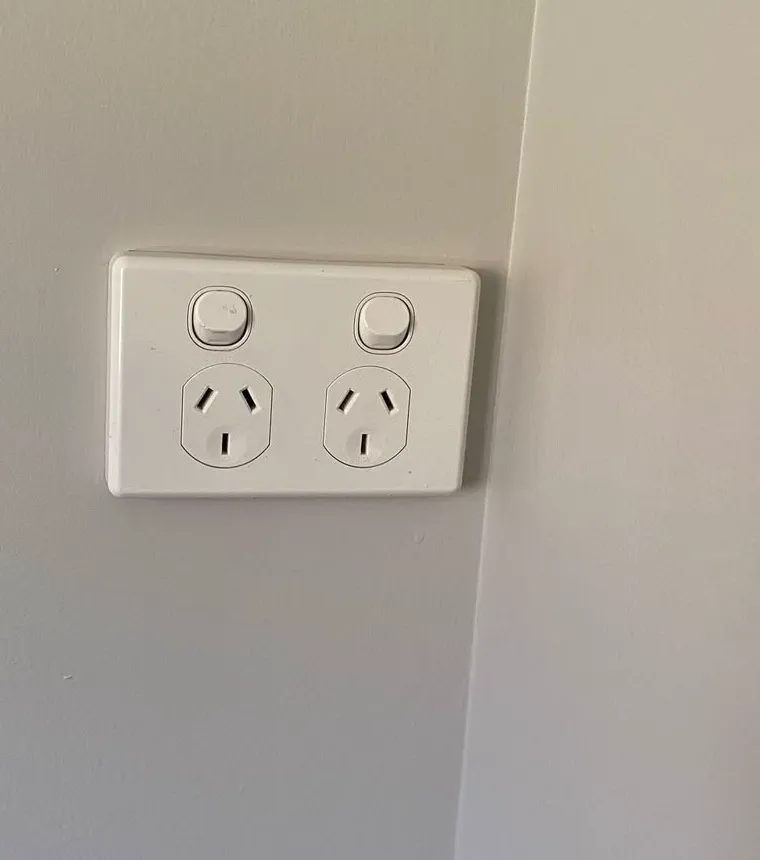
Where a single outlet exists, it can usually be swapped for a double in the same spot on the same cable. That's the quickest way to more outlets. It doesn't add capacity, though: two heaters on a new double still draw from the same circuit.
USB power points combine a double outlet with USB charging built in. They suit bedsides, desks, kitchen benches and lounges, and free up the sockets for other things. Choose ones with USB-C if your phones and laptops use it, and check the charging output suits the device, since a laptop needs more than a phone.
Outdoors, use a weatherproof outlet with a cover that closes over the plug, placed where a lead won't sit in water.
Heights and positions that work
Bedside points work best just above the bedside table, so the plug isn't hidden behind the bed. Desk points go above the desktop. On kitchen benches, put points where appliances actually live, with one spare double for the appliance you haven't bought yet. A point inside the pantry keeps the toaster or coffee machine off the bench.
For a wall-mounted TV, put a double behind the screen at mounting height and another lower down for the cabinet, so no cable hangs below the screen. The fridge outlet should be reachable without pulling the fridge out, often in the cupboard beside it.
Island benches need power from the floor. In a slab home that means planning the cable route before any bench work starts, so ask early.
When you need a new circuit, not just more points
Phone chargers, lamps, a TV and a desk setup can usually join an existing circuit. Heaters, kettles, air fryers, microwaves and anything with a heating element draw far more, and stacking them on one circuit is what trips breakers and overheats connections. Energy Safe Victoria says fire brigades respond to more than 300 domestic electrical fires each year, many caused by old wiring that has degraded or can't cope with modern equipment.
Fixed appliances such as ovens, cooktops and air conditioners belong on their own circuits. Energy Safe Victoria guidance says that if an air conditioner manufacturer specifies a dedicated circuit or a safety switch, that must be followed. A home office that runs a heater beside the computers often benefits from its own circuit too.
If a circuit already trips when a heater and kettle run together, more outlets on it make things worse. A new circuit from the switchboard is the fix, which may mean making room on the board first.
Safety switches and the switchboard
Energy Safe Victoria notes that the Wiring Rules require additional safety switch protection when an existing installation is altered. A regulators' advisory note gives the example that when an existing power-point circuit is extended with an extra outlet, only that altered circuit needs a safety switch fitted.
In practice, if the circuit you're adding to already has a safety switch, the board usually needs nothing. If it doesn't, the job includes adding one, and on an old fuse board that can be the moment to look at the board as a whole. We check this before quoting, so it isn't a surprise on the day.
Before you book
A list of rooms and points, a photo of each wall marked with where you want the outlet, and a photo of the switchboard let us plan the cable routes and spot the hard walls early. You'll have the price before work starts, and every new or altered point is tested and covered by a Certificate of Electrical Safety.
Adding or moving a power point isn't a DIY job. Energy Safe Victoria's campaign says electrical work isn't for DIY, even small jobs like changing power points or light switches. A point can look fine and still be wired dangerously.
Common questions
Quick answers
- How many appliances can I plug into one power board?It's the total load that counts, not the number of sockets.
- Why do plugs keep falling out of my power point?Plugs drop out when the contacts inside the outlet have lost their grip, or when the outlet itself has come loose from the wall.
- Why is my power point warm?A plug that feels slightly warm after a heater or kettle has run for a while can be normal.
- Can a power point be added to my kitchen island?Usually, yes.
Sources for this guide
9 sources, with the date each was checked
- 1.Victorian Government, Hobsons Bay Planning Scheme (PDF snapshot, last updated by VC292 on 11/09/2025): SPECIAL CHARACTER AREAS, ALTONA 1.0 24/02/2022 C131hbay Neighbourhood character objectives To preserve the characteristics of the neighbourhood, comprising intact post-war brick and weatherboard dwellings with… Accessed 30 September 2026.
- 2.Victorian Electoral Commission (2023 electoral structure review fact sheet): Pre- and post-war homes characterise the established suburbs of Sunshine, St Albans and Deer Park. The more recently developed suburbs of Cairnlea, Sydenham, Hillside, and Derrimut feature more contemporary housing. Accessed 30 September 2026.
- 3.Victorian Heritage Database (Heritage Council Victoria); entry maintained by Hobsons Bay City Council from the Hobsons Bay Heritage Study 2006: Unusual or rare early building styles and types such as the basalt houses and the timber duplex houses with no dividing wall that are characteristic of this part of Williamstown but less common elsewhere in the… Accessed 30 September 2026.
- 4.Energy Safe Victoria: Fire brigades respond to more than 300 domestic electrical fires each year. Many of these fires are caused by old wiring that has degraded or is unable to cope with the demands of modern electrical equipment. Accessed 30 September 2026.
- 5.Energy Safe Victoria: This means that if the manufacturer’s specifications require an air conditioner to be installed on a dedicated circuit or protected by a residual current device then they must be adhered to. Accessed 30 September 2026.
- 6.Energy Safe Victoria: Clause 2.6.3.2.5 of the Wiring Rules states: Additional protection by RCDs shall be provided in existing electrical installations where alterations or a switchboard replacement is completed. Accessed 30 September 2026.
- 7.Electrical Regulatory Authorities Council (ERAC): An existing final sub-circuit for socket outlets is extended and an additional socket outlet is installed. Only that circuit that is altered is required to have a RCD fitted. Accessed 30 September 2026.
- 8.Energy Safe Victoria: Electrical work isn’t a DIY job, even for small jobs such as changing power points or light switches. Accessed 30 September 2026.
- 9.Energy Safe Victoria: Whenever a licensed electrician completes any electrical installation work, they must provide a Certificate of Electrical Safety (COES). Accessed 30 September 2026.
Planning advice for homeowners. Installation requirements depend on the property and equipment. Where this guide refers to Victorian safety or rental rules, use the linked official guidance for the current requirements.