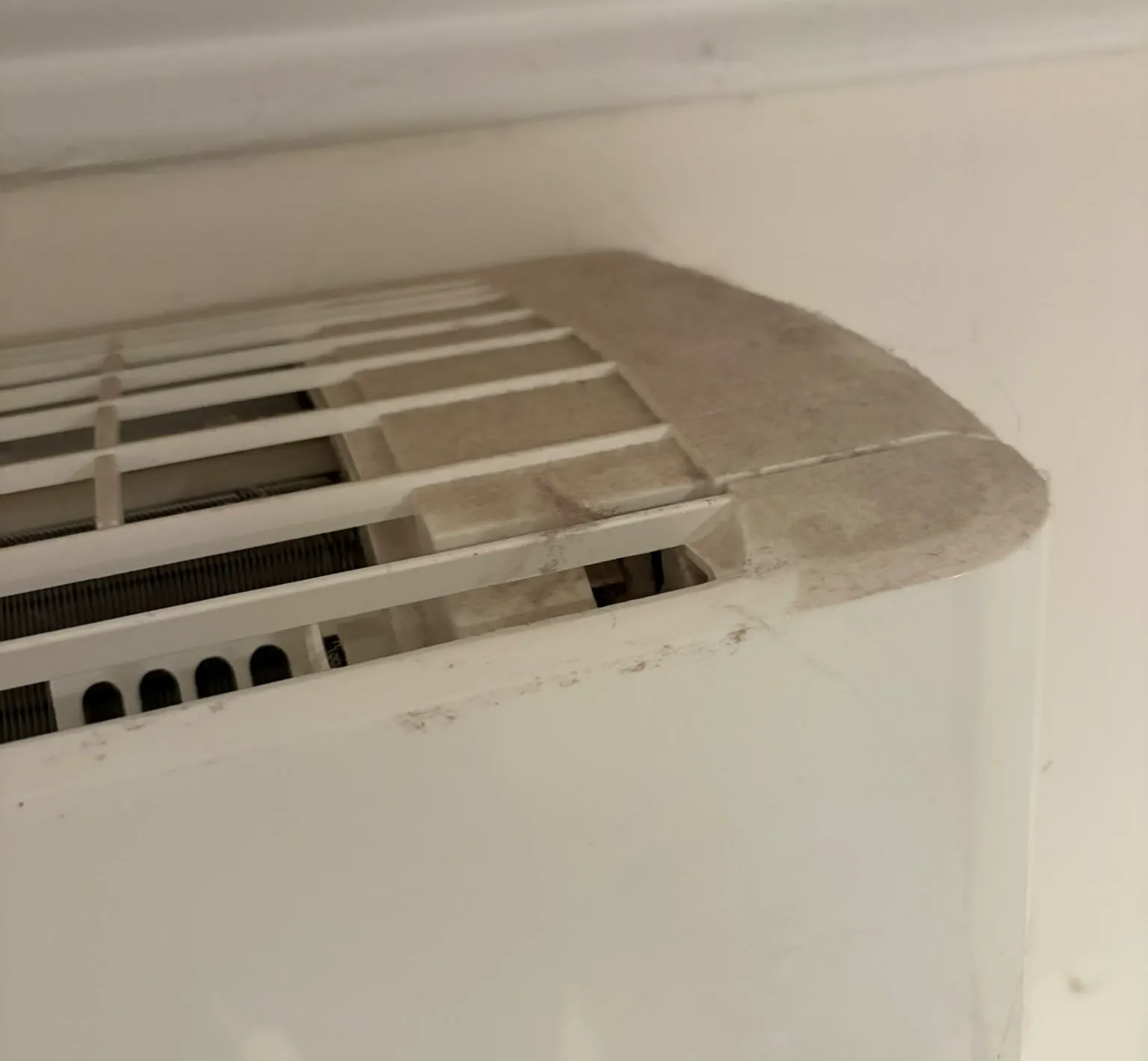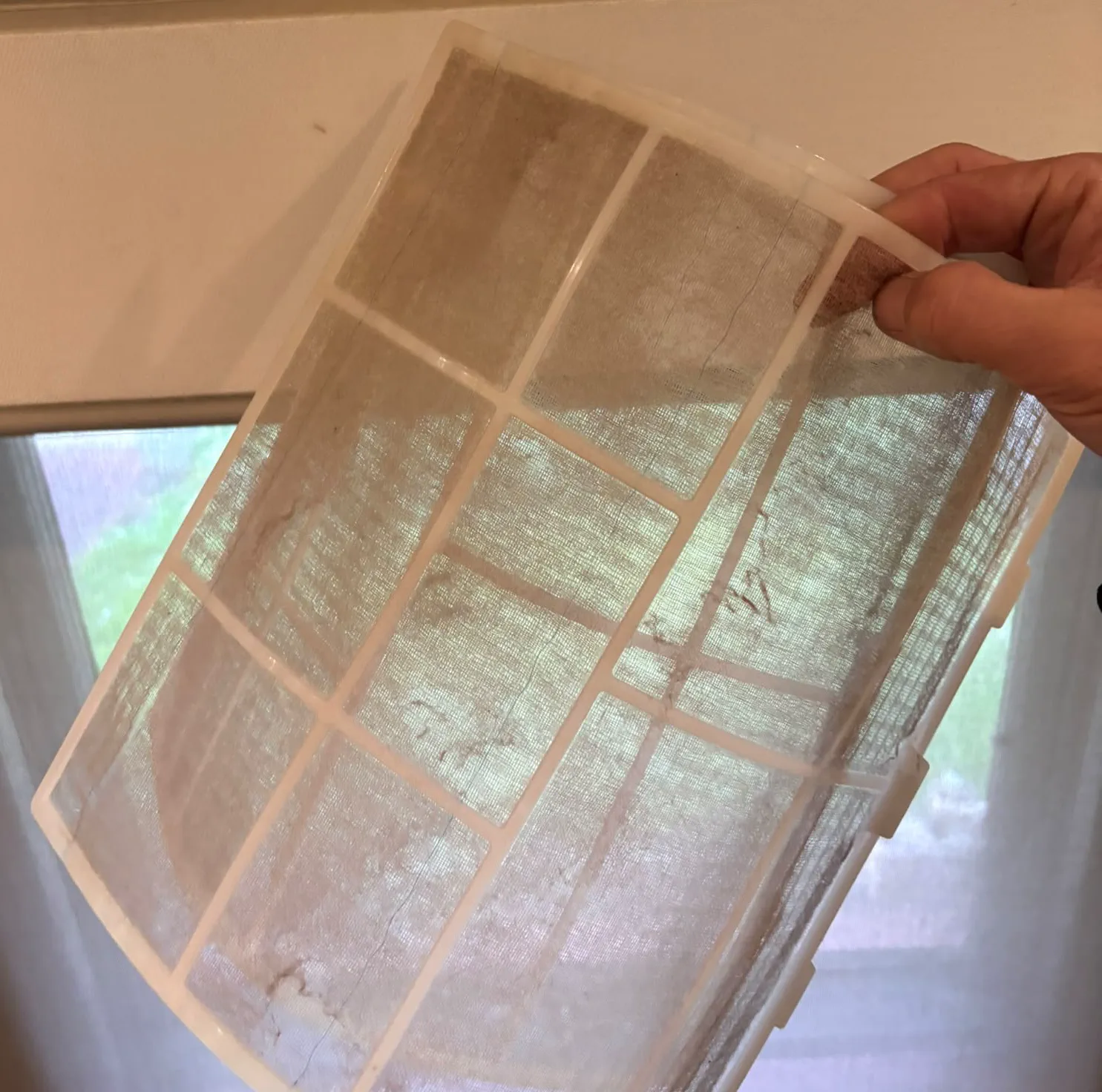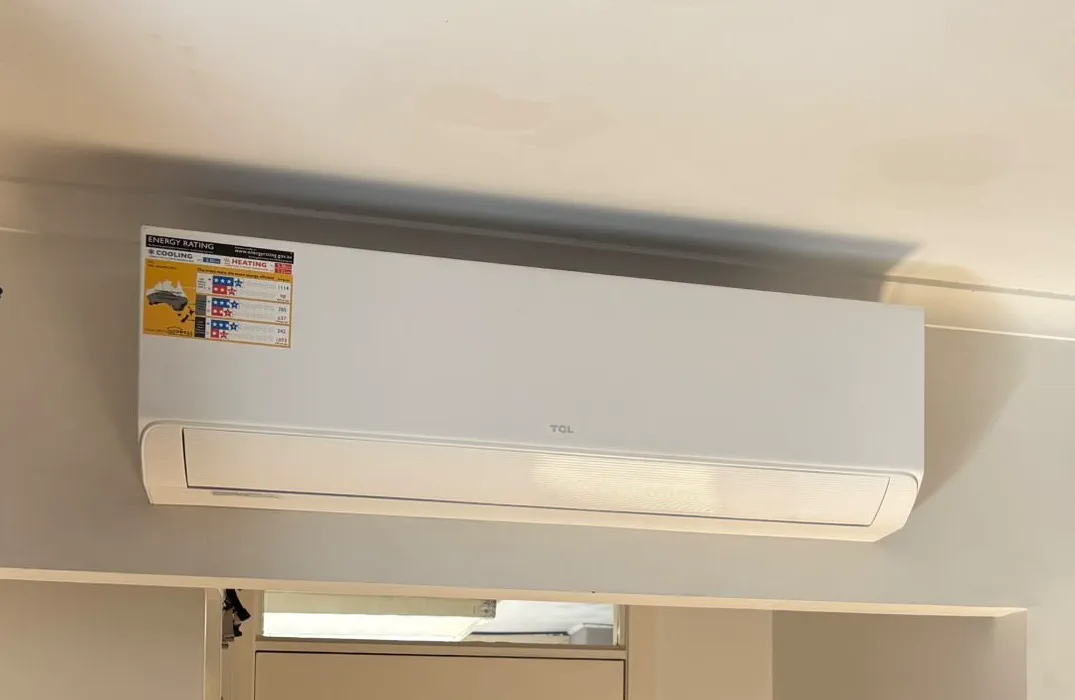
A blocked or badly sloped drain, a failed pump or a frozen coil sends condensate into the room instead of outside. We trace the water from tray to outlet, check any electrics it has reached and fix the cause.
When to get it checked
Drips or spray from the head
Water falls from under the unit or past the louvres, or spits out with the air when the tray is brimming.
A damp patch on the wall
Bubbling paint or a tide mark below the unit means water has been running down behind the head for a while.
A stain on the ceiling
A brown ring under a ducted unit or around a cassette, or a pump that never stops, means water is sitting instead of draining.
A dry outlet outside
After cooling on a warm day, the drain hose outside should drip. Dry outside and wet inside means it's escaping on the way.
Why it happens
6 common causes
A blocked drain
Dust that slips past the filter turns into a slime that clogs the tray and hose. Insects nest in the open end outside.
Not enough fall
The hose must run downhill all the way. A sag, a kink or an outlet buried in mulch backs water into the tray.
Ice melting off the coil
A clogged filter, dirty coil, weak fan or low refrigerant can freeze the coil. When it thaws, the melt swamps the tray.
A failed condensate pump
Heads on internal walls and most cassettes need a small pump. If it or its float switch fails, the tray overflows.
A head out of level
The tray falls towards its outlet. A head bumped on its bracket tips water the other way and out the back.
Sweating pipes or rain
Pipes with split or missing insulation sweat inside the wall. A badly sealed pipe hole lets rain run in along them.
What the job covers
What we usually do on this job. Your quote confirms it for your place.
- Leak traced to its source
- Circuit and isolator checked for water
- Drain tray and line cleared and flushed
- Drain fall and outlet end checked
- Filters, coil and fan checked for ice
- Condensate pump tested where fitted
- Unit run in cooling to confirm it drains
Your options, explained
Clear and flush the drain
Low disruption- Best for
- A blockage in a drain with good fall
- How it works
- The tray and hose are cleared, flushed and flow-tested.
- Worth knowing
- The most common fix. Quick re-blocking points to dirty filters or coil.
Re-run the drain or fit a pump
Medium disruption- Best for
- Sagging or uphill drains, and heads gravity can't drain
- How it works
- The hose is re-run with steady fall, or a pump lifts the water out.
- Worth knowing
- More work inside walls or roofs. Plaster and paint repairs are separate.
Fix the icing
Medium disruption- Best for
- Leaks that start as ice on the coil
- How it works
- Airflow faults are cleaned or repaired. A low charge means fixing the leak before recharging.
- Worth knowing
- Most icing is airflow. Refrigerant repairs are licensed work.
The people behind the work
One local team for electrical, heating and cooling. Family-run, based in Altona Meadows, with 19 years in the industry.
Licensed electrical contractor (REC 38187)See more team photos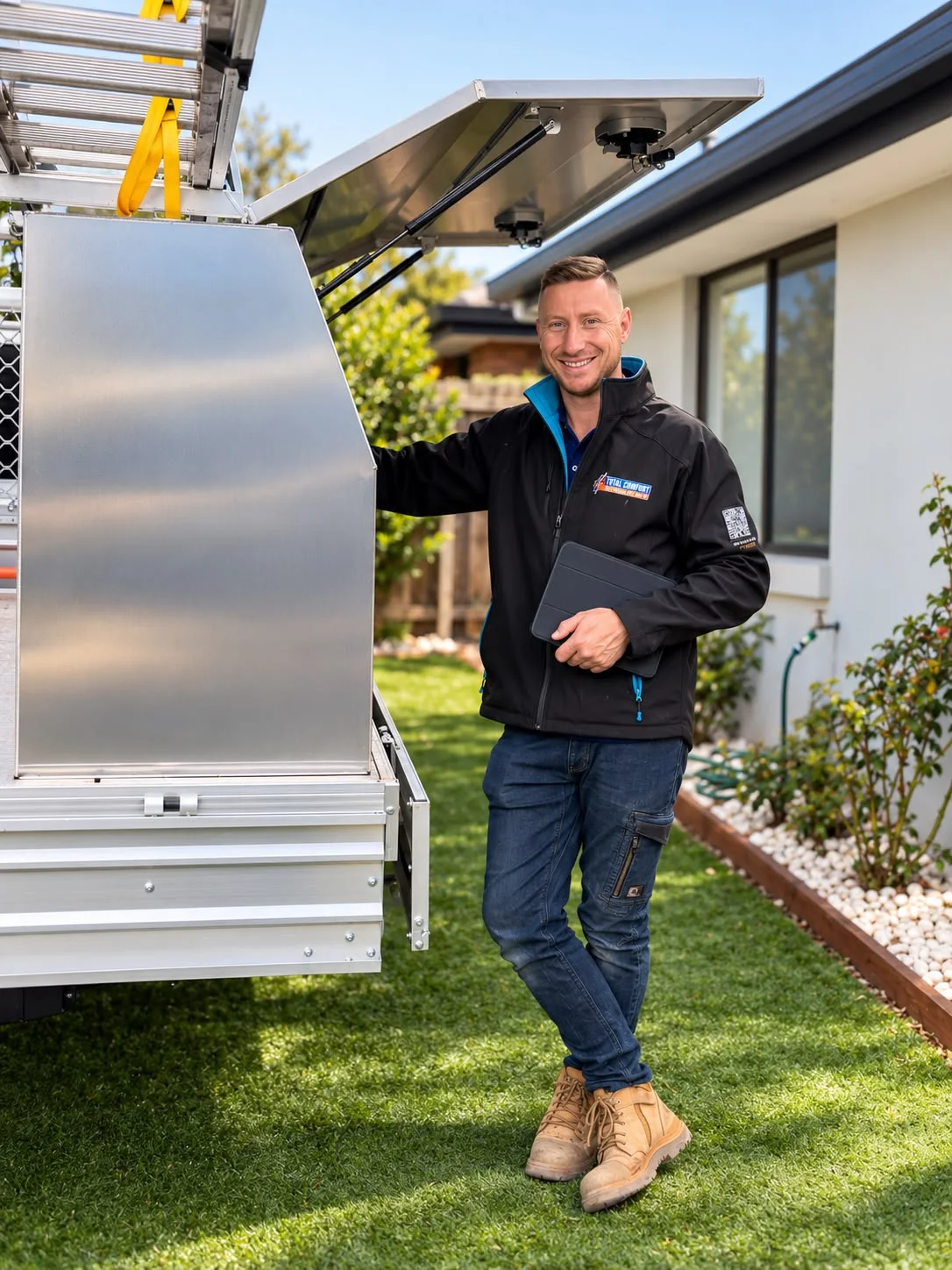
Worth knowing before you book
- Turn it off first
- Switch the unit off and catch the drip. If water is near wiring, switch off at the switchboard if safe.
- Some water outside is normal
- The drain hose drips when cooling, and the outdoor unit drains when heating.
- Gas isn't the first fix
- Most leaks are drain faults. Low refrigerant means a leak to repair before any recharge.
What affects the price?
The right scope depends on your installation. These are the details we check so your quote is useful, with any additional work explained before it proceeds.
Where the drain runs
An exposed hose on an outside wall is quick. One inside a wall or roof space takes longer to trace and re-run.
Height and access
Upstairs heads, cassettes and roof-space ducted units need more setup than a head reached from a stepladder.
Parts and wet electrics
A failed pump or float switch adds a part. A wet control board or power point needs testing, and anything damaged replacing.
Ice and refrigerant
A dust-caked coil may need a proper clean. Ice from a refrigerant leak means a bigger repair.
How it runs
- 1
Tell us what you see
Where the water appears, plus a few photos.
- 2
Trace and price
We follow the water and price the fix before we start.
- 3
Fix and prove it
We repair it and check it drains outside.
Step by step, in more detail
4 steps
Get the story
We ask where the water shows, the mode it was in and what changed lately, like a service or new garden bed. Photos help.
Make it safe
We're electricians too, so we check whether water has reached the head's wiring, a power point or the circuit before it runs again.
Follow the water
We flow-test from tray to outlet, check fall, joins and any pump, and look for dirt and ice on the filters and coil.
Price, fix and prove it
You get the price before we start. After the repair we run it in cooling and watch water leave at the outlet.
What is safe to do, and what to leave to us
Safe for you to do
- Turn the unit off and leave it off until it's checked.
- If water is reaching a power point, light or wiring, switch off at the switchboard if it's dry and safe to get to.
- Catch the drip and photograph the wet area and the drain outlet outside.
- If a safety switch has tripped, reset it once with the unit off. If it trips again or won't reset, call a licensed electrician.
Leave these to us
- Running the unit while water lands on a power point or the head's electrics.
- Taking the casing off, blowing through the drain or pushing wire up the hose.
- Paying for a regas to cure ice. Topping up before the system is fully tested and every identified leak repaired is illegal.
When to get us in
- Water from the indoor unit, a cassette or a ceiling vent
- A new stain, bubbling paint or damp patch near the unit
- Ice on the coil or pipes
- A safety switch that tripped when the leak started
More detail
Where the water is meant to go
Room air passing over a cold coil drops its moisture, like a cold drink fogging and dripping. It collects in a tray and a hose carries it outside, or a small pump lifts it there. A leak inside means something on that path has blocked, sagged or stopped.
When the real problem is ice
A frozen coil holds a lot of water and dumps it as it thaws. Dirty filters are the usual cause, and the Victorian Government suggests cleaning the dust filters about twice a year, more with heavy use. If clean filters don't stop it, the coil, fan and refrigerant charge need checking, and refrigerant work needs a Refrigerant Handling Licence.
Stains under a ducted system
A ducted unit in the roof drains from its own tray, often over a second safety tray, so a stain right under it points there. A stain along a duct run is more likely a sweating duct: the Australian Government's Your Home guide says ducts should be insulated to at least R1.5 with joints sealed to prevent condensation. If the plaster sags, keep out from under it.
Local rules and conditions
Victorian requirements and local conditions that shape this job, with the sources listed at the foot of the page.
Hot days find the weak drain
Laverton's weather station averages 27.0 days a year at or above 30 °C, most from December to February. Long runs then push the most water down the drain and show up any partial blockage. Victoria's health department advises checking your air conditioner works before extreme heat.
Winter water outside is normal
Laverton's July mean minimum is 5.2 °C. On cold mornings a reverse-cycle system heating the house defrosts its outdoor coil, and melt water runs out of the outdoor unit. That's normal as long as the ice clears.
Renters: put the leak in writing
Consumer Affairs Victoria lists a rental provider's cooling appliance that isn't working as an urgent repair, to be made immediately. Other repairs are due within 14 days of a written request. The rental provider pays unless the renter caused it.
Useful reading
Guides to read before you decide, with checklists and questions to bring to the quote.
- Air conditioner maintenance: what to watch between servicesKeep useful records, follow model-specific filter care and recognise symptoms that need a repair visit.
- Getting your air conditioning ready for a heatwaveA spring test run, clean filters, a clear outdoor unit and a backup plan: how to find a tired air conditioner before the first hot northerly does.
- Landlords: heating, cooling and electrical obligations in VictoriaA rental provider's map of the heating, switchboard, safety check and repair duties on a Victorian rental, and what the 2027 energy standards change.
Common questions
Questions people ask about this
More in the Help centreFrom the blog
Sources for the rules and local facts on this page
8 sources, with the date each was checked
- 1.Bureau of Meteorology: Mean number of days ≥ 30 °C 6.9 6.0 4.5 0.7 0.0 0.0 0.0 0.0 0.1 0.9 2.8 5.1 27.0 82 1943 2026 Mean number of days ≥ 35 °C 3.6 2.4 0.9 0.0 0.0 0.0 0.0 0.0 0.0 0.1 0.5 1.9 9.4 Accessed 30 September 2026.
- 2.Better Health Channel (Department of Health, Victoria): Check that your fan and air-conditioner works well. Have your air-conditioner serviced if needed. Ensure the filters, pads and air vents are clean. Accessed 30 September 2026.
- 3.Consumer Affairs Victoria: a cooling appliance or service provided by the rental provider is not working the property does not meet minimum standards a safety-related device, such as a smoke alarm or pool fence, is not working Accessed 30 September 2026.
- 4.Australian Refrigeration Council (ARC), Fact Sheet 13 (ARC5225, 11/22): ‘Topping-up’ a system before the system has been fully tested and all identified leaks repaired by any individual is illegal. Accessed 30 September 2026.
- 5.Australian Refrigeration Council (ARC): A Refrigerant Handling Licence must be held by any person who carries out work in relation to refrigeration and air conditioning (RAC) equipment. Carrying out work in relation to RAC equipment means to do anything with… Accessed 30 September 2026.
- 6.Solar Victoria (updated 20 November 2025): Check the manufacturer’s instructions or manual and have the air conditioner serviced regularly at the recommended frequency to ensure it continues to operate efficiently. Cleaning the filters regularly helps the system… Accessed 30 September 2026.
- 7.YourHome (Australian Government): Ducts must be well insulated, to at least R1.5, and joints sealed to prevent condensation and leakage. The roof should have reflective foil insulation installed and be vented to dispel hot air. Zoned systems cool only… Accessed 30 September 2026.
- 8.Energy Safe Victoria: Locate your electricity box outside your home and check whether the safety switch has tripped. If it has tripped, reset the switch. If the switch won’t reset, call a licensed electrician. Accessed 30 September 2026.