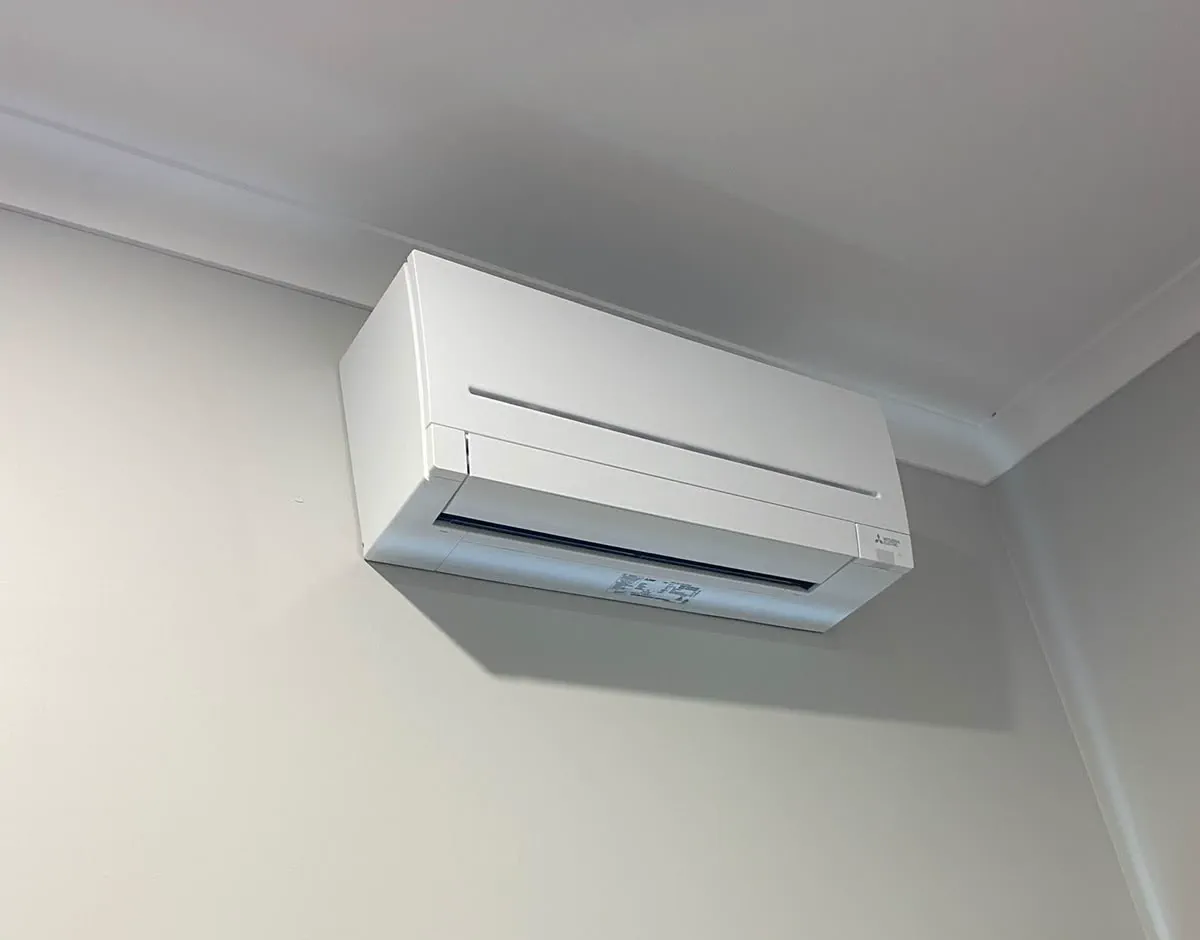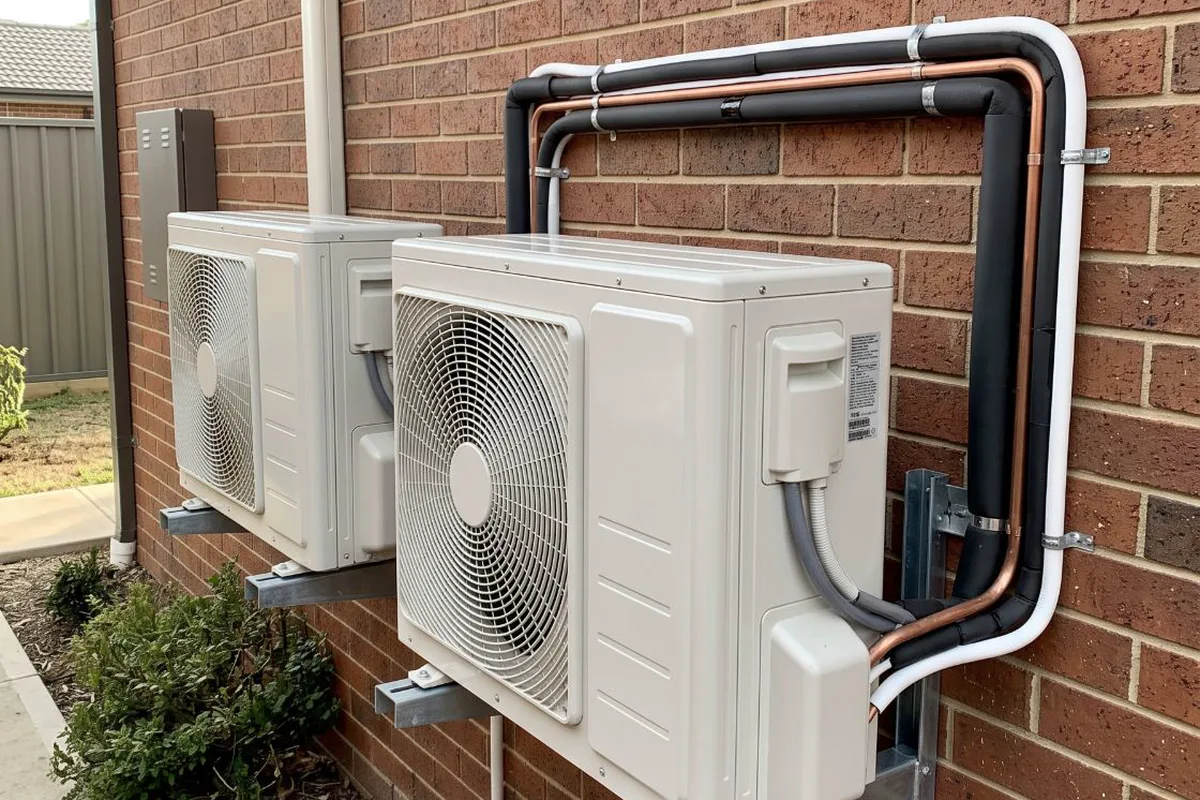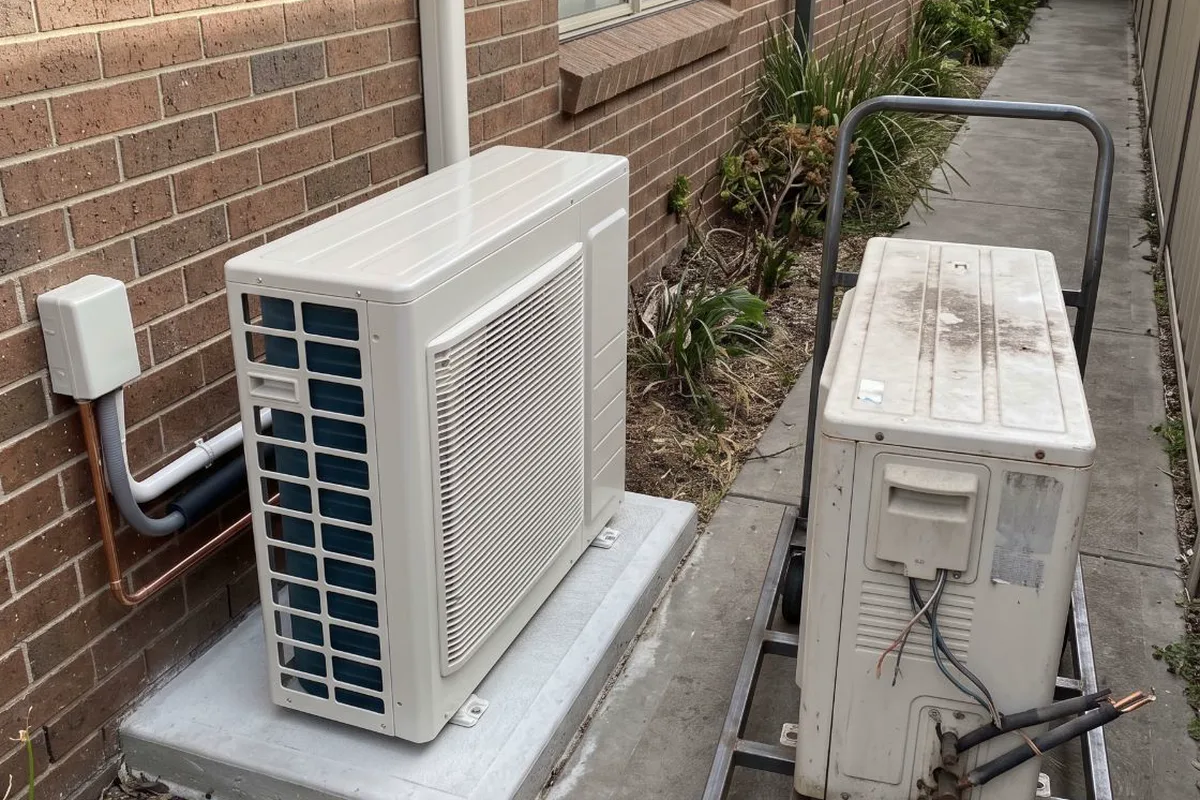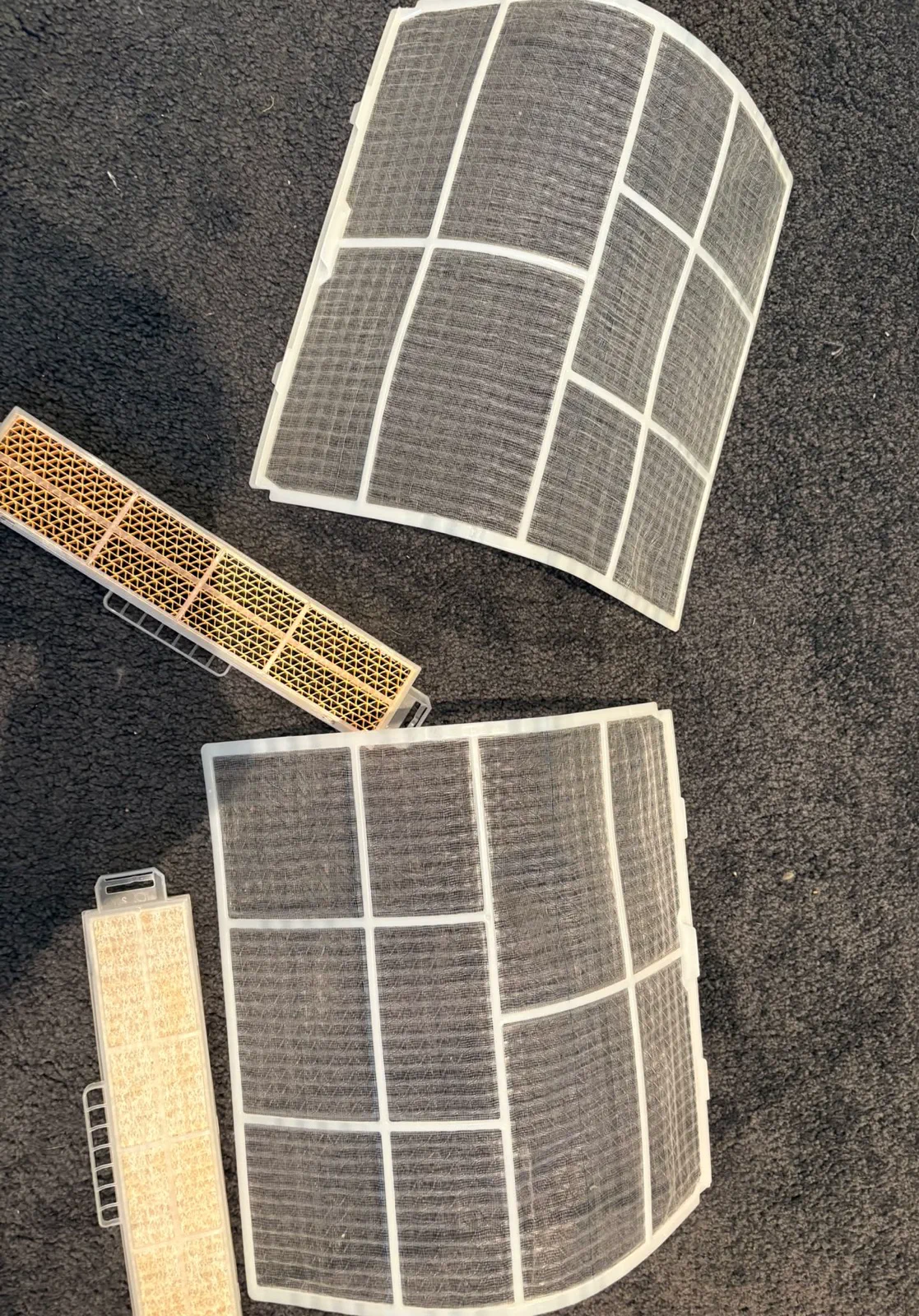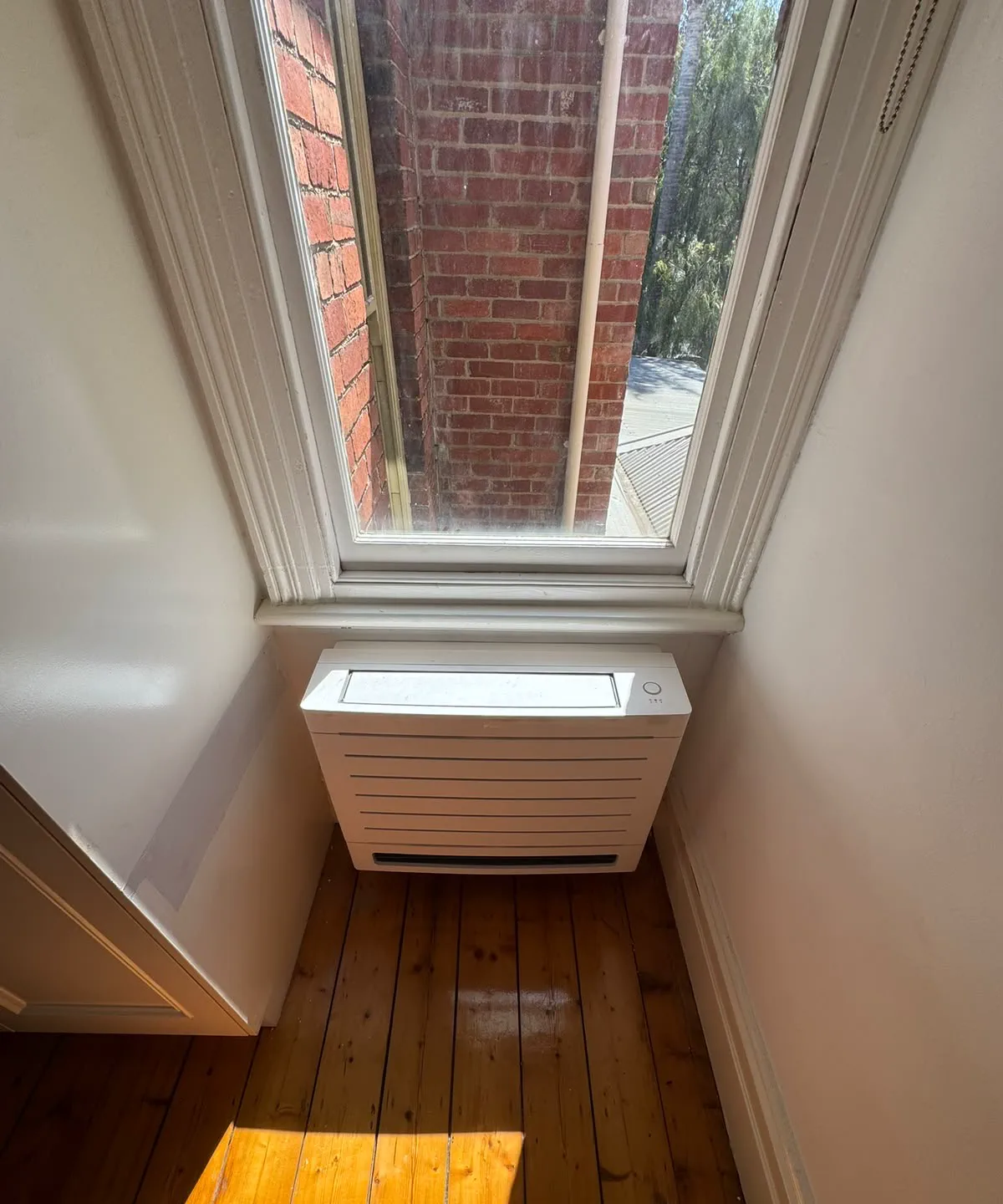
A floor console is a split system with its indoor unit at skirting height. It suits rooms with full-height glass, sloping ceilings or an old heater's spot, and heats well because warm air starts low. We install it and run the circuit ourselves.
When to get it checked
Glass where a wall unit would go
Sliding doors and full-height windows leave no solid wall up high. The strip under a window is often the best spot left.
A sloping or low ceiling
Attic rooms and raked extensions leave no space near the ceiling for a wall unit to sit and throw its air.
Winter is the main reason
If you mostly want heating, warm air released near the floor lands where you sit, not at the ceiling.
An old heater is coming out
A gas wall heater or space heater leaves a low spot on an external wall, often right where a console fits.
Why it happens
4 common causes
Heat rises and stays up
Heating from a high wall unit under a tall ceiling can leave a warm layer up top and cold feet below.
Cold glass drags air down
Big windows chill the air beside them, which sinks into a floor-level draught. A console under the window meets it where it starts.
The pipes have nowhere to go
A high unit on an internal wall needs pipes through the roof space. A console on an external wall usually goes straight out the back.
Awkward walls
Old lath and plaster, thin cladding or a wall that's mostly window frame are poor places to hang a unit high.
What the job covers
What we usually do on this job. Your quote confirms it for your place.
- Room, wall and outdoor unit position checked
- Capacity sized for the room, weighted to heating
- Console fixed level at skirting height
- Pipes, drain and cable through the wall or floor
- Drain with steady fall, or a condensate pump
- Pipework pressure tested and vacuumed
- Dedicated circuit and outdoor isolator
- Tested in heating and cooling, filters shown
- Certificate of Electrical Safety for the wiring
Your options, explained
Standard floor console
Low disruption- Best for
- Under a window, on an external wall or in an old heater's spot
- How it works
- Stands at skirting height, piped out the back to an outdoor unit.
- Worth knowing
- The usual choice. Needs clear floor in front and servicing room at the sides.
Semi-recessed console
High disruption- Best for
- Renovations where the wall is open
- How it works
- Part of the unit sits in the wall cavity or joinery, so it projects less.
- Worth knowing
- Only some models allow it. Framing and service access are planned with the builder.
High wall split instead
Low disruption- Best for
- Rooms with solid wall up high, where cooling matters most
- How it works
- The familiar indoor unit near the ceiling, with a similar outdoor unit.
- Worth knowing
- Often simpler when the wall allows. We'll tell you if so.
The people behind the work
One local team for electrical, heating and cooling. Family-run, based in Altona Meadows, with 19 years in the industry.
Licensed electrical contractor (REC 38187)See more team photos
Worth knowing before you book
- Keep the front clear
- Furniture against the console blocks its air.
- Heating is its strength
- Warm air released low spreads as it rises.
- No ladder for filters
- Floor-level filters are easy to reach and clean.
What affects the price?
The right scope depends on your installation. These are the details we check so your quote is useful, with any additional work explained before it proceeds.
Capacity and model
More glass, floor area or ceiling height needs more output. Stronger heating ratings and quieter fans cost more.
Pipe, drain and outdoor unit
Straight out through an external wall to a nearby pad is simplest. Under-floor runs, brackets, upper storeys or long side paths add time.
Walls and building work
Coring brick takes longer than weatherboard. A recessed console adds framing, plastering and painting.
Power and what's coming out
A full or dated switchboard may need work first. Removing an old heater and sealing its flue opening adds steps.
How it runs
- 1
Tell us about the room
Its size, windows and where you'd like the console.
- 2
Look, size and price
We check the wall, drain route and switchboard, then price it before we start.
- 3
Install, wire and test
Console, outdoor unit and circuit in, then tested in heating and cooling.
Step by step, in more detail
4 steps
Look and measure
We check the wall, what's under the floor, where the outdoor unit and drain can go, and the switchboard's spare room.
Size and price
Capacity comes from the room size, glass, insulation and ceiling height, weighted to heating if that's the priority. You get the price before we start.
Install and wire
The console is fixed level at skirting height and piped through the wall or floor to the outdoor unit. Our electricians run a dedicated circuit and fit a lockable isolator beside the outdoor unit, not on it.
Test and hand over
Pipework is pressure tested and vacuumed before the refrigerant is released. We run it in heating and cooling, check the drain and show you the filters.
What is safe to do, and what to leave to us
Safe for you to do
- Keep furniture, curtains and washing clear of the console's front and outlets.
- Clean the dust filters as the manual describes, about twice a year or more with heavy use.
- If it trips a safety switch, reset it once. If it trips again or won't reset, leave it off and call a licensed electrician.
Leave these to us
- Opening the casing, moving the unit or touching its wiring. Electrical work isn't DIY, even small jobs.
- Disconnecting an old gas heater yourself. Gasfitting by unlicensed people is illegal.
- Letting anyone without a refrigerant handling licence install it, even a pre-charged unit.
When to get us in
- Planning heating or cooling for a room with big windows, a sloping ceiling or no high wall space
- An old gas wall heater or space heater is due to come out
- Renovating, and you want the console recessed before the walls close
More detail
How a console moves air
Most consoles draw air in at the front and blow it out through top louvres, and many add a lower outlet for heating. That lower stream sends warm air across the floor in winter, while the top louvres throw cool air up and out in summer. A couch pushed hard against the front cuts both.
Pipes and water at floor level
Pipes usually leave through the wall right behind the console. On a raised timber floor they can drop through and run underneath, out of sight. On a slab the drain exits close to the ground, so it needs somewhere lower to run, or a small pump.
Replacing an old gas heater
Owner-occupiers aren't required to switch gas space heating to electric, but a console is a natural replacement for a tired wall heater. A licensed gasfitter must disconnect the gas and make it safe first.
Local rules and conditions
Victorian requirements and local conditions that shape this job, with the sources listed at the foot of the page.
Cold, still winter nights
Laverton's coldest month is July, with a mean minimum of 5.2 °C. Victorians typically use more energy for heating than cooling, so the Victorian Government suggests a unit with higher heating efficiency.
Glass rooms on hot afternoons
Laverton's weather station averages 27.0 days a year at or above 30 °C, mostly December to February. A console under west-facing glass has to handle those afternoons, so we check its cooling output too.
Renting the home out
For leases from 29 March 2023, the main living area needs an energy-efficient fixed heater, and a non-ducted air conditioner rated 2 stars or above counts. From 1 March 2027 a new lease also needs fixed cooling there, 3 stars or more on the GEMS cooling rating for a non-ducted unit. One reverse-cycle unit can meet both.
Useful reading
Guides to read before you decide, with checklists and questions to bring to the quote.
- What size split system do you need?What a split system's kW rating measures, why floor area alone gets it wrong, and how glass, ceilings and afternoon sun change the size a room needs.
- Reading the Zoned Energy Rating LabelWhich zone to read in Melbourne, why the red heating stars matter most, what the kWh and noise figures mean, and how to compare two units fairly.
- Reverse-cycle air conditioning or gas heating?How each one makes heat, how it feels on a cold night in Melbourne's west, what Victoria's gas rules mean for you and what switching really involves.
- Split system or ducted: choose around the rooms you useCompare layouts, zoning, installation work and quote details before choosing equipment for your home.
Common questions
Questions people ask about this
More in the Help centreFrom the blog
Sources for the rules and local facts on this page
17 sources, with the date each was checked
- 1.Bureau of Meteorology: Mean minimum temperature (°C) 14.0 14.4 12.7 10.0 7.8 5.9 5.2 5.7 6.8 8.4 10.3 12.2 9.5 81 1943 2026 Accessed 30 September 2026.
- 2.Department of Energy, Environment and Climate Action (energy.vic.gov.au), page last updated 14/04/25: Victorians typically use more energy for heating than cooling, so look for a unit with a higher heating efficiency. Accessed 30 September 2026.
- 3.Consumer Affairs Victoria: All rental properties must have a fixed heater (not portable) in good working order in the main living area. For rental agreements entered into from 29 March 2023, this must be an energy efficient fixed heater in the… Accessed 30 September 2026.
- 4.Consumer Affairs Victoria: From 1 March 2027, rental providers must install an energy-efficient, fixed cooling system with an outlet in the main living area. This applies at the start of a new rental agreement. All rental properties must have… Accessed 30 September 2026.
- 5.Consumer Affairs Victoria: Definition: From 1 March 2027, energy efficient fixed cooling means: (a) a non-portable, non-ducted electric air conditioner or heat pump capable of cooling, with a GEMS 3-star or above cooling rating (for the climate… Accessed 30 September 2026.
- 6.Consumer Affairs Victoria: Tip: A reverse-cycle air conditioner can satisfy both the heating and cooling standards. Accessed 30 September 2026.
- 7.Commonwealth of Australia (2019), 'The new zoned energy rating label for air conditioners—What installers and retailers need to know', hosted on energyrating.gov.au: Melbourne is in a black ‘COLD’ area—read the black Cold ratings. Accessed 30 September 2026.
- 8.Energy Rating (GEMS Regulator / DCCEEW): On the right of the label after the stars, is the estimated annual energy use or power input in kilowatt hours (kWh) displaying cooling in blue (top number) and heating in red for each climate zone. ... Products are… Accessed 30 September 2026.
- 9.Energy Rating (GEMS Regulator / DCCEEW): Reverse cycle air conditioners are much more efficient at heating than standard electric heaters (bar heaters, convection, or radiant heaters). ... During the normal operating range in Australia for every unit of… Accessed 30 September 2026.
- 10.Solar Victoria (updated 20 November 2025): Check the manufacturer’s instructions or manual and have the air conditioner serviced regularly at the recommended frequency to ensure it continues to operate efficiently. Cleaning the filters regularly helps the system… Accessed 30 September 2026.
- 11.Australian Refrigeration Council (ARC): NO. If the refrigerant is contained in equipment, such as a split system air conditioner, a Refrigerant Trading Authorisation is not required. However a refrigerant handling licence is required to install this type of… Accessed 30 September 2026.
- 12.Access Canberra Electrical Inspections (ACT Government), Electrical Fact Sheet, updated September 2019: Air-conditioning and heat pump systems incorporating a compressor shall be provided with an isolating switch (lockable) in accordance with Clause 2.3.2.2, installed adjacent to but not on the unit, which isolates all… Accessed 30 September 2026.
- 13.Energy Safe Victoria: Locate your electricity box outside your home and check whether the safety switch has tripped. If it has tripped, reset the switch. If the switch won’t reset, call a licensed electrician. Accessed 30 September 2026.
- 14.Energy Safe Victoria: Electrical work isn’t a DIY job, even for small jobs such as changing power points or light switches. Accessed 30 September 2026.
- 15.Energy Safe Victoria: Gas and electricity are inherently dangerous and it’s illegal and potentially fatal for unlicensed and unqualified people to undertake any gasfitting or electrical work. Accessed 30 September 2026.
- 16.Department of Energy, Environment and Climate Action (energy.vic.gov.au), page last updated 05/08/26: From 1 March 2027, when a hot water or heating appliance breaks and cannot be repaired, it must be replaced with a heat pump water heater or an efficient electric reverse cycle air-conditioner (RCAC) in the main living… Accessed 30 September 2026.
- 17.Energy Safe Victoria: Whenever a licensed electrician completes any electrical installation work, they must provide a Certificate of Electrical Safety (COES). Accessed 30 September 2026.