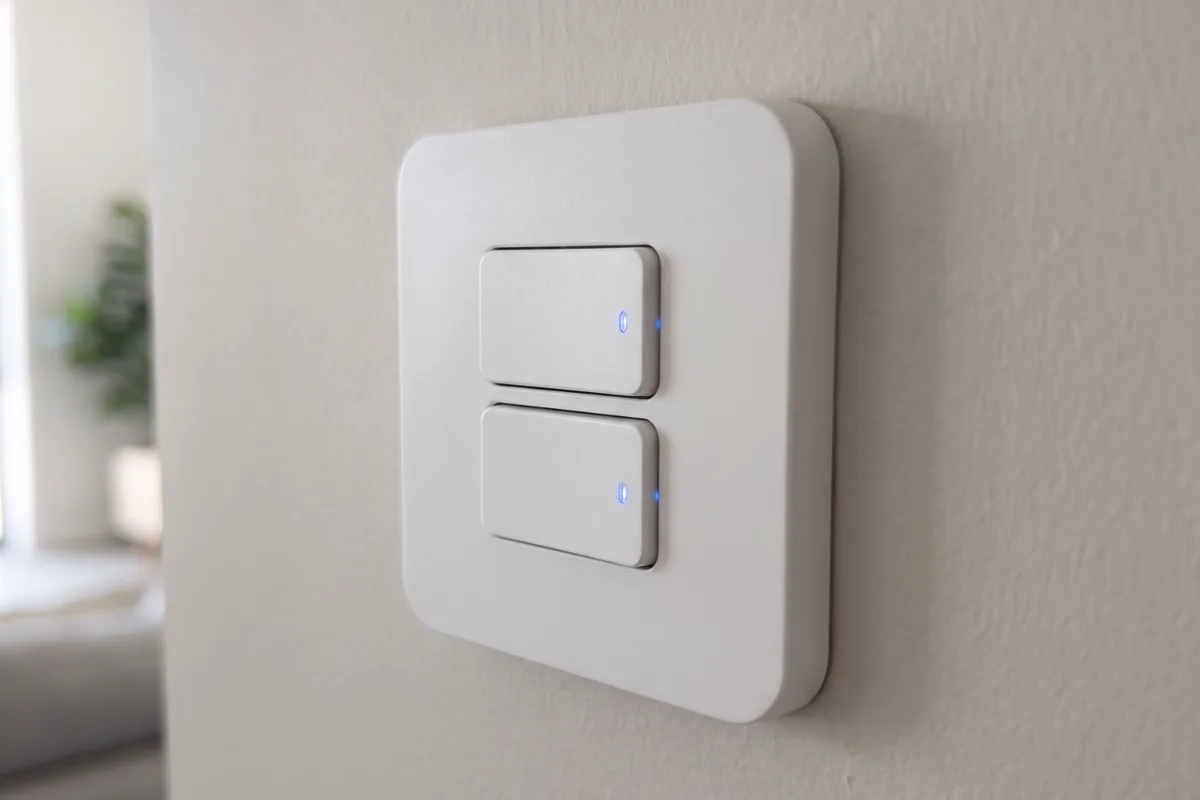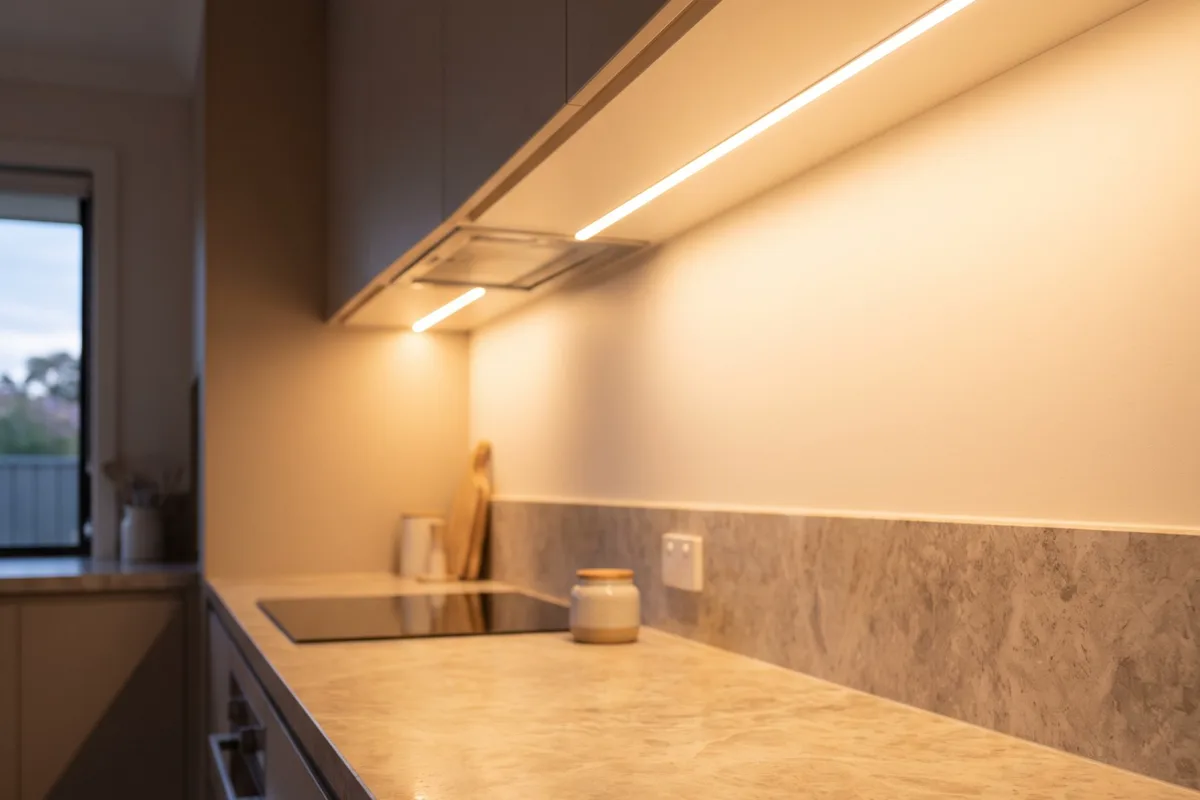
LED strip puts light where downlights can't: under cupboards, along stairs, in shelves and wardrobes, and in ceiling coves. We mount it in aluminium channel with a diffuser so it runs cool and looks even, with the driver where you can reach it.
When to get it checked
Your shadow on the benchtop
Downlights sit behind you at the bench and the cupboards block the rest. Strip under the cupboards puts light on the chopping board.
Dark stairs and halls at night
A low line of light along the treads or skirting lets people move about at night without a bright ceiling light waking everyone.
Dots reflected in a glossy bench
Strip without a channel shows every LED as a bright dot, and stone or gloss benchtops bounce them back. A diffuser turns them into one even line.
Peeling, patchy or buzzing
Strip hanging off its adhesive, dark sections or a driver that hums or smells hot point to heat, a failed join or a tired driver.
Why it happens
4 common causes
Adhesive doing a bracket's job
The tape on the back of strip softens with heat, so above a cooktop or in a warm bulkhead it lets go. A fixed channel holds it and draws heat away.
Heat with nowhere to go
LEDs dim and drift in colour when they run hot for years. Strip in a closed recess, or a driver in an airless cupboard, ages early.
Long runs fed from one end
Voltage drops along a strip, so the far end of a long run looks dimmer or a different white. Feeding it at more than one point keeps it even.
Mismatched drivers and dimmers
A driver near its limit runs hot. A non-dimmable driver on a dimmer, or a mismatched dimmer, flickers, buzzes or won't dim low.
What the job covers
What we usually do on this job. Your quote confirms it for your place.
- Each run measured and the strip chosen
- Aluminium channel and opal diffuser fixed to joinery or plaster
- Driver sized with spare capacity
- Driver placed somewhere ventilated and reachable
- Cable from a lighting circuit or a new concealed point
- Switch, dimmer or sensor matched to the driver
- Every section tested through its dimming range
- Certificate of Electrical Safety for the work
Your options, explained
Surface channel with diffuser
Low disruption- Best for
- Under cupboards, shelves, wardrobes and vanities
- How it works
- Strip sits in a slim aluminium channel under the joinery, with an opal cover that softens the dots.
- Worth knowing
- Near the front edge it lights the bench. Near the wall it washes the splashback but reflects more in gloss.
Recessed channel
High disruption- Best for
- New kitchens, renovations and shadow-line ceilings
- How it works
- A plaster-in or routed channel sits flush, so you see a clean line of light and no fitting.
- Worth knowing
- Plan it before plaster and joinery are finished. Retrofitting means cutting, patching and painting.
Hidden cove or kicker lighting
Medium disruption- Best for
- Bulkheads, bedheads, floating vanities and toe-kicks
- How it works
- Strip hides behind a ledge or kickboard and lights the surface beside it, so you see the glow, not the source.
- Worth knowing
- Bounced light is softer than you expect, so allow for a brighter strip.
The people behind the work
One local team for electrical, heating and cooling. Family-run, based in Altona Meadows, with 19 years in the industry.
Licensed electrical contractor (REC 38187)See more team photos
Worth knowing before you book
- The driver needs a home
- Drivers usually fail before the strip, so plan a ventilated spot you can reach.
- Channel beats sticky tape
- Adhesive alone lets go in warm spots. Channel holds the strip, draws heat away and hides the dots.
- Recessed strip is planned early
- Flush lines in plaster or joinery go in before the plasterer and cabinet maker finish.
What affects the price?
The right scope depends on your installation. These are the details we check so your quote is useful, with any additional work explained before it proceeds.
Length and number of runs
Every run needs cutting, joins, a feed and end caps, so several short runs take longer than one long one.
Surface or recessed
Surface channel goes up quickly. Recessed channel means routing or plastering, timed around other trades.
Getting power there
Some drivers plug into a new concealed point in a cupboard. Others need cable run through walls or ceilings.
Control and strip type
Dimmers, sensors, colour controllers, sealed strip and dotless strip all add hardware and set-up.
How it runs
- 1
Plan the runs
Tell us where you want light. We measure, suggest strip and channel, and pick driver and switch spots.
- 2
Install
Cable, driver, channel and strip go in, with every join made properly.
- 3
Test and certify
Every run is checked for brightness, colour and dimming, and you get your certificate.
Step by step, in more detail
4 steps
Work out what the light is for
Task light under cupboards, a glow from a bulkhead and a night path on stairs need different strip and switching. We start with how you use the space.
Plan the run and the driver
We measure each run, choose strip and channel, and size the driver with spare capacity for a dry, ventilated spot you can reach. You get the price before we start.
Wire and mount
With the circuit isolated, we run cable, fit the driver and channel, and make every join properly. Recessed work is timed around your cabinet maker or plasterer.
Test and hand over
Each section is dimmed through its range and checked at the far end. We show you where the driver sits and issue your Certificate of Electrical Safety.
What is safe to do, and what to leave to us
Safe for you to do
- Switch the strip off at the wall if the driver buzzes or smells hot, and leave it off until it's checked.
- If a safety switch trips when the strip comes on, reset it once. If it trips again, leave it off and call us.
- Keep the product details of any strip or driver you've bought.
Leave these to us
- Wiring in a driver or switch yourself. Energy Safe Victoria says electrical work isn't a DIY job, even for small jobs like changing light switches.
- Threading a plug-in strip's lead through a wall or ceiling cavity.
- Burying a driver behind a fixed panel or under insulation.
- Using indoor strip near a shower, over a bath or outdoors.
When to get us in
- You're renovating and want strip built into joinery or a ceiling
- Strip is peeling, flickering or dark in sections
- A driver buzzes, smells hot or shows scorch marks
- You've bought strip and a driver that need connecting
More detail
Where the driver goes matters most
The driver is the part most likely to fail, so it has to be reachable. We don't seal drivers behind fixed kickboards, in plaster or under insulation. A ventilated cupboard, the roof space near the manhole or an access panel all work.
Choosing the strip
Dotless strip, with the LEDs under a continuous coating, gives a smoother line in shallow channels. Match the white to your downlights, and in kitchens choose a high colour rendering (CRI) strip so food and timber look right.
Dimming strip without flicker
Strip dims either on the mains side, with a dimmable driver and matched wall dimmer, or on the extra-low voltage side, with a controller between driver and strip. Both work when the parts suit each other. For scenes and app control, see our dimmers and smart switches page.
Local rules and conditions
Victorian requirements and local conditions that shape this job, with the sources listed at the foot of the page.
A certificate for strip lighting too
Energy Safe Victoria lists lights among the work a non-prescribed Certificate of Electrical Safety covers. A licensed electrician must provide one for any electrical installation work, and can't withhold it for any reason, even a payment dispute.
Older homes and new circuits
Energy Safe Victoria notes the Wiring Rules call for additional safety switch protection when an existing installation is altered. From Williamstown, settled in the 1840s, to post-war Altona and Laverton, a new strip-light circuit in an older home can mean board work too.
Strip lighting in rentals
Victoria's rental minimum standards say rooms and hallways need enough light to be usable, with artificial light at night. Since 29 March 2023, rental lighting circuits must connect to a switchboard-type circuit breaker and safety switch. Treat strip as an extra, not a room's only light.
Useful reading
Guides to read before you decide, with checklists and questions to bring to the quote.
- A room-by-room lighting plan that goes beyond more downlightsPlan task lighting, comfortable evening light and outdoor coverage around how each space is used.
- The electrical decisions to make before your renovation walls closePlan appliances, lighting, outlets and future upgrades while access and options are still available.
- What electrical work you can and can't do yourself in VictoriaWhere Victorian law draws the line on home electrical work, the short list of jobs that are yours, and what to do when a job goes past it.
- Certificates of Electrical Safety explainedWhat a Victorian COES records, how prescribed and non-prescribed work differ, when your copy should arrive and why it belongs in your house file.
Common questions
Sources for the rules and local facts on this page
10 sources, with the date each was checked
- 1.Energy Safe Victoria: For electrical installation work performed within your electrical installation including but not limited to lights, power points, air conditioning, hot water service etc. Accessed 30 September 2026.
- 2.Energy Safe Victoria: Whenever a licensed electrician completes any electrical installation work, they must provide a Certificate of Electrical Safety (COES). Accessed 30 September 2026.
- 3.Energy Safe Victoria: Clause 2.6.3.2.5 of the Wiring Rules states: Additional protection by RCDs shall be provided in existing electrical installations where alterations or a switchboard replacement is completed. Accessed 30 September 2026.
- 4.Victorian Government, Hobsons Bay Planning Scheme (PDF snapshot, last updated by VC292 on 11/09/2025): The heritage places of Hobsons Bay reflect the key themes that have shaped the development of the city since the establishment of Williamstown in the 1840s as the first port of Melbourne, through the development of… Accessed 30 September 2026.
- 5.Consumer Affairs Victoria: Inside rooms, corridors and hallways must have access to light to make the areas functional. During the day, natural light can include light borrowed from an adjoining room. At night, renters should have access to… Accessed 30 September 2026.
- 6.Consumer Affairs Victoria: From 29 March 2023 all power outlets and lighting circuits in a rental premises must connect to both a switchboard-type circuit breaker that complies with AS/NZS 3000 and a switchboard-type residual current device that… Accessed 30 September 2026.
- 7.Victorian Legislation (legislation.vic.gov.au) - Electricity Safety Act 1998, authorised version 089 (effective 8 Sep 2026): electrical installation work means installation, alteration, repair or maintenance of an electrical installation; Accessed 30 September 2026.
- 8.Victorian Legislation (legislation.vic.gov.au) - Electricity Safety (Registration and Licensing) Regulations 2020, version 003: For the purposes of Division 2 of Part 3 of the Act, the following classes of electrical installation work are prescribed classes of electrical work— (a) electrical installation work carried out on an electrical… Accessed 30 September 2026.
- 9.Energy Safe Victoria: Electrical work isn’t a DIY job, even for small jobs such as changing power points or light switches. Accessed 30 September 2026.
- 10.Energy Safe Victoria: Locate your electricity box outside your home and check whether the safety switch has tripped. If it has tripped, reset the switch. If the switch won’t reset, call a licensed electrician. Accessed 30 September 2026.