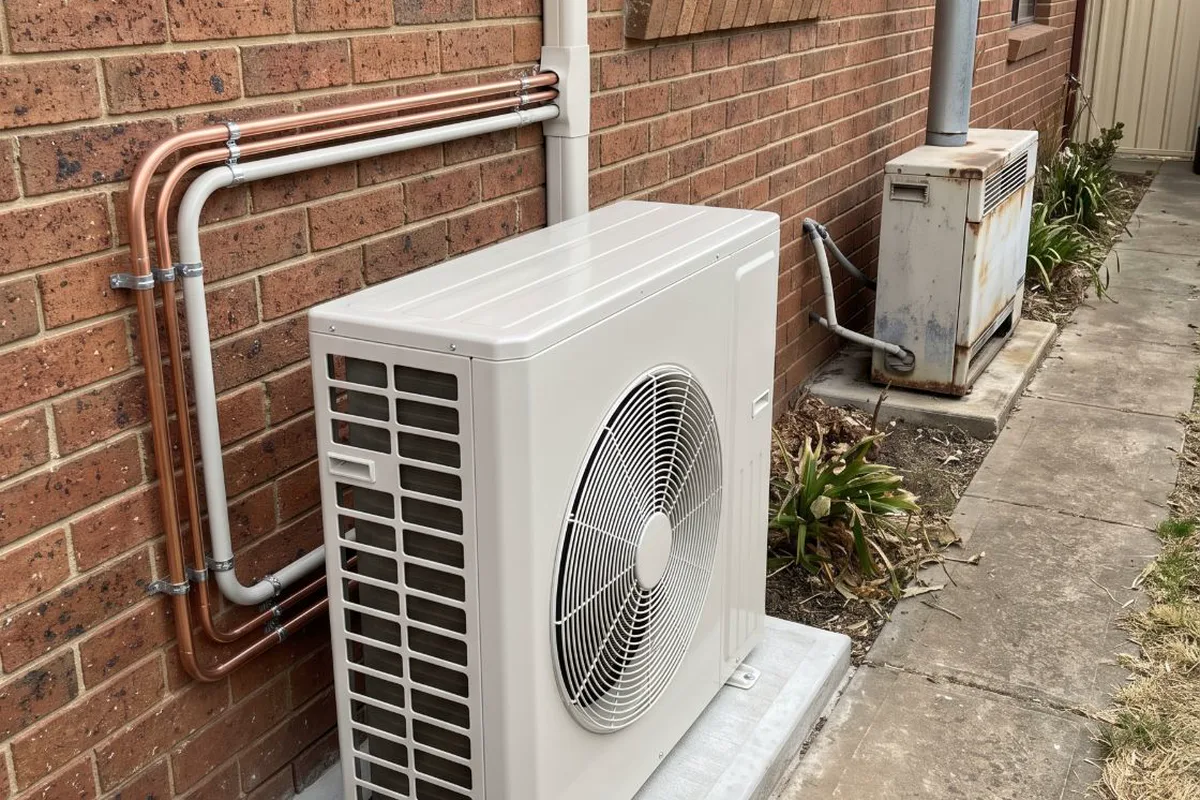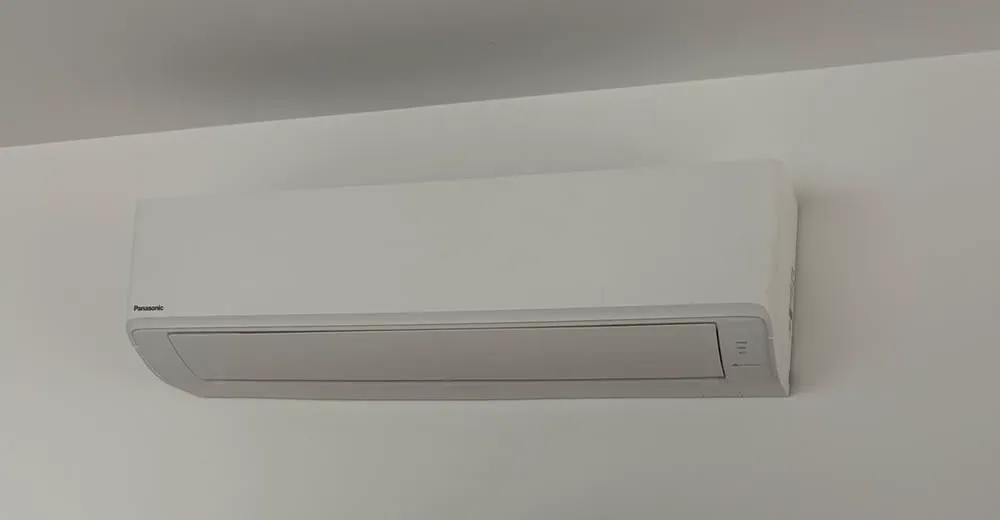
A reverse cycle heat pump moves heat from the outside air into your home instead of making heat by burning gas or running an element, and the same system cools in summer. We install wall splits, multi-head and ducted reverse cycle systems set up for heating, and we do the electrical side ourselves. That covers the circuit, the isolator and any switchboard changes. If you're moving away from an old gas heater or electric panel heaters, we'll talk through sizing, placement and noise before we start. Heat pump hot water is a different system and has its own page.
When to get it checked
Rooms kept warm with plug-in heaters
Bar, fan and oil heaters turn one unit of electricity into about one unit of heat. A reverse-cycle heat pump moves three to five units of heat for each unit it uses, so a heater-heavy winter bill is a good reason to compare.
An old split that struggles on cold mornings
If an older reverse-cycle unit runs flat out and the room still feels cool, it may be undersized for heating or simply worn. The Victorian Government says a system more than 15 years old typically uses more than three times the energy of a modern one.
A gas heater you're ready to move on from
An ageing gas wall or ducted heater is a natural point to price electric heating. Owner-occupiers don't have to switch, but a reverse-cycle system heats in winter and cools in summer from the one unit.
Cold rooms at one end of the house
The living area warms up but the bedrooms down the hall never do. One wall unit can't push warmth around corners, so a second head, a multi-head system or zoned ducted may suit the layout better.
Solar power going back to the grid
If your panels export most of what they make, running the heating through the afternoon can use that power to warm the house before the evening, instead of buying it back later.
Why it happens
5 common causes
Sized for summer, not winter
A unit picked by cooling capacity alone can fall short on a July morning. Victorians use more energy heating than cooling, so the Victorian Government suggests choosing a unit with higher heating efficiency. We size for the heating load first.
Reading the wrong star rating
Melbourne sits in the Cold zone on the Zoned Energy Rating Label, where heating is used much more than cooling. How a unit performs below 5.5 °C, when the outdoor coil can frost, matters most here, so compare the Cold zone heating figures.
An outdoor unit boxed in
The outdoor unit pulls warmth out of the air passing over its coil. Squeezed under a deck or into a tight corner, it breathes its own cold air, works harder and heats more slowly.
Dirty filters
Clogged filters cut airflow and can noticeably reduce heating performance. The Victorian Government suggests cleaning reverse-cycle dust filters about twice a year, or more often with heavy use.
The thermostat pushed too high
Setting it to 26 °C won't warm the room any faster. The Victorian Government suggests 18 °C to 20 °C for heating, and each degree higher adds around 10% to running costs.
What the job covers
What we usually do on this job. Your quote confirms it for your place.
- A walk through the rooms you want heated and how you use them
- System sized for winter heating, not only for summer cooling
- Indoor and outdoor positions chosen with airflow, noise and drainage in mind
- Indoor unit mounted and outdoor unit set on a level base or wall brackets
- Refrigerant pipework and condensate drain run neatly
- Dedicated circuit and isolator installed
- Switchboard checked and upgraded if needed
- System run in heating mode and checked before we leave
- Heating modes, timers and settings explained
Your options, explained
Wall-mounted split system
Low disruption- Best for
- A living area or one large room
- How it works
- One indoor unit on the wall and one outdoor unit outside, joined by refrigerant pipework.
- Worth knowing
- The most efficient way to heat a single space. Most wall splits take about half a day to install.
Multi-head split system
Medium disruption- Best for
- A few rooms that each need their own control
- How it works
- One outdoor unit runs several indoor units, each with its own controller.
- Worth knowing
- Fewer outdoor units on the wall, but if the outdoor unit fails, every room on it loses heating.
Ducted reverse-cycle
High disruption- Best for
- Heating the whole house from one system
- How it works
- An indoor unit in the roof space feeds each room through insulated ducts, with zones so areas can be heated on their own.
- Worth knowing
- Ducted systems lose some efficiency through the ducts but are still more cost-efficient than gas heating. Zones are easiest to plan at the start.
Floor console
Low disruption- Best for
- Rooms with no good wall space up high, or where heating is the priority
- How it works
- A split system with the indoor unit low on the wall, so warm air starts near the floor.
- Worth knowing
- It sits closer to where you'll hear it, so compare the indoor noise ratings.
The people behind the work
Our own photos from jobs like this one. Family-run, based in Altona Meadows, with 19 years in the industry.
Licensed electrical contractor (REC 38187)See more team photos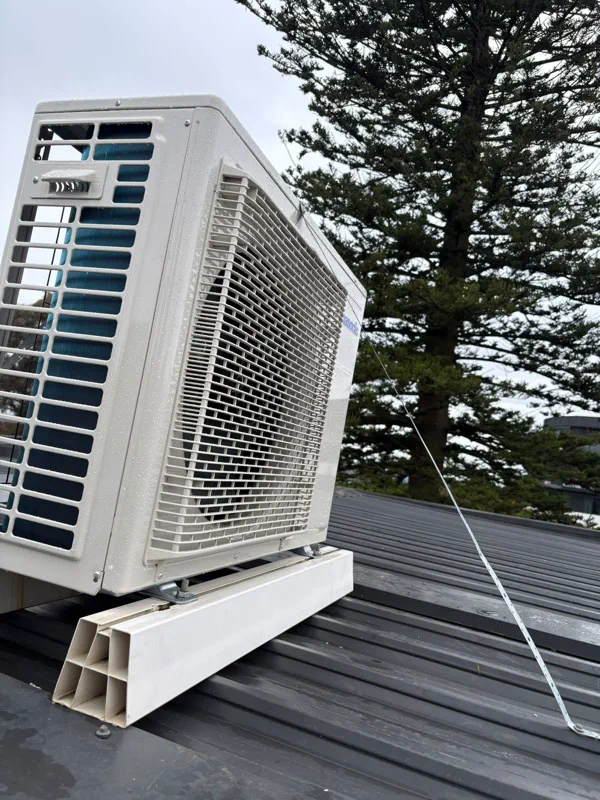
Worth knowing before you book
- Think about where it goes
- The outdoor unit has a fan and compressor, so it makes some noise. Keep it away from bedroom windows, including your neighbour's, and leave room around it for airflow.
- Size it for cold mornings
- A system that is too small for the room runs flat out in winter and still struggles. Older homes with less insulation usually need more heating capacity than the floor area suggests.
- Solar changes the settings
- If you have solar panels, warming the house in the afternoon can use your own power. We can show you how to set the timer to suit.
What affects the price?
The right scope depends on your installation. These are the details we check so your quote is useful, with any additional work explained before it proceeds.
System type and number of rooms
A single wall split is the simplest job. Multi-head and ducted systems add indoor units, pipework, ducts and roof access.
Heating capacity
Older homes with thin insulation or high ceilings usually need more heating output than the floor area suggests, and a bigger unit costs more.
Where the units go
Long pipe runs, a second storey, wall brackets or a tight roof space all add time to the install.
Circuit and switchboard
A dedicated circuit and isolator are part of most installs. A full board with old fuses may need an upgrade, and a replaced main switchboard can't be switched back on until a licensed electrical inspector has checked it.
What's coming out
Old heaters or an old split are removed and taken away. A gas heater must be disconnected and made safe by a licensed gasfitter first.
Before the visit
- List the rooms you want heated and when you usually use them.
- Send photos of the current heater, its label and your switchboard.
- If a gas heater is being replaced, ask who disconnects and caps the gas supply.
How it runs
- 1
Tell us what you have now
Send photos of your current heater, the rooms you want heated and your switchboard.
- 2
Recommend and quote
We suggest a system type and size, explain placement and give you a fixed price.
- 3
Install
Units mounted, pipework run and the electrical done on the same visit.
- 4
Run and explain
We test it in heating mode, set it up and show you how the controls work.
Step by step, in more detail
5 steps
Tell us what you have now
Send photos of your current heaters, the rooms you want heated and your switchboard. Tell us how the house is used across a winter day and whether you have solar.
Size it for winter
We look at room sizes, insulation, glazing and ceiling height, then size for the heating load. For ducted, the Victorian Government's guide is 1.1 to 1.4 kW of heating output for every 10 m² covered, depending on the home.
Check the board, then quote
We check the switchboard, the new circuit and the supply, and choose indoor and outdoor positions for airflow, noise and drainage. You get a fixed price for the agreed scope.
Install
The units are mounted, the refrigerant pipework and condensate drain are run, and our electricians fit the dedicated circuit and isolator on the same visit.
Test, set and hand over
We run the system in heating mode, test the circuit and safety switch, set the timer and show you the controls. Then we issue a Certificate of Electrical Safety.
What is safe to do, and what to leave to us
Safe for you to do
- If the safety switch trips with the heating on, reset it once. If it trips again or won't reset, leave it off and call a licensed electrician.
- Keep plants, bins and stored gear clear of the outdoor unit so it can draw air.
- Clean the dust filters as the manual shows, with the unit switched off.
- Write down any error code and the model details from the outdoor unit's label.
Leave these to us
- Opening the unit's covers, the isolator or the switchboard. Electrical work isn't a DIY job, even small jobs.
- Running a plug-in heater from an extension lead or power board.
- Touching the sealed refrigerant circuit. Only licensed technicians can handle refrigerants.
- Covering the outdoor unit while it's running.
When to get us in
- Rooms stay cold with the heating running flat out
- The safety switch or breaker trips when the heating starts
- Ice builds up on the outdoor unit and doesn't clear
- A burning smell, buzzing or heat at the isolator or switchboard (get everyone out if there's smoke or fire)
- Bar heaters or an old gas heater you'd like replaced before winter
- A rental whose heating has failed
More detail
How a heat pump heats your home
A reverse-cycle air conditioner is a heat pump. In heating mode the outdoor unit absorbs warmth from the outside air and the indoor unit releases it into the room. Because it moves heat instead of making it, it uses far less electricity than a standard electric heater. The Victorian Government reports CHOICE calculations showing a reverse-cycle system costs about a third as much to run as an electric heater in the same space.
Defrost, timers and solar
On frosty mornings the outdoor unit pauses briefly to defrost its coil, which is normal. A heat pump does its best work at a steady setting, so we set timers to warm the house before you need it rather than starting from cold. With solar, running the heating through the afternoon can use your own power.
The electrical side, done by our own team
Under the Wiring Rules, air conditioners with a compressor need a lockable isolating switch next to the unit, not on it. Where a manufacturer specifies a dedicated circuit or RCD protection, Energy Safe Victoria says that must be followed. As a licensed electrical contractor (REC 38187), we do this work ourselves, and your copy of the Certificate of Electrical Safety must reach you within 30 days.
Heat pump hot water is a separate job
A heat pump water heater uses the same idea to heat a storage tank instead of a room. It's a different system with its own plumbing, placement and circuit, so it has its own page: see heat pump hot water.
Local rules and conditions
Victorian requirements and local conditions that shape this job, with the sources listed at the foot of the page.
Cold, still winter nights
July is the coldest month at the Laverton weather station, with a mean minimum of 5.2 °C. Melbourne is in the Cold zone on the Zoned Energy Rating Label, where performance below 5.5 °C is critical, so we compare Cold zone heating figures when we choose a unit.
Rental heaters from 1 March 2027
Victorian rentals must have a working fixed heater in the main living area. From 1 March 2027, a rental heating appliance that breaks and can't be repaired must be replaced with an efficient electric reverse-cycle air conditioner in the main living area. One reverse-cycle system can meet both the heating and cooling standards.
Narrow blocks and wide setbacks
Yarraville's heritage precinct is mostly small Victorian and Edwardian houses with narrow frontages, so an outdoor unit often sits close to a neighbour's windows. Altona's post-war special character areas are known for generous side setbacks, which leaves more room for a quiet spot.
Useful reading
Guides to read before you decide, with checklists and questions to bring to the quote.
- Reverse-cycle air conditioning or gas heating?How each one makes heat, how it feels on a cold night in Melbourne's west, what Victoria's gas rules mean for you and what switching really involves.
- What size split system do you need?What a split system's kW rating measures, why floor area alone gets it wrong, and how glass, ceilings and afternoon sun change the size a room needs.
- Reading the Zoned Energy Rating LabelWhich zone to read in Melbourne, why the red heating stars matter most, what the kWh and noise figures mean, and how to compare two units fairly.
- Going all-electric in a Melbourne homeHot water, heating and cooking don't have to go electric at once. How to stage the move off gas, check the switchboard once and time each step.
Common questions
Questions people ask about this
- Is it safe to leave the heating on overnight?It depends on the heater.
- Why does my reverse-cycle heat the ceiling and leave my feet cold?Warm air rises, so a high-wall unit blowing gently forward can leave a warm layer at the ceiling and cool air at floor level.
- My rental has no fixed heater in the living area. Is that allowed?No.
- What happens if the heater in my rental breaks after March 2027?If it can be repaired, it's repaired as an urgent repair, as it is now.
- My gas heater flame looks different. Is that a problem?Yes, treat it as one.
From the blog
- Are old gas space heaters still safe to use?Older open-flued gas wall and space heaters can spill carbon monoxide. Why some can no longer be sold, what servicing should cover and when reverse-cycle makes sense.
- Is your rental heater inefficient? What renters can ask forIf your agreement started on or after 29 March 2023, the fixed heater in the living area must be energy efficient. Here's how to check yours and ask in writing.
- Should landlords replace a working gas heater before 2027?No. A compliant working heater can stay. But for an old, open-flued or unreliable heater, or a property with no cooling, replacing early often makes sense.
Sources for the rules and local facts on this page
22 sources, with the date each was checked
- 1.Bureau of Meteorology: Mean minimum temperature (°C) 14.0 14.4 12.7 10.0 7.8 5.9 5.2 5.7 6.8 8.4 10.3 12.2 9.5 81 1943 2026 Accessed 30 September 2026.
- 2.Commonwealth of Australia (2019), 'The new zoned energy rating label for air conditioners—What installers and retailers need to know', hosted on energyrating.gov.au: Melbourne is in a black ‘COLD’ area—read the black Cold ratings. Accessed 30 September 2026.
- 3.Consumer Affairs Victoria: All rental properties must have a fixed heater (not portable) in good working order in the main living area. For rental agreements entered into from 29 March 2023, this must be an energy efficient fixed heater in the… Accessed 30 September 2026.
- 4.Department of Energy, Environment and Climate Action (energy.vic.gov.au), page last updated 05/08/26: From 1 March 2027, when a hot water or heating appliance breaks and cannot be repaired, it must be replaced with a heat pump water heater or an efficient electric reverse cycle air-conditioner (RCAC) in the main living… Accessed 30 September 2026.
- 5.Consumer Affairs Victoria: Tip: A reverse-cycle air conditioner can satisfy both the heating and cooling standards. Accessed 30 September 2026.
- 6.Victorian Heritage Database (Heritage Council Victoria); entry maintained by Maribyrnong City Council: The general character of the Yarraville Residential Precinct is that of small Victorian & Edwardian single-storey detached housing with mainly weatherboard and some brick wall cladding, corrugated iron roofing, front… Accessed 30 September 2026.
- 7.Victorian Government, Hobsons Bay Planning Scheme (PDF snapshot, last updated by VC292 on 11/09/2025): SPECIAL CHARACTER AREAS, ALTONA 1.0 24/02/2022 C131hbay Neighbourhood character objectives To preserve the characteristics of the neighbourhood, comprising intact post-war brick and weatherboard dwellings with… Accessed 30 September 2026.
- 8.YourHome (Australian Government): A reverse cycle air-conditioner is a type of heat pump that uses electricity to warm your home in winter and cool it in summer (refer to Heat pumps below). In heating mode, the system absorbs heat from the outside air… Accessed 30 September 2026.
- 9.Energy Rating (GEMS Regulator / DCCEEW): Reverse cycle air conditioners are much more efficient at heating than standard electric heaters (bar heaters, convection, or radiant heaters). ... During the normal operating range in Australia for every unit of… Accessed 30 September 2026.
- 10.Solar Victoria (updated 28 August 2026): Calculations from Choice found that a reverse-cycle air conditioner is about a third of the cost of an electric heater to run in the same space. Accessed 30 September 2026.
- 11.energy.gov.au (Australian Government, DCCEEW): The energy efficiency of reverse-cycle air conditioners on the Australian market ranges between 300% to 600% efficient. Air conditioners can achieve such high rates of energy efficiency because they do not use… Accessed 30 September 2026.
- 12.Department of Energy, Environment and Climate Action (energy.vic.gov.au), page last updated 14/04/25: Victorians typically use more energy for heating than cooling, so look for a unit with a higher heating efficiency. Accessed 30 September 2026.
- 13.Solar Victoria (updated 2 October 2025): A system that is more than 15 years old for example will typically use more than three times the amount of energy than a modern reverse-cycle air conditioner. Accessed 30 September 2026.
- 14.Solar Victoria (updated 20 November 2025): Check the manufacturer’s instructions or manual and have the air conditioner serviced regularly at the recommended frequency to ensure it continues to operate efficiently. Cleaning the filters regularly helps the system… Accessed 30 September 2026.
- 15.Access Canberra Electrical Inspections (ACT Government), Electrical Fact Sheet, updated September 2019: Air-conditioning and heat pump systems incorporating a compressor shall be provided with an isolating switch (lockable) in accordance with Clause 2.3.2.2, installed adjacent to but not on the unit, which isolates all… Accessed 30 September 2026.
- 16.Energy Safe Victoria: This means that if the manufacturer’s specifications require an air conditioner to be installed on a dedicated circuit or protected by a residual current device then they must be adhered to. Accessed 30 September 2026.
- 17.Energy Safe Victoria: 'Prescribed' certificates are for electrical installation work that requires inspection by a Licensed Electrical inspector. This includes (but is not limited to): Consumer mains cables, main switchboard, meter box and… Accessed 30 September 2026.
- 18.Department of Climate Change, Energy, the Environment and Water (DCCEEW): It's illegal to release regulated refrigerants into the air. This is because some refrigerants can stay in the atmosphere for decades or more and can be thousands of times worse for climate change than carbon dioxide… Accessed 30 September 2026.
- 19.Energy Safe Victoria: The electrician has eight business days after the work is completed to have that work inspected by a licensed electrical inspector (LEI). If an electrician replaces a main switchboard at a property, power cannot go back… Accessed 30 September 2026.
- 20.Energy Safe Victoria: Locate your electricity box outside your home and check whether the safety switch has tripped. If it has tripped, reset the switch. If the switch won’t reset, call a licensed electrician. Accessed 30 September 2026.
- 21.Energy Safe Victoria: Electrical work isn’t a DIY job, even for small jobs such as changing power points or light switches. Accessed 30 September 2026.
- 22.Energy Safe Victoria: Gas and electricity are inherently dangerous and it’s illegal and potentially fatal for unlicensed and unqualified people to undertake any gasfitting or electrical work. Accessed 30 September 2026.