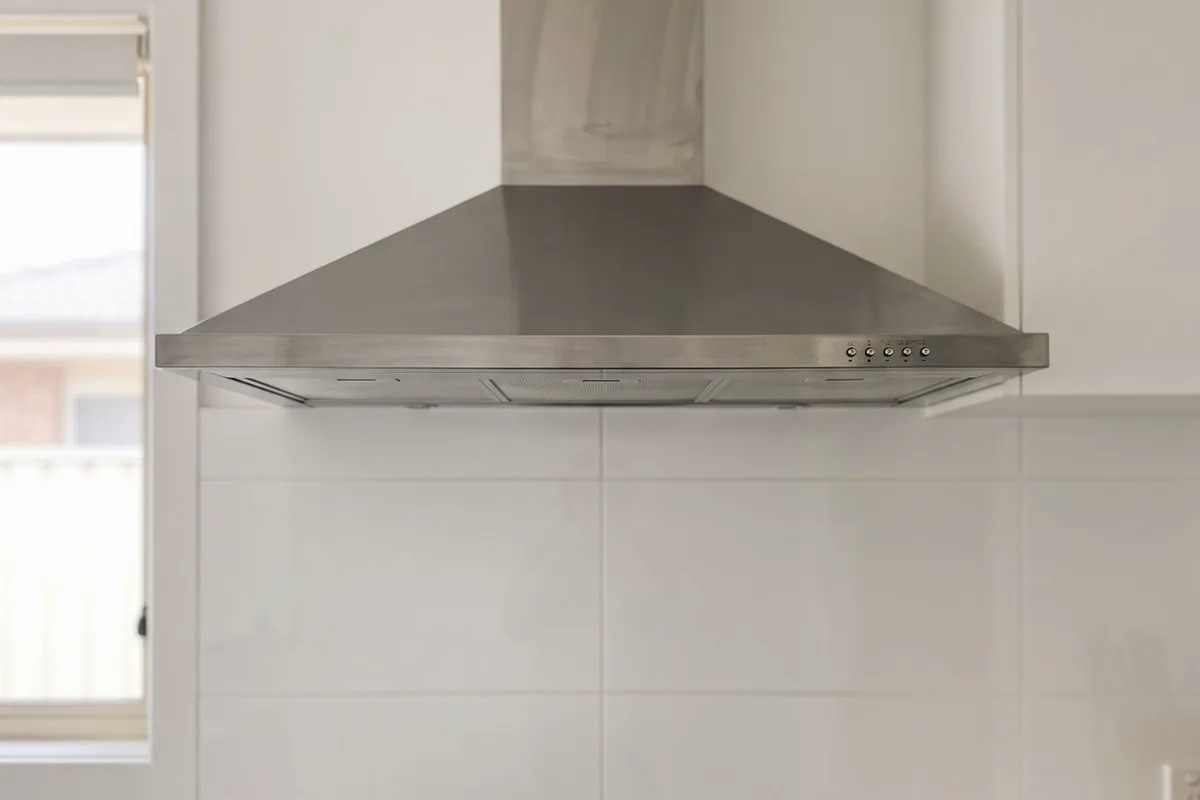
A rangehood needs power in the right place, the right height above the cooktop and a duct that reaches outside. We fit or move the power point, mount canopy, undermount and island hoods, and duct them to a roof cowl or wall vent.
When to get it checked
Steam rolls past the hood
Steam fogging the window or the top cupboards means the hood is too small, too high or not moving enough air.
Grease where it shouldn't be
A sticky film on the cabinet tops or a brown ring on the ceiling means grease is escaping the filters or the duct.
Loud but weak
A motor that roars without pulling much air usually has a choked duct, a flap stuck shut or clogged filters.
Smells that hang around
Last night's dinner still in the lounge next morning points to spent charcoal filters, or a duct venting into the roof space.
Why it happens
5 common causes
Ducts that stop in the roof space
Plenty of older installs run flexible duct into the ceiling and stop. Steam and grease settle on the insulation and timbers, and the smell comes back down.
Long, narrow or crushed duct
Every bend and every step down in size cuts airflow. Sagging or flattened duct chokes even a strong motor.
Tired filters
Grease clogs mesh and baffle filters, and spent charcoal stops absorbing smells.
A stuck backdraught flap
The flap at the outlet keeps cold air and insects out. Gummed with grease or blocked by a nest, it leaves the fan pushing against a closed door.
Power squeezed in behind the hood
A point jammed against the canopy, plug bent hard over, bakes in heat and grease for years.
What the job covers
What we usually do on this job. Your quote confirms it for your place.
- Hood manual and cooktop checked first
- Power point fitted or moved to suit the manual
- Hardwired connection with isolation where needed
- Old rangehood disconnected and taken down
- Hood mounted level at the manual's height
- Duct run to a roof cowl or wall vent
- Backdraught flap fitted and penetrations sealed
- Every speed and light tested
- Certificate of Electrical Safety issued
Your options, explained
Ducted through the roof
Medium disruption- Best for
- Single-storey homes with roof space above the kitchen
- How it works
- Duct runs up through the ceiling to a roof cowl with a backdraught flap.
- Worth knowing
- Tile and iron roofs take different cowls. If yours needs a roofer, we say so up front.
Ducted through a wall
Medium disruption- Best for
- Kitchens on an outside wall and two-storey homes
- How it works
- A short duct goes straight out to a louvred wall vent.
- Worth knowing
- Often the most efficient run.
Recirculating
Low disruption- Best for
- Apartments and kitchens with no route outside
- How it works
- Grease and charcoal filters clean the air and return it to the room.
- Worth knowing
- Deals with grease and some smell, not steam.
Swap into the existing duct
Low disruption- Best for
- Like-for-like replacements
- How it works
- The new hood connects to the existing duct and power once both are checked.
- Worth knowing
- Only if the old duct is the right size and reaches outside.
The people behind the work
Our own photos from jobs like this one. Family-run, based in Altona Meadows, with 19 years in the industry.
Licensed electrical contractor (REC 38187)See more team photos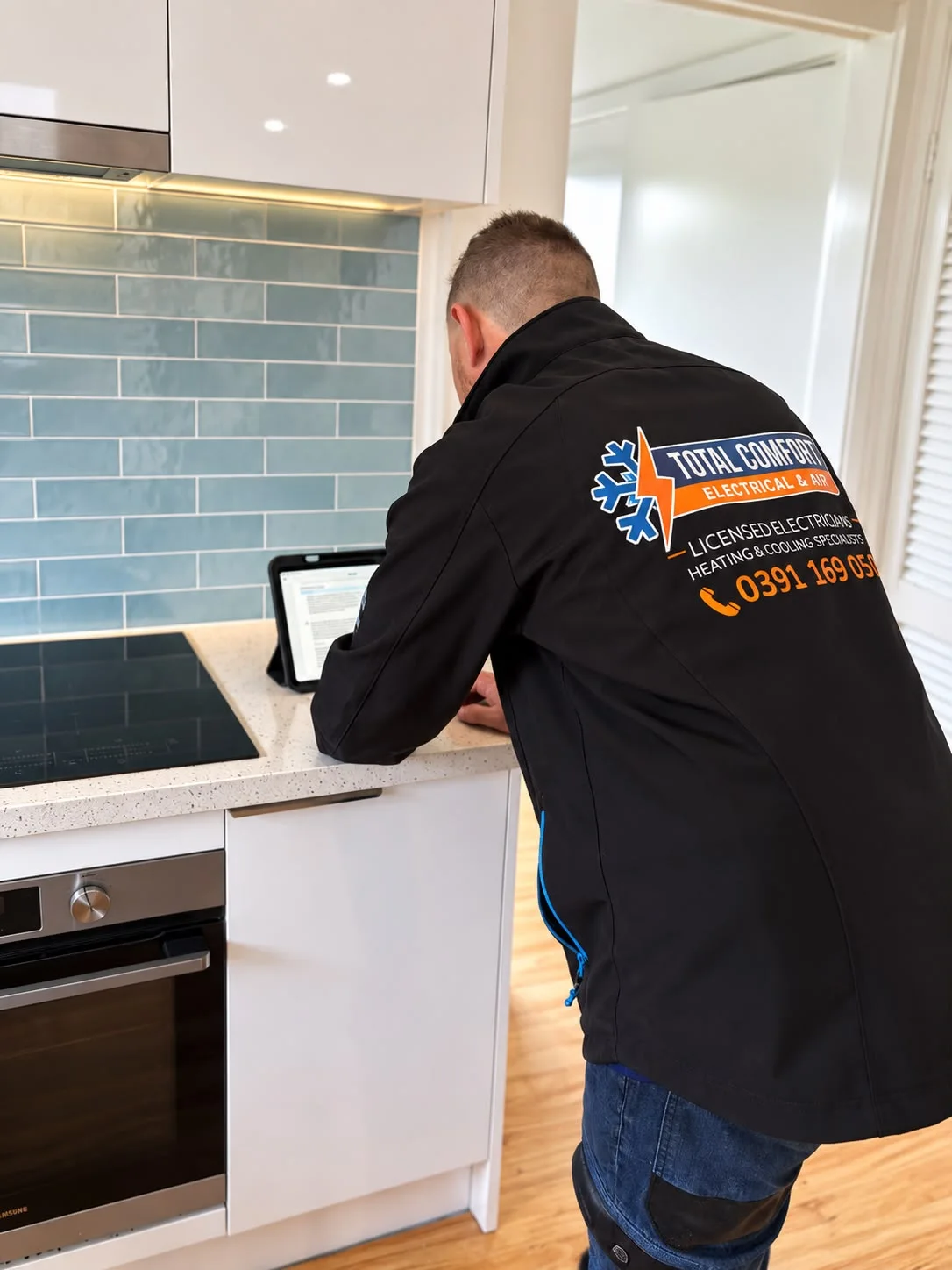
Worth knowing before you book
- Send the manual before the cabinetry
- Undermount and slide-out hoods need a cupboard built around them. Get the manual to your cabinet maker and us early.
- Heavy hoods need solid fixing
- Canopy and island hoods need timber behind the plaster, fitted before a renovation closes the wall or ceiling.
- Recirculating is a fallback
- Charcoal filters catch grease and some smell, but the steam stays in the kitchen.
What affects the price?
The right scope depends on your installation. These are the details we check so your quote is useful, with any additional work explained before it proceeds.
The type of hood
An undermount in existing cabinetry is simpler than a canopy with a chimney cover. Island and ceiling hoods need solid fixing and power from above.
The duct route
A short run through a wall is less work than a long run across the roof. Two storeys, flat ceilings and brick all add time.
Power already there or not
Reusing a suitable point is quick. A new or moved point adds cable and time.
Access and the old hood
Tight roof space, fragile tiles, or an old hood to take down and its duct hole to close, all add steps. You get the price before we start.
How it runs
- 1
Send the details
The model number and photos of the cooktop wall and the space above.
- 2
Check the route
We confirm power, height and the duct path, then give you an upfront price.
- 3
Install and test
Power fitted, hood mounted, duct run and sealed, everything tested.
Step by step, in more detail
5 steps
Model and photos first
Send the model number and photos of the cooktop wall and the space above. The manual gives us the height, power and duct size.
Plan the route out
We find the shortest, straightest path outside, around joists, eaves and windows.
Power in the right spot
We fit or move a power point to where the manual puts it, usually inside the canopy or cupboard. Hardwired hoods get their own isolation.
Mount and duct
The hood goes up level at the right height. The duct runs to a roof cowl or wall vent with a backdraught flap, joins taped and sealed.
Test and hand over
We run every speed and light, test the circuit and safety switch, and issue your Certificate of Electrical Safety.
What is safe to do, and what to leave to us
Safe for you to do
- Clean or replace the filters as the manual describes.
- If the hood smells hot, sparks or trips the power, stop using it and turn that circuit off at the switchboard if it's safe to reach.
- Keep the rangehood off while a gas heater is running.
Leave these to us
- Fitting or moving the power point yourself. Electrical work isn't DIY in Victoria, even changing a power point.
- Running an extension lead or power board into the cupboard for the hood.
- Ending the duct in the roof space.
- Mounting the hood outside the height range in its manual.
When to get us in
- A burning smell, sparks or scorch marks at the hood or its power point
- The hood trips a safety switch or breaker
- Grease or water dripping from the duct or ceiling
- You're renovating, changing the cooktop or moving it to an island
More detail
Choosing the type of hood
Canopy hoods mount on the wall with a chimney cover hiding the duct. Undermount hoods sit inside a cupboard, and slide-out hoods pull forward when you cook. Island and ceiling hoods sit further from the pots, so they need more airflow for the same result.
Height and width
Every manual sets a minimum and maximum height above the cooktop, and gas normally needs more clearance than electric or induction. Too low is a heat and fire risk. Too high and the steam escapes first. Match the cooktop width or go wider, never narrower.
Why the duct matters more than the motor
A powerful motor on a poor duct performs like a cheap hood. Airflow drops with every bend, every step below the outlet size and every sag in flexible duct. Most of the noise comes from the same place, so a bigger, straighter run makes the hood quieter as well as stronger. Some hoods take a remote motor mounted in the roof.
Local rules and conditions
Victorian requirements and local conditions that shape this job, with the sources listed at the foot of the page.
Gas heating and a strong rangehood
Energy Safe Victoria advises against running a kitchen rangehood while a gas heater is on, because the negative pressure can draw carbon monoxide into living spaces. It says open-flued heaters spill carbon monoxide more easily than other types. Laverton’s July mean minimum is 5.2 °C, so heaters often run through dinner out west. Turn the heater off first.
A new point is an alteration
A new or moved point for a rangehood alters your wiring. Energy Safe Victoria's guidance cites the Wiring Rules clause requiring additional RCD protection where existing installations are altered. Whenever a licensed electrician completes electrical installation work, they must provide a Certificate of Electrical Safety.
Older roofs in Newport and Yarraville
Heritage homes in Newport and Yarraville are mostly single-storey weatherboards with corrugated iron roofs, and in Newport often Marseilles-pattern terracotta tile. Iron needs a sealed, flashed penetration for a cowl, and old terracotta cracks underfoot, so a wall vent is sometimes the cleaner answer.
Useful reading
Guides to read before you decide, with checklists and questions to bring to the quote.
- Moving to induction: the checks to make before you buyA practical order for checking the supply, bench opening, gas disconnection and installation day.
- The electrical decisions to make before your renovation walls closePlan appliances, lighting, outlets and future upgrades while access and options are still available.
- What electrical work you can and can't do yourself in VictoriaWhere Victorian law draws the line on home electrical work, the short list of jobs that are yours, and what to do when a job goes past it.
- Certificates of Electrical Safety explainedWhat a Victorian COES records, how prescribed and non-prescribed work differ, when your copy should arrive and why it belongs in your house file.
Common questions
From the blog
Sources for the rules and local facts on this page
8 sources, with the date each was checked
- 1.Energy Safe Victoria: Don’t use kitchen rangehoods or bathroom exhaust fans at the same time as your heater. It can create a negative pressure environment, drawing carbon monoxide into living spaces. Accessed 30 September 2026.
- 2.Bureau of Meteorology: Mean minimum temperature (°C) 14.0 14.4 12.7 10.0 7.8 5.9 5.2 5.7 6.8 8.4 10.3 12.2 9.5 81 1943 2026 Accessed 30 September 2026.
- 3.Energy Safe Victoria: Clause 2.6.3.2.5 of the Wiring Rules states: Additional protection by RCDs shall be provided in existing electrical installations where alterations or a switchboard replacement is completed. Accessed 30 September 2026.
- 4.Energy Safe Victoria: Whenever a licensed electrician completes any electrical installation work, they must provide a Certificate of Electrical Safety (COES). Accessed 30 September 2026.
- 5.Victorian Heritage Database (Heritage Council Victoria); entry maintained by Hobsons Bay City Council from the Hobsons Bay Heritage Study 2006: Aesthetically, it is significant for the groups of relatively intact examples of representative housing, from the Victorian, Federation and Interwar periods. They are notable for their consistent character, which is… Accessed 30 September 2026.
- 6.Victorian Heritage Database (Heritage Council Victoria); entry maintained by Maribyrnong City Council: The general character of the Yarraville Residential Precinct is that of small Victorian & Edwardian single-storey detached housing with mainly weatherboard and some brick wall cladding, corrugated iron roofing, front… Accessed 30 September 2026.
- 7.Energy Safe Victoria: Electrical work isn’t a DIY job, even for small jobs such as changing power points or light switches. Accessed 30 September 2026.
- 8.Energy Safe Victoria: Gas and electricity are inherently dangerous and it’s illegal and potentially fatal for unlicensed and unqualified people to undertake any electrical or gasfitting work. Homeowners and consumers must always use… Accessed 30 September 2026.