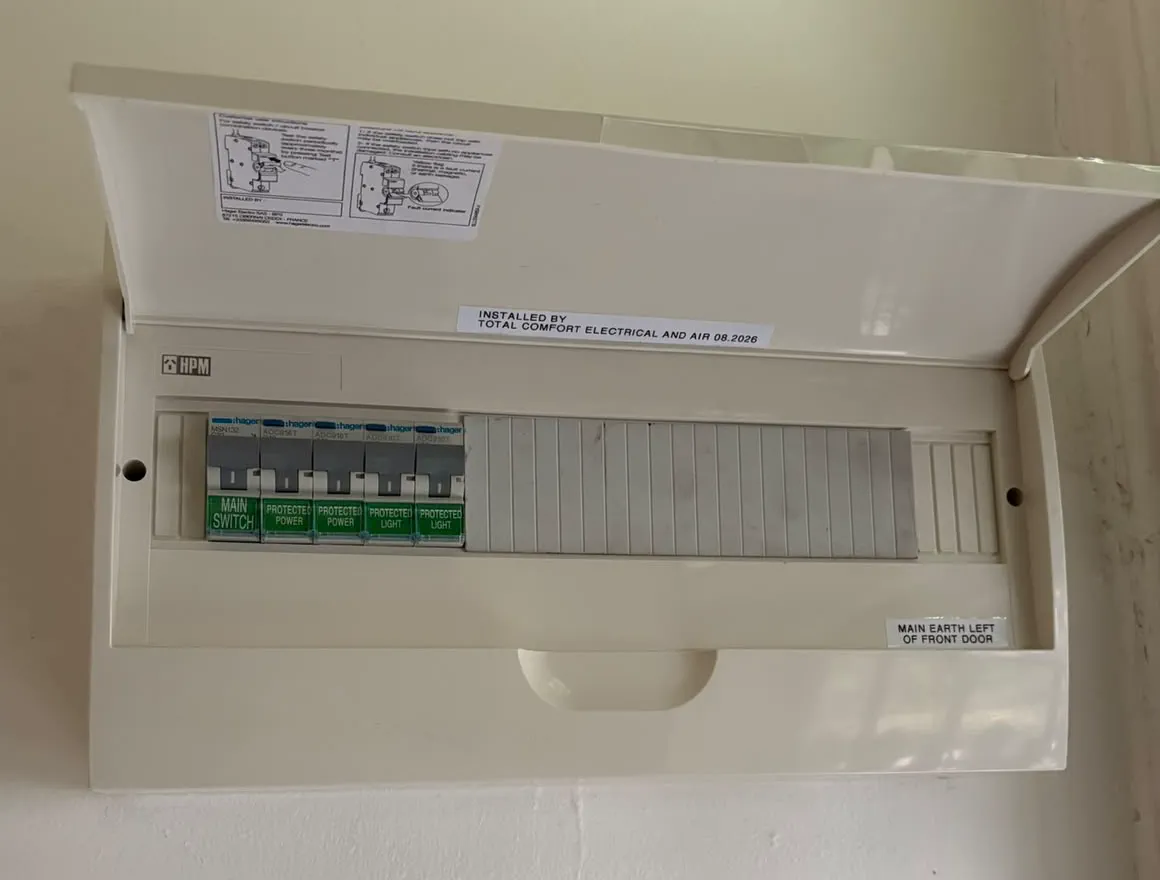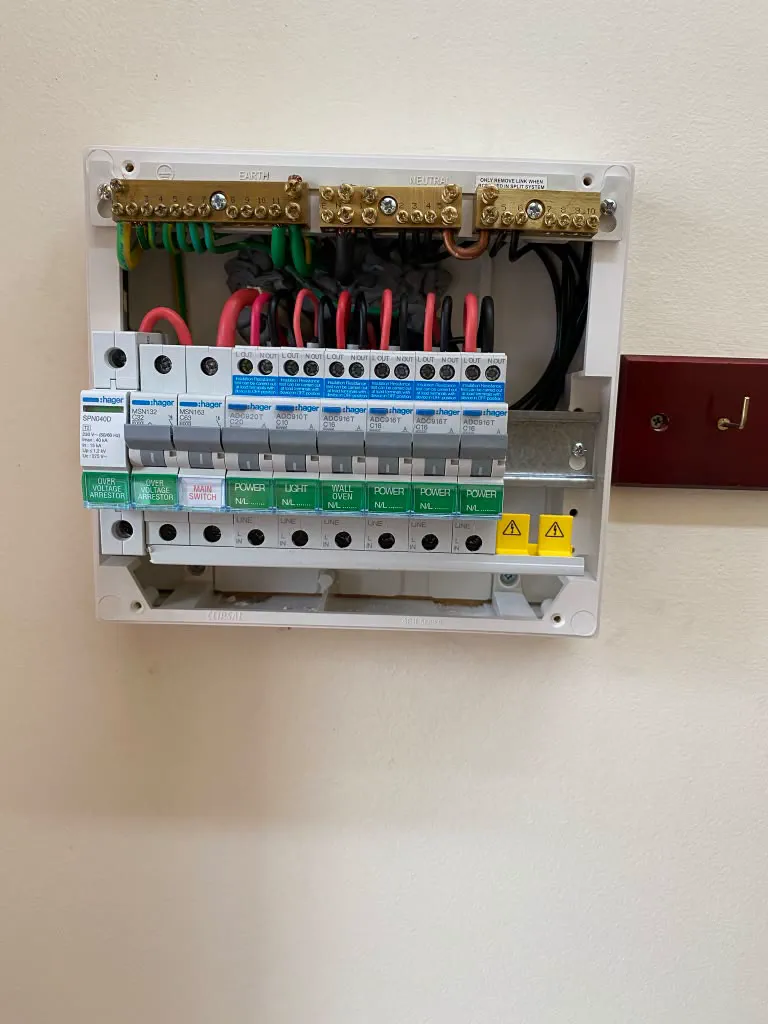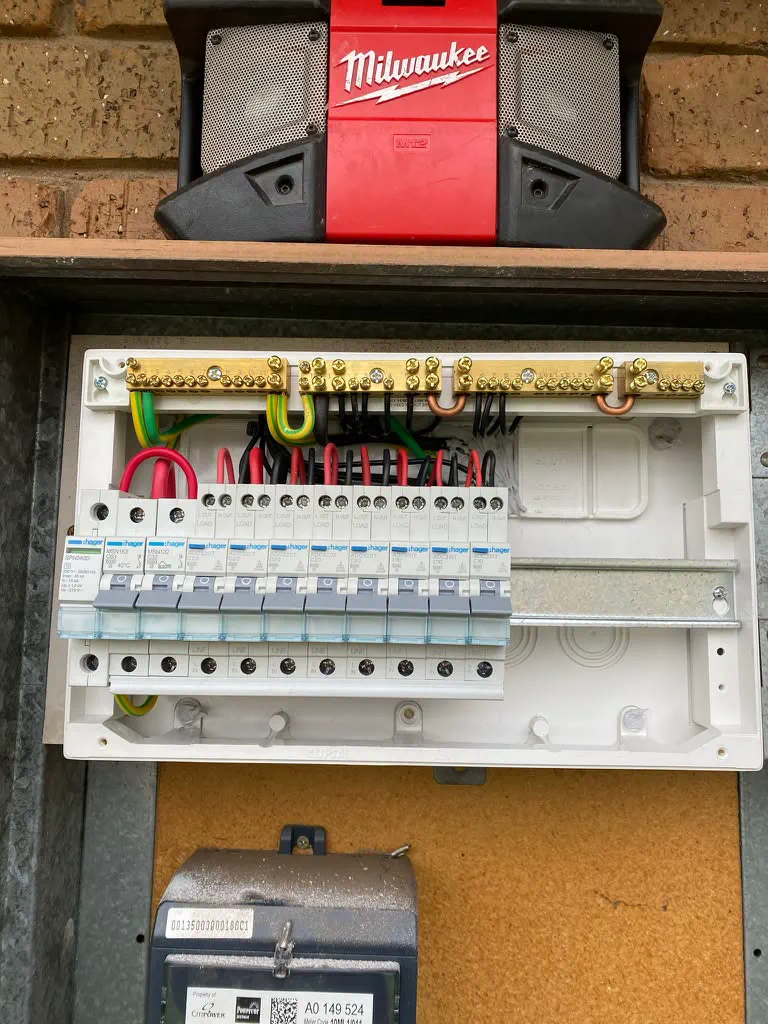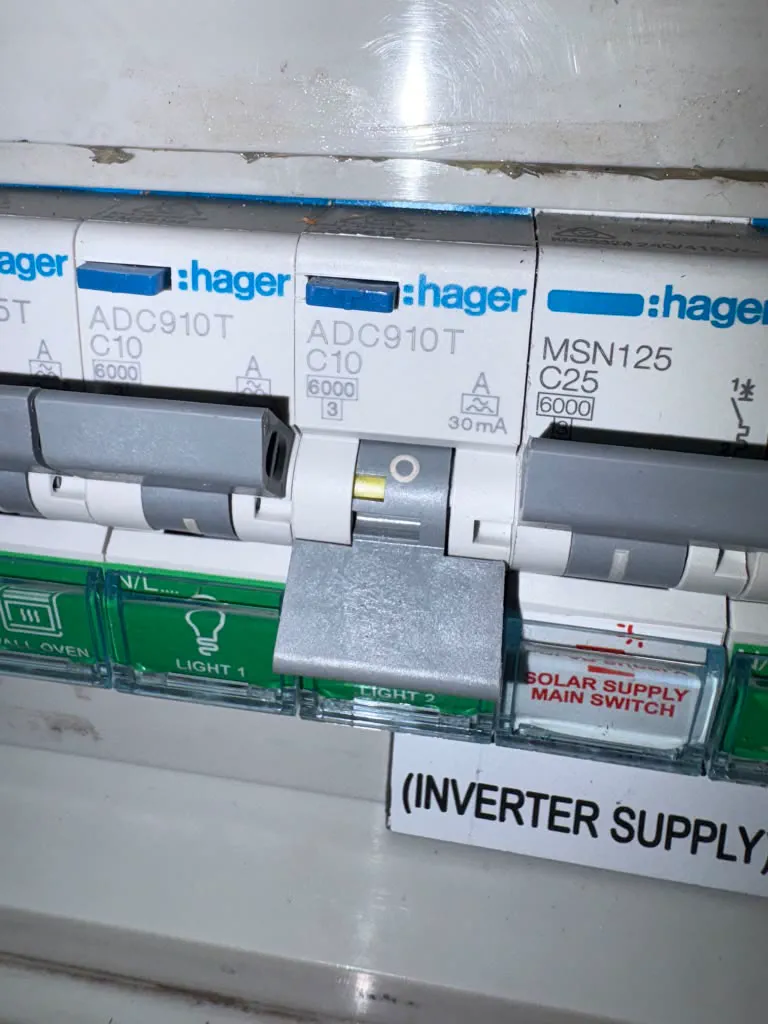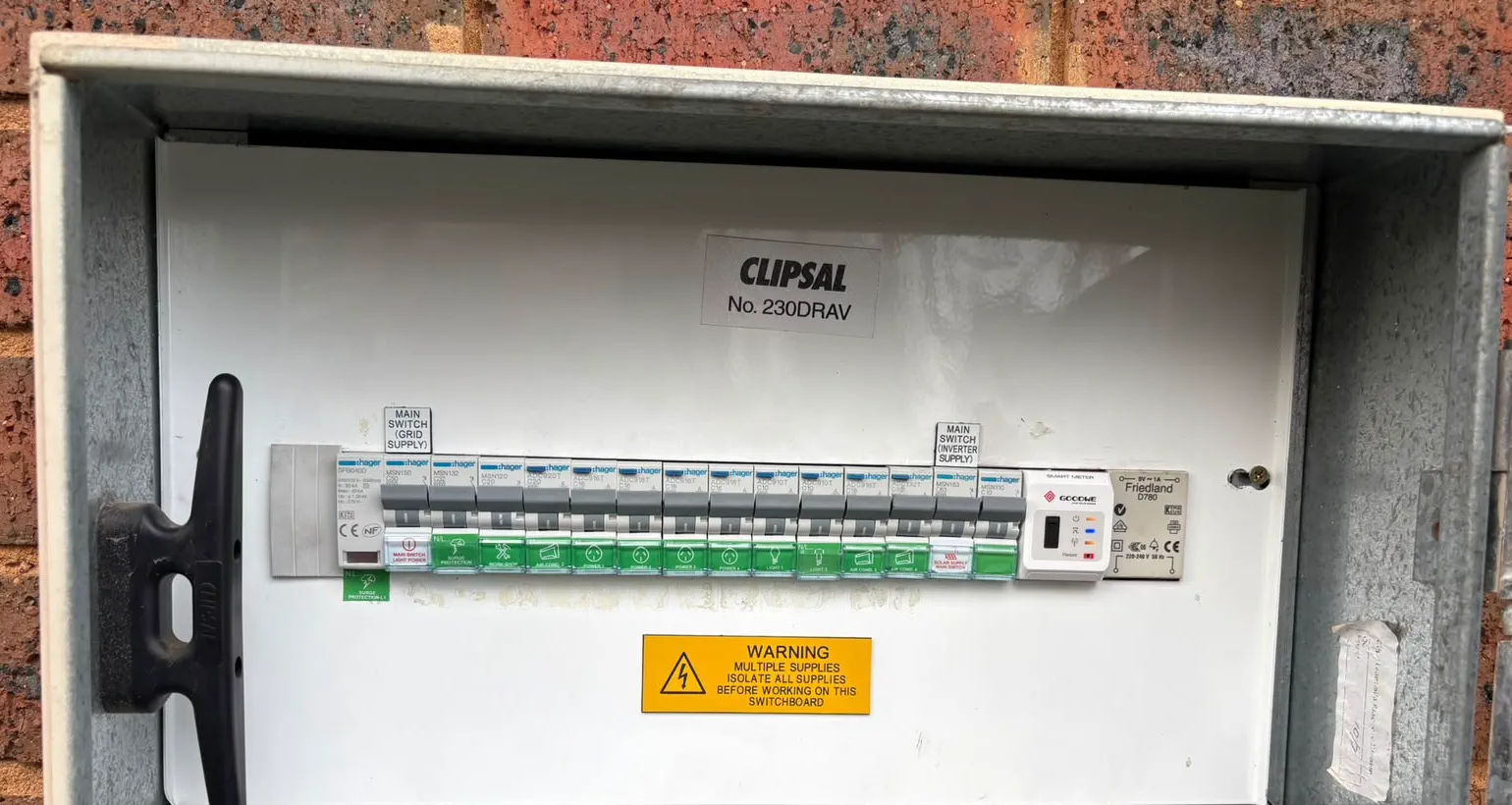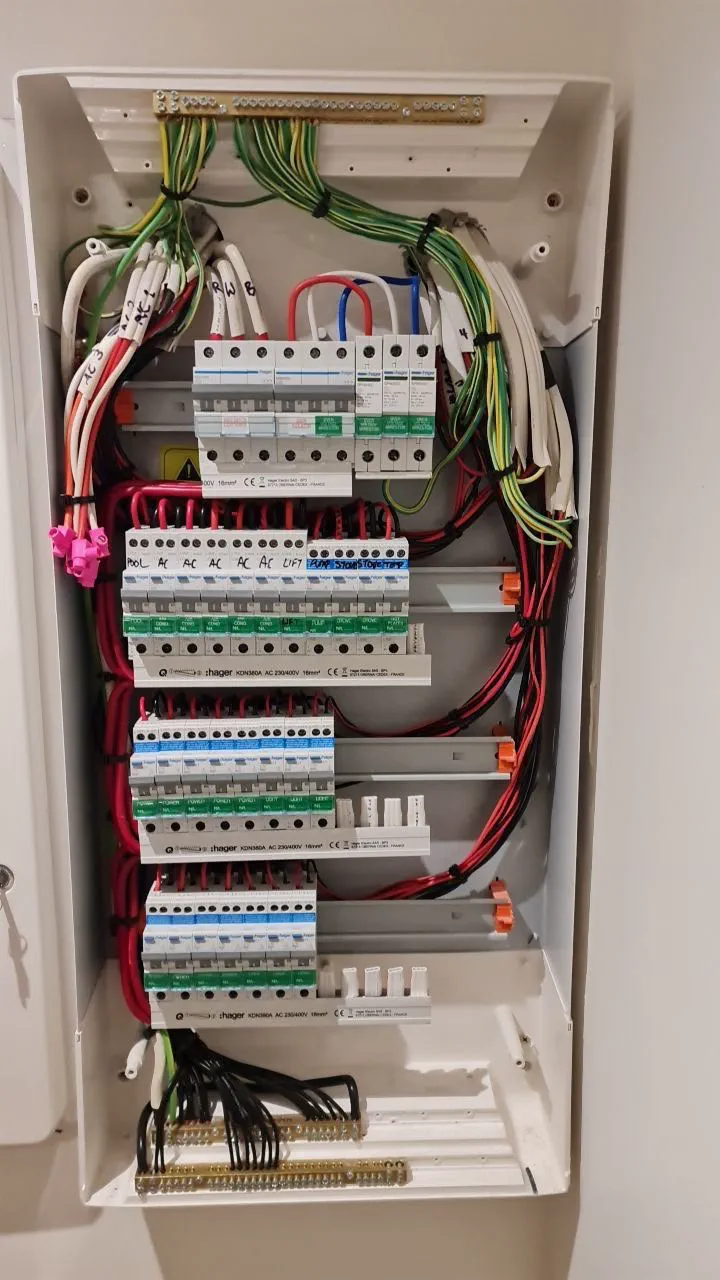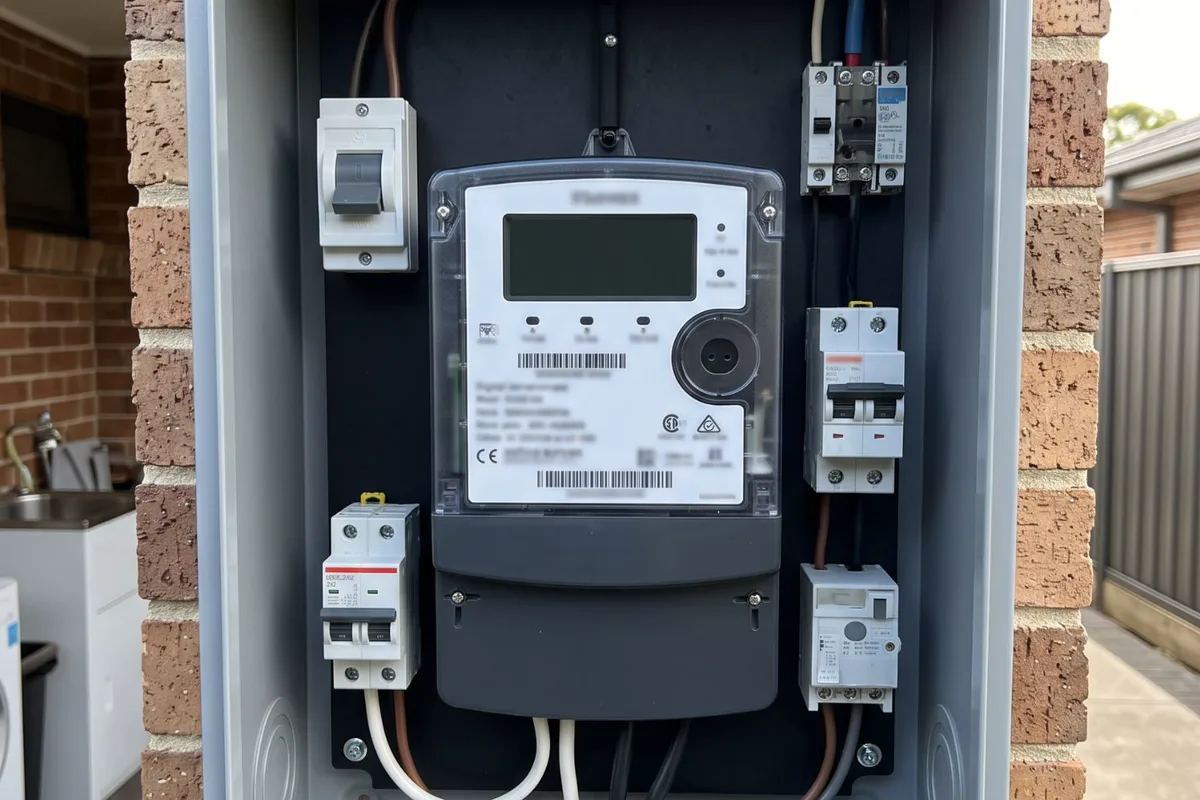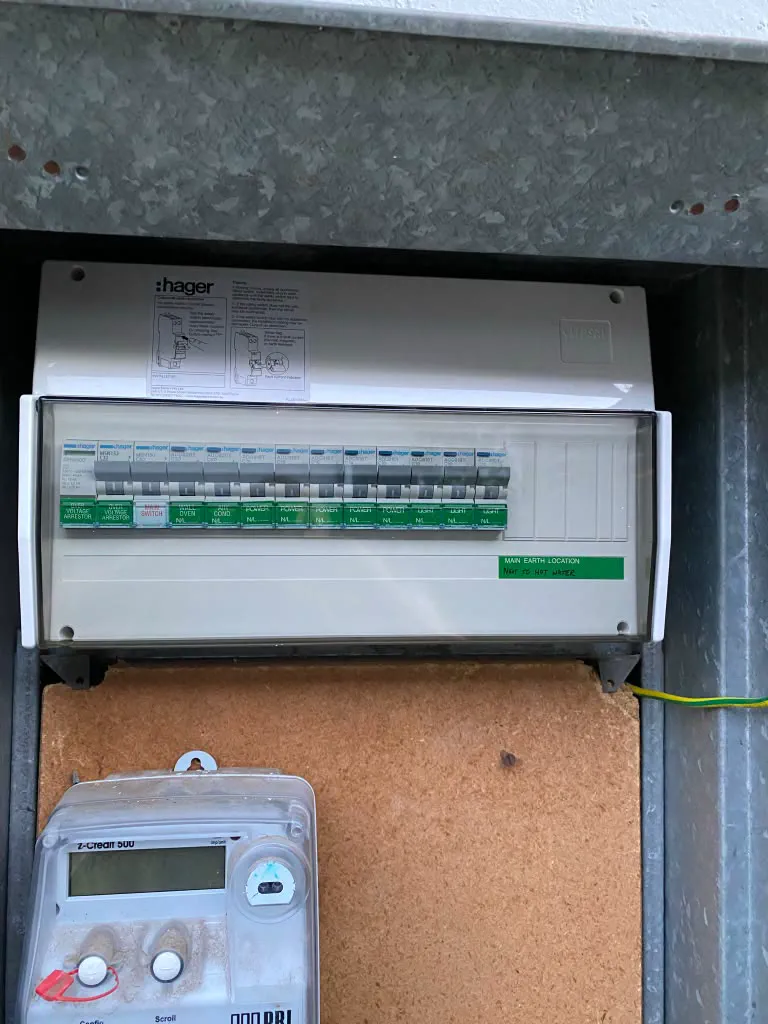
Many homes in suburbs like Altona, Newport and Hoppers Crossing still run on the switchboard they were built with. That often means rewireable fuses, one safety switch or none, and no space for the air conditioner, induction cooktop or EV charger you want to add. We replace the board with modern breakers and safety switches, test every circuit and label it so you can find the right one when something trips. We also tidy boards other trades have left messy, such as after a solar or battery install.
When to get it checked
Ceramic fuses and fuse wire
A blown circuit means pulling out a ceramic carrier and threading in new fuse wire. Many of these boards can't take safety switches at all, so the fix is usually a new board.
No safety switch, or just one
Safety switches have a test button and 30mA printed on them. If there are none, or one covers only the power points, the rest of the house goes without. Energy Safe Victoria lists old switchboards, particularly those without a safety switch, among the tell-tale signs of faulty wiring.
Nowhere to add a circuit
Every slot is full, breakers are doubled up, or a past addition was squeezed in beside the board. That's when a new air conditioner or cooktop stops being a simple job.
Tripping under ordinary use
The main switch or a breaker drops when the kettle, heater and dryer run together, or on a hot afternoon with the air conditioning on.
Heat, buzzing or scorch marks
A warm cover, a hum, discoloured devices or a burning smell mean loose or overloaded connections. That's a call to make now, not an upgrade to plan for later.
A tired or unlabelled board
Cracked covers, faded labels, or 'spare' written on circuits that clearly aren't. If nobody knows which breaker runs what, every fault takes longer to find.
Why it happens
5 common causes
Built for a different house
Many boards were fitted when a home had a stove, hot water, lights and a few power points. Add air conditioning, a dryer and a home office, and the board is doing far more than it was laid out for.
Big new appliances
Induction cooktops, split and ducted systems, heat pump hot water and EV chargers each want their own circuit. Before a new reverse-cycle system goes in, it pays to check the switchboard can take it.
Decades of add-ons
Solar, a battery, a spa and a shed can each leave a breaker and cable at the board. Without a plan, you get a crowded enclosure and labels nobody trusts.
Age and heat
Connections loosen after years of warming and cooling, mechanisms wear, and old enclosures crack or let in dust. None of it shows until something trips or gets hot.
An inspection flags it
A pre-purchase report, a rental safety check or an insurer notes an old board or missing safety switches, and a someday job suddenly has a deadline.
What the job covers
What we usually do on this job. Your quote confirms it for your place.
- Old fuses or breakers removed and a new board fitted
- Circuit breakers on every circuit
- Safety switches covering the power and lighting circuits
- Spare room left for future circuits like air con or an EV charger
- Main switch and earthing checked
- Consumer mains upgraded where the incoming cable is too small
- Every circuit tested before the power goes back on
- Every circuit clearly labelled
- Cabling inside the board dressed neatly
- Messy solar or battery wiring at the board tidied up
Your options, explained
Add protection to the existing board
Low disruption- Best for
- A breaker-type board in good condition with spare room
- How it works
- Safety switches or RCBOs are added or swapped into the existing enclosure so unprotected circuits are covered.
- Worth knowing
- Only suits a sound board that takes compatible devices, so we check that before quoting it.
New board with an RCBO on every circuit
Medium disruption- Best for
- Most houses, particularly busy ones with lots of appliances
- How it works
- Each circuit gets a combined breaker and safety switch, so a fault switches off only the circuit it's on.
- Worth knowing
- More devices, but a trip in the laundry won't take out the fridge or the kitchen lights.
New board with grouped safety switches
Medium disruption- Best for
- Smaller homes and units with few circuits
- How it works
- Two or more safety switches each protect a group of circuit breakers, so every circuit still has shock protection.
- Worth knowing
- Fewer devices, but a fault trips its whole group, so we split groups to keep lights and power points apart.
New board plus mains or supply work
High disruption- Best for
- Older homes with undersized mains, or homes adding several big appliances
- How it works
- The board is replaced and the consumer mains upgraded, with any change to the connection applied for through your distributor.
- Worth knowing
- Takes the most planning, so we confirm the extra capacity is genuinely needed first.
The people behind the work
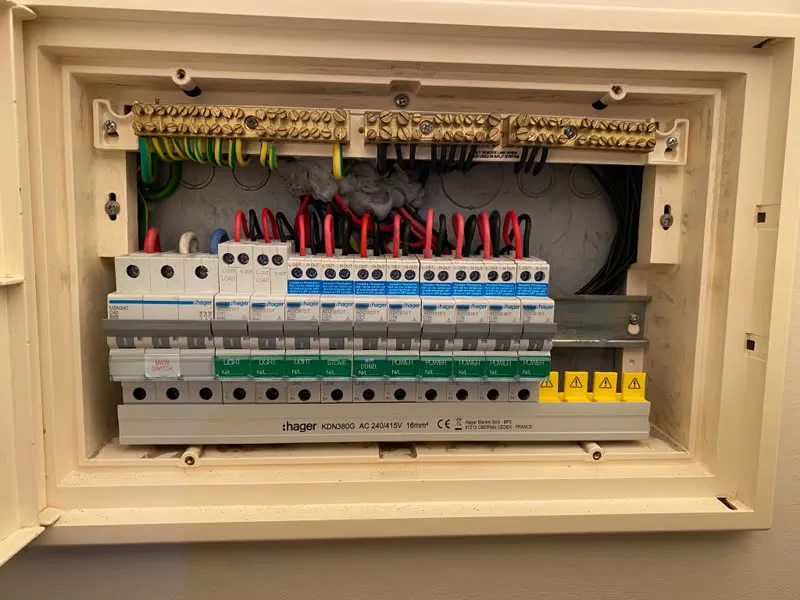
Our own photos from jobs like this one. Family-run, based in Altona Meadows, with 19 years in the industry.
Licensed electrical contractor (REC 38187)See more team photos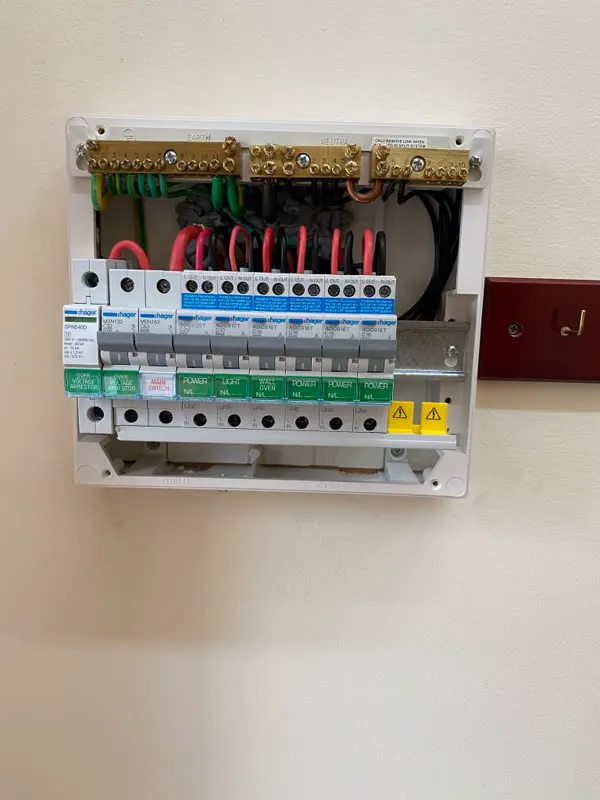
Worth knowing before you book
- Signs it's time
- Rewireable fuses, no safety switches, breakers that feel warm, buzzing, or no room to add a circuit. A burning smell or scorch marks on the board need looking at straight away.
- Plan around the power being off
- The house is without power for most of the job. Keep the fridge and freezer shut, and tell us if anyone at home relies on powered medical equipment so we can plan around it.
- Older boards and asbestos
- Some older switchboard panels contain asbestos. If yours might, we'll tell you when we look at it and talk you through how it needs to be handled before any work starts.
What affects the price?
The right scope depends on your installation. These are the details we check so your quote is useful, with any additional work explained before it proceeds.
How many circuits
Every circuit needs a device, a test and a label. An RCBO on every circuit also means more parts than grouped safety switches.
What's behind the board
An undersized consumer mains cable, a poor main earth or a damaged meter box can all need work before the new board is finished.
The old backing panel
A backing panel that may contain asbestos is assessed before it comes off the wall. If it has deteriorated, a licensed asbestos removalist may be needed.
Faults found in testing
A circuit that fails its insulation or earth test isn't connected as found. We explain the fault and agree the repair with you before it goes ahead.
Access and extras
A cramped cupboard, joinery around the board or moving it adds work, as do surge protection or new circuits at the same visit.
Before the visit
- List future electric appliances as well as the immediate job.
- Share safe external photos and any previous inspection report.
- Plan around the agreed outage and discuss critical appliances in advance.
How it runs
- 1
Look at the board
Aaron checks the switchboard, the mains and what you're planning to add, then gives you options.
- 2
Confirm and book
You get an upfront price and a date, with a rough idea of when the power will be off.
- 3
Replace the board
Power off, old board out, new board in, circuits reconnected and labelled.
- 4
Test and hand over
Every circuit is tested before power is restored. We show you the new board and how the safety switches work.
Step by step, in more detail
6 steps
Look at the board and your plans
Send a photo of the board with the door open and no covers removed. On site we check the board, meter box, consumer mains and main earth, and ask what you plan to add over the next few years.
Options and a fixed price
You get the options and a fixed price for the agreed scope before work starts. The quote names exactly which circuits get new protection.
Book the changeover
We agree a date and an expected window for the power being off. If anyone at home relies on powered medical equipment, we plan around that first.
Replace the board
The supply is isolated, the old board comes out and the new enclosure, main switch and protective devices go in. Each circuit is brought across, dressed neatly and labelled.
Test, inspect, switch on
Every circuit is tested for insulation, earthing, polarity and correct connection. A Licensed Electrical Inspector then inspects the work, and the new board is switched on once that's done.
Hand over
We walk you through the new board, test each safety switch with you, and hand over your Certificate of Electrical Safety.
What is safe to do, and what to leave to us
Safe for you to do
- Press the test button on each safety switch every three months. If the power doesn't go off, call a licensed electrician.
- Reset a tripped safety switch once. If it won't stay on, leave it off and call a licensed electrician.
- Note what was running when something tripped. It helps narrow down the circuit.
- Keep the area in front of the board clear.
- If the board is hot or smells of burning, switch off at the main switch only if it's dry and safe to reach. If it's alight, don't use water. Get everyone out.
Leave these to us
- Taking the switchboard cover off or touching anything behind it.
- Fitting heavier fuse wire, or taping a breaker on so it can't trip.
- Drilling, cutting or sanding an old backing board.
- Running more power boards because there are no spare circuits.
- Letting anyone unlicensed work on the board. Energy Safe Victoria says that's illegal and potentially fatal.
When to get us in
- Heat, buzzing, crackling or scorch marks at the board
- A safety switch or main switch that trips again after one reset
- Ceramic fuses, or no safety switches at all
- Before you order an air conditioner, induction cooktop or EV charger
- A meter box door that's broken or lets water in
More detail
What changes and what stays
The enclosure, main switch, fuses or breakers, safety switches and the neutral and earth links are replaced. The cables in your walls stay, and a new board doesn't make them new. Energy Safe Victoria says wiring in a house built more than 30 years ago should be checked. Our testing shows how yours is holding up, and any rewiring is quoted separately.
Why the rules shape the new layout
When a switchboard is replaced, clause 2.6.3.2.5 of AS/NZS 3000 requires safety switches on all final sub-circuits. Type AC safety switches, common on older boards, can no longer be installed in Australia, even like for like, although existing ones installed, tested and certified before 1 May 2023 don't have to come out. So a new board is never a device-for-device copy of the old one.
The meter box and mains come into it
From the point of supply, the installation is the property owner's to maintain and repair. Powercor lists a meter box with a missing door, broken hinges or no weatherproofing as the customer's to fix, so it's worth sorting at the same time as the board. Older homes can have a small single-phase supply. If yours can't carry what you're adding, that becomes a capacity upgrade, and for big combined loads, a single to three-phase upgrade.
New protection can show up old faults
Fuses and old breakers only react to overloads and short circuits. Safety switches also react to current leaking to earth, so a new board can expose a worn oven element, a damp outdoor point or tired insulation that has leaked quietly for years. That's why testing comes before switch-on, and why a trip soon after an upgrade is worth a call, not repeated resets.
Local rules and conditions
Victorian requirements and local conditions that shape this job, with the sources listed at the foot of the page.
No power until the inspector has been
In Victoria, main switchboard work is prescribed, along with consumer mains, the meter box and the main earthing system. Energy Safe Victoria says power can't go back on to a new main switchboard until a Licensed Electrical Inspector has inspected it, so we book the inspection as part of the job.
Rentals: add to the board or replace it
Since 29 March 2023, every power outlet and lighting circuit in a Victorian rental must connect to a switchboard-type circuit breaker and safety switch. A breaker board with room can often take the extra safety switches. With a panel-and-fuse or federal fuse board, the whole board may have to be replaced, and then every circuit needs protection, including cooking, hot water and air conditioning. The rental provider engages the electrician.
Asbestos behind older boards
Hobsons Bay's planning scheme credits post-war industrial and residential expansion with transforming Altona and Laverton. WorkSafe Victoria lists switchboards and their backing boards among typical asbestos locations, particularly in buildings built or renovated before the late 1980s. If an asbestos mounting panel has to come out, it must be replaced with non-asbestos material, so we check the panel before we quote.
Hot afternoons show a board's limits
The Laverton weather station averages 27.0 days a year at or above 30 °C and 9.4 at or above 35 °C, mostly December to February. Air conditioning, fridges and freezers all work hard on those days, so a board that runs warm or drops its main switch then is telling you something.
Useful reading
Guides to read before you decide, with checklists and questions to bring to the quote.
- Planning a switchboard upgrade without surprisesWhat the electrician needs to check, how to compare the scope and what to organise before the power goes off.
- Ceramic fuses and old switchboards: what to look forA look-but-don't-touch guide to old switchboards: rewireable fuses, a missing safety switch, suspect backing panels, heat marks and what replacement involves.
- Certificates of Electrical Safety explainedWhat a Victorian COES records, how prescribed and non-prescribed work differ, when your copy should arrive and why it belongs in your house file.
- Going all-electric in a Melbourne homeHot water, heating and cooking don't have to go electric at once. How to stage the move off gas, check the switchboard once and time each step.
Common questions
Questions people ask about this
- Do I need to be home for a switchboard upgrade?Someone should be there at the start and at the end, and the electrician needs access to the switchboard and to the rooms inside for testing.
- What is a sub-board, and do I have one?A sub-board is a smaller switchboard fed by its own cable from a circuit breaker on your main switchboard.
- Why does a Licensed Electrical Inspector need to check my new switchboard?Because replacing a main switchboard is prescribed work in Victoria.
- Will my fridge and freezer be OK during a switchboard upgrade?Usually, with some planning.
- What photos help with an electrical enquiry?Three or four clear photos usually do it: the switchboard with its door open and every cover left in place, a wider shot of where the job is, and any appliance or…
From the blog
- Is it worth upgrading the switchboard before you sell?A working board with breakers and safety switches rarely needs replacing to sell. An old fuse board with no safety switches is a different story, and timing matters.
- Upgrading the electrical in a heritage home in Williamstown or YarravilleFront-wall meter boxes, lath and plaster, basalt walls and period fittings all shape how a heritage home in Melbourne's inner west gets rewired.
- What affects the cost of rewiring a house?Testing, storeys, roof and subfloor access, wall types, added points, the switchboard and making good decide what a rewire involves. Here's how to compare quotes.
Sources for the rules and local facts on this page
19 sources, with the date each was checked
- 1.Energy Safe Victoria: The electrician has eight business days after the work is completed to have that work inspected by a licensed electrical inspector (LEI). If an electrician replaces a main switchboard at a property, power cannot go back… Accessed 30 September 2026.
- 2.Energy Safe Victoria: 'Prescribed' certificates are for electrical installation work that requires inspection by a Licensed Electrical inspector. This includes (but is not limited to): Consumer mains cables, main switchboard, meter box and… Accessed 30 September 2026.
- 3.Consumer Affairs Victoria: The electrical safety rental minimum standard commenced on 29 March 2023. Rental properties must have modern switchboards, with circuit breakers and electrical safety switches installed. Electrical safety switches are… Accessed 30 September 2026.
- 4.Consumer Affairs Victoria: From 29 March 2023 all power outlets and lighting circuits in a rental premises must connect to both a switchboard-type circuit breaker that complies with AS/NZS 3000 and a switchboard-type residual current device that… Accessed 30 September 2026.
- 5.Victorian Government, Hobsons Bay Planning Scheme (PDF snapshot, last updated by VC292 on 11/09/2025): The heritage places of Hobsons Bay reflect the key themes that have shaped the development of the city since the establishment of Williamstown in the 1840s as the first port of Melbourne, through the development of… Accessed 30 September 2026.
- 6.WorkSafe Victoria: A person who has management or control of a workplace, and employers or self-employed persons and employees should be aware of the typical uses and applications of ACMs, particularly in buildings constructed or… Accessed 30 September 2026.
- 7.WorkSafe Victoria: If the condition of electrical mounting boards has deteriorated or ACD is present an asbestos removal licence holder may be required to undertake asbestos removal work For example, if an ACM electrical mounting panel… Accessed 30 September 2026.
- 8.Bureau of Meteorology: Mean number of days ≥ 30 °C 6.9 6.0 4.5 0.7 0.0 0.0 0.0 0.0 0.1 0.9 2.8 5.1 27.0 82 1943 2026 Mean number of days ≥ 35 °C 3.6 2.4 0.9 0.0 0.0 0.0 0.0 0.0 0.0 0.1 0.5 1.9 9.4 Accessed 30 September 2026.
- 9.Energy Safe Victoria: If a switchboard is required to be replaced then as per clause 2.6.3.2.5 (Alterations to installations and replacement of switchboards) of AS/NZS 3000: RCD’s are required on all final sub-circuits. Accessed 30 September 2026.
- 10.Energy Safe Victoria: Whenever a licensed electrician completes any electrical installation work, they must provide a Certificate of Electrical Safety (COES). Accessed 30 September 2026.
- 11.Energy Safe Victoria: Copies of prescribed COES must be provided to the relevant parties within 16 calendar days from completion of the work. Accessed 30 September 2026.
- 12.Energy Safe Victoria: Type AC RCDs must not be installed in Australia. This includes like for like replacement. We recommend that electrical contractors advise customers of the new requirements. However, it is not mandatory to replace… Accessed 30 September 2026.
- 13.Energy Safe Victoria: Old switchboards, particularly those without a safety switch Old power switches or power points, particularly broken ones Flickering lights Sparks from switchboards, switches or power points. If your house is over 30… Accessed 30 September 2026.
- 14.Energy Safe Victoria: monitors the flow of electricity through a circuit detects a problem that may pose a risk to personal safety turns the power off within 0.03 of a second always has a test button and '30ma' printed on them. Accessed 30 September 2026.
- 15.Energy Safe Victoria: Clause 2.6.3.2.5 of the Wiring Rules states: Additional protection by RCDs shall be provided in existing electrical installations where alterations or a switchboard replacement is completed. Accessed 30 September 2026.
- 16.Energy Safe Victoria: Locate your electricity box outside your home and check whether the safety switch has tripped. If it has tripped, reset the switch. If the switch won’t reset, call a licensed electrician. Accessed 30 September 2026.
- 17.Energy Safe Victoria: Gas and electricity are inherently dangerous and it’s illegal and potentially fatal for unlicensed and unqualified people to undertake any electrical or gasfitting work. Homeowners and consumers must always use… Accessed 30 September 2026.
- 18.Energy Safe Victoria: The point of supply is the changeover point from the electricity distribution network to the electrical installation, where the property owner becomes responsible for the maintenance and repair of the electrical… Accessed 30 September 2026.
- 19.CitiPower & Powercor: Customer installation defects fall under customer responsibility and require prompt rectifications to ensure either the safety of the electrical installation, unhindered access to our assets by our employees or that our… Accessed 30 September 2026.