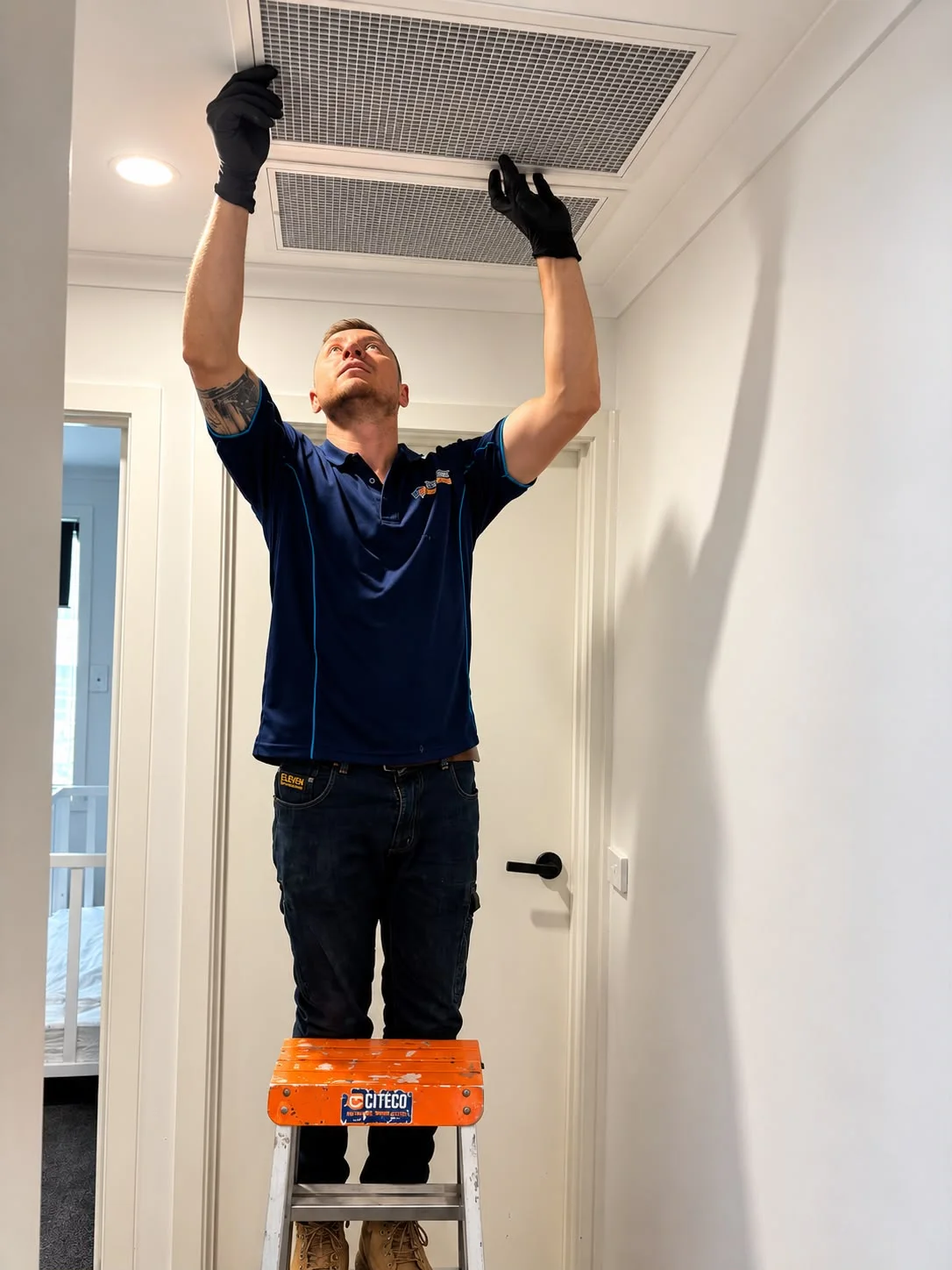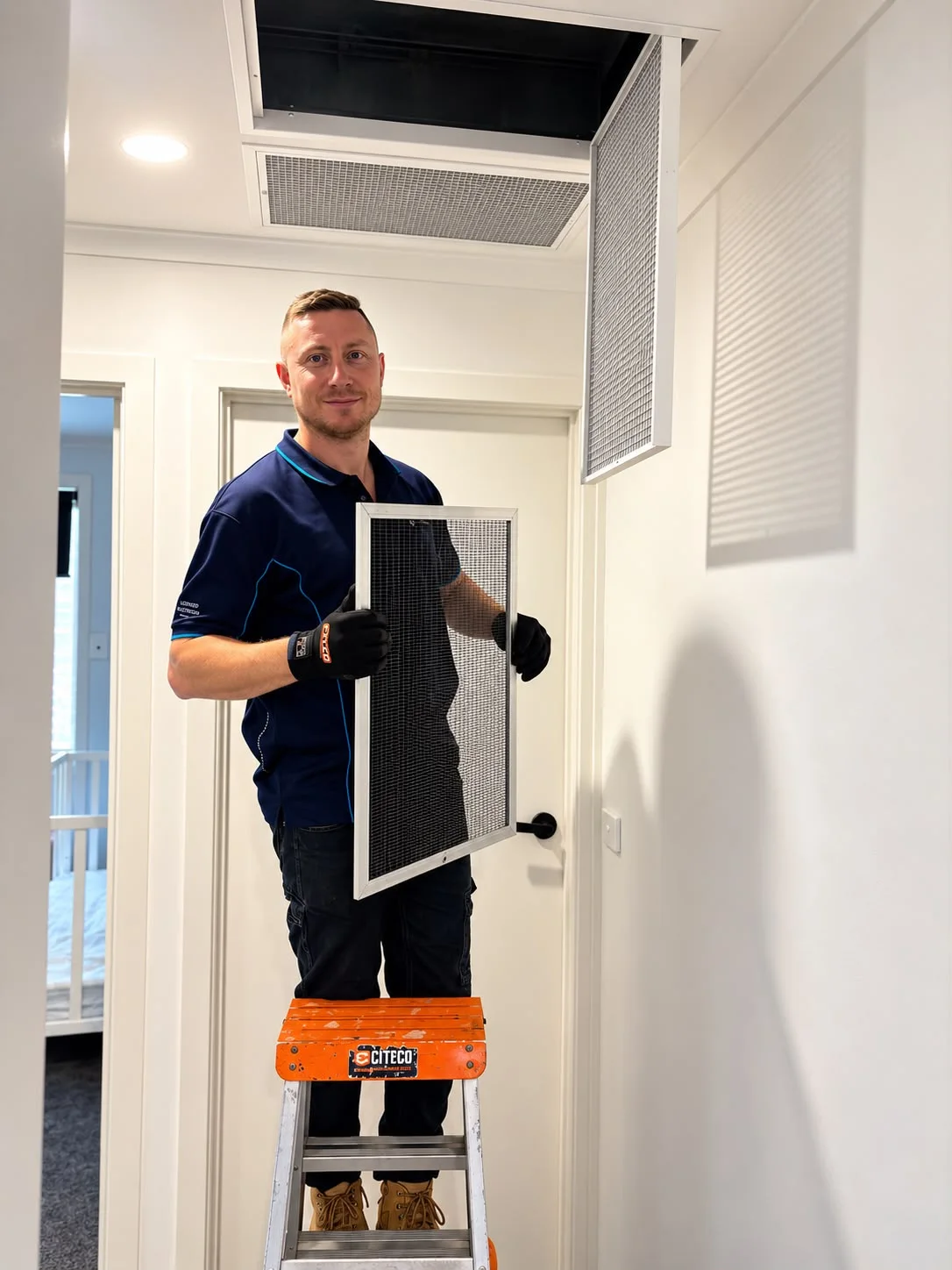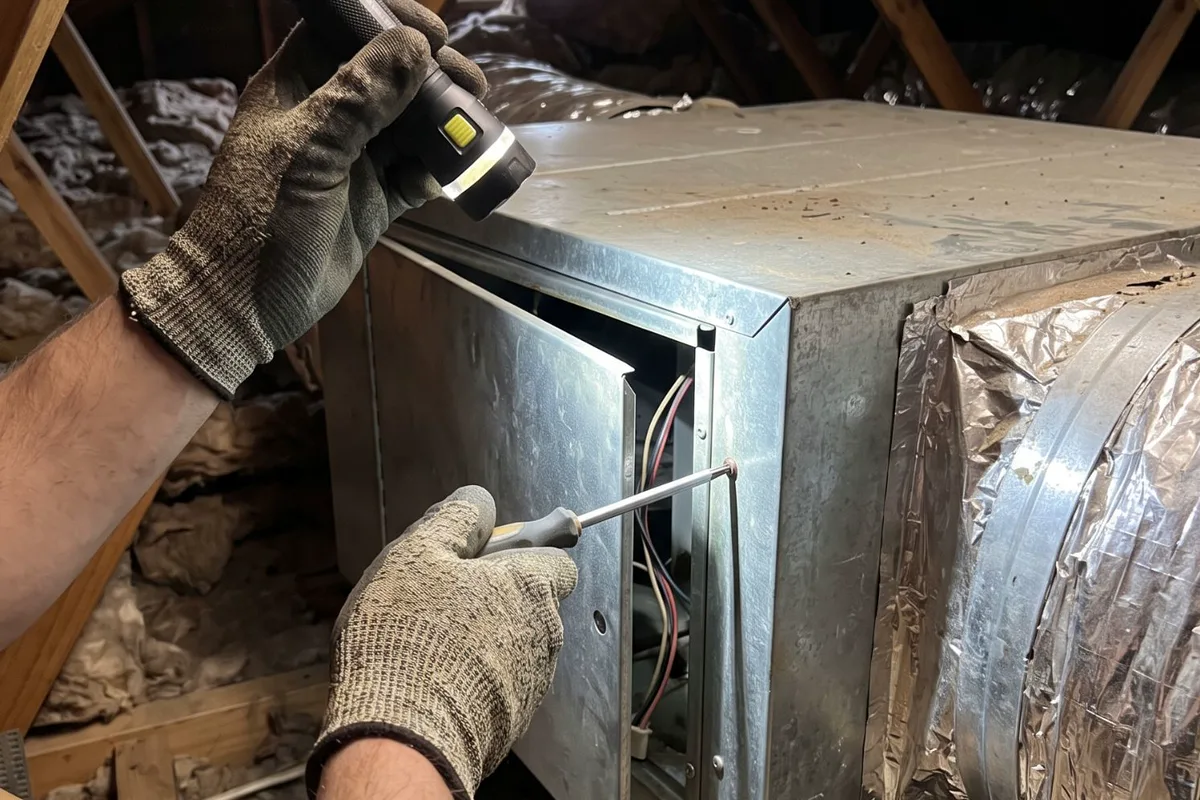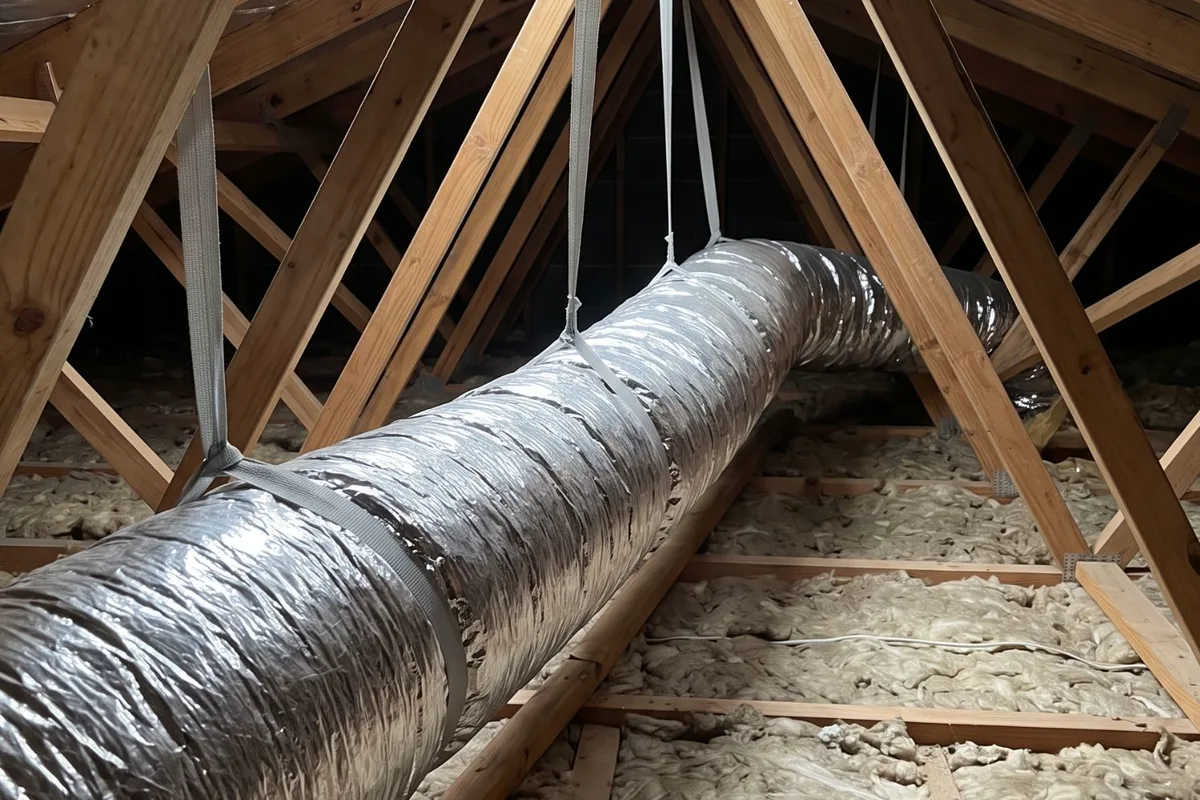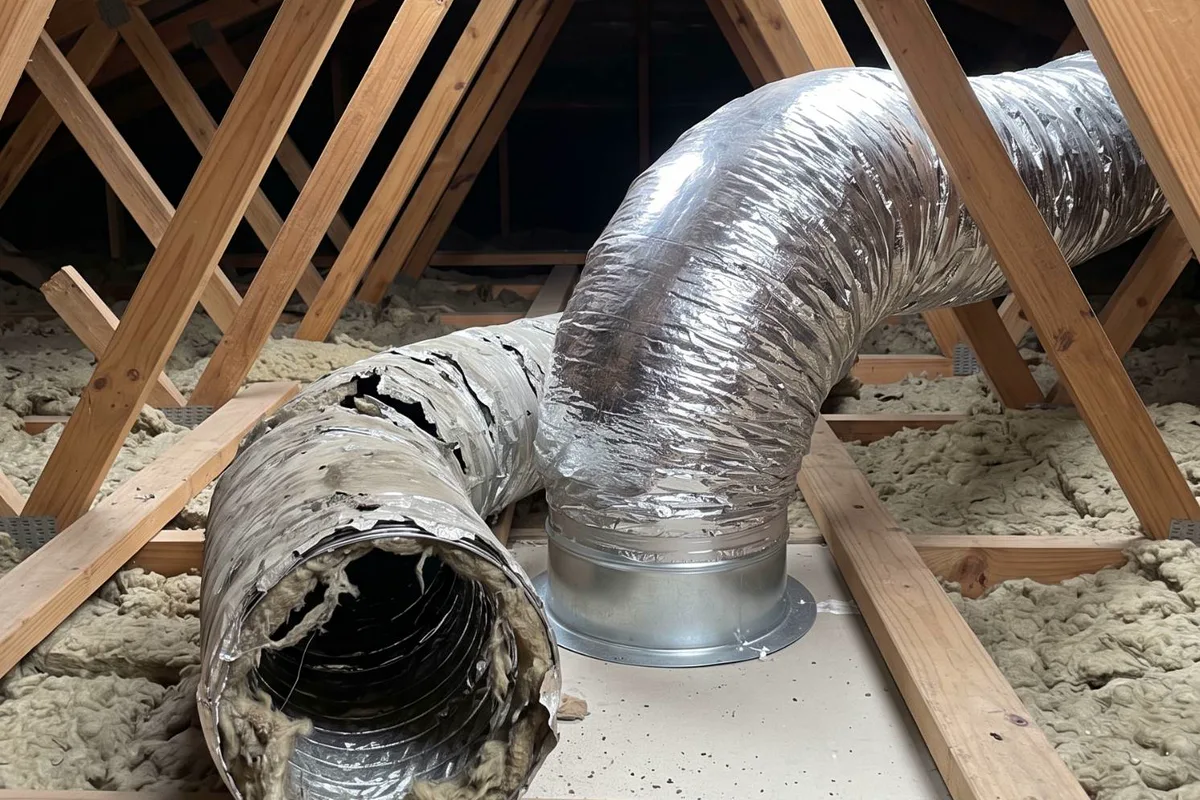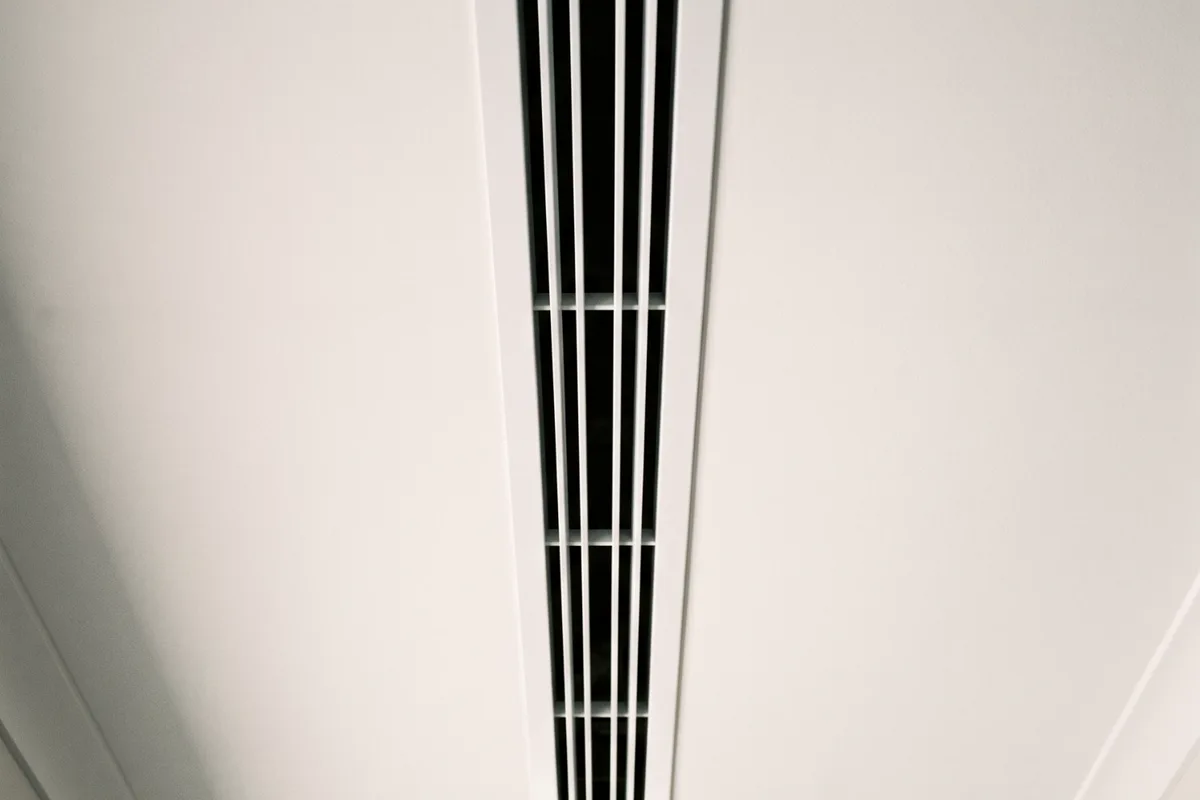
Outlets and return grilles take years of sun and warm air, and eventually yellow, crack or whistle. Our team replaces them with outlets matched to the duct and the room, sealed properly to the ceiling. We check the duct behind each one and rebalance the system when we're done.
When to get it checked
Yellowed or brittle plastic
Years of light and warm air turn white outlets cream or brown, and the plastic goes brittle and cracks.
Whistling or rattling outlets
A loose blade, a gap at the collar or an outlet too small for the air behind it makes noise, especially on high fan.
Dust marks and draughts
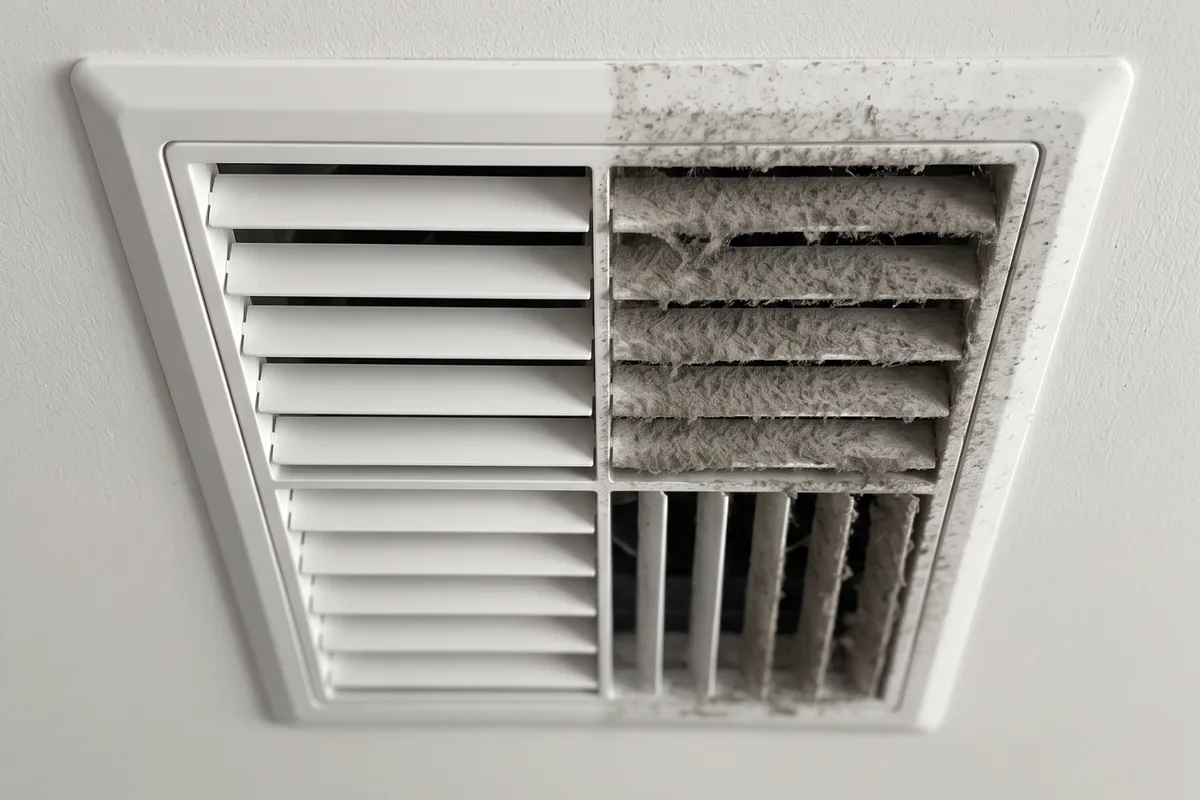
Grey marks on the ceiling around an outlet, or a cold draught from it when the system is off, point to gaps between the outlet, the ceiling and the duct.
Blades that won't adjust
Fixed or broken blades blow air straight down onto the couch or the bed, with no way to redirect it.
A return grille that's a pain to clean
The filter is awkward to get out, or the grille has no filter frame at all.
Old floor vents
Floor outlets from an old gas heater collect dust and small toys, and they don't suit cooling.
Why it happens
4 common causes
Age, heat and sunlight
Plastic outlets near windows or under skylights age faster, and warm air through them every winter speeds it up.
Gaps at the collar
If the duct isn't firmly attached to the outlet collar, or the outlet doesn't seal against the plaster, air leaks into the ceiling space and dust marks the ceiling.
Mismatched sizes
Outlets swapped over the years for whatever fitted the hole may not suit the duct behind them, causing noise or a weak throw.
The system changed, the outlets didn't
A switch from gas ducted heating to reverse cycle often leaves floor vents, or outlets designed only for heating.
What the job covers
What we usually do on this job. Your quote confirms it for your place.
- Every outlet and grille measured
- Duct and collar checked behind each outlet
- Outlet styles and sizes matched to the room
- Old outlets removed, new ones sealed in
- Filter-backed return grille option
- Floors and furniture covered while we work
- Each outlet adjusted and balanced
- Heating and cooling tested room by room
Your options, explained
Like-for-like outlet replacement
Low disruption- Best for
- Yellowed, cracked or noisy outlets on a system that otherwise works well
- How it works
- New outlets of the same size and fixing go into the existing holes and onto the existing collars.
- Worth knowing
- The neatest option for the ceiling, with no patching.
A different outlet style
Medium disruption- Best for
- Updating the look, or steering air away from beds and couches
- How it works
- A different style, such as square or linear outlets with adjustable blades, matched to the duct size.
- Worth knowing
- A new shape may mean recutting the ceiling hole and patching around it.
Filter-backed return grille
Low disruption- Best for
- Return grilles that are hard to clean or have no filter frame
- How it works
- A hinged grille with a filter frame behind it replaces the old grille, so the filter lifts out without tools.
- Worth knowing
- Makes regular filter cleaning far easier to keep up.
Floor vents to ceiling outlets
High disruption- Best for
- Homes moving from gas ducted heating to reverse cycle
- How it works
- Floor vents are removed and the openings covered, and new ceiling outlets are fed from new duct runs.
- Worth knowing
- Usually done as part of a duct replacement or a change of system.
The people behind the work
One local team for electrical, heating and cooling, based in Altona Meadows, with 19 years in the industry.
Licensed electrical contractor (REC 38187)See more team photos
Worth knowing before you book
- Like-for-like is neatest
- The same size means no ceiling patching.
- Check the duct too
- A new vent won't fix a crushed duct.
- Filter-backed returns
- They make filter cleaning far easier.
What affects the price?
The right scope depends on your installation. These are the details we check so your quote is useful, with any additional work explained before it proceeds.
Number of outlets and grilles
Each outlet takes time to remove, fit, seal and adjust.
Style and size
Adjustable, linear and designer outlets cost more than standard round or square ones.
Ceiling changes
A different outlet shape or size can mean recutting the hole and patching the plaster.
Duct and collar condition
A loose, crushed or undersized duct behind an outlet needs fixing for the new outlet to work properly.
Ceiling height
Raked and high ceilings need taller ladders or a platform.
How it runs
- 1
Measure
Every outlet and grille counted and sized.
- 2
Choose
Styles, sizes and price agreed.
- 3
Replace and balance
Fitted, sealed and adjusted room by room.
Step by step, in more detail
5 steps
Count and measure
We list every outlet, floor vent and return grille, measure their sizes and check how each one is fixed to the ceiling and the duct.
Check the duct behind
Where access allows, we check the collar and duct at each outlet. A crushed or loose duct behind a new outlet won't fix the airflow.
Choose styles and sizes
Round, square or linear outlets, with adjustable or fixed blades, matched to the duct and the room. You see the options and the price before we start.
Replace and seal
Old outlets come out and new ones go in, sealed to the ceiling and fixed to the duct collar. Floors and furniture are covered below.
Rebalance and test
We adjust each outlet, run heating and cooling, and check airflow and noise room by room.
What is safe to do, and what to leave to us
Safe for you to do
- Turn the system off before cleaning outlets or the return grille.
- Vacuum outlets with a soft brush attachment rather than pulling them down.
- Keep the return grille clear of furniture, curtains and shelving.
- If water drips from an outlet, turn the system off and keep clear of nearby light fittings.
Leave these to us
- Pulling outlets out of the ceiling yourself. The duct can come off its collar up in the roof.
- Taping over outlets to push air elsewhere. Ducted systems need a minimum airflow.
- Fitting a smaller outlet than the duct behind it to quieten a draught.
- Climbing into the roof space to reconnect a loose duct.
When to get us in
- Outlets are yellowed, cracked or brittle
- Outlets whistle, rattle or drip
- Grey dust marks appear on the ceiling around outlets
- The return grille filter is hard to reach, or missing
- You're switching from gas ducted heating and still have floor vents
More detail
Outlets do more than look tidy
A ceiling outlet decides where the air goes in the room. The right size and blade pattern spreads air across the room at a comfortable speed; the wrong one dumps it in one spot or makes it whistle.
That's why we match each outlet to the duct behind it and the room in front of it, not just to the hole in the ceiling.
Return grilles and filters
Most ducted systems draw air back through one or two large return grilles, with the filter behind them. A filter-backed grille has a hinged face and a frame that holds the filter, so it lifts out without tools.
A return grille that's too small for the system can whistle and starve the unit of air. We check its size against the system while we're there.
When it's the duct, not the vent
A weak or noisy outlet isn't always the outlet's fault. A crushed, loose or undersized duct behind it gives the same symptoms, and a new outlet won't fix that.
Where we find a duct problem, we tell you and price the repair separately. Our ductwork and duct replacement pages cover that work.
Local rules and conditions
Victorian requirements and local conditions that shape this job, with the sources listed at the foot of the page.
Filters twice a year
The Victorian Government suggests cleaning reverse-cycle dust filters about twice a year, more often with heavy use, and dirty filters significantly cut airflow and efficiency. A filter-backed return grille that opens without tools makes that habit much easier to keep.
Older ceilings in the inner west
Newport's heritage precinct is mostly single-storey weatherboard homes from the Victorian, Federation and Interwar periods, and Yarraville's is mostly small Victorian and Edwardian houses. In homes that age, ducted systems arrived long after the house did, so we place and size new outlets with care around older ceilings.
Ready before the heat
Victoria's health department advises checking your air conditioner works before extreme heat and keeping filters, pads and vents clean. Spring is a good time to replace tired outlets, before the system is running every afternoon.
Useful reading
Guides to read before you decide, with checklists and questions to bring to the quote.
- Air conditioner maintenance: what to watch between servicesKeep useful records, follow model-specific filter care and recognise symptoms that need a repair visit.
- Ducted zoning explainedZones, dampers, controllers and room sensors in plain terms, plus the airflow limits that decide whether zoning will fix your comfort problem.
- Reverse-cycle air conditioning or gas heating?How each one makes heat, how it feels on a cold night in Melbourne's west, what Victoria's gas rules mean for you and what switching really involves.
- Air conditioner filters, dust and allergiesHow filters, return grilles and coils affect dust, smells and hay fever season at home, which filter upgrades help, and where your own cleaning should stop.
Common questions
From the blog
Sources for the rules and local facts on this page
5 sources, with the date each was checked
- 1.Solar Victoria (updated 20 November 2025): Check the manufacturer’s instructions or manual and have the air conditioner serviced regularly at the recommended frequency to ensure it continues to operate efficiently. Cleaning the filters regularly helps the system… Accessed 30 September 2026.
- 2.Energy Rating (GEMS Regulator / DCCEEW): Dirty filters significantly reduce the amount of airflow and the energy efficiency of the unit. It can also impact the effectiveness of its heating. Cleaning clogged filters, or replacing a worn one, can lower the… Accessed 30 September 2026.
- 3.Victorian Heritage Database (Heritage Council Victoria); entry maintained by Hobsons Bay City Council from the Hobsons Bay Heritage Study 2006: Aesthetically, it is significant for the groups of relatively intact examples of representative housing, from the Victorian, Federation and Interwar periods. They are notable for their consistent character, which is… Accessed 30 September 2026.
- 4.Victorian Heritage Database (Heritage Council Victoria); entry maintained by Maribyrnong City Council: The general character of the Yarraville Residential Precinct is that of small Victorian & Edwardian single-storey detached housing with mainly weatherboard and some brick wall cladding, corrugated iron roofing, front… Accessed 30 September 2026.
- 5.Better Health Channel (Department of Health, Victoria): Check that your fan and air-conditioner works well. Have your air-conditioner serviced if needed. Ensure the filters, pads and air vents are clean. Accessed 30 September 2026.