
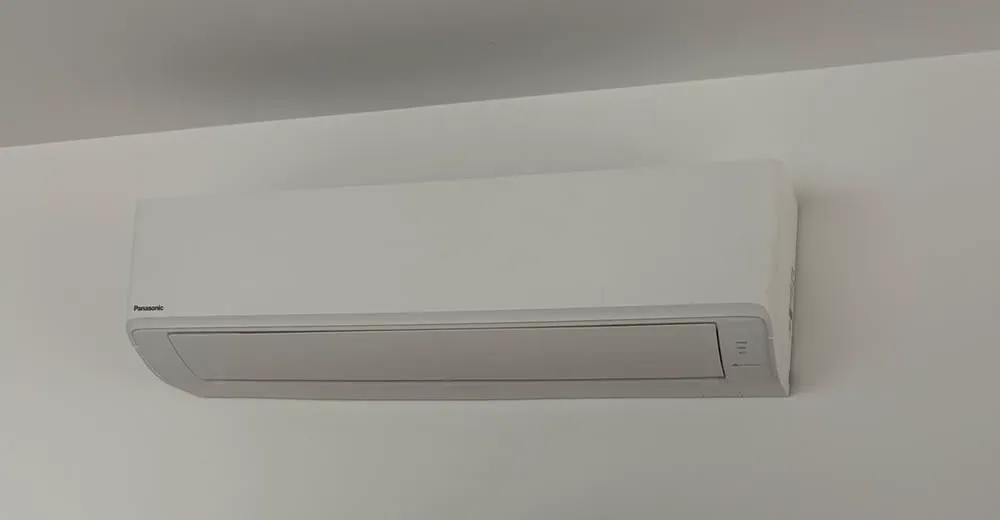
Why can't my split system keep my open-plan living room warm?
- Warm air rises and escapes up stairwells and voids, so the far end of the room stays cool.
- The unit reads the temperature high on the wall, where it's warmest, and throttles back too soon.
- Louvres down, a higher fan speed and closed doors help straight away.
- A ceiling fan in winter mode, a floor unit or a second split fixes what settings can't.
Why one wall unit struggles
A split system heats the air near it and relies on that warm air spreading through the room. In a closed lounge, it does. In an open kitchen, dining and family area joined to a stairwell, a void or a long hallway, the warm air has too many places to go. It rises, drifts up the stairs and gathers at the ceiling, while the couch at the far end stays cool.
Often nothing is wrong with the unit. It's being asked to heat a space far bigger, taller and leakier than the room it was sized for, or one where the warm air never reaches where you sit.
The usual culprits
Most open-plan heating complaints come back to one or more of these.
Glass loses heat much faster than an insulated wall, and on a cold night a wall of sliding doors sends a cool draught across the floor. A stairwell behaves like a chimney. Neither shows up in a simple floor-area sizing chart.
- An open stairwell or void carrying warm air upstairs
- High or raked ceilings where heat collects above head height
- Large areas of glass, especially sliding doors and older single glazing
- A head mounted high at one end, blowing along the ceiling
- A unit sized for the old lounge before walls came out or an extension went on
- Dirty filters cutting airflow and heating performance
The unit may think the room is warm
Most wall splits read the temperature at the indoor unit, high on the wall where the warmest air collects. The unit reaches its set point up there, slows down, and the part of the room you're sitting in never gets there. The natural response is to turn the set point up, which makes the top of the room hotter without fixing the floor.
Some models can read the temperature at the remote or a separate sensor instead, which tells the unit what it's like where you actually sit. Check your manual to see whether yours has it and how to turn it on.
Settings that help straight away
Point the louvres down in heating mode, so warm air is pushed towards the floor rather than along the ceiling. Use a higher or auto fan speed; more airflow mixes the room and carries heat to the far end. Close doors to hallways and bedrooms, and draw the curtains over big windows once it's dark.
Expect some pauses on frosty mornings. Melbourne sits in the Cold zone on the energy rating label, where performance in frosting conditions below 5.5 °C really matters, and Laverton's July mean minimum is 5.2 °C. The outdoor unit stops now and then to defrost, so start the heating a little earlier on cold mornings, and keep the filters clean.
Fixes that change the room
A ceiling fan on its winter (reverse) setting at low speed gently pushes warm air from the ceiling back down without making a draught. Under high or raked ceilings it's often the single most useful improvement. A door, or even a heavy curtain, at the foot of an open stairwell stops the chimney effect.
Sometimes the space needs a second source of heat. A floor-standing unit heats at floor level, where you sit, and suits rooms with lots of glass or no good high wall. A second split at the other end of the room, or replacing an undersized unit with one sized for the whole open area, may be the real fix.
Getting it looked at properly
Before buying anything, have the space assessed as a whole: floor area, ceiling height, glass, the stairwell, insulation and where people actually sit, compared with the unit's capacity and where it's mounted. Sometimes the answer is a fan and better settings; sometimes it's a second unit.
Factor in the unit's age as well. The Victorian Government says a reverse-cycle system more than 15 years old will typically use more than three times the energy of a modern one. You'll have the price for any work before it starts.
Questions that come next
Sources for this article
4 sources, with the date each was checked
- 1.Commonwealth of Australia (2019), 'The new zoned energy rating label for air conditioners—What installers and retailers need to know', hosted on energyrating.gov.au: Melbourne is in a black ‘COLD’ area—read the black Cold ratings. Accessed 30 September 2026.
- 2.Bureau of Meteorology: Mean minimum temperature (°C) 14.0 14.4 12.7 10.0 7.8 5.9 5.2 5.7 6.8 8.4 10.3 12.2 9.5 81 1943 2026 Accessed 30 September 2026.
- 3.Energy Rating (GEMS Regulator / DCCEEW): Dirty filters significantly reduce the amount of airflow and the energy efficiency of the unit. It can also impact the effectiveness of its heating. Cleaning clogged filters, or replacing a worn one, can lower the… Accessed 30 September 2026.
- 4.Solar Victoria (updated 2 October 2025): A system that is more than 15 years old for example will typically use more than three times the amount of energy than a modern reverse-cycle air conditioner. Accessed 30 September 2026.