
What's the best way to heat a cold bathroom?
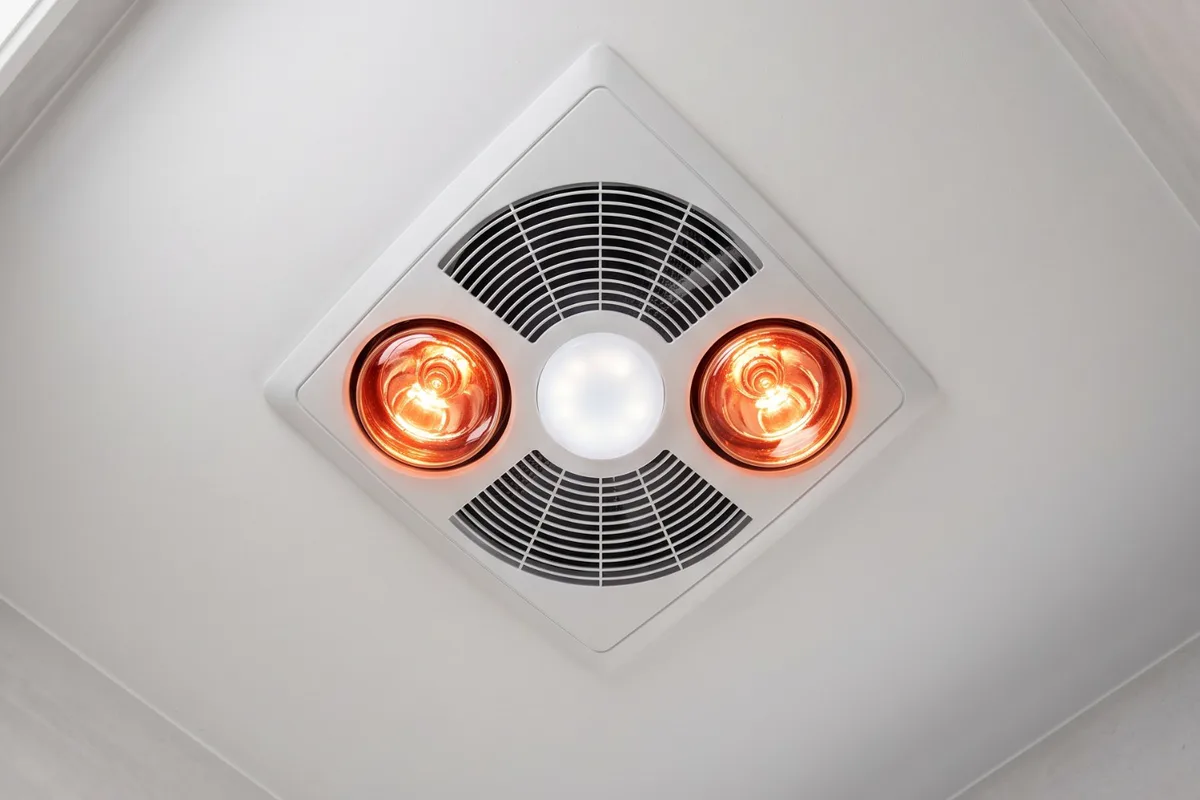
- Heat lamps give instant warmth to whoever stands under them, best in small rooms and quick showers.
- Fan heaters, in a 3-in-1 or on the wall, warm the room air and suit family or larger bathrooms.
- A heated towel rail dries towels but won't warm a cold room on its own.
- Whatever heats the room, the exhaust fan still has to vent outside.
You, the room or the towel?
Bathroom heaters do three different jobs. Some warm you directly while you stand under them, some warm the air in the room, and some mostly warm and dry the towels. On a July morning, when Laverton's mean minimum is 5.2 °C and the tiles are cold underfoot, the right choice depends on which of those you actually need.
Think about who uses the room and how. A quick shower before work is a different job from bathing a toddler, or helping an older parent who takes their time drying and dressing. The answer for a small ensuite is rarely the answer for the family bathroom.
Heat lamps: instant warmth for you
Infrared heat lamps warm whatever they shine on, much like stepping into sunshine. They feel warm within seconds, need no warm-up and suit a quick shower in a small room. Most come as part of a 3-in-1 ceiling unit with a light and an exhaust fan.
The downside is that they warm you, not the room. Step out from under them and the air is still cold, and in a large bathroom much of the heat lands on the floor and vanity. They're bright, which some people don't love first thing, and they draw a lot of power while on, although most people only run them for a few minutes.
Fan heaters: warming the room itself
A fan heater, in a 3-in-1 ceiling unit or mounted on the wall, blows air over a heating element and warms the room. It takes a few minutes to lift the temperature, but then the whole room is comfortable, including the corner where you dry off and dress. That suits family bathrooms and anyone who spends more than a few minutes in there.
A wall heater usually puts out more heat than a ceiling unit and delivers it at body height. Positions near the shower and bath are restricted under the Wiring Rules, so the electrician will tell you where one can go. Like any element heater, it turns one unit of electricity into about one unit of heat, so use it on a timer or switch it off on the way out.
Heated towel rails: dry towels, not a warm room
A heated towel rail keeps towels warm and dry, which helps in a damp bathroom and stops that musty towel smell. It's a gentle, low-power heat source that can run on a timer for an hour or two morning and evening. A hardwired rail on its own switch or timer looks tidier than a plug-in one and frees up the power point.
What it won't do is warm a cold room on a July morning, because most rails give off too little heat. Treat a towel rail as an extra alongside a heater, not a replacement for one.
What we'd fit, room by room
Our rule of thumb: heat lamps for speed in small rooms, fan heat for comfort in bigger or busier ones, and a towel rail as the finishing touch.
Whatever heats the room, the exhaust fan still needs to be ducted outside rather than into the roof space, or the moisture ends up in your ceiling.
- Small ensuite, quick showers: a 3-in-1 with heat lamps
- Family bathroom, longer use: a 3-in-1 with a fan heater, or a wall heater with a separate exhaust fan
- Large bathroom or high ceiling: a wall heater at body height plus a separate exhaust fan
- Damp bathroom, musty towels: add a heated towel rail on a timer to whichever heater suits
The electrical side
Heaters are the heaviest load in most bathrooms. Depending on the unit and what else the bathroom circuit carries, a new heater may need its own circuit from the switchboard, so we check before installing. Heat, light and fan go on separate switches, so nobody runs the heater just to get some light.
If the house also has a gas heater, Energy Safe Victoria advises against running bathroom exhaust fans while it's on, because the negative pressure can draw carbon monoxide into living spaces. Bathroom heaters are a job for a licensed electrician, and a Certificate of Electrical Safety is issued when the work is done.
Questions that come next
Sources for this article
4 sources, with the date each was checked
- 1.Bureau of Meteorology: Mean minimum temperature (°C) 14.0 14.4 12.7 10.0 7.8 5.9 5.2 5.7 6.8 8.4 10.3 12.2 9.5 81 1943 2026 Accessed 30 September 2026.
- 2.Energy Rating (GEMS Regulator / DCCEEW): Reverse cycle air conditioners are much more efficient at heating than standard electric heaters (bar heaters, convection, or radiant heaters). ... During the normal operating range in Australia for every unit of… Accessed 30 September 2026.
- 3.Energy Safe Victoria: Don’t use kitchen rangehoods or bathroom exhaust fans at the same time as your heater. It can create a negative pressure environment, drawing carbon monoxide into living spaces. Accessed 30 September 2026.
- 4.Energy Safe Victoria: Whenever a licensed electrician completes any electrical installation work, they must provide a Certificate of Electrical Safety (COES). Accessed 30 September 2026.