
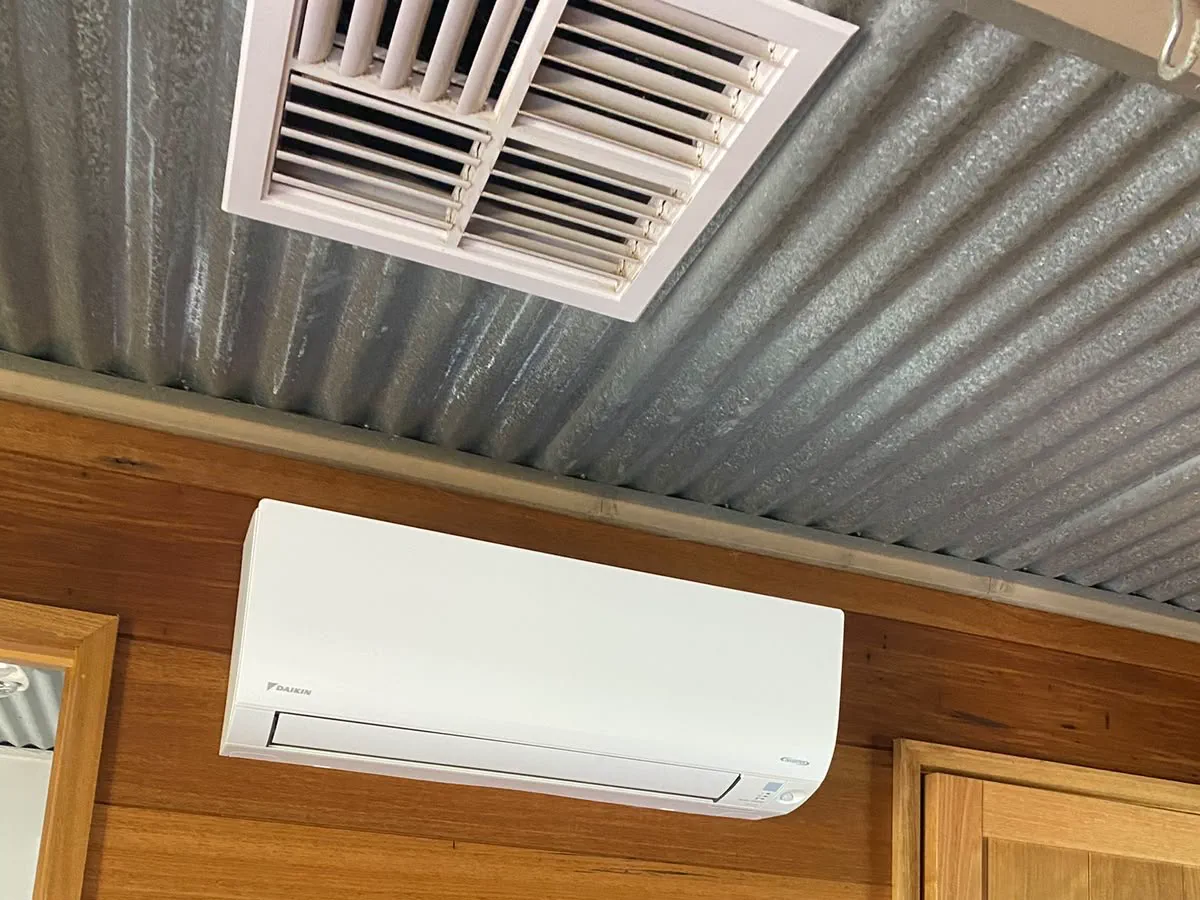
Will a split system be too noisy in my bedroom?
- Compare indoor noise ratings at the lowest fan speed, between units of similar capacity.
- An undersized unit runs flat out for hours, which is when it's loudest.
- Aim the airflow across the room, not at the pillow, and turn swing off at night.
- Keep the outdoor unit away from bedroom windows, yours and the neighbours'.
The short answer
A well-chosen, well-installed split system is quiet enough for most bedrooms. At low fan speed a modern indoor unit makes a soft rush of air that most people stop noticing within a night or two. Where people do lose sleep, it's usually one of four things: a unit too small for the room, a head aimed at the bed, an outdoor unit under a window, or a fault that has crept in since installation.
If you're a light sleeper, each of those can be planned for before the unit goes on the wall.
Reading the noise ratings
Split systems on the Zoned Energy Rating Label carry separate noise ratings for the indoor and outdoor units. For a bedroom, the indoor figure matters most. Spec sheets often list several figures for different fan speeds, so compare the lowest-speed or quiet-mode figure between models of the same capacity.
Decibels don't add up in a straight line, and a difference of a few can be noticeable in a quiet room at night. Don't fixate on the brochure, though. Ratings are measured in controlled conditions, and sizing, placement and installation make as much difference in a real bedroom.
An undersized unit is a noisy unit
An undersized split runs at high speed for hours to keep up, which is exactly when it's loudest. On a hot night when the roof is still radiating the afternoon's heat, a unit too small for an upstairs bedroom will roar into the early hours. A correctly sized inverter unit reaches the set temperature, then settles at low speed and stays there.
Going much bigger isn't the answer either, because an oversized unit can cycle on and off and leave the room clammy. Ask for the room to be sized properly, taking in the ceiling height, glazing, orientation and whether it's upstairs.
Placement and airflow direction
Put the head where its air reaches the room without landing on the bed. Above the bedhead blowing towards the foot of the bed, or on a side wall throwing air along the ceiling, usually works better than the wall facing the pillow. A head directly opposite the bed sends both sound and a cold draught straight at your face.
Once it's in, use the settings. Point the louvres up or across rather than down at the bed, and turn swing off at night, because air sweeping back and forth across the bed can wake light sleepers. Quiet and sleep modes cap the fan speed, and many sleep modes ease the set point through the night.
The outdoor unit matters too
The compressor and the big fan live in the outdoor unit, and a badly placed one can be louder in the bedroom than the indoor head. The usual problems are a unit directly below a bedroom window, bolted to a lightweight wall that resonates, or squeezed into a narrow side passage where sound bounces between walls. On tight estate blocks it can end up a few steps from a neighbour's bedroom too.
Mount it on solid ground or a sturdy bracket with anti-vibration mounts, with room to breathe, away from bedroom windows. A longer pipe run to a better spot is often worth it. If several bedrooms need heads, a multi-head system runs them all from one outdoor unit, leaving only one compressor to place carefully.
When a quiet unit gets noisy
A unit that used to be quiet and isn't any more is telling you something. Dirty filters cut airflow and make the fan work harder; the Victorian Government suggests cleaning the dust filters about twice a year, or more often with heavy use. Rattles, clicks, gurgling or a new hum can point to a loose panel, a drain problem, a worn fan or a bracket that has shifted.
Clean the filters first. If the noise is still there, book a service rather than learning to sleep through it, because small noises tend to grow.
Questions that come next
Sources for this article
3 sources, with the date each was checked
- 1.Energy Rating (GEMS Regulator / DCCEEW): On the right of the label after the stars, is the estimated annual energy use or power input in kilowatt hours (kWh) displaying cooling in blue (top number) and heating in red for each climate zone. ... Products are… Accessed 30 September 2026.
- 2.Energy Rating (GEMS Regulator / DCCEEW): Dirty filters significantly reduce the amount of airflow and the energy efficiency of the unit. It can also impact the effectiveness of its heating. Cleaning clogged filters, or replacing a worn one, can lower the… Accessed 30 September 2026.
- 3.Solar Victoria (updated 20 November 2025): Check the manufacturer’s instructions or manual and have the air conditioner serviced regularly at the recommended frequency to ensure it continues to operate efficiently. Cleaning the filters regularly helps the system… Accessed 30 September 2026.