
The key points
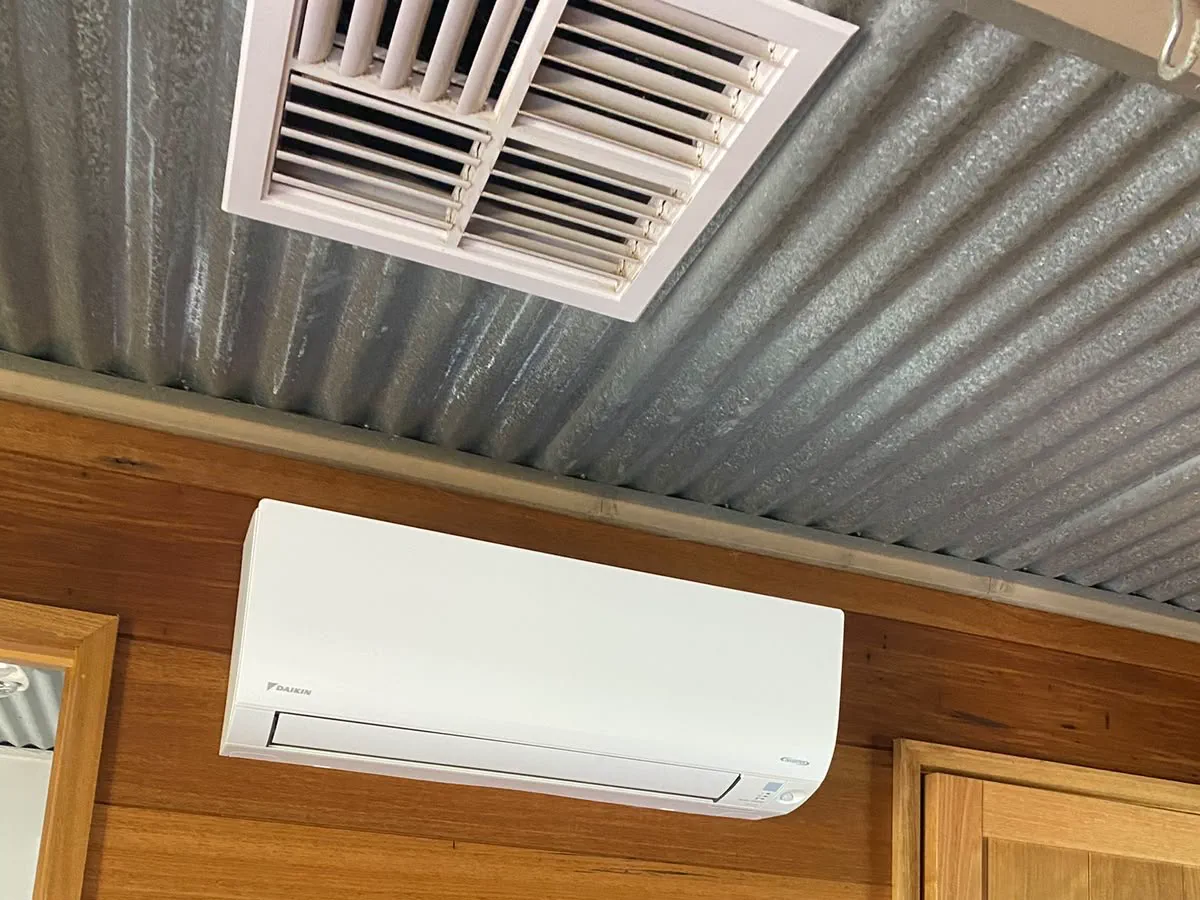
- Mount the head high, on a wall that lets it throw air along the longest open line of the room.
- Keep the airflow off where people sit and sleep: across the room or above the bed head, not straight at the pillow or couch.
- Place it for heating as well as cooling, with room for the louvres to aim warm air down to the floor.
- The drain decides more than people expect. It needs a steady fall to outside, or a condensate pump.
- Leave room to lift the cover and clean the filters from a step stool.
How a wall head moves air
A split system head draws room air in through the grille on top, passes it over the coil and blows it out of the bottom through adjustable louvres. The air travels in a long stream across the room, then mixes and makes its way back to the top of the unit.
That gives two rules. The head needs space above it to breathe, so it can't be tucked tighter under a ceiling, cornice or bulkhead than the manufacturer allows. And the air needs an open path: a head blowing into a tall wardrobe, a pendant light or a bookcase two metres away will never treat the far end of the room.
In most rooms, the best wall lets the head blow along the room's longest open dimension, towards where people spend time but not straight at them.
Living rooms and open plan spaces
In a lounge, place the head so the air crosses the room above the couch rather than hitting the back of someone's head. A side wall blowing across the seating usually works better than the wall directly behind it or facing it.
In an open plan space, aim the air into the area you use most, often the family room, and let the kitchen and dining area pick up the mixed air. A head blowing straight down a hallway or through a doorway sends your heating and cooling elsewhere and leaves the room it was bought for short.
Keep the head away from the cooktop and rangehood, where cooking grease coats the coil, and from directly above the TV, where a drip from a blocked drain lands on the screen.
Bedrooms: keep it off the pillow
The classic mistake is a head on the wall facing the bed, blowing air onto the pillow all night. Better spots are above the bed head, where the air is thrown away from the sleeper and mixes before it comes back, or a side wall blowing across the foot of the bed.
Think about indoor noise as well. Split systems carry an indoor noise rating on the Zoned Energy Rating Label, and most are quiet on low fan, but a head right above a light sleeper still gets noticed. Low or quiet fan overnight helps.
In children's rooms, allow for a bunk bed or a tall wardrobe later. A head that ends up blowing straight into the top bunk is a common complaint.
Place it for heating, not just cooling
Cool air sinks, so cooling from a high wall head spreads well. Warm air rises, so in heating the same head has to push air down to the floor against its natural tendency. Victorians typically use more energy for heating than cooling, so placement should suit winter as much as summer.
Choose a wall that lets the louvres angle down into the room without hitting furniture first. Tall rooms, like those in the older cottages of Williamstown, Newport and Yarraville, let warmth gather up high; a floor console under a window, or a ceiling fan on low in its winter direction, can help.
The head reads the temperature where it sits, near the ceiling, where winter air is warmest. If the room still feels cold when the controller says it's at temperature, a remote-sensor or 'follow me' setting measures the air where you sit instead.
Pipe, drain and cable routes
Every head needs a pair of refrigerant pipes, a cable to the outdoor unit and a drain for the water it makes in cooling. The simplest install puts the head on an external wall with the outdoor unit behind it, so everything goes straight through.
The drain needs a steady fall all the way outside or to a drain point. A head on an internal wall, or one whose pipes must climb before leaving the room, usually needs a small condensate pump, which is one more part to maintain and makes a faint noise. Brick veneer and double brick walls need a core hole through the brick, and outside the pipes are best run in a cover duct to the outdoor unit.
The cable between head and outdoor unit isn't a DIY job. Energy Safe Victoria has classed the wiring between a split system's indoor and outdoor units as installation wiring, and air conditioning is non-prescribed electrical work, so the electrician completes a Certificate of Electrical Safety and gives you a copy within 30 days.
- An external wall, with the outdoor unit's spot behind or close by
- A clear path for the drain to fall to outside
- Studs or solid fixing for the mounting plate
- No hidden cables, water pipes or gas lines where the pipe hole goes
- Space beside and above the head for its cover and airflow
Living with it: filters, windows and looks
The Victorian Government suggests cleaning the dust filters about twice a year, more often with heavy use. Put the head where you can lift the front cover from a step stool, not above a staircase or behind a fixed bunk.
Above a window is a common spot in brick veneer homes. Check there's enough wall between the top of the frame and the ceiling for the head and its clearances, and that curtains or a pelmet won't block its air.
On looks, a head on the wall you see least from the couch often sits better than one centred on the feature wall, and a spot that works beats a symmetrical one. If no wall suits, a floor console or a bulkhead unit may be the better answer for that room.
Common questions
Quick answers
- Can one reverse-cycle air conditioner meet both rental heating and cooling standards?Yes.
- What is the switch next to my outdoor unit for?It's an isolating switch that cuts all power to the air conditioner, so a technician can work on the system safely without relying on the switchboard.
- My rental has no fixed heater in the living area. Is that allowed?No.
- What happens if the heater in my rental breaks after March 2027?If it can be repaired, it's repaired as an urgent repair, as it is now.
Sources for this guide
7 sources, with the date each was checked
- 1.Energy Rating (GEMS Regulator / DCCEEW): On the right of the label after the stars, is the estimated annual energy use or power input in kilowatt hours (kWh) displaying cooling in blue (top number) and heating in red for each climate zone. ... Products are… Accessed 30 September 2026.
- 2.Department of Energy, Environment and Climate Action (energy.vic.gov.au), page last updated 14/04/25: Victorians typically use more energy for heating than cooling, so look for a unit with a higher heating efficiency. Accessed 30 September 2026.
- 3.Energy Safe Victoria (Industry alert, issued June 2017): The wiring installed between the outside unit and the indoor unit is classified as installation wiring and shall comply with the conductor insulation colours as specified in Table 3.4 of AS/NZS 3000:2007. Accessed 30 September 2026.
- 4.Energy Safe Victoria: 'Prescribed' certificates are for electrical installation work that requires inspection by a Licensed Electrical inspector. This includes (but is not limited to): Consumer mains cables, main switchboard, meter box and… Accessed 30 September 2026.
- 5.Solar Victoria (updated 20 November 2025): Check the manufacturer’s instructions or manual and have the air conditioner serviced regularly at the recommended frequency to ensure it continues to operate efficiently. Cleaning the filters regularly helps the system… Accessed 30 September 2026.
- 6.Department of Climate Change, Energy, the Environment and Water (DCCEEW): It's illegal to release regulated refrigerants into the air. This is because some refrigerants can stay in the atmosphere for decades or more and can be thousands of times worse for climate change than carbon dioxide… Accessed 30 September 2026.
- 7.Australian Refrigeration Council (ARC): NO. If the refrigerant is contained in equipment, such as a split system air conditioner, a Refrigerant Trading Authorisation is not required. However a refrigerant handling licence is required to install this type of… Accessed 30 September 2026.
Planning advice for homeowners. Installation requirements depend on the property and equipment. Where this guide refers to Victorian safety or rental rules, use the linked official guidance for the current requirements.