
Is it cheaper to leave my air conditioner running all day or turn it on when I get home?
- Holding a cool or warm house against the weather all day usually costs more than a timed catch-up.
- Inverter efficiency narrows the gap but rarely reverses it.
- Very hot northerly days are the exception: start earlier so the house doesn't heat-soak.
- On frosty winter mornings, give a reverse-cycle unit extra lead time for defrost pauses.
The short answer: usually not
For most homes, running the air conditioner all day while nobody's there costs more than switching it on shortly before you get home. That holds for modern inverter systems too, summer and winter. Heat moves through the roof, walls and glass faster the bigger the gap between inside and outside, so holding a cool or warm house against the weather for eight empty hours means paying for that gap the whole time.
Let the house drift while you're out and the gap shrinks, so less heat moves through the building. The system then has some catching up to do, but in most homes the catch-up uses less energy than holding the temperature all day.
Where the 'leave it on' idea comes from
The idea isn't baseless. Inverter units are most efficient running steadily at low output and less efficient flat out, so a unit switched on into a hot house works hard for a while, which feels expensive. And on extreme days, a house that has been left to bake can be more than the system can pull down by bedtime.
Those points narrow the gap; they rarely reverse it. The answer to them is timing rather than all-day running: start the system early enough that it's working at a sensible pace before the house is fully heated through.
In summer
On ordinary warm days, use the timer or app to start cooling half an hour to an hour before you get home, at 24 to 26 °C. The Victorian Government says each degree beyond its suggested ranges adds around 10% to running costs, so the set point matters more than the start time.
Hot northerly days are the exception. Laverton averages 9.4 days a year at or above 35 °C, mostly December to February. On those days, start well before the afternoon peak, or hold a moderate set point from late morning, so the house never heats past what the system can handle. Close the blinds and windows before you leave.
In winter
Victorians typically use more energy for heating than cooling, so winter habits matter more to the bill. Let the house cool while you're out and overnight, and set the timer to start heating before you wake or arrive, at 18 to 20 °C.
Laverton's July mean minimum is 5.2 °C, and in the cold, frosting conditions below 5.5 °C, a reverse-cycle unit pauses now and then to defrost its outdoor coil. Give it a longer lead time on frosty mornings so the house is warm when you get up, rather than still catching up.
What changes the answer
Your house and routine can tip the balance one way or the other.
Age matters too. The Victorian Government says a reverse-cycle system more than 15 years old will typically use more than three times the energy of a modern one, so with a unit that old, how you run it matters less than whether it's time to replace it.
- Someone home during the day, such as a baby, an older parent or pets on a hot day
- Insulation and glazing: a well-insulated house holds its temperature longer, narrowing the difference
- West-facing glass: rooms that bake in the afternoon may need cooling started earlier
- An older fixed-speed unit, which can't idle gently and suits short, timed runs even more
- Zoning: on ducted systems, running only the rooms you'll use beats either approach for the whole house
Set a schedule and stop thinking about it
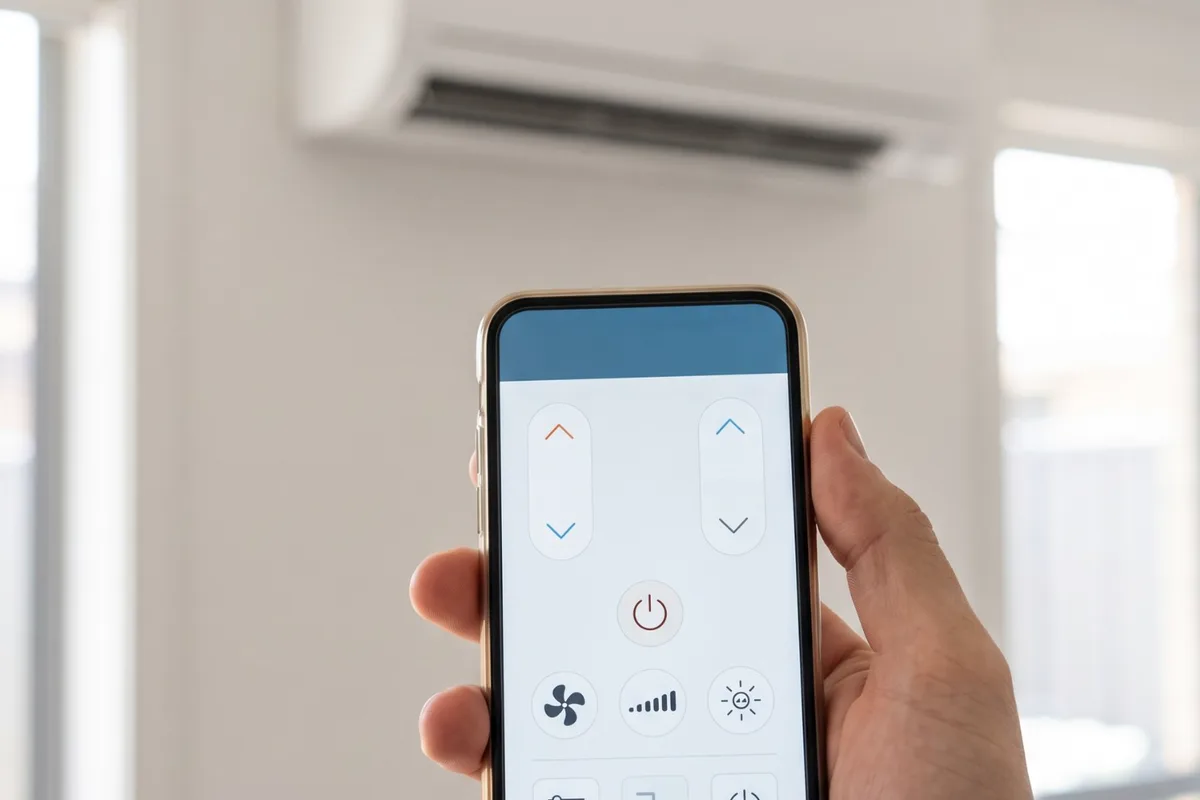
The easiest way to get this right is a schedule. Most current units have a built-in timer, and the maker's Wi-Fi adapter or controller lets you adjust it from your phone when plans change. We can set up schedules room by room, so the house is comfortable when you arrive without anyone remembering to press a button.
Keep the filters clean as well. Dirty filters cut airflow and efficiency, which costs you whichever approach you choose.
Questions that come next
Sources for this article
6 sources, with the date each was checked
- 1.Solar Victoria (updated 20 November 2025): To heat a room, try setting the temperature between 18°C to 20°C. Every 1°C higher will add around 10% to your heating bill. Set your air conditioner thermostat for cooling between 24°C and 26°C for living areas – every… Accessed 30 September 2026.
- 2.Bureau of Meteorology: Mean number of days ≥ 30 °C 6.9 6.0 4.5 0.7 0.0 0.0 0.0 0.0 0.1 0.9 2.8 5.1 27.0 82 1943 2026 Mean number of days ≥ 35 °C 3.6 2.4 0.9 0.0 0.0 0.0 0.0 0.0 0.0 0.1 0.5 1.9 9.4 Accessed 30 September 2026.
- 3.Department of Energy, Environment and Climate Action (energy.vic.gov.au), page last updated 14/04/25: Victorians typically use more energy for heating than cooling, so look for a unit with a higher heating efficiency. Accessed 30 September 2026.
- 4.Commonwealth of Australia (2019), hosted on energyrating.gov.au: In the Cold zone the heating function is used much more than the cooling function and the performance of the air conditioner in frosting conditions (below 5.5°C) is critical in determining the overall performance of the… Accessed 30 September 2026.
- 5.Solar Victoria (updated 2 October 2025): A system that is more than 15 years old for example will typically use more than three times the amount of energy than a modern reverse-cycle air conditioner. Accessed 30 September 2026.
- 6.Energy Rating (GEMS Regulator / DCCEEW): Dirty filters significantly reduce the amount of airflow and the energy efficiency of the unit. It can also impact the effectiveness of its heating. Cleaning clogged filters, or replacing a worn one, can lower the… Accessed 30 September 2026.