
Are DIY split system cleaning kits safe and worth using?
- Washing the filters is genuine owner maintenance and worth doing about twice a year.
- Foaming coil sprays only reach the front of the coil. They don't touch the fan barrel, where black specks and musty smells usually start.
- Bag kits put a lot of water near the control board and can overflow a drain that's already partly blocked.
- In Victoria, maintenance of a split system is regulated as a class of plumbing work, a good reason to leave anything past the filters to a service.
What the kits actually are
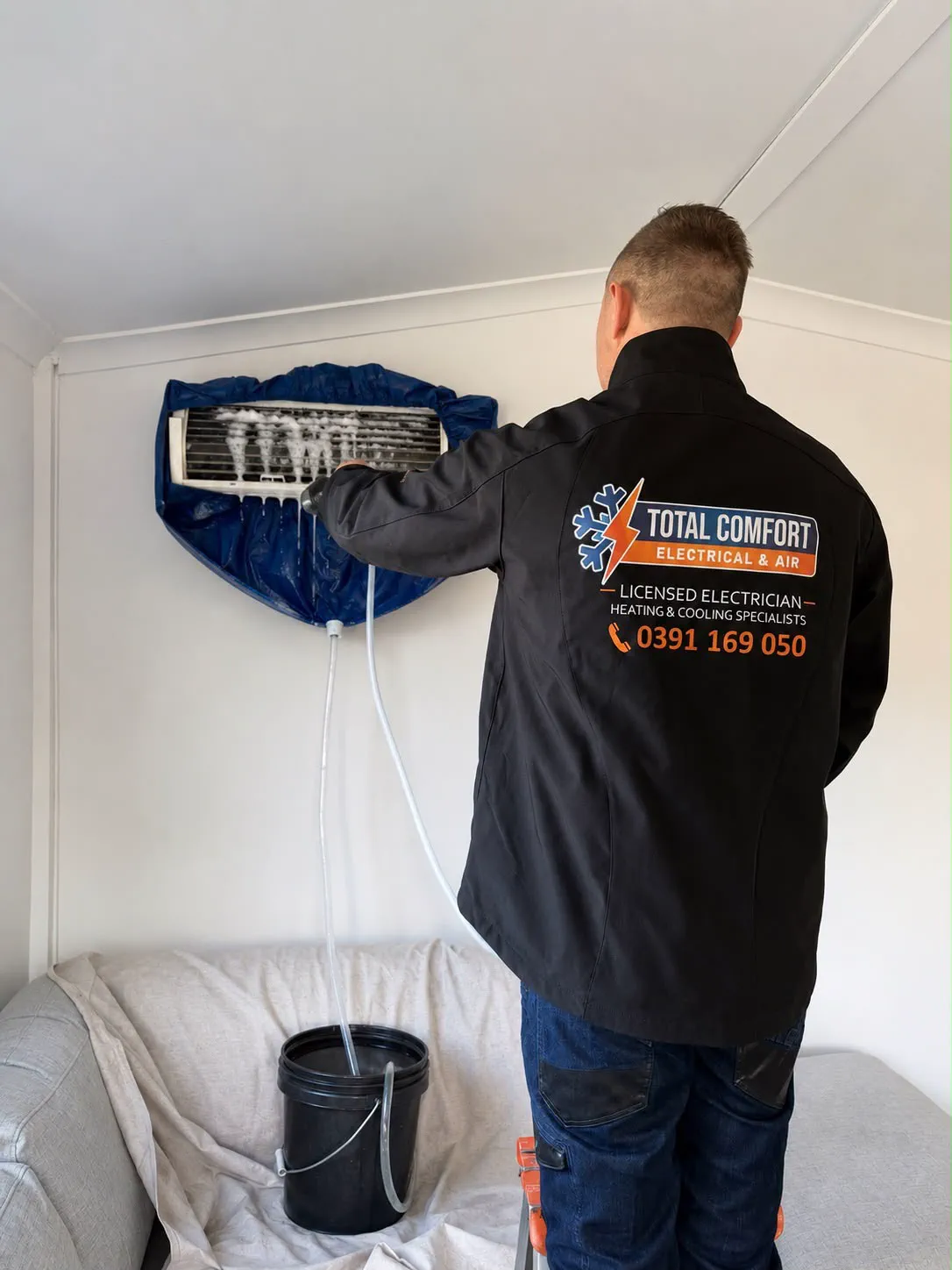
There are two main types. Spray cans of foaming coil cleaner are sprayed onto the indoor coil behind the filters, and the foam is meant to lift grime and drain away through the unit's drain. Bag kits are a plastic catch bag that hangs under the indoor unit, with a pump sprayer used to wash the coil and fan while the dirty water runs into the bag.
A bag is also what a technician uses during a service. The difference is what goes on around it: the unit isolated, electronics protected, the drain checked, the fan barrel cleaned properly, and the system run and tested afterwards.
What a spray can reaches, and what it doesn't
Behind the filters, a spray reaches the front face of the coil. That's the easy part, and a lightly dusty coil may look better afterwards. What it doesn't reach is the fan barrel, the long cylindrical fan below the coil, or the drain tray beneath it. Those are where mould and grime build up, and where black specks and a musty smell usually come from.
The foam and loosened grime have to go somewhere. In a unit whose drain is already partly blocked, a can of foam can be enough to overflow the tray and send dirty water down the wall. Some cleaners also leave a scent that masks a smell for a few days without removing its source.
The risks with bag kits
A bag kit uses far more water, and on most indoor units the control board and display electronics sit right beside the coil. Water sprayed at the wrong angle, or a bag that sags and spills, can reach parts that don't tolerate it. Covers held on with screws shouldn't come off, and turning the unit off with the remote doesn't isolate it.
Then there's the drain. A coil wash pushes a lot of water and debris through the tray in a short time. A kinked hose, a partly blocked outlet or a drain with too little fall overflows into the room, sometimes days later when the system next runs in cooling.
Where owner cleaning stops
Filter cleaning is the part worth doing yourself. The Victorian Government suggests cleaning the dust filters on a reverse-cycle air conditioner about twice a year, or more often with heavy use, and having it serviced at the frequency the manufacturer recommends. Dirty filters significantly cut airflow and efficiency, so a clean filter is the cheapest performance gain there is.
Past that, the rules are worth knowing. Victoria's Plumbing Regulations class the maintenance of refrigerated air-conditioning equipment, including any part of a single-head split system, as refrigerated air-conditioning work, a class of plumbing work. That's one reason we treat the coil, fan barrel, drain and electrics as service work rather than a DIY job.
- Owner work: washing filters, wiping the front panel, keeping the outdoor unit clear of leaves and plants
- Service work: coil and fan barrel cleaning, drain flushing and flow testing, electrical checks and any refrigerant work
When a professional service is worth it
Black specks, mustiness at start-up or a unit that seems weaker than it used to won't be fixed by a spray can. Those signs point to a dirty fan barrel, coil or drain tray. A proper service cleans all three, checks the drain flows, looks over the electrical connections and isolator, and runs the system in heating and cooling.
Small faults cost more than people expect. Federal bench tests found common faults in air conditioning equipment caused average energy losses of 14% to 20% in most tests. A service that catches a slow drain or a tired fan before summer is better value than a kit that hides the symptoms.
Questions that come next
Sources for this article
4 sources, with the date each was checked
- 1.Solar Victoria (updated 20 November 2025): Check the manufacturer’s instructions or manual and have the air conditioner serviced regularly at the recommended frequency to ensure it continues to operate efficiently. Cleaning the filters regularly helps the system… Accessed 30 September 2026.
- 2.Energy Rating (GEMS Regulator / DCCEEW): Dirty filters significantly reduce the amount of airflow and the energy efficiency of the unit. It can also impact the effectiveness of its heating. Cleaning clogged filters, or replacing a worn one, can lower the… Accessed 30 September 2026.
- 3.Building and Plumbing Commission (Victorian Building Authority, trading as the Building and Plumbing Commission): Under Part 4 of the Plumbing Regulations 2018, Refrigerated Air-conditioning work is: The construction, installation, replacement, repair, alteration, maintenance, testing or commissioning of refrigerated… Accessed 30 September 2026.
- 4.energy.gov.au (Australian Government, DCCEEW): The findings indicated that on average there were energy losses between 14% and 20% across most tests. When several faults co-existed, energy use increased substantially, with a high likelihood of system failure if… Accessed 30 September 2026.