
The key points
- Choose the hood style around your layout: canopy on a wall, undermount or slide-out in cabinetry, island or ceiling hoods over an island.
- The duct route decides how well any hood works. Short, straight and full-size beats a bigger motor every time.
- Ducted hoods should vent outside, never into the roof space.
- Recirculating hoods filter grease and smells but return steam to the room. They're the fallback when there's no way out.
- If the home has a gas heater, think about how the hood and heater are used together.
Hood styles and where they suit
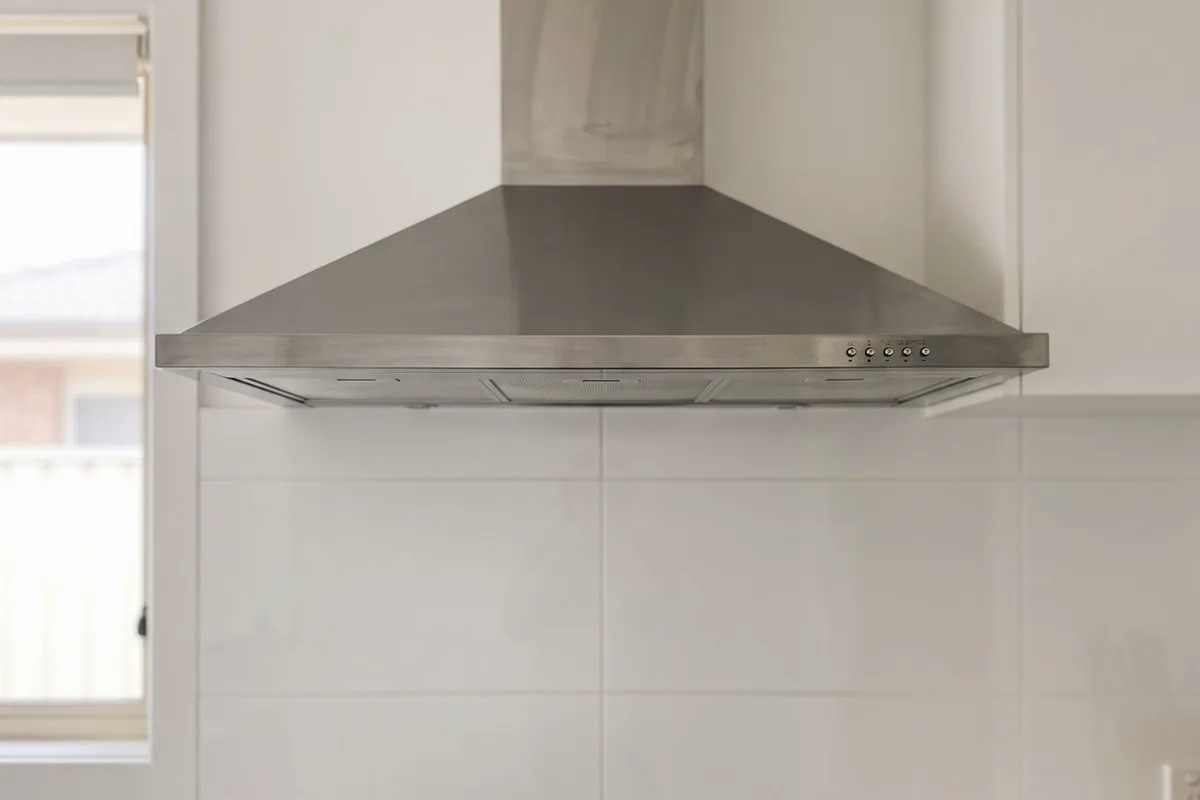
Canopy hoods mount on the wall above the cooktop, with a chimney cover hiding the duct. They're usually the easiest to duct and among the most effective, because the wide canopy catches what rises.
Undermount hoods sit inside a cupboard above the cooktop, and slide-out hoods pull forward when you cook. Both keep the kitchen clean-lined, but most of the cupboard above goes to the hood and duct. Ceiling hoods sit flush in the ceiling over an island, out of the sightline, but their distance from the pots means they need more airflow for the same result.
Island canopies hang from the ceiling over an island cooktop. They need solid fixing above the plaster, power from the ceiling and a duct route through the roof space, so they're a decision for the design stage.
Extraction capacity in plain terms
Hoods are rated by how much air they move, usually in cubic metres per hour. Higher isn't automatically better. The figure is measured in ideal conditions, and real performance depends on the duct, the height above the cooktop and how easily replacement air can get back into the house.
Match the hood to how you cook. Wok cooking, frying and an open-plan kitchen ask more of a hood than light cooking in a closed kitchen. A hood at least as wide as the cooktop catches more than a powerful narrow one.
Noise rises with airflow, and the top speed is always the loudest. A hood that does the job on a middle speed is easier to live with than a bigger one that has to run flat out.
The duct route matters more than the motor
Every bend, every step down from the hood's outlet size and every sag in a flexible duct cuts airflow. A powerful hood on a long, kinked duct performs like a cheap one, and most hood noise is air fighting through the duct. Keep the run short and straight, at the full outlet size, with smooth-walled duct where you can.
The duct should end outside, through the roof with a proper cowl or through an external wall with a grille and a backdraught flap. Venting into the roof space leaves steam to condense on timbers and insulation, lets grease build up and sends the smell back into the house.
In a single-storey home with roof space, the roof is usually the easiest way out. In a double-storey home, a ground-floor kitchen has a floor above, so the duct may need to run through a bulkhead to an outside wall. That route is why the hood belongs on the drawings, not in the last week of the build.
When a recirculating hood makes sense
A recirculating hood draws air through grease filters and a charcoal filter, then returns it to the kitchen. It takes out some grease and odour, but not the steam or heat, so windows can fog and moisture stays in the room.
It's the right answer when there's genuinely no duct route: an apartment kitchen with no external wall, a heritage limit on roof penetrations, or an owners corporation that won't approve a new outlet. Replace the charcoal filters as often as the maker says, or the hood does little.
Rangehoods and gas heaters
If the home still has a gas heater, a strong rangehood matters for safety as well as comfort. Energy Safe Victoria advises against running kitchen rangehoods or bathroom exhaust fans while a gas heater is on, because the negative pressure can draw carbon monoxide into living spaces.
Energy Safe Victoria also says open-flued gas heaters can spill carbon monoxide more easily than other types. If a bigger hood is going into a home with one, have the heater checked by a licensed gasfitter, and plan not to run the two together.
Power point, height and width
Most rangehoods plug into a power point inside the canopy chimney or the cupboard above. The manual says where it should be, usually inside the hood's cover so no lead shows. Fitting that point, or a hardwired connection where the hood calls for one, is licensed electrical work. The hood normally runs from a nearby power circuit, not the cooktop's dedicated circuit.
Every manual sets a minimum and maximum height above the cooktop, and gas usually needs more clearance than electric or induction. Too low is a heat and fire risk; too high and the steam escapes before the hood catches it. Match the cooktop's width or go wider, never narrower.
Some hoods use a remote motor mounted in the roof space to take noise out of the kitchen. It needs its own power and service access, so plan both.
A planning checklist for your kitchen
Settle the hood before the cabinet drawings are final. The cupboard above, any bulkhead, the splashback and the power point all depend on it. Send us the model and a photo or plan of the kitchen, and we can check the duct route and power position before you order.
Every electrical connection for the hood comes with a Certificate of Electrical Safety, as all electrical installation work must.
- Hood style to suit a wall, cabinetry or island cooktop
- Width equal to or wider than the cooktop
- Mounting height within the manual's range for gas or electric
- A duct route outside, at full outlet size, with as few bends as possible
- Power point position inside the canopy or cupboard
- Recirculating filters if there's no duct route
- Any gas heater in the home, and how the two will be used
Common questions
Quick answers
- Why does my oven trip the power when I turn it on?Most often an oven element has failed or taken in moisture, and current is leaking to earth, which trips the safety switch.
- Can a power point be added to my kitchen island?Usually, yes.
Sources for this guide
2 sources, with the date each was checked
- 1.Energy Safe Victoria: Don’t use kitchen rangehoods or bathroom exhaust fans at the same time as your heater. It can create a negative pressure environment, drawing carbon monoxide into living spaces. Accessed 30 September 2026.
- 2.Energy Safe Victoria: Whenever a licensed electrician completes any electrical installation work, they must provide a Certificate of Electrical Safety (COES). Accessed 30 September 2026.
Planning advice for homeowners. Installation requirements depend on the property and equipment. Where this guide refers to Victorian safety or rental rules, use the linked official guidance for the current requirements.