
The key points
- Pick one colour temperature for each space and stick to it. Mixing warm and cool white in one room is the most common regret.
- Beam angle changes how a room feels: wider beams wash a room evenly, narrower ones put light where you aim it.
- Compare lumens, not watts. Watts tell you the power drawn; lumens tell you the light you get.
- Measure the existing cut-out before ordering, and choose an IC-rated fitting wherever insulation is or will be laid.
- Check the dimmer and driver suit each other before buying. Most flicker and buzz complaints start there.
A complete fitting, not just a globe
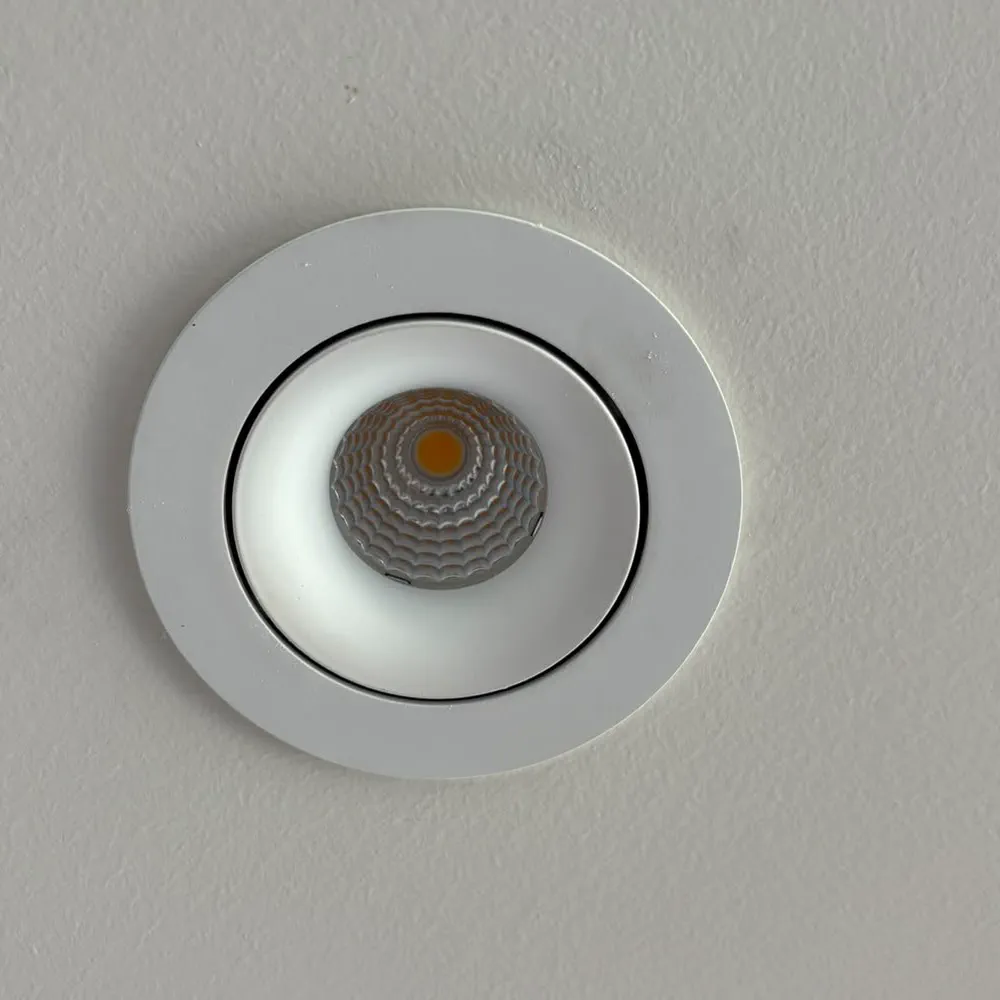
Modern LED downlights are usually a complete unit: the light, its trim and a driver that powers it, installed as one. The old halogen setup was different, with a separate globe in a fitting and a transformer lying in the roof. An LED globe can go into an old halogen fitting, but that keeps the old fitting, the old transformer and often the old heat problem.
This guide is about choosing the fitting itself. The heat and insulation side is covered in our guide to downlights, insulation and fire risk, and where lights go in each room is covered in the room-by-room lighting plan guide.
Colour temperature: warm, neutral or cool
Colour temperature is the tint of the white light, given in kelvin (K) on the box. Lower numbers are warmer and more yellow, closer to the old halogens. Higher numbers are cooler and bluer. Packaging usually adds a name such as warm white, cool white or daylight.
Warm white suits bedrooms, lounges and dining areas, where you want the room to feel relaxed at night. Cooler white suits laundries, garages and some kitchens where you want crisp light to work by. Many people choose warm white throughout and add task lighting, such as strip under the cabinets, where they need more.
Whatever you choose, keep each open space consistent. A kitchen in cool white running into a lounge in warm white looks like two different houses at night. If you're replacing a few lights, match the ones that stay, or do the whole room together.
Colour-selectable fittings
Many downlights now have a small switch on the driver or fitting to choose between two or three colour temperatures. That helps when you're unsure, or when you want the same fitting throughout the house but a cooler tint in the laundry. The switch is set at installation, so decide before the electrician leaves, or ask how easy it is to reach later.
Some fittings change colour from the wall switch or an app, stepping through settings each time you flick the switch. They suit people who like to tune the mood, but check how they behave with your dimmer and whether every fitting on the circuit changes together.
Beam angle, brightness and glare
Beam angle is how wide the cone of light spreads. A wider beam washes the room evenly with fewer dark patches between fittings, which suits general lighting in living areas and bedrooms. A narrower beam puts light where you aim it, which suits a bench, artwork or feature wall, but takes more fittings to light a whole room.
Brightness is given in lumens. Wattage tells you how much power the fitting draws; lumens tell you how much light comes out. Compare lumens between models, and remember that a high ceiling needs more light, or a narrower beam, to reach the floor.
Glare comes from seeing the bright LED directly. Fittings with the light set back inside the trim, or behind a diffuser, are more comfortable over sofas and beds. Tilting gimbal fittings let you aim light at a wall or bench, which is handy on raked ceilings.
Cut-out size and what's above the ceiling
The cut-out is the hole size the fitting needs, printed on the box in millimetres. When you're replacing old lights, measure an existing hole first. A fitting with a slightly larger cut-out means enlarging each hole neatly. A fitting with a smaller cut-out leaves a gap the trim won't cover, which means patching.
Check the height of the fitting too. Low-pitched roofs, tight extensions and ceilings with a floor above can leave little room, and a fitting with a tall driver may not fit. Ground-floor ceilings in double-storey homes have no roof space above, so cable routes and access need planning.
Wherever ceiling insulation is laid, or might be laid later, choose a fitting rated for insulation contact (IC). The rating is marked on the fitting and in its instructions, and it lets insulation run over the light within the maker's limits rather than leaving gaps.
Dimming without flicker or buzz
An LED downlight dims through its driver, so the driver and the wall dimmer have to suit each other. Many fittings are dimmable, but only with certain dimmer types, and the spec sheet or the maker's compatibility list says which. Old dimmers built for halogens are the usual cause of flicker, buzzing or lights that won't dim smoothly to low.
The number of fittings on one dimmer matters too. A dimmer has a minimum and a maximum load, and a few low-wattage LEDs can fall below the minimum while a long run can exceed the maximum. When you send us the fitting model and the count for each room, we match the dimmer to both.
Smart dimmers and app-controlled switches follow the same rule: compatibility first. If you want scenes or voice control, choose the dimmer and the fittings together.
A buying checklist
Use this list when comparing fittings, or send us the product links and we'll check them against your ceiling and switches before you order. If you're unsure about colour or glare, buy one sample and look at it in the room at night. Both are easier to judge in place than on a shop shelf.
Fitting LED downlights is licensed electrical work. A licensed electrician must provide a Certificate of Electrical Safety for it, and lights sit under the non-prescribed certificate.
- Colour temperature, or colour-selectable, matched across each space
- Beam angle to suit general or feature lighting
- Lumens compared between models
- Cut-out size against your existing holes
- IC rating wherever insulation is or will be laid
- Dimmable, and compatible with the dimmer you'll use
- Fitting height for tight ceiling spaces
Common questions
Quick answers
- One downlight has stopped working. Is it the globe or the fitting?Check whether it has a removable globe.
- Why do my LED lights buzz or hum?Most buzzing LEDs come from a mismatch rather than a fault: a dimmer built for old halogen globes, an LED driver that doesn't suit the dimmer, an old transformer left in…
- Why do my light globes keep blowing?Globes that fail early usually have help.
- Why has the ceiling around my light gone brown?A brown ring hugging the edge of a light is usually heat or dust.
Sources for this guide
3 sources, with the date each was checked
- 1.Energy Safe Victoria: Electrical work isn’t a DIY job, even for small jobs such as changing power points or light switches. Accessed 30 September 2026.
- 2.Energy Safe Victoria: Whenever a licensed electrician completes any electrical installation work, they must provide a Certificate of Electrical Safety (COES). Accessed 30 September 2026.
- 3.Energy Safe Victoria: For electrical installation work performed within your electrical installation including but not limited to lights, power points, air conditioning, hot water service etc. Accessed 30 September 2026.
Planning advice for homeowners. Installation requirements depend on the property and equipment. Where this guide refers to Victorian safety or rental rules, use the linked official guidance for the current requirements.