
What electrical problems are common in 1950s and 1960s homes in Melbourne's west?
- Altona, Laverton and parts of Newport grew quickly after the war, so many homes have wiring and switchboards from the 1950s and 1960s, added to over the decades.
- Common finds are rewireable fuses, no safety switches, tired cable in hot roof spaces, unearthed lighting and unlicensed additions.
- Old switchboard backing panels may contain asbestos. Look, but don't touch, drill or sand.
- Energy Safe Victoria says homes built before the 1980s should have their wiring checked before you move in.
- A safety check tells you what's there, so fixes can be planned in a sensible order instead of all at once.
Why the age of these suburbs matters
The Hobsons Bay Planning Scheme describes post-war industrial and residential growth as transforming Altona and Laverton, and Altona still has special character areas set aside to keep intact post-war brick and weatherboard homes with established gardens. In West Newport, the Housing Commission built a whole estate between 1945 and 1960. The result is a lot of local homes whose electrical bones are 60 to 80 years old.
That isn't automatically a problem. Plenty of these houses were rewired or had their boards replaced along the way. But many were added to in stages: a back room in the 1970s, a carport light, a split system, a kitchen renovation, each tapping into what was already there. Behind the walls you usually find a mix of eras, and the oldest part limits the rest.
What electricians commonly find
The same issues turn up again and again in homes of this age. Some are visible from the meter box; others only show when a fitting comes off or the wiring is tested.
Energy Safe Victoria's tell-tale signs of faulty wiring include old switchboards, particularly those without a safety switch, old or broken switches and power points, flickering lights and sparks from switchboards, switches or points. It advises owners of houses over 30 years old to have their wiring checked by a licensed electrician.
- Original switchboards with rewireable ceramic fuses, sometimes with heavier fuse wire fitted so they stop blowing
- No safety switches, or one covering the power points but not the lights
- Rubber-insulated or early plastic cable that has hardened in a hot roof space
- Lighting circuits with no earth, and metal fittings that aren't earthed
- Unlicensed additions: points spliced off old circuits, sheds run on extension leads, joints buried in walls
The switchboard and what it's mounted on
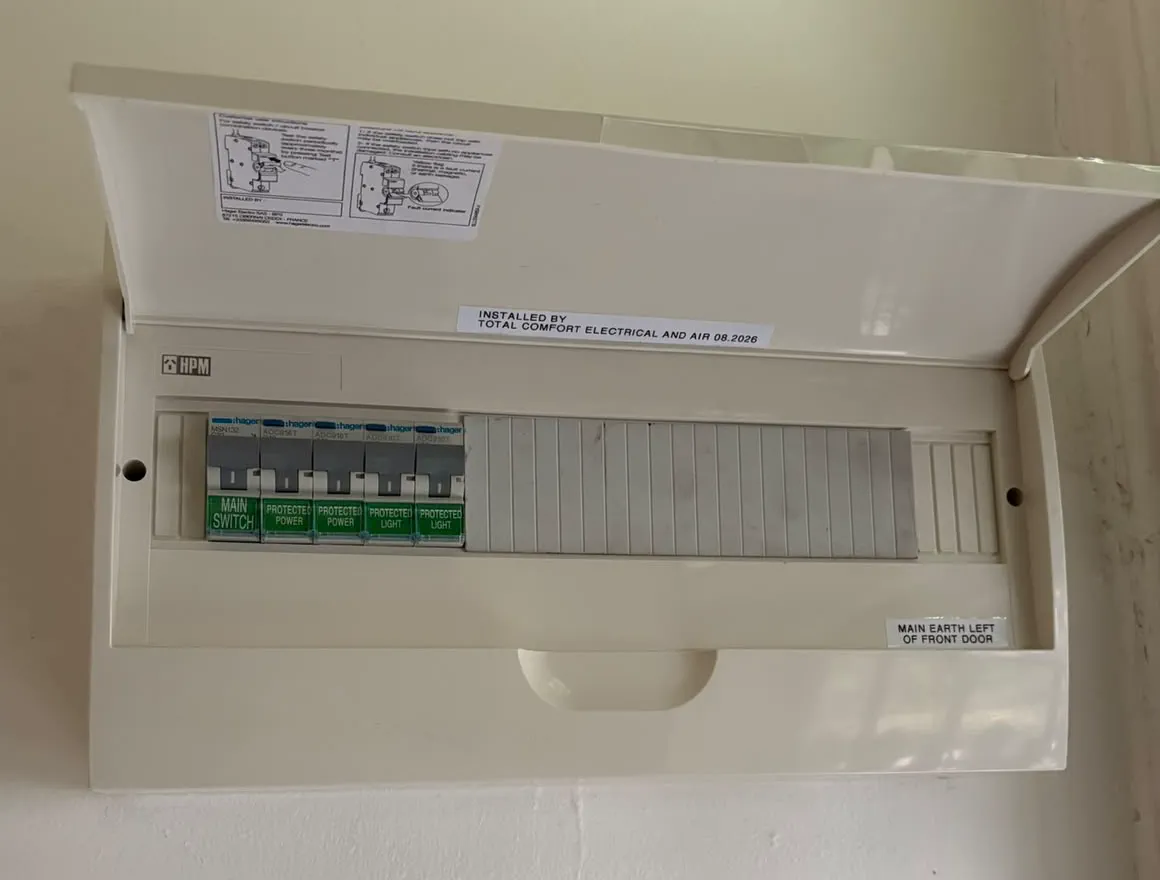
Open the meter box and look, without touching anything. Rewireable fuses sit in ceramic holders that pull out. Circuit breakers are switches in a row. A safety switch has a test button and '30mA' printed on it. Fuses and no test button usually means no safety switch protection. Energy Safe Victoria says a safety switch is now compulsory on new residential installations, and these boards predate that by decades.
Treat the panel the board is mounted on as possible asbestos. WorkSafe Victoria lists switchboards and their backing boards as a typical location for asbestos-containing materials in buildings built or renovated before the late 1980s, and its examples include ceramic fuses and pitch-based boards. Don't drill, screw into, sand or break the panel.
A replacement main switchboard needs safety switches on all final sub-circuits, and Energy Safe Victoria says the power can't go back on until a licensed electrical inspector has inspected the work.
Tired wiring and unlicensed additions
Cable in the roof of a brick or weatherboard house cooks every summer and cools every winter. After 60-odd summers, rubber insulation can be hard and crumbly, and even early plastic cable can be brittle where it sat beside old halogen downlights or under a hot roof. Testing shows how well insulation is holding up, but not how brittle a cable is where nobody has disturbed it, which is why renovations often uncover more.
Unlicensed additions are the other common thread. Decades of handy owners have added points, moved switches and wired sheds, sometimes neatly and sometimes with indoor cable buried in the garden or joints taped up inside walls. They're hard to spot without opening things up, and they're where many faults begin.
Where to start
Energy Safe Victoria says that when buying a home built before the 1980s, it is imperative to have the wiring checked by a licensed electrical inspector or registered electrical contractor before moving in. If you've already moved in, a safety check is still the right first step. It gives you a written picture of the board, the circuits and any faults, so you can decide what's urgent and what can wait.
A sensible order for most post-war homes is safety switch protection first, then anything found overheating or damaged, then the circuits that test poorly. Rewiring room by room can line up with renovations, and an old board is usually best dealt with before you add air conditioning, an induction cooktop or an EV charger. Our guide to old house wiring types shows what each generation of cable looks like.
Questions that come next
Sources for this article
9 sources, with the date each was checked
- 1.Victorian Government, Hobsons Bay Planning Scheme (PDF snapshot, last updated by VC292 on 11/09/2025): The heritage places of Hobsons Bay reflect the key themes that have shaped the development of the city since the establishment of Williamstown in the 1840s as the first port of Melbourne, through the development of… Accessed 30 September 2026.
- 2.Victorian Heritage Database (Heritage Council Victoria); entry maintained by Hobsons Bay City Council: The Housing Commission of Victoria (HCV) West Newport Estate Residential Heritage Precinct, designed and constructed by the HCV between 1945 and 1960 ... is notable as the first HCV estate to use the Fowler… Accessed 30 September 2026.
- 3.Energy Safe Victoria: Old switchboards, particularly those without a safety switch Old power switches or power points, particularly broken ones Flickering lights Sparks from switchboards, switches or power points. If your house is over 30… Accessed 30 September 2026.
- 4.Energy Safe Victoria: monitors the flow of electricity through a circuit detects a problem that may pose a risk to personal safety turns the power off within 0.03 of a second always has a test button and '30ma' printed on them. Accessed 30 September 2026.
- 5.Energy Safe Victoria: Having a safety switch installed is now compulsory on new residential installations and a great step to electrical safety in your home, if you are unsure if a safety switch is installed at your property, contact a… Accessed 30 September 2026.
- 6.WorkSafe Victoria: A person who has management or control of a workplace, and employers or self-employed persons and employees should be aware of the typical uses and applications of ACMs, particularly in buildings constructed or… Accessed 30 September 2026.
- 7.Energy Safe Victoria: If a switchboard is required to be replaced then as per clause 2.6.3.2.5 (Alterations to installations and replacement of switchboards) of AS/NZS 3000: RCD’s are required on all final sub-circuits. Accessed 30 September 2026.
- 8.Energy Safe Victoria: The electrician has eight business days after the work is completed to have that work inspected by a licensed electrical inspector (LEI). If an electrician replaces a main switchboard at a property, power cannot go back… Accessed 30 September 2026.
- 9.Energy Safe Victoria: Clause 2.6.3.2.5 of the Wiring Rules states: Additional protection by RCDs shall be provided in existing electrical installations where alterations or a switchboard replacement is completed. Accessed 30 September 2026.