
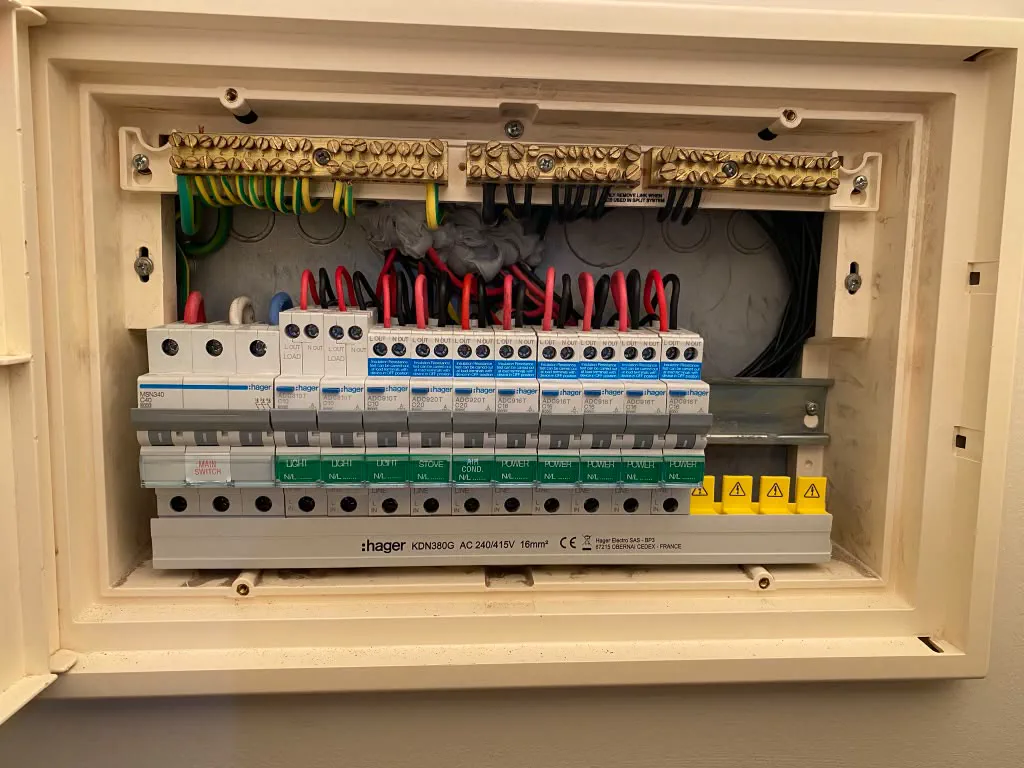
Can running the air fryer, kettle and toaster together overload my kitchen circuit?
- Kettles, air fryers, toasters and coffee machines are among the hungriest appliances in the house, and they often share one circuit.
- A breaker that trips when several run at once is protecting the cable. Spread the load or add a circuit; never fit a bigger breaker.
- A warm, discoloured or crackling power point is a different problem: a connection running hot, which a breaker won't catch.
- Don't run heating appliances through power boards or double adaptors on the bench.
- Regular trips, an island bench or a renovation are good reasons to add kitchen circuits.
How kitchen power points share a circuit
Most power points are wired in groups, with several outlets on one cable run back to one circuit breaker at the switchboard. In many older Melbourne homes every bench point sits on the same circuit, sometimes shared with the dining room, the laundry or a back bedroom. The oven and cooktop usually have their own circuit; the benchtop appliances don't.
That made sense when the bench held a kettle, a toaster and a radio. Today the same bench may carry an air fryer, a coffee machine, a microwave and a sandwich press, with a dishwasher underneath, and several run at once in the morning rush. Appliances that heat use the most power: check the rating labels and you'll find a kettle or air fryer draws about as much as a portable heater.
When the breaker trips
A circuit breaker switches a circuit off when more current flows than its cable can safely carry. If the bench power drops when the kettle, air fryer and toaster are all going, that's usually overload, and the breaker is doing its job. Unplug what was running, reset it once and run the appliances one or two at a time. If it trips again with little running, leave it off and have it tested.
Don't fix nuisance tripping with a bigger breaker. The breaker is sized to protect the cable in the wall, and a larger one lets that cable carry more than it was designed for and run hot. The answer is spreading the load, by moving the air fryer or coffee machine to a point on another circuit or adding a circuit to the kitchen.
If it's the safety switch that trips rather than a circuit breaker, it's a different fault. Energy Safe Victoria says a safety switch detects a problem that may put people at risk, such as current leaking to earth, often from a worn kettle or toaster element. Try the appliance on another circuit; if it trips there too, the appliance is the problem.
A hot power point is a different warning
A power point that feels warm, smells of hot plastic or fish, has brown marks around the pins or crackles when the kettle runs is a more serious sign than a breaker trip. It usually means a loose or worn connection at the plug, in the outlet or at its terminals, making heat at normal current. A circuit breaker doesn't detect that, because the current isn't high enough to trip it.
Stop using that point, unplug what's in it and have it checked. Energy Safe Victoria says not to touch or try to repair a loose, cracked or broken power point; cover it and have a licensed electrician replace it. Discoloured or loose plug tops and damaged appliance leads should be replaced too.
- A faceplate that's warm or hot to touch
- Brown or black marks around the pins
- A smell of hot plastic or fish
- Crackling or buzzing under load
- Plugs that fit loosely or fall out
Power boards and double adaptors on the bench
A power board doesn't add capacity; it shares one outlet between more plugs. Running a kettle and an air fryer through one board puts both loads through a single plug and outlet, which is how boards and points end up warm. On a bench with water, crumbs and grease nearby, a board is a poor long-term answer.
If the bench has more appliances than points, the fix is more fixed outlets in the right places: one for each appliance that heats, spaced so leads don't trail across the cooktop or sink. Swapping singles for doubles helps, but only if the circuit behind them has capacity for what you plan to plug in.
When more circuits are worth adding
Adding a kitchen circuit means running new cable from the switchboard to a group of bench points, so the morning load is split between two circuits instead of one. It's worth considering when the breaker trips regularly, when the kitchen shares a circuit with other rooms, when you add an island bench, or when you're renovating and the walls are open anyway.
Energy Safe Victoria notes the Wiring Rules require additional safety switch protection when existing installations are altered, so the electrician checks how new and altered circuits are protected. An older switchboard may need space or an upgrade to take the new circuit. You get the price before work starts, and a Certificate of Electrical Safety when it's done.
Questions that come next
Sources for this article
4 sources, with the date each was checked
- 1.Energy Safe Victoria: monitors the flow of electricity through a circuit detects a problem that may pose a risk to personal safety turns the power off within 0.03 of a second always has a test button and '30ma' printed on them. Accessed 30 September 2026.
- 2.Energy Safe Victoria: Do not touch or attempt to repair a loose, cracked or broken power point switch – cover it immediately and arrange for a licensed electrician to replace it. Accessed 30 September 2026.
- 3.Energy Safe Victoria: Clause 2.6.3.2.5 of the Wiring Rules states: Additional protection by RCDs shall be provided in existing electrical installations where alterations or a switchboard replacement is completed. Accessed 30 September 2026.
- 4.Energy Safe Victoria: Whenever a licensed electrician completes any electrical installation work, they must provide a Certificate of Electrical Safety (COES). Accessed 30 September 2026.