
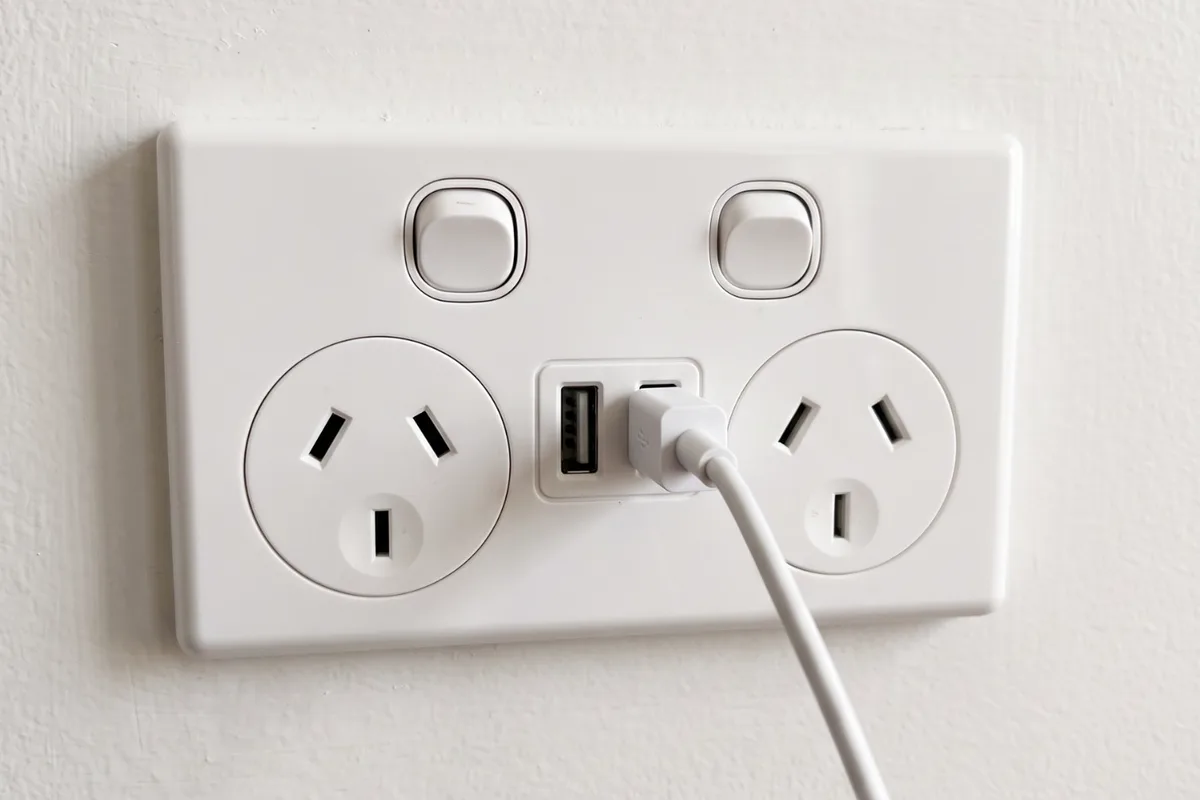
Are cheap electrical products bought online safe to use?
- Online marketplaces host overseas sellers whose products may not meet Australian safety standards.
- Look for the Regulatory Compliance Mark (RCM) on mains-powered household products, and check the seller is based in Australia.
- Chargers, power boards and smart plugs that run hot, feel flimsy or lack markings are the riskiest buys.
- Light fittings, smart switches and USB points must be installed by a licensed electrician, who may decline products that can't be shown to comply.
- Stop using anything that gets hot, smells, buzzes or has damaged plugs or cords.
Why a bargain charger can be a fire risk
A phone charger or power board looks simple from the outside. Inside, the insulation, the spacing between live parts, the overload protection and the case material decide whether it fails safely or fails with heat and smoke. Products built to a price for a global market can skip those details, and some are designed for other countries' voltages and plugs.
Energy Safe Victoria warns that some electrical products for sale online don't meet Australian safety standards, and that big online platforms work like a virtual shopping centre, hosting stores that may be based outside Australia. It says equipment from overseas may not have the correct voltage rating or be designed to Australian Standards, which can make it unsafe.
Price alone proves nothing either way, and expensive isn't automatically safe. You can't see inside, so the markings, the seller and how the product behaves once it arrives are what you have to go on.
What to check before you buy
Energy Safe Victoria says mains-operated household equipment sold in Australia is required to carry the Regulatory Compliance Mark, or RCM, and that equipment marked with it is suitable for use in Australia. The mark is usually on the rating label. If a listing doesn't show it, ask the seller for a photo of the marked product, and reconsider buying if they can't provide one.
Energy Safe Victoria also suggests checking that the seller is based in Australia, and notes that buying online from an Australian bricks-and-mortar store is a good way to reduce the risk. Listings with different brands in different photos, prices that seem impossible, or reviews mentioning heat and melting are worth skipping.
- The RCM on the product's rating label, not just in a listing photo
- A seller with an Australian address, or an Australian store selling online
- An Australian plug, not an adaptor supplied in the box
- A rating that covers 230 to 240 volts
The products that cause the most trouble
Chargers sit on bedside tables and couches, often overnight and against fabric, so a cheap one that overheats has fuel close by. Power boards and travel adaptors carry the full load of whatever is plugged into them. Chargers for e-bikes, scooters and power tools feed batteries that store a lot of energy, and a poor or mismatched charger adds to the risk.
Smart plugs add a relay and a radio to the mix. A cheap one rated for light loads and then used to switch a heater or portable air conditioner is carrying far more than it was built for. Check the rating on the plug against the appliance, and don't use one for heaters, kettles or other heavy loads unless it's clearly rated for them.
Light fittings, switches and USB points bought online
Some products bought online aren't plug-in items at all. Downlights, pendants, ceiling fans, dimmers, smart switches and USB power points connect to your home's fixed wiring, and installing them is licensed electrical work in Victoria, whatever the box says. Energy Safe Victoria's 'Don't do it yourself' campaign makes the point that even changing a power point or light switch is not a DIY job.
The electrician who installs a fitting tests the work and issues a Certificate of Electrical Safety for it, putting their name to that installation being safe. That's why an electrician may decline a fitting with no RCM, no Australian approval details, missing instructions or a driver that doesn't suit the dimmer. They can't certify what they can't confirm.
If you're buying fittings yourself, send the links or model numbers to your electrician before you order. It's much easier to swap a product before it arrives than to have install day stall because the fittings can't be used.
Signs to stop using something now
Wherever you bought it, the warning signs are the same. A charger or board too hot to hold comfortably, a smell of hot plastic or fish, buzzing or crackling, scorch marks around the pins, a loose fit in the socket, or a cord with exposed or crushed insulation all mean unplug it and stop using it.
If a product has damaged a power point, or the point is now warm, loose or discoloured, leave it alone. Energy Safe Victoria says not to touch or try to repair a loose, cracked or broken power point; cover it and have a licensed electrician replace it.
Questions that come next
Sources for this article
3 sources, with the date each was checked
- 1.Energy Safe Victoria: Electrical work isn’t a DIY job, even for small jobs such as changing power points or light switches. Accessed 30 September 2026.
- 2.Energy Safe Victoria: Whenever a licensed electrician completes any electrical installation work, they must provide a Certificate of Electrical Safety (COES). Accessed 30 September 2026.
- 3.Energy Safe Victoria: Do not touch or attempt to repair a loose, cracked or broken power point switch – cover it immediately and arrange for a licensed electrician to replace it. Accessed 30 September 2026.