
The key points
- Rubber-insulated cable, often under a fabric braid, is the oldest wiring still found in many Melbourne homes. Its insulation hardens and crumbles with age and heat.
- Some very old installations have cable in a metal sheath or steel conduit. Early plastic (TPS) cable from later decades is far more durable, but older lighting runs may have no earth.
- The fittings, the switchboard and any cable you can see behind a fitting usually tell you which generation you have.
- Testing measures how well insulation is holding up and whether earths are connected. It can't show how brittle a cable is where nobody has disturbed it.
- Energy Safe Victoria says that when buying a home built before the 1980s, it's imperative to have the wiring checked before moving in.
Why the type of cable matters
A house rarely has one wiring age. An Edwardian cottage in Yarraville or Williamstown may have original circuits in the roof, an extension wired a generation later and a kitchen redone in the 1990s. Each part ages differently, and knowing what you have tells you where to look first.
The cable is the part nobody sees. Switches get replaced and walls get painted, but the cable behind them can be decades older. Energy Safe Victoria says fire brigades respond to more than 300 domestic electrical fires each year, many caused by old wiring that has degraded or can't cope with modern equipment. This guide is about recognising what's there; our old wiring replacement page covers what replacing it involves.
Rubber and fabric-covered cable
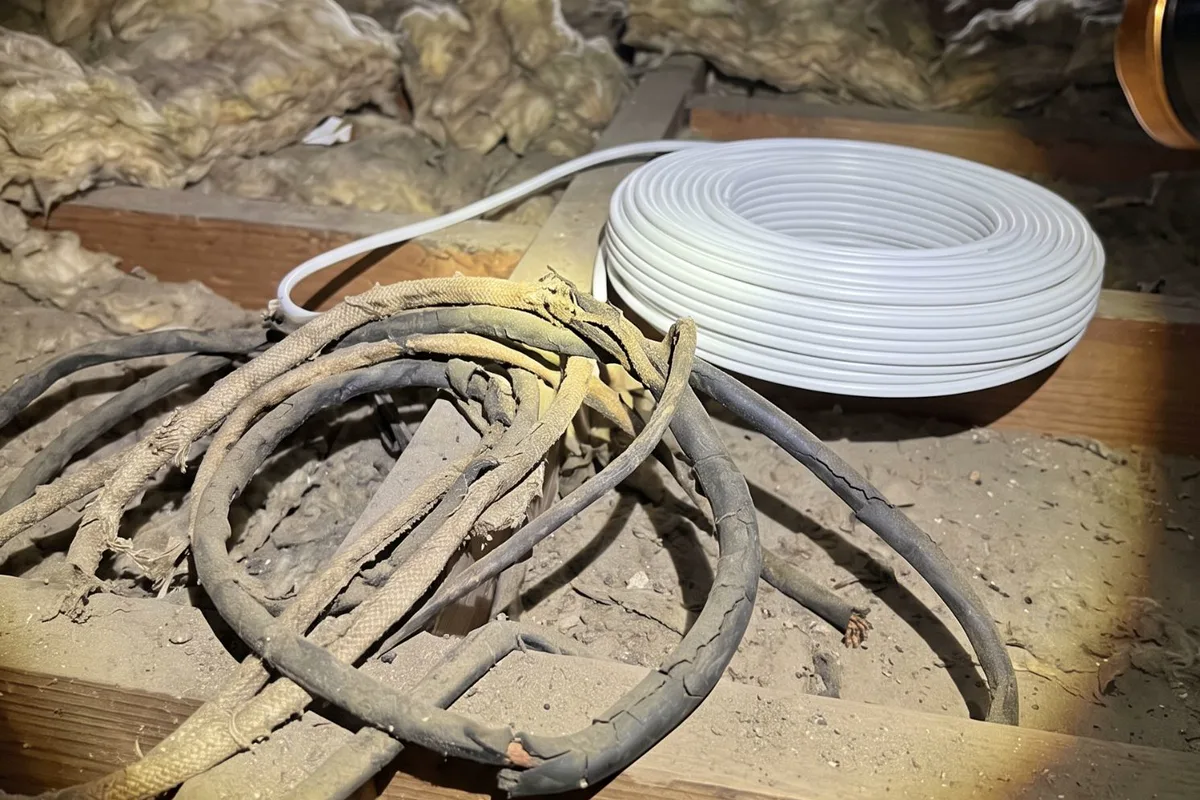
The oldest common cable in Melbourne homes has copper conductors insulated with vulcanised rubber, often called VIR. Many runs also have a cotton or fabric braid over the rubber, sometimes coated in a tar-like compound. In a roof space it can look like dark, fuzzy or cloth-wrapped cable, run along timbers on small cleats or through old conduit.
Rubber doesn't last. Over decades it hardens and cracks, and it goes faster where it's hot: under a roof on a run of northerly summer days, or beside an old light fitting. The braid can hide the damage, so the outside looks intact while the rubber inside has turned to crumbs. Once the insulation falls away, bare copper sits against timber and against the other conductor.
Disturbance is the real risk. Rubber cable that hasn't moved for years may hold together, then crack when a plumber crawls under the floor, a downlight is cut in or insulation batts are dragged across it.
Metal-sheathed cable, conduit and rubber-sheathed cable
Some of the oldest installations have rubber-insulated wires inside a dull grey metal sheath, often lead, clipped along timbers. Others have wires pulled through steel conduit, particularly in brick homes and around the switchboard. Both protect the insulation from knocks, but neither stops the rubber inside from ageing, and where the sheath or conduit was relied on as part of the earth path, corroded joints can break it.
In between rubber and plastic, some homes have tough rubber-sheathed cable: rubber-insulated wires inside a black rubber outer sheath. From a distance it looks like modern flat cable, but it ages like rubber, hardening and cracking, especially in a hot roof. If you see any of these in the roof or under the floor, treat that circuit as early and have it tested.
Early plastic cable (TPS)
Rubber eventually gave way to PVC-insulated cable with a flat plastic outer sheath, known as TPS. Many post-war homes in suburbs like Altona and Laverton, and nearly everything built from the 1970s on, run mostly on TPS. It's far more durable than rubber, and plenty of it is still sound.
Early TPS has its own weak points. Some older lighting circuits were run in two-core cable with no earth wire, which matters when a metal light fitting or ceiling fan goes in later. Sheaths go brittle where they've been baked beside old halogen downlights and their transformers. And the colours may not match today's: older cable often has red and black conductors, with green or no earth at all.
Clues you can spot without touching anything
You can often date a circuit from the room. Round-pin power points, bakelite dolly switches and ceiling roses with a cloth flex down to the light usually belong to the first wiring. Energy Safe Victoria lists old switchboards, old or broken switches and power points, and flickering lights among the tell-tale signs of faulty wiring.
The switchboard tells you more. Ceramic fuses and no safety switch usually mean the circuits behind them haven't been touched in a long time. A modern board doesn't prove the cable is new, though, because boards are often replaced and the old circuits reconnected. If someone has to go into the roof for another reason, ask them to photograph the cable without handling it.
- Round-pin points or bakelite dolly switches: likely original wiring.
- Ceramic fuses and no test button at the board: original circuits are probably still in use.
- Cloth-covered or crumbling cable seen behind a fitting: rubber insulation.
- Metal light fittings on a circuit with only two wires: no earth.
- Warm switch plates or lights that flicker: get it checked whatever the cable type.
What testing can and can't tell you
An electrician's testing replaces guesses with measurements. An insulation resistance test applies a test voltage to each circuit and measures how much current leaks through the insulation. Continuity tests confirm the earth runs all the way to each fitting, and polarity checks confirm the wires are connected the right way round. Together they show which circuits are failing now.
What testing can't show is how close to the edge a circuit is. Rubber that's hard and cracked but hasn't moved can test well, then fail the first time the cable is disturbed. Testing also can't see a join buried in a wall that's been running warm. That's why an electrician looks at the cable wherever it can be reached, in the roof, under the floor and behind a switch plate, as well as testing it.
Results are usually mixed. Original lighting circuits in the roof often fail while later power circuits test fine, which lets you replace what has failed and plan the rest, rather than assuming the whole house needs rewiring.
If you're buying, renovating or adding insulation
Energy Safe Victoria says that when buying a home built before the 1980s, it's imperative to have the wiring checked by a licensed electrical inspector or registered electrical contractor before moving in. A lot of Melbourne's west was built well before then, from Victorian and Edwardian cottages to post-war brick and weatherboard.
Renovations are the other trigger. Opening walls, a new kitchen or a ceiling insulation top-up all disturb old cable. A new switchboard also brings safety switches on every final sub-circuit, which Energy Safe Victoria says the Wiring Rules require when a board is replaced, and those will trip on old circuits leaking to earth. Testing the wiring before the work is planned means it can be dealt with in one go.
Common questions
Quick answers
- Are old round or Bakelite light switches safe?Many still work, but age is the concern, not the shape.
- What happens if extra work is found during the job?We stop and tell you.
- How do I avoid cables when drilling or hanging pictures?Assume a cable could be anywhere until you've ruled it out.
- Do I need to be home for the visit?Not always, but someone needs to give us access to everything the job involves.
Sources for this guide
4 sources, with the date each was checked
- 1.Energy Safe Victoria: Fire brigades respond to more than 300 domestic electrical fires each year. Many of these fires are caused by old wiring that has degraded or is unable to cope with the demands of modern electrical equipment. Accessed 30 September 2026.
- 2.Energy Safe Victoria: Old switchboards, particularly those without a safety switch Old power switches or power points, particularly broken ones Flickering lights Sparks from switchboards, switches or power points. If your house is over 30… Accessed 30 September 2026.
- 3.Energy Safe Victoria: If a switchboard is required to be replaced then as per clause 2.6.3.2.5 (Alterations to installations and replacement of switchboards) of AS/NZS 3000: RCD’s are required on all final sub-circuits. Accessed 30 September 2026.
- 4.Energy Safe Victoria: Electrical work isn’t a DIY job, even for small jobs such as changing power points or light switches. Accessed 30 September 2026.
Planning advice for homeowners. Installation requirements depend on the property and equipment. Where this guide refers to Victorian safety or rental rules, use the linked official guidance for the current requirements.