
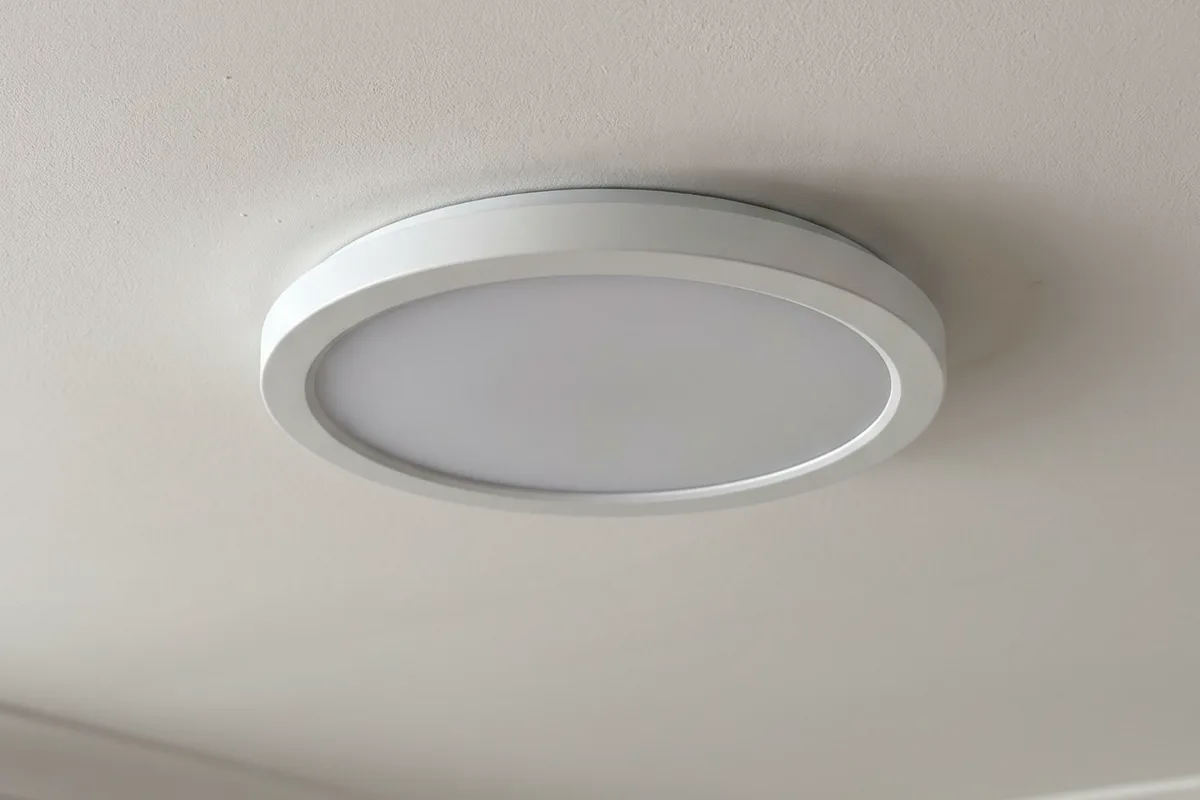
Are oyster lights or downlights better for bedrooms and hallways?
- In a bedroom, an oyster avoids the glare of downlights shining straight down at the bed.
- An oyster usually reuses the existing light point, so it suits ceilings with poor roof access or insulation you'd rather not disturb.
- Downlights suit long halls that need even light, rooms being renovated and spaces where you want a clean ceiling.
- Taking down an old fitting is a good chance to check the wiring behind it.
One fitting or several
An oyster is a single fitting that sits flush, or nearly flush, against the ceiling and spreads light through a diffuser. Downlights put several small points of light into the ceiling, each throwing a cone downwards. A bedroom might take one oyster, or four to six downlights to light the same space.
Fewer fittings means fewer holes, less cabling and less to go wrong. More fittings means more control over where the light lands. Which matters more depends on the room and what happens in it.
Bedrooms and glare
Lie on a bed under a downlight and you will see the problem. A downlight is a bright point aimed at your face, and in a bedroom you spend a lot of time looking at the ceiling. An oyster's diffuser spreads the light so there is no single glaring spot.
For most bedrooms, our preference is a central oyster for general light, with bedside lamps or wall lights for reading. If you prefer downlights, keep them away from the bed, towards the robe and doorway, and put them on a dimmer matched to the fittings.
Ceiling access and insulation
A like-for-like oyster usually goes on the existing light point, so nobody has to crawl through the roof. Downlights need cable run between each fitting, which means access above the ceiling. In older homes with low-pitched roofs, or rooms under a flat-roofed extension, that access can be tight or missing.
Each downlight is also a hole through the ceiling and its insulation. Choose IC-rated fittings, which are designed to have insulation against or over them, wherever insulation is or will be laid. An oyster leaves the insulation alone, which is one reason it suits a ceiling that has just been insulated.
Hallways
A short hall is often lit perfectly well by one oyster. A long hall with a single fitting in the middle leaves dim ends, and that is where a second oyster or a row of downlights earns its place. Evenly spaced downlights give a long hall a clean, even wash of light.
A sensor oyster suits halls that see night-time trips to the bathroom or kitchen, switching on without anyone hunting for a switch. If you are adding fittings to a long hall, plan in switching at both ends.
When downlights win, and a note for landlords
Downlights make sense when a room is being renovated and the ceiling is open anyway, when you want a clean, flat ceiling, or when light needs aiming at particular spots like a robe or a desk. They also work under low ceilings, though so does a slim oyster.
For landlords, the rental minimum standards say rooms, corridors and hallways must have enough light to be usable, with artificial light at night. A good oyster in a dim hall or bedroom is an easy way to meet that without opening up the ceiling.
Whatever goes up, taking down the old fitting shows us the cable behind it. Energy Safe Victoria lists flickering lights and old or broken switches among the signs of faulty wiring, so brittle insulation or scorched terminals found at a light point are dealt with before the new fitting goes up.
Questions that come next
Sources for this article
3 sources, with the date each was checked
- 1.Consumer Affairs Victoria: Inside rooms, corridors and hallways must have access to light to make the areas functional. During the day, natural light can include light borrowed from an adjoining room. At night, renters should have access to… Accessed 30 September 2026.
- 2.Energy Safe Victoria: Old switchboards, particularly those without a safety switch Old power switches or power points, particularly broken ones Flickering lights Sparks from switchboards, switches or power points. If your house is over 30… Accessed 30 September 2026.
- 3.Energy Safe Victoria: Whenever a licensed electrician completes any electrical installation work, they must provide a Certificate of Electrical Safety (COES). Accessed 30 September 2026.