
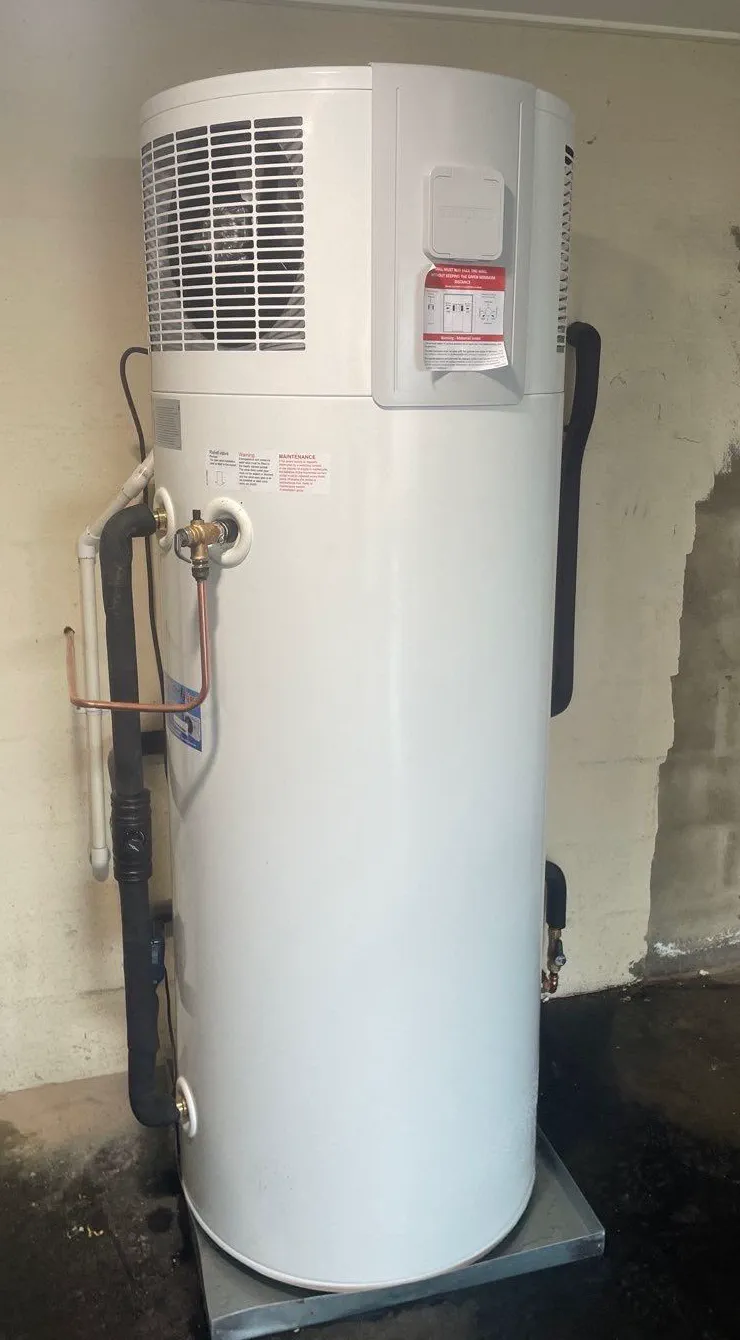
Should I choose a heat pump or an electric storage hot water system?
- For a household of three or more with an outdoor spot that has open airflow, a heat pump is usually the better long-term choice.
- An electric storage tank still suits light users, spots with no fresh air and a quick swap when the old tank has failed.
- A heat pump works best heating through the warmer part of the day, so an overnight off-peak setup may need changing.
- Both need a circuit with safety switch protection, and the water connections are done by a licensed plumber.
Where the running cost difference comes from
An electric storage tank heats water with an element, much like a kettle, so every bit of heat in the tank is paid for as electricity. A heat pump water heater uses a fan, compressor and refrigerant circuit to pull warmth out of the outside air and move it into the water, so it uses much less electricity to heat the same tank.
That gap matters most when a household uses a lot of hot water. A family with teenagers running long showers pays for that water every day, so a heat pump's savings add up quickly. A single person who rarely runs a hot wash gets far less back from the extra outlay, especially on a cheap overnight rate.
Space, airflow and noise
An electric tank is happy almost anywhere it can be plumbed and drained: a laundry cupboard, an internal alcove or a tight spot beside the fence. A heat pump needs fresh air in, room for its chilled exhaust air to get away, a level base, a drain for condensation and access for servicing. Boxed into a cupboard, it struggles.
A heat pump also hums while it runs, like an air conditioner's outdoor unit. Under your bedroom window, or the neighbour's, it will be heard. On narrow blocks where the side path runs close to the house next door, that can rule out the old tank position and point you towards a split heat pump or another wall.
Off-peak, solar and cold Melbourne nights
A heat pump works less efficiently as the air gets colder, and night is the coldest part of the day. July at Laverton averages a minimum of 5.2 °C, so running a heat pump only on an overnight off-peak circuit means slower heating and more time on any backup element, just when the household wants the most hot water.
With solar panels, the usual setup is a timer that runs the heat pump through the middle of the day on your own power. Without solar, we look at your tariff and when the household uses hot water, then set the timer around both. An element tank, by contrast, is perfectly happy heating at 2am on a cheaper overnight rate.
Household size and the busiest hour
Both systems store hot water, so the tank has to cover your busiest stretch, usually the morning shower rush or the evening run of baths and dishes. Many heat pumps reheat more slowly than an element, especially on cold mornings, so a heat pump is sized on that busiest hour rather than copied from the old tank's label.
As a rough guide, this is where we think each one wins, assuming the tank is sized properly for the household:
- Heat pump: three or more people, an outdoor spot with open airflow, solar panels or plans for them, and a tank that is ageing but still working.
- Electric storage: one or two light users, a unit or townhouse with no suitable outdoor spot, or a failed tank where hot water is needed back quickly.
- Rentals: from 1 March 2027, a hot water service that fails and can't be repaired must be replaced with an energy-efficient electric system, so check what qualifies before choosing a plain element tank.
What changes at the switchboard
Swapping one electric tank for another usually reuses the existing circuit once it has been tested. Moving to a heat pump may mean changing how that circuit is switched, adding a timer or running a new circuit, depending on the model and where it goes. Energy Safe Victoria's guidance on the Wiring Rules says every final sub-circuit, the hot water circuit included, needs safety switch protection.
Some older homes have a hot water circuit with no safety switch at all, and the changeover is a good time to fix that. A licensed plumber connects the water and our team does the electrical side, with a Certificate of Electrical Safety for that work.
If your current system is gas, note that from 1 March 2027 a gas hot water system in an existing home that breaks and can't be repaired must be replaced with an electric alternative. Ask which options qualify for your home before you choose.
Questions that come next
Sources for this article
5 sources, with the date each was checked
- 1.Bureau of Meteorology: Mean minimum temperature (°C) 14.0 14.4 12.7 10.0 7.8 5.9 5.2 5.7 6.8 8.4 10.3 12.2 9.5 81 1943 2026 Accessed 30 September 2026.
- 2.Energy Safe Victoria: Clause 2.6.3.2.2 requires all final sub-circuits in a domestic installation be protected by a residual current device (RCD). A hot water service is included in this requirement Accessed 30 September 2026.
- 3.Energy Safe Victoria: For electrical installation work performed within your electrical installation including but not limited to lights, power points, air conditioning, hot water service etc. Accessed 30 September 2026.
- 4.Consumer Affairs Victoria: From 1 March 2027, when an existing hot water system permanently fails and can't be repaired, rental providers must replace it with an energy-efficient electric hot water system. Accessed 30 September 2026.
- 5.Department of Energy, Environment and Climate Action (Victoria): From 1 March 2027, if a gas hot water appliance breaks and cannot be repaired, it must be replaced with an electric alternative. No requirement to upgrade gas space heating or stovetop gas cooking to electric, however… Accessed 30 September 2026.