
Is an induction cooktop worth it over a ceramic electric cooktop?
- For most people cooking every day, induction is worth it for its quick response, easier cleaning and cooler glass.
- Ceramic still makes sense for cookware you won't replace, a basic rental fit-out or a short-term swap.
- Both are usually hardwired, and the circuit has to be checked against the exact model's rating.
- Moving from gas to either needs a licensed gasfitter to disconnect the gas and make it safe.
How each one makes heat
A ceramic cooktop has radiant elements under the glass. They glow red, heat the glass, and the glass heats the pan. An induction cooktop uses a magnetic field to heat the base of the pan directly, and the glass only warms up from the hot pan sitting on it.
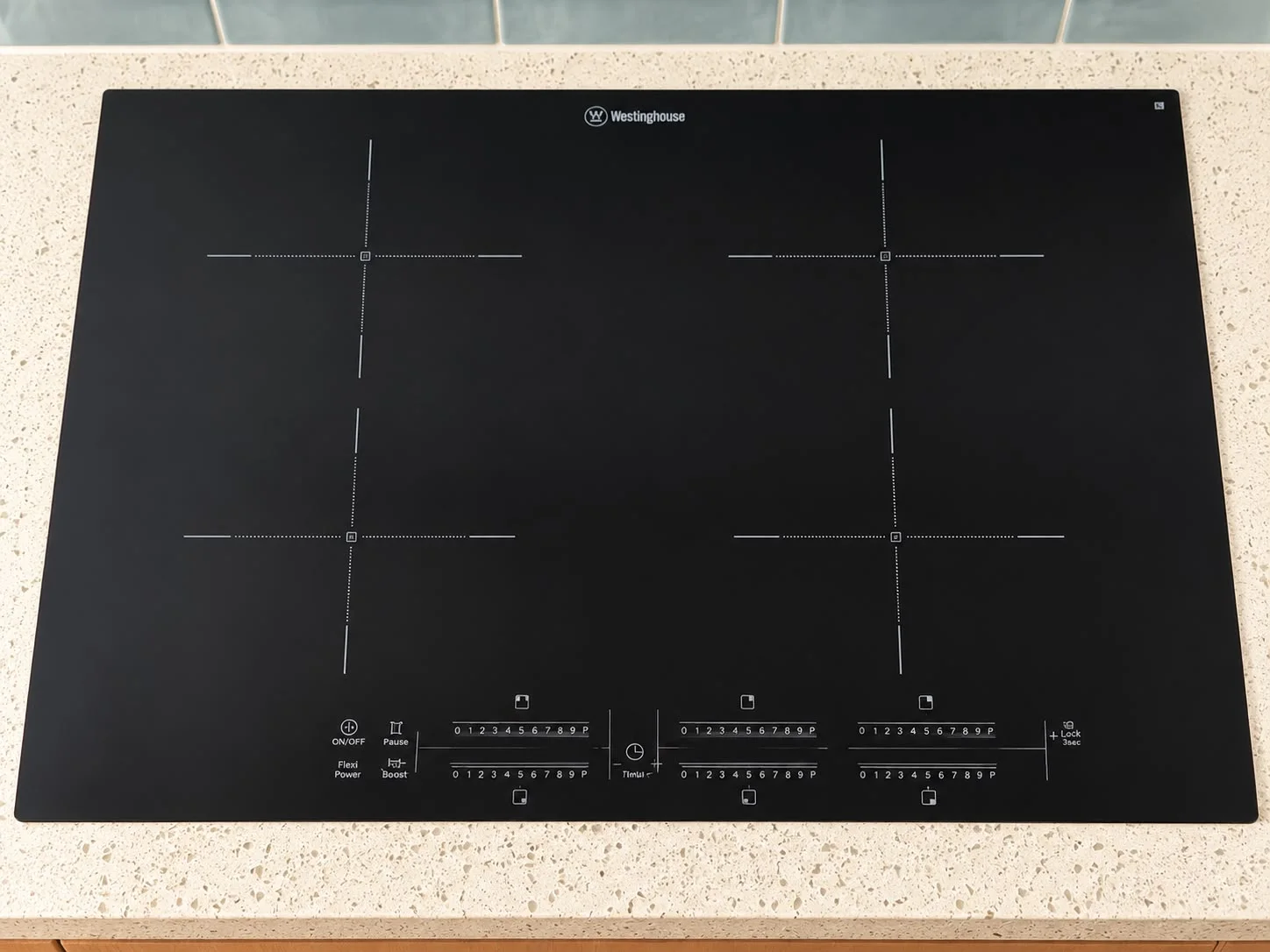
That one difference explains most of what follows: how fast each responds, how hot the glass gets, which cookware works and how easy the top is to clean. Switched off in a showroom they look much the same, so the label and the cookware guidance tell you which is which.
Cooking feel
Induction reacts almost instantly. Turn it down and the simmer drops straight away, much like gas. Ceramic is slower both ways: it takes time to heat up, and the glass holds heat after you turn it down, so a pot about to boil over keeps going unless you lift it off.
Wok cooks should look closely. A round-bottomed wok doesn't sit well on a flat induction zone, and induction only heats where the pan touches. A flat-based wok works, and some cooktops have a dedicated wok zone. Ceramic is no better for high-heat wok cooking, so test before you buy if that is how you cook.
Cookware
Ceramic works with almost any flat-based pan. Induction needs a magnetic base, so aluminium, copper and glass pans won't work unless they have a magnetic plate built in. A fridge magnet that sticks firmly to the base is a useful first test, though base size and flatness matter too.
If your kitchen is full of good pans that fail the magnet test, factor in replacing them. Most households find it is fewer pans than they expected, because a couple of everyday pots and a frying pan do most of the work.
Cleaning and safety
Because induction glass stays cooler, spills don't bake on, and a wipe after cooking usually does it. On ceramic, a boil-over lands on hot glass and burns on, and the top has to cool before you can clean it properly.
Induction only heats when a suitable pan is on the zone, and stops heating when the pan is lifted away. The glass is still hot after cooking, from the pan, so residual heat indicators matter on both. For homes with young children, or an older parent who forgets a burner, we see induction as the safer of the two. If anyone in the house has an implanted medical device, check the cooktop manual and ask their doctor before buying.
Supply and installation
Both types are usually hardwired on their own circuit, and a full-size induction cooktop can draw a large current with several zones on boost. Some electric-to-induction swaps can reuse the existing cable and breaker, and some models can be power-managed to suit a smaller circuit. The installation sheet for the exact model decides it.
Moving from gas means a new circuit from the switchboard, and a licensed gasfitter disconnects the gas and makes it safe. When an existing installation is altered, the Wiring Rules call for additional safety switch protection, which on an older board can bring switchboard work with it. Owner-occupiers don't have to give up gas cooking, so the timing is yours.
Check the cut-out before buying, because two cooktops with the same advertised width can need different openings. You receive a Certificate of Electrical Safety for the connection.
Questions that come next
Sources for this article
3 sources, with the date each was checked
- 1.Energy Safe Victoria: Whenever a licensed electrician completes any electrical installation work, they must provide a Certificate of Electrical Safety (COES). Accessed 30 September 2026.
- 2.Energy Safe Victoria: Clause 2.6.3.2.5 of the Wiring Rules states: Additional protection by RCDs shall be provided in existing electrical installations where alterations or a switchboard replacement is completed. Accessed 30 September 2026.
- 3.Department of Energy, Environment and Climate Action (Victoria): From 1 March 2027, if a gas hot water appliance breaks and cannot be repaired, it must be replaced with an electric alternative. No requirement to upgrade gas space heating or stovetop gas cooking to electric, however… Accessed 30 September 2026.